




Nuclear career requirements vary sharply across healthcare and power generation. A medical dosimetrist’s preparation is different from a nuclear technician’s training. A commercial reactor operator needs a facility-linked licensing process. Before comparing pay, ask what must happen between your current qualifications and eligibility for the specific role.
Checked October 26, 2026. BLS’s October 19 Nuclear Science Week report supplies May 2025 employment and annual mean wages. We pair four selected occupations with official training and licensing sources. Five figures and a source-linked evidence table distinguish workforce size, pay and entry requirements. These are career-research tools, not a finding that a reader qualifies to practise.
Nuclear career requirements begin with the actual occupation
The BLS Nuclear Science Week report covers occupations across several fields. We select medical dosimetrists, nuclear medicine technologists, nuclear power reactor operators and nuclear technicians. They illustrate different routes rather than the entire nuclear workforce. The employment figures count estimated employment, not unfilled positions.
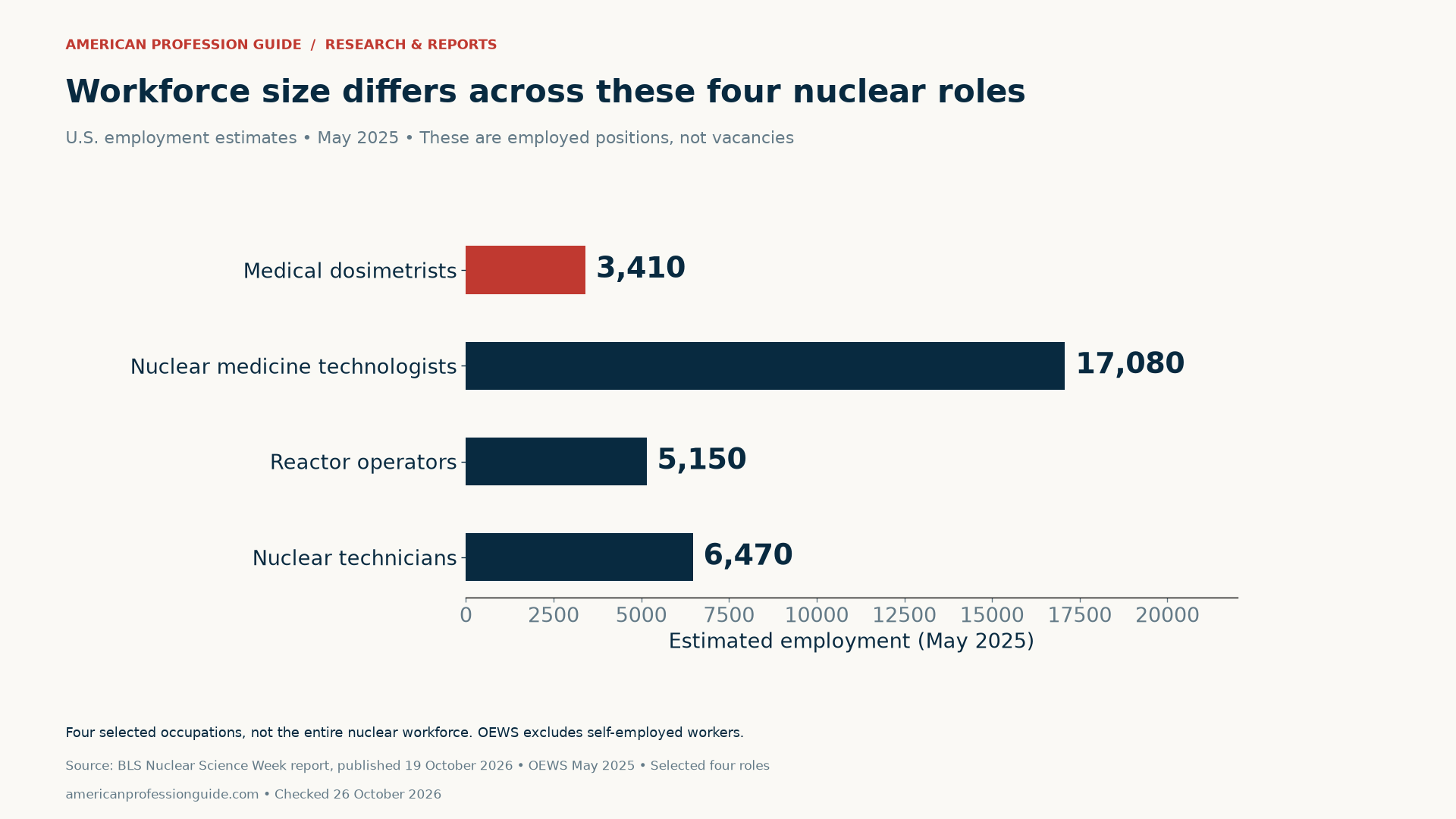
Within this selection, nuclear medicine technologists have the largest employment estimate and medical dosimetrists the smallest. That does not reveal how many employers are recruiting today. A large workforce can have few suitable local vacancies; a smaller one can still recruit for replacement needs. Current openings require separate employer evidence.
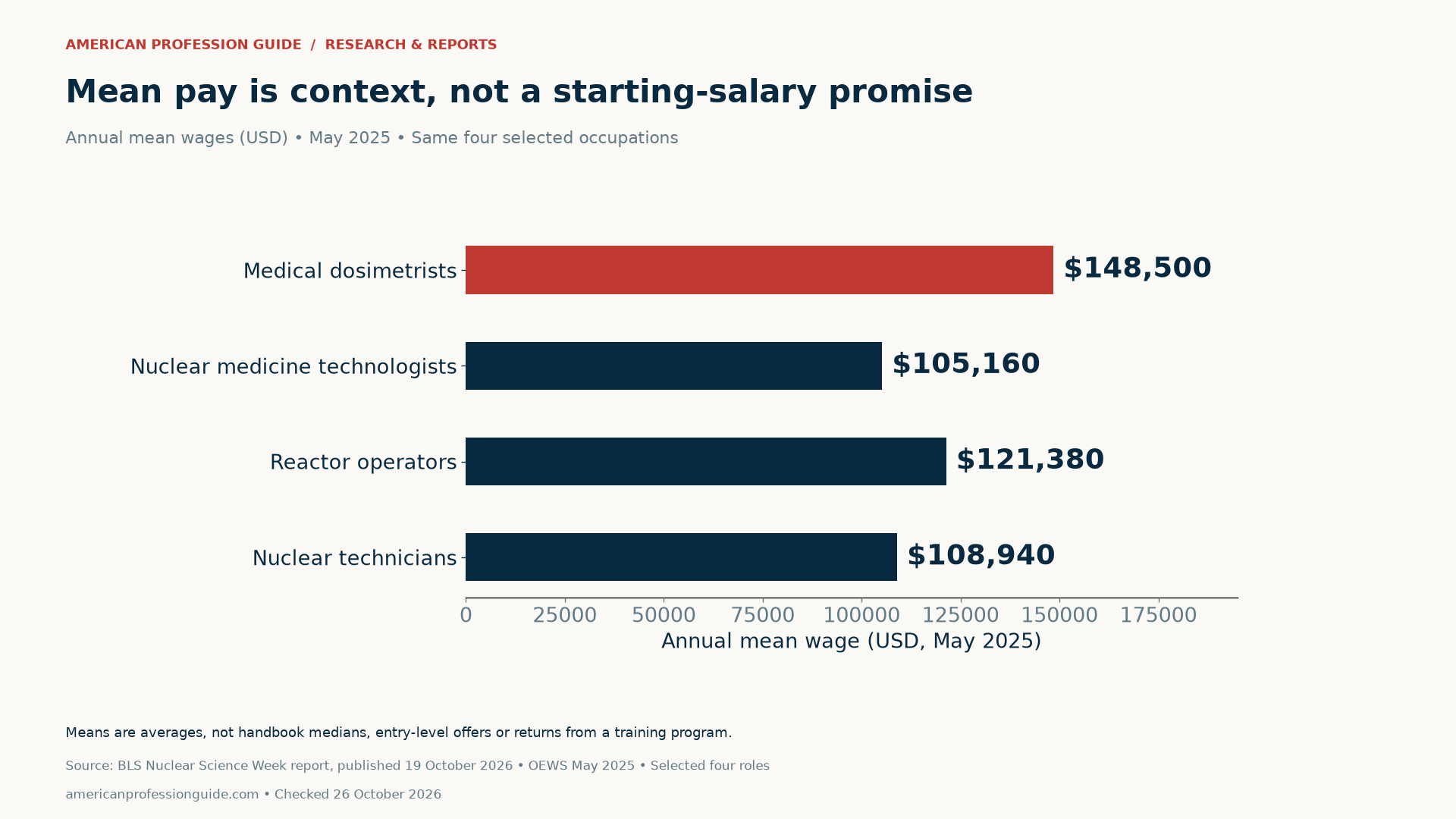
Mean wages provide context, not a training return
| Selected occupation | Employment estimate, May 2025 | Annual mean wage, May 2025 |
|---|---|---|
| Medical dosimetrists | 3,410 | $148,500 |
| Nuclear medicine technologists | 17,080 | $105,160 |
| Nuclear power reactor operators | 5,150 | $121,380 |
| Nuclear technicians | 6,470 | $108,940 |
A mean is an average, while a median is the midpoint of an earnings distribution. They answer different questions. These national averages do not show the wage a new entrant would receive, local living costs, training expenses or the probability of completing a program. They also do not estimate the return from another degree or credential.
For that reason, we use the Occupational Outlook Handbook for pathways while retaining the Nuclear Science Week report’s statistical series for the charts. Handbook employment and wage measures can differ in basis or presentation. We do not merge them into one supposed vacancy count or replace a mean with a median.
Compare the four routes before choosing a program
| Occupation and primary pathway source | Education and preparation | Credential or jurisdiction check |
|---|---|---|
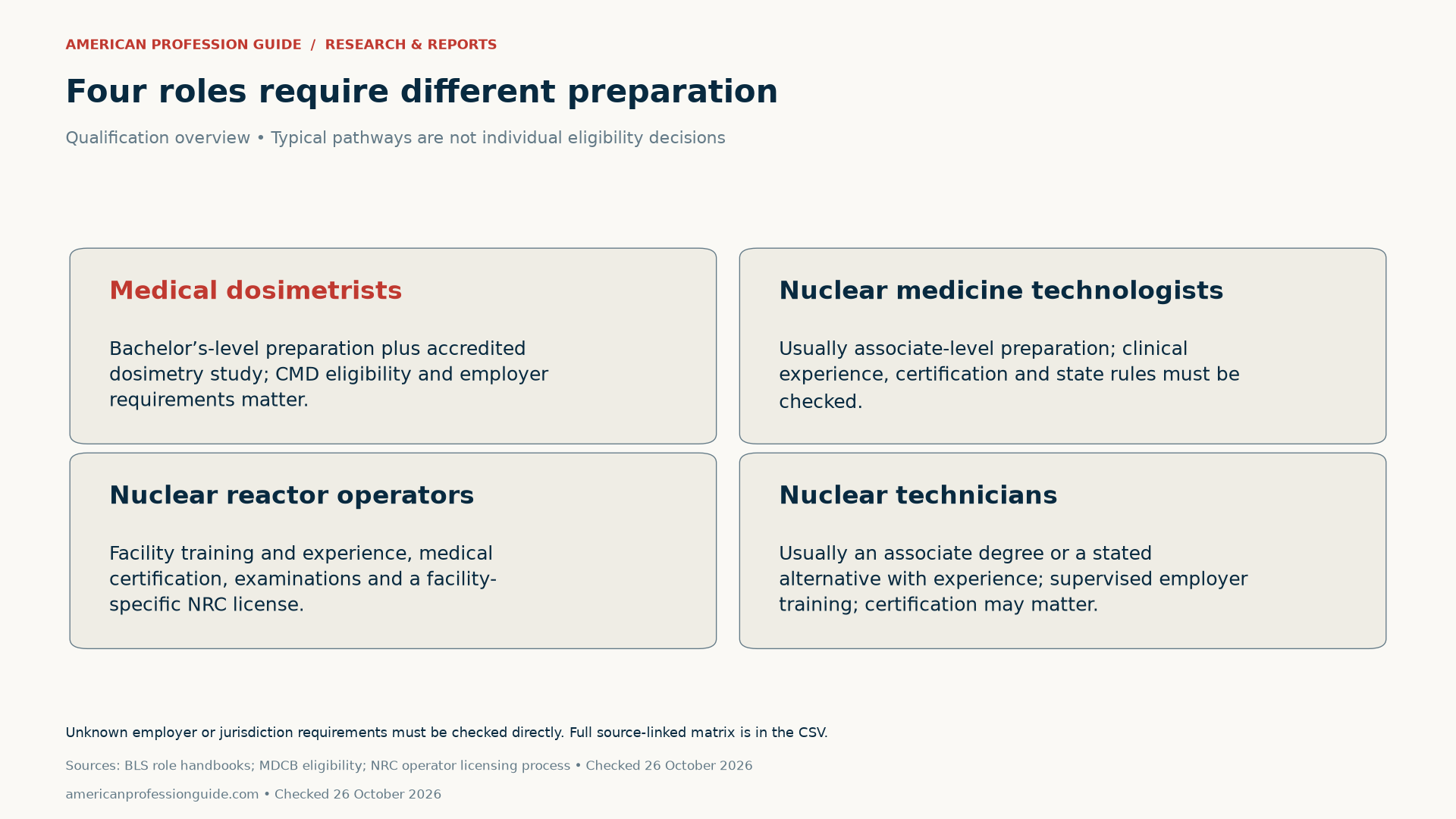
| Medical dosimetrists | Typically a bachelor’s degree plus an accredited dosimetry program, including supervised clinical experience. | Employers usually require or prefer certification. Check current MDCB eligibility and the exact duties and jurisdiction. |
| Nuclear medicine technologists | Typically an associate degree in nuclear medicine technology; other stated educational routes exist. Clinical experience is part of preparation. | Most become certified. Some states require licensure; employers may require certification regardless of state rules. |
| Nuclear reactor operators | The broad operator group typically needs at least high school or equivalent. Facility education, experience and training requirements also apply. | Commercial reactor operators need the NRC process described below. A generic course does not confer a facility license. |
| Nuclear technicians | Usually an associate degree in nuclear science or related technology. Some enter through a stated alternative plus relevant experience. | Employers may prefer or require certification. Verify employer and jurisdiction requirements; technician status does not confer reactor authority. |
Clinical credentials: check both program and person
For U.S. Route 1 candidates, the Medical Dosimetrist Certification Board requires at least a bachelor’s degree and graduation from a JRCERT-accredited medical dosimetry program lasting at least 12 months. This describes an exam-eligibility requirement. It does not say a person starting without the prerequisites can become a dosimetrist in 12 months.
Program admission can require specific prior coursework or credentials. Ask which route fits your actual education and what supervised placement arrangements the program provides. Applicants trained internationally should check the board’s current eligibility rules directly. Our table does not decide whether an overseas qualification, past training route or individual application meets those rules.
For nuclear medicine technology, certification and state permission are separate checks. BLS notes that licensing varies by state and employers may require certification even where state rules differ. Check the intended state’s health board and the actual employer, rather than treating a national overview as a complete practice authorization.
For example, the Maryland Board of Physicians lists a recognized education program and current ARRT or NMTCB certification among its conditions. It says JRCNMT accreditation ceased to be a board requirement on October 21, 2024. This is a dated Maryland example, not a rule for every state or a complete application checklist.
Reactor licensing depends on the facility
The NRC operator licensing process requires the facility licensee to certify training and experience requirements. Applicants also undergo medical fitness certification and written and operating examinations. The resulting license is valid for the facility for which the applicant applied. Maintenance and renewal obligations continue after initial licensing.
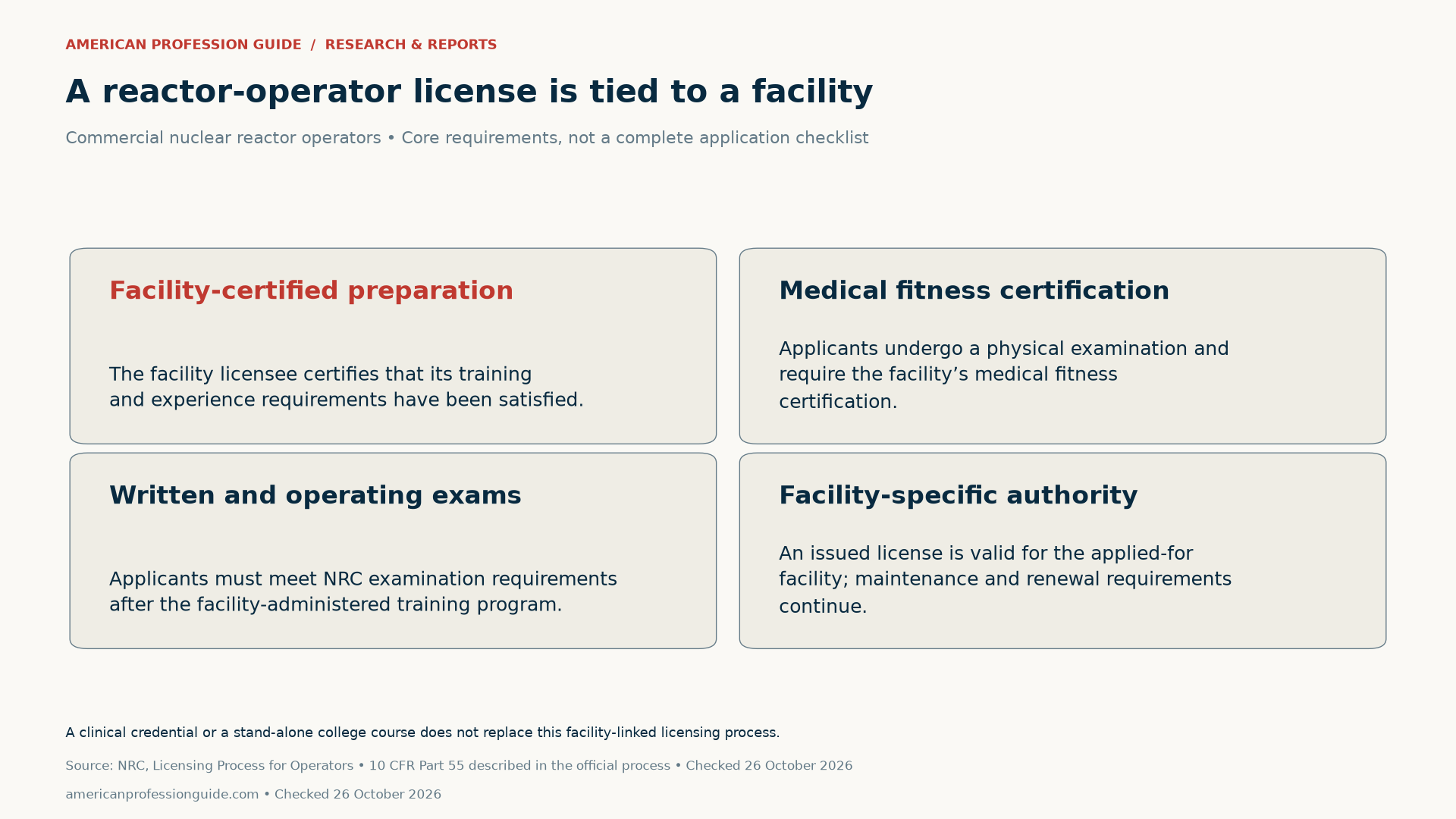
This facility dependence changes the questions to ask a recruiter or training provider. Confirm whether a real employer sponsors the relevant preparation, what prerequisites it requires and how the program connects to that facility. A stand-alone course description or an announcement about future reactors does not demonstrate immediate recruitment or establish an applicant’s eligibility.
Nuclear technicians have a different route. The BLS handbook describes supervised employer training and possible certification preferences or requirements. Some enter with an associate degree; others combine a stated education alternative with relevant military or apprenticeship experience. Read the specific vacancy carefully. Advancement to reactor operation requires additional preparation and the relevant licensing process.
Verify nuclear career requirements before paying

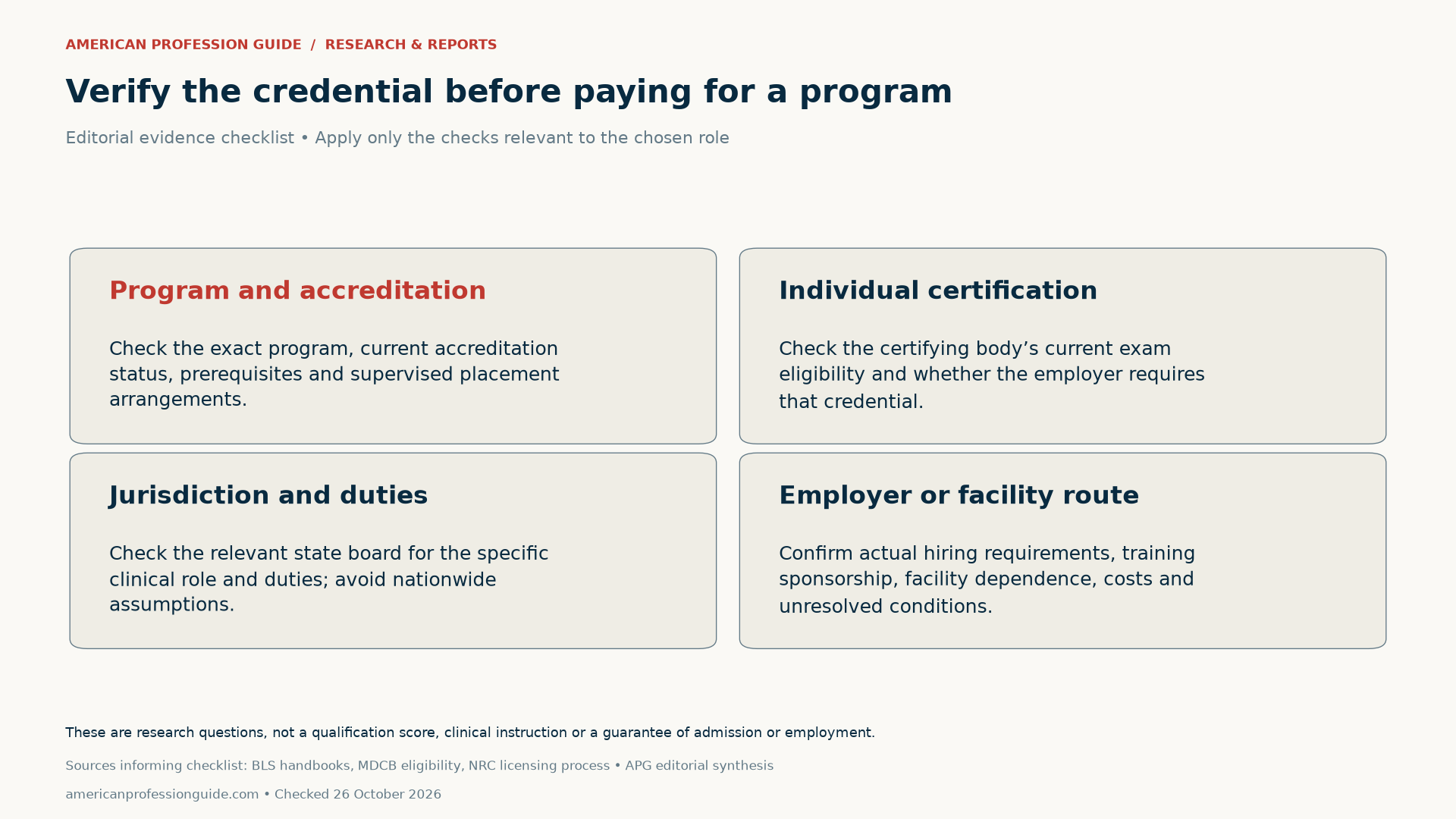
First, name the exact occupation and location. Then separate what a school admits, what a certifying body accepts, what a regulator permits and what an employer requires. Those decisions come from different organizations. Record the source, date and any unresolved condition for each. A missing answer should remain visibly unresolved.
Next, document tuition, fees, study time, clinical placements and employer support. Our graduate-degree earnings report explains why a broad pay gap cannot predict a course’s personal return. Our degree-entry career comparison provides wider context while distinguishing education from experience and training.
Methods and downloadable evidence
We transcribed four employment and annual mean-wage rows from BLS’s October 19 report, preserving their May 2025 reference period. We matched each occupation to its official handbook and added NRC or MDCB sources where relevant. Each row in the evidence file carries source links. Unknown universal state or employer requirements remain unresolved; an unknown is not recorded as “no requirement.”
Download the nuclear career evidence matrix (CSV) and blank nuclear program verification worksheet (CSV). The matrix includes education, accredited preparation, certification, jurisdiction checks, employer or facility dependence and setting. The worksheet helps compare actual programs without inventing a time-to-qualification score.
Suggested citation: American Profession Guide, “Nuclear Career Requirements in 2026: The Training and Licensing Gates Behind the Pay,” checked October 26, 2026. Credit BLS for the May 2025 estimates and the named authorities for pathway requirements. Credit this report for the comparison and checklist, retaining the distinction between typical preparation and individual eligibility.


