







Careers without a bachelor’s degree can offer strong pay, but the route into them varies widely. Some require an associate degree or a technical award. Others rely on an apprenticeship, lengthy training, or years of related work experience.
American Profession Guide analyzed 831 detailed occupations in the latest federal projections. We found 541 occupations with typical entry education below a bachelor’s degree. Of those, 59 have a published annual median wage of at least $75,000, and 13 reach $100,000.
For a more focused shortlist, we added two demand measures. An occupation must have projected growth of at least 3.5% and at least 1,000 annual openings. Twenty careers pass all three thresholds. Together, they account for 279,200 projected annual openings.
2026 research edition: Wages refer to 2025, while projections cover 2025–2035. BLS released the projections on August 27, 2026. We analyzed them on October 19, 2026. The wage figures are occupation medians, not starting salaries or promises to individual workers.
Jump to key findings, the 20-career shortlist, experience requirements, or the full downloadable dataset.
Careers without a bachelor’s degree: five data findings
- Higher pay appears across several training routes. The 59 occupations with medians of at least $75,000 include 33 high-school-entry occupations, 15 associate-degree occupations, and 11 requiring a postsecondary nondegree award.
- Twenty combine pay, growth, and scale. The screened list contains seven associate-degree occupations, seven nondegree-award occupations, and six high-school-entry occupations.
- Nine of the twenty typically require related experience. Six require less than five years; three require five years or more. The shortlist includes advancement roles as well as entry routes.
- Commercial pilots lead pay within the shortlist. Their 2025 median is $123,220. Elevator and escalator installers and repairers follow at $109,910.
- Diagnostic medical sonographers lead shortlist growth. Employment is projected to increase 13.9% from 2025 to 2035. Their 2025 median wage is $96,590.
How we selected the 20 careers
We used the BLS occupational projections workbook to create a transparent filter. First, we selected occupations whose typical entry education falls below a bachelor’s degree. Next, we applied the following three conditions together.
| Measure | Threshold | Reason for including it |
|---|---|---|
| Annual median wage in 2025 | At least $75,000 | Provides a clear pay benchmark |
| Projected employment growth, 2025–35 | At least 3.5% | Matches or exceeds the published national growth rate |
| Average annual openings, 2025–35 | At least 1,000 | Adds a minimum measure of national opportunity scale |
This is a screening tool, not a universal ranking of the best careers. A role just below a cutoff may still be a good fit. Likewise, passing the filter does not make a career easy to enter, affordable to train for, or available in every location.
We include associate degrees because the question concerns a bachelor’s degree. Therefore, “without a bachelor’s degree” should not be read as “without college.” It also does not mean that every employer accepts the same education or experience.
The highest-paying occupations in the broader group
Before applying the growth and opening thresholds, air traffic controllers have the highest median wage among the 541 occupations: $148,080. Commercial pilots rank second at $123,220. Nuclear power reactor operators rank third at $122,890.
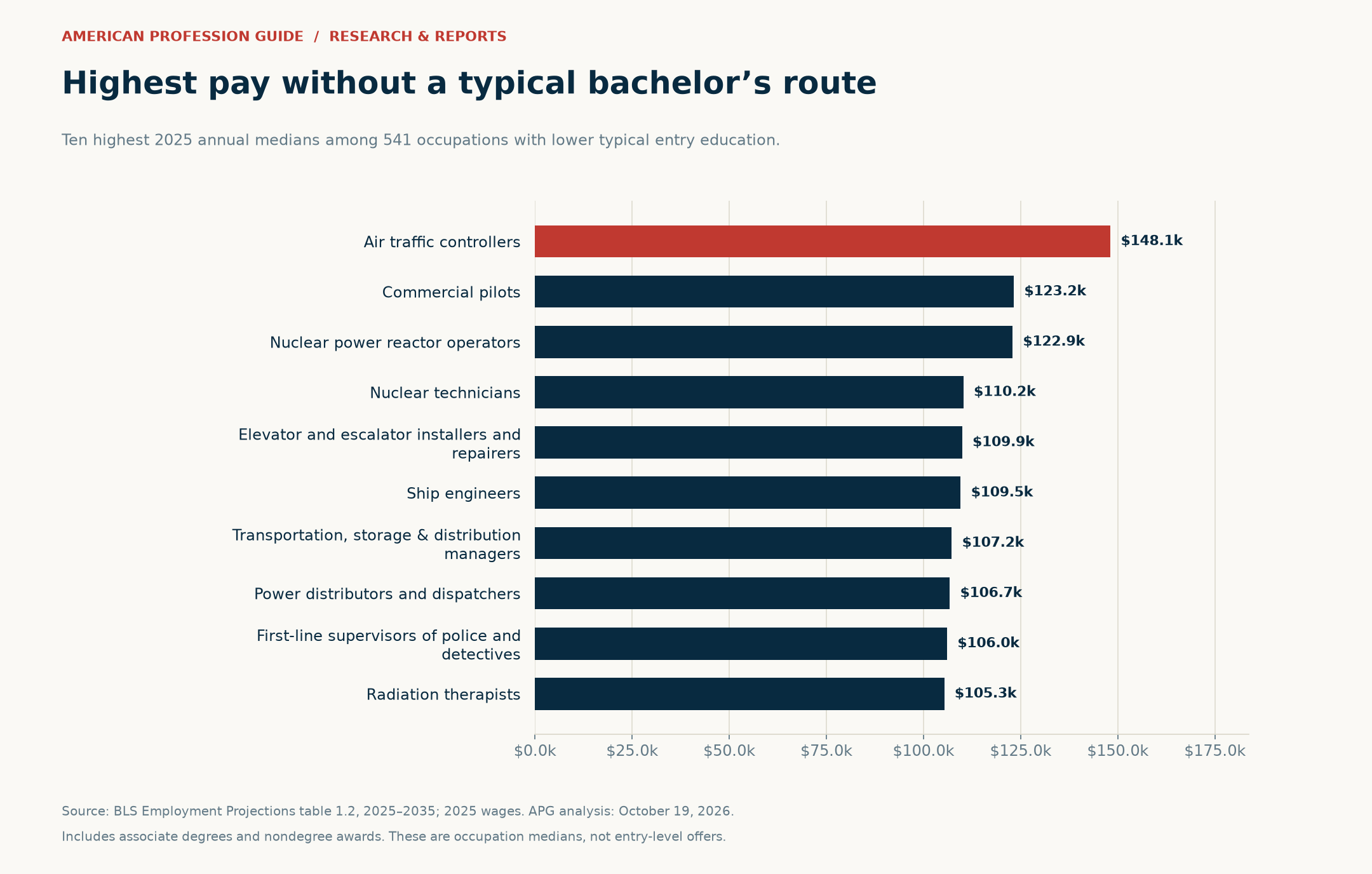
| Occupation | 2025 median pay | Projected growth | Annual openings |
|---|---|---|---|
| Air traffic controllers | $148,080 | 1.7% | 2,100 |
| Commercial pilots | $123,220 | 5.2% | 5,200 |
| Nuclear power reactor operators | $122,890 | -5.9% | 400 |
| Nuclear technicians | $110,240 | 1.1% | 900 |
| Elevator and escalator installers and repairers | $109,910 | 5.7% | 1,900 |
| Ship engineers | $109,530 | 2.7% | 900 |
| Transportation, storage, and distribution managers | $107,230 | 6.1% | 18,300 |
| Power distributors and dispatchers | $106,730 | 1.2% | 700 |
| First-line supervisors of police and detectives | $106,040 | 3.3% | 10,600 |
| Radiation therapists | $105,310 | 2.8% | 700 |
The contrast shows why pay alone is an incomplete guide. Air traffic controllers fall outside our shortlist because their projected growth is 1.7%. Nuclear power reactor operators have projected growth of −5.9% and only 400 annual openings. Both pay well, but they describe different opportunity patterns from the screened careers.
In fact, 14 of the 59 occupations with medians of at least $75,000 have declining projected employment. A declining total can coexist with openings as workers leave. Our study of growth versus annual openings across 831 occupations explains that distinction in detail.
Twenty careers without a bachelor’s degree meeting the screen
The following tables show every occupation that passes the three thresholds. We group them by typical entry education and sort each group by pay. The groups clarify the preparation route, while the experience column helps distinguish first-entry opportunities from later career moves.
Associate-degree routes: seven qualifying occupations
| Occupation | 2025 median pay | Growth, 2025–35 | Annual openings | Related experience |
|---|---|---|---|---|
| Dental hygienists | $98,100 | 8.0% | 15,000 | None |
| Diagnostic medical sonographers | $96,590 | 13.9% | 6,000 | None |
| Magnetic resonance imaging technologists | $95,480 | 7.7% | 2,300 | Less than 5 years |
| Aerospace engineering and operations technologists and technicians | $82,890 | 11.9% | 1,100 | None |
| Respiratory therapists | $82,280 | 8.5% | 8,600 | None |
| Radiologic technologists and technicians | $80,110 | 5.0% | 13,000 | None |
| Funeral home managers | $78,790 | 4.1% | 2,600 | Less than 5 years |
Dental hygienists lead pay in this group at $98,100, followed by diagnostic medical sonographers at $96,590. Radiologic technologists and technicians have 13,000 annual openings, compared with 6,000 for sonographers. Thus, the fastest-growing option does not necessarily have the largest opening count.
Magnetic resonance imaging technologists and funeral home managers have a related-experience requirement in the BLS classification. The other five associate-degree occupations show none. However, none in that column does not remove the education, clinical preparation, or other requirements of the job.
The BLS sonographer profile, for example, describes associate-degree and certificate routes. Programs usually include clinical training, and some workers need licensing or certification. Therefore, review the specific program and local rules before treating a degree label as a complete entry plan.
Postsecondary nondegree awards: seven qualifying occupations
| Occupation | 2025 median pay | Growth, 2025–35 | Annual openings | Related experience |
|---|---|---|---|---|
| Commercial pilots | $123,220 | 5.2% | 5,200 | None |
| Electrical and electronics repairers, powerhouse, substation, and relay | $103,020 | 9.7% | 1,800 | Less than 5 years |
| First-line supervisors of firefighting and prevention workers | $93,530 | 3.7% | 6,600 | Less than 5 years |
| Captains, mates, and pilots of water vessels | $92,460 | 4.0% | 3,800 | Less than 5 years |
| Avionics technicians | $82,280 | 9.4% | 1,700 | None |
| Aircraft mechanics and service technicians | $79,870 | 5.4% | 11,400 | None |
| Fire inspectors and investigators | $75,920 | 4.2% | 1,600 | 5 years or more |
Commercial pilots lead this group and the full shortlist. However, the occupation is separate from airline pilots, copilots, and flight engineers. Combining those categories would overstate the pay for the role we actually screened and would blur their different education routes.
The BLS pilot profile says commercial pilots typically need flight training and must meet FAA requirements. Some employers may require or prefer a degree. Airline pilots typically need a bachelor’s degree and experience. Our table uses the detailed commercial-pilot code, 53-2012, throughout.
The same group also includes aviation maintenance, electrical equipment repair, and public-safety advancement roles. Their common education category does not make their training interchangeable. In particular, firefighting supervisors and fire investigators typically need related experience, while aircraft mechanics have a different route into specialized technical work.
High school or equivalent: six qualifying occupations
| Occupation | 2025 median pay | Growth, 2025–35 | Annual openings | Related experience |
|---|---|---|---|---|
| Elevator and escalator installers and repairers | $109,910 | 5.7% | 1,900 | None |
| Transportation, storage, and distribution managers | $107,230 | 6.1% | 18,300 | 5 years or more |
| Electrical power-line installers and repairers | $95,320 | 10.3% | 10,900 | None |
| First-line supervisors of construction trades and extraction workers | $79,920 | 5.0% | 67,000 | 5 years or more |
| First-line supervisors of mechanics, installers, and repairers | $79,860 | 4.1% | 48,900 | Less than 5 years |
| Police and sheriff's patrol officers | $76,210 | 3.5% | 51,500 | None |
Elevator and escalator installers and repairers have the highest median in this group, at $109,910. Transportation, storage, and distribution managers follow at $107,230. Yet their preparation routes are quite different: BLS lists an apprenticeship for elevator work and five years or more of related experience for the management role.
The BLS elevator profile describes a typical four-year apprenticeship with technical instruction and paid work. Most states require a license. As a result, the high school label identifies the starting education level, while the skilled occupation requires substantial further preparation.
The three supervisor or manager occupations in this group account for many openings. However, they should not be presented as immediate jobs for a new high school graduate. A worker may need to build experience in an underlying occupation before qualifying for those responsibilities.
Which qualifying careers have the most openings?
Construction and extraction supervisors lead the shortlist with 67,000 annual openings. Police and sheriff’s patrol officers follow at 51,500. Supervisors of mechanics, installers, and repairers rank third at 48,900. Together, these three account for 167,400 openings, or about 60.0% of the shortlist total.
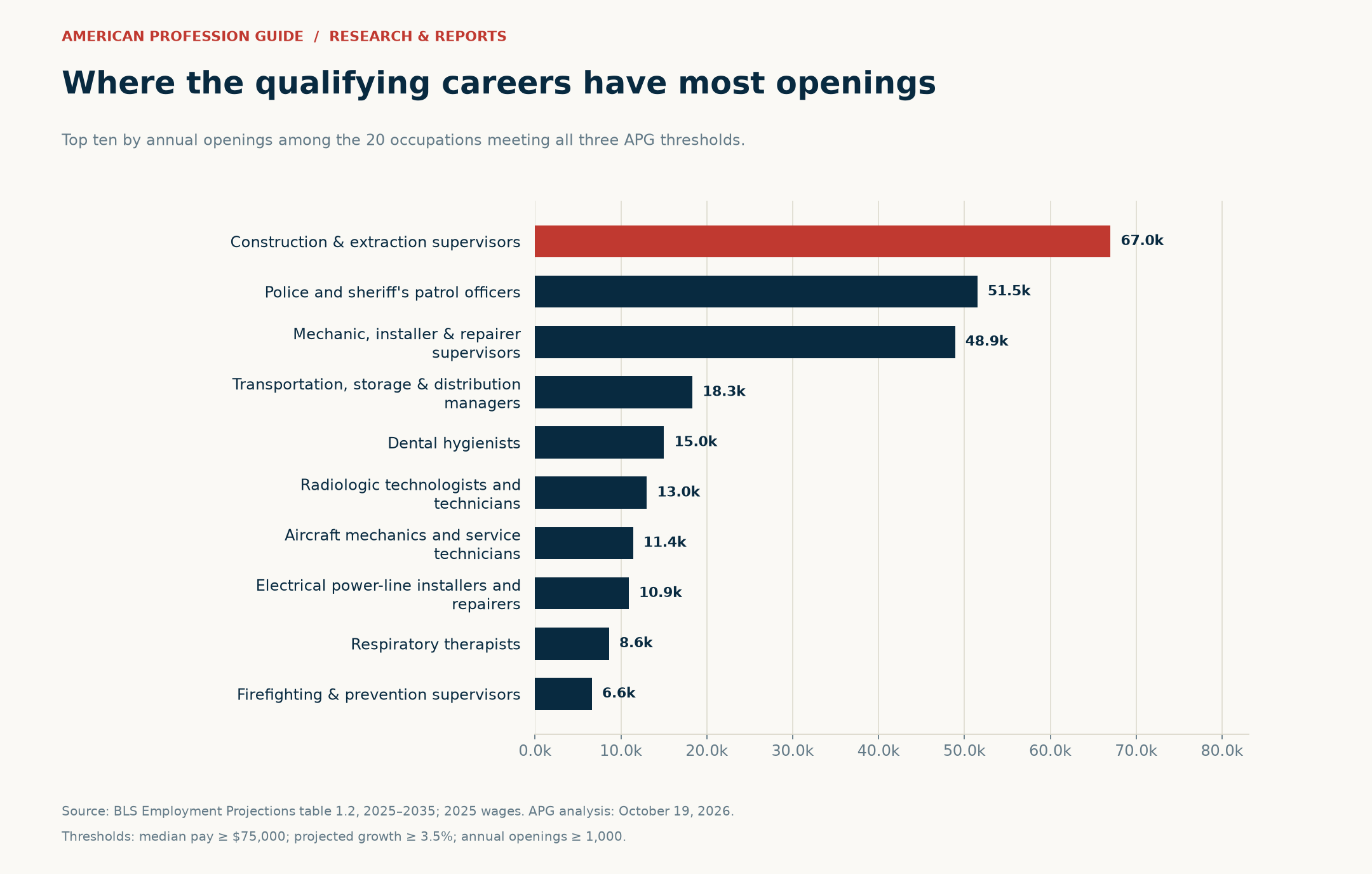
By comparison, elevator and escalator installers and repairers have 1,900 annual openings. That smaller figure does not negate the occupation’s strong median wage. It means the national flow of openings is much smaller than in the largest occupations on the list.
Annual openings also include workers replacing people who leave an occupation. Consequently, they are not all newly created jobs. The figures do not count applicants, measure hiring competition, or establish how easy it is to secure an offer.
Which qualifying careers grow fastest?
Diagnostic medical sonographers lead projected growth at 13.9%. Aerospace engineering and operations technologists and technicians follow at 11.9%. Electrical power-line installers and repairers rank third at 10.3%. Each grows well above the 3.5% national benchmark used in our screen.
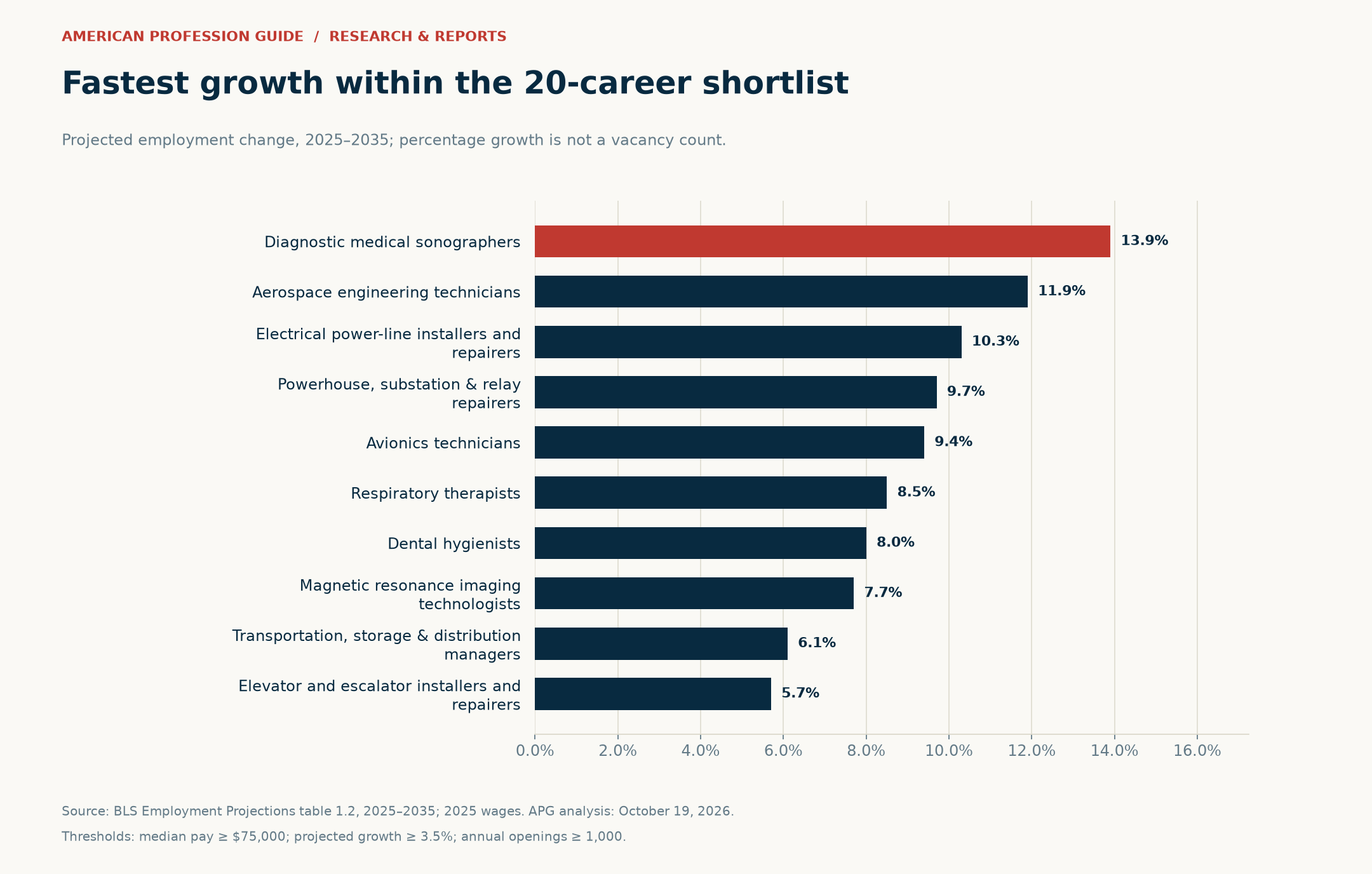
Aerospace engineering technicians illustrate the difference between pace and scale. They have the second-highest growth rate in the shortlist, but only 1,100 annual openings. Dental hygienists grow at a slower 8.0%, yet have 15,000 annual openings. Therefore, a career comparison should include both measures.
The growth figures are projections over a decade. They do not promise a steady increase each year. Nor do they show that a particular local employer will expand at the same rate as the national occupation.
What the education labels reveal
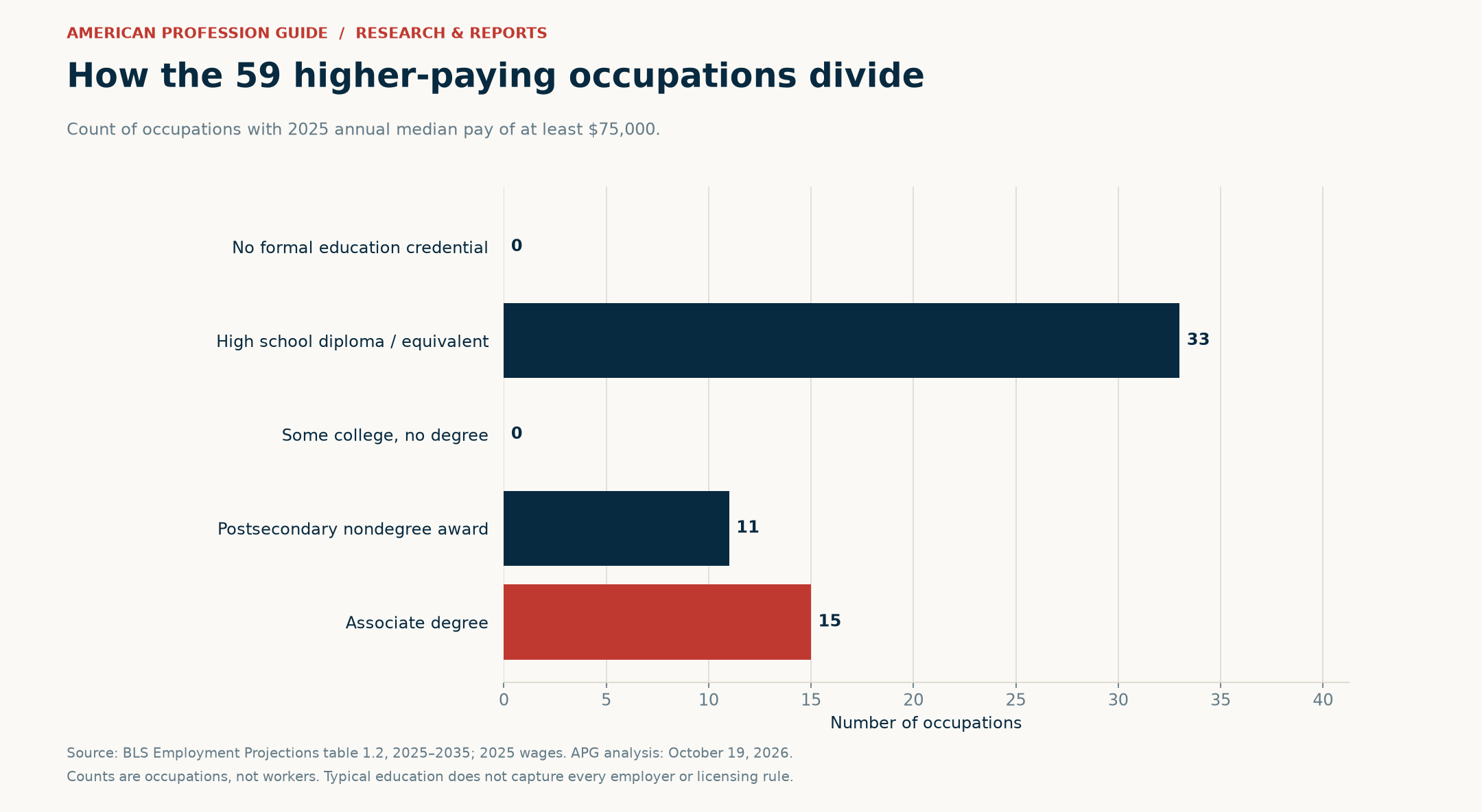
| Typical entry education | Occupations examined | Median pay at least $75,000 | Pass all three thresholds |
|---|---|---|---|
| No formal educational credential | 109 | 0 | 0 |
| High school diploma or equivalent | 326 | 33 | 6 |
| Some college, no degree | 7 | 0 | 0 |
| Postsecondary nondegree award | 51 | 11 | 7 |
| Associate's degree | 48 | 15 | 7 |
None of the occupations classified as requiring no formal educational credential has a published annual median of $75,000 in this dataset. The same is true of the small “some college, no degree” group. That finding concerns occupation medians. It does not mean no individual in those occupations earns that amount.
Likewise, these counts cannot measure the financial return to a particular qualification. We do not track the same people before and after training. We also do not control for experience, hours, location, or who enters each occupation. The table describes career categories, not a causal degree premium.
Experience changes the meaning of an accessible career
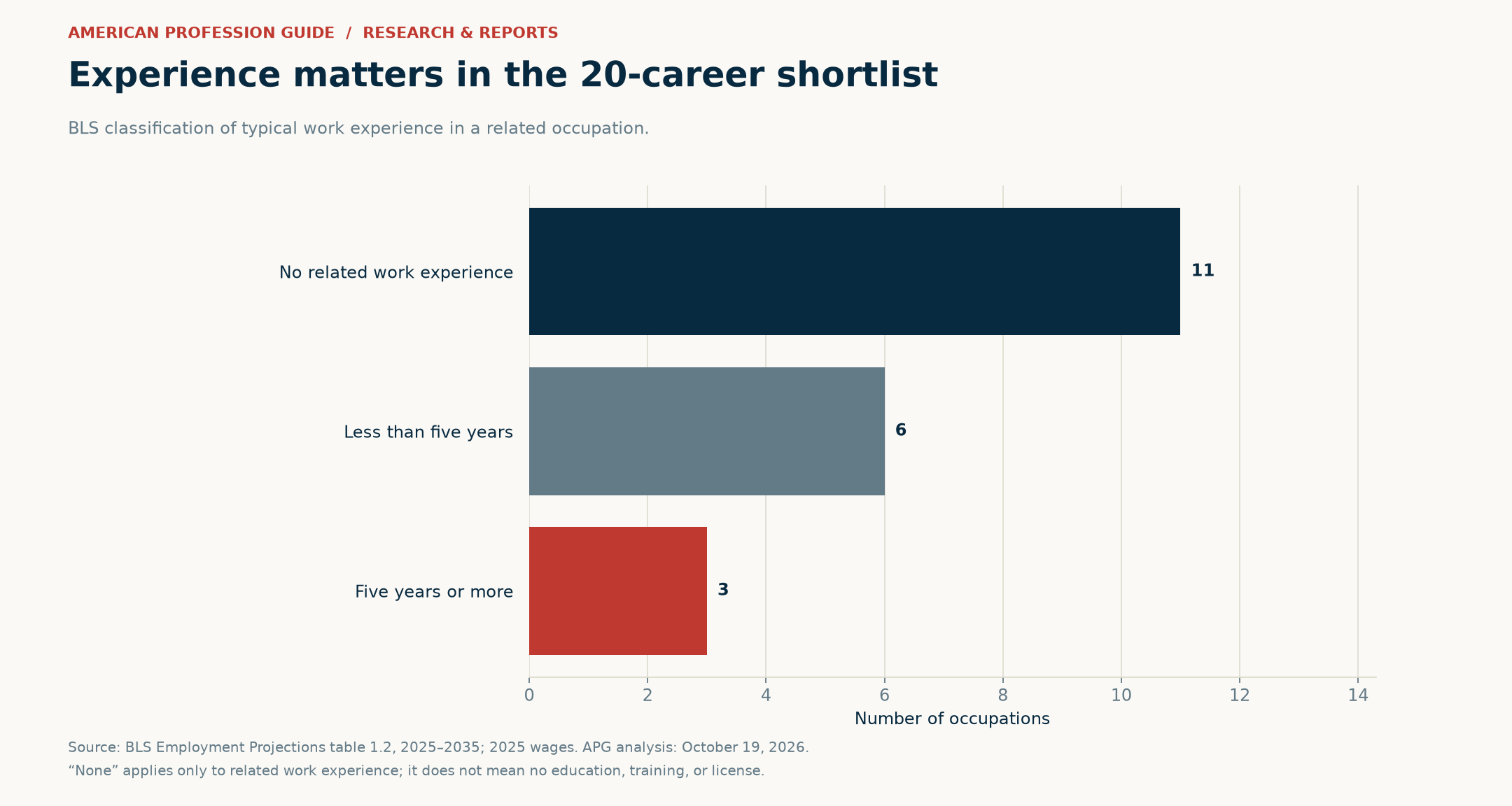
Eleven occupations in the shortlist have no typical related-work-experience requirement in the source. Six require less than five years, and three require five years or more. This distinction is especially useful for readers comparing a first career with an advancement move.
The three with at least five years are transportation, storage, and distribution managers; construction and extraction supervisors; and fire inspectors and investigators. A course alone may not supply the work history associated with those roles. Therefore, evaluate the full career path, including the earlier jobs that build relevant experience.
BLS also records on-the-job training separately from education and prior experience. For example, it lists long-term training for electrical power-line installers and repairers. These separate fields explain why a simple “no bachelor’s required” label cannot capture the full commitment.
How to compare careers without a bachelor’s degree

Start by matching a role to your interests, existing skills, and practical constraints. Next, use the tables to identify what you still need. A pathway that works well for an experienced worker may be less direct for someone entering the workforce for the first time.
- Verify the specific role. Use the occupation code and Handbook link to avoid confusing similar titles with different requirements.
- Check the full entry route. Review education, related experience, training, licensing, and employer expectations together.
- Compare local vacancies. Look for employers within your realistic travel or relocation range. National openings do not guarantee local availability.
- Budget for the whole program. Include fees, equipment, travel, exams, and any time away from paid work. Do not assume a national median is the first wage you will earn.
- Assess work conditions. Consider schedules, physical demands, travel, responsibility, and whether the day-to-day tasks fit your goals.
Then compare real offers with the cost of living where you would work. Our metro salary purchasing power research shows how location can change a wage comparison. Keep its historical data years separate from the 2025 national wages used here.
Methodology and limits
We used table 1.2 of the BLS occupational projections workbook. We retained detailed rows labeled “Line item” and excluded summary groups. This leaves 831 distinct occupation codes before the education filter.
The education filter retains five categories: no formal credential, high school or equivalent, some college without a degree, postsecondary nondegree award, and associate degree. It yields 541 occupations. Of these, 535 have usable annual median wage estimates. The six missing values remain blank in the download and do not qualify for the wage screen.
We applied the $75,000 wage, 3.5% growth, and 1,000-opening thresholds to the published values. All three must hold. We converted employment and openings from thousands to whole counts for display. Pay ranks use descending medians, with tied values sharing the minimum rank. Occupation code provides a stable order when displayed pay ties.
Wages come from the Occupational Employment and Wage Statistics program. They exclude self-employed workers and other groups specified in the source. Employment projections can cover a broader job population. Also, a national median is neither a guaranteed individual outcome nor a measure of starting pay.
The BLS education and training definitions describe typical entry preparation. They do not prescribe every employer’s hiring rule. Furthermore, the projections are modeled national estimates. They do not measure training costs, licensing eligibility, applicant competition, or local labor shortages.
Download the full data and reuse the findings
Download the 541-occupation dataset (CSV). It includes occupation codes, wages, education, related experience, training, growth, annual openings, Handbook links, and flags identifying all twenty qualifying careers.
Transform Your Career Today
Unlock a personalized career strategy that drives real results. Get tailored advice and a roadmap designed just for you.
Start NowSuggested citation: American Profession Guide. “20 Careers Without a Bachelor’s Degree With Median Pay of $75,000+.” October 19, 2026. Analysis of BLS Employment Projections table 1.2, 2025–2035, using 2025 wage estimates.
Journalists, educators, and career advisers may cite the findings and charts with attribution and a link to this article. Please identify BLS as the underlying source and APG as the analyst. Keep the median-pay wording, wage year, projection period, and screening thresholds with reused statistics.
Visuals: The five charts use published BLS figures and the calculations described here. The featured image and workshop scene are AI-generated editorial illustrations. They are not photographs of actual study participants.


