




Team trust at work involves more than confidence in a manager. People also depend on colleagues to complete shared work. New ADP findings provide a reason to examine both relationships, while a simple handoff log can help a new manager make everyday commitments clearer.
Team trust at work: what the reported groups show
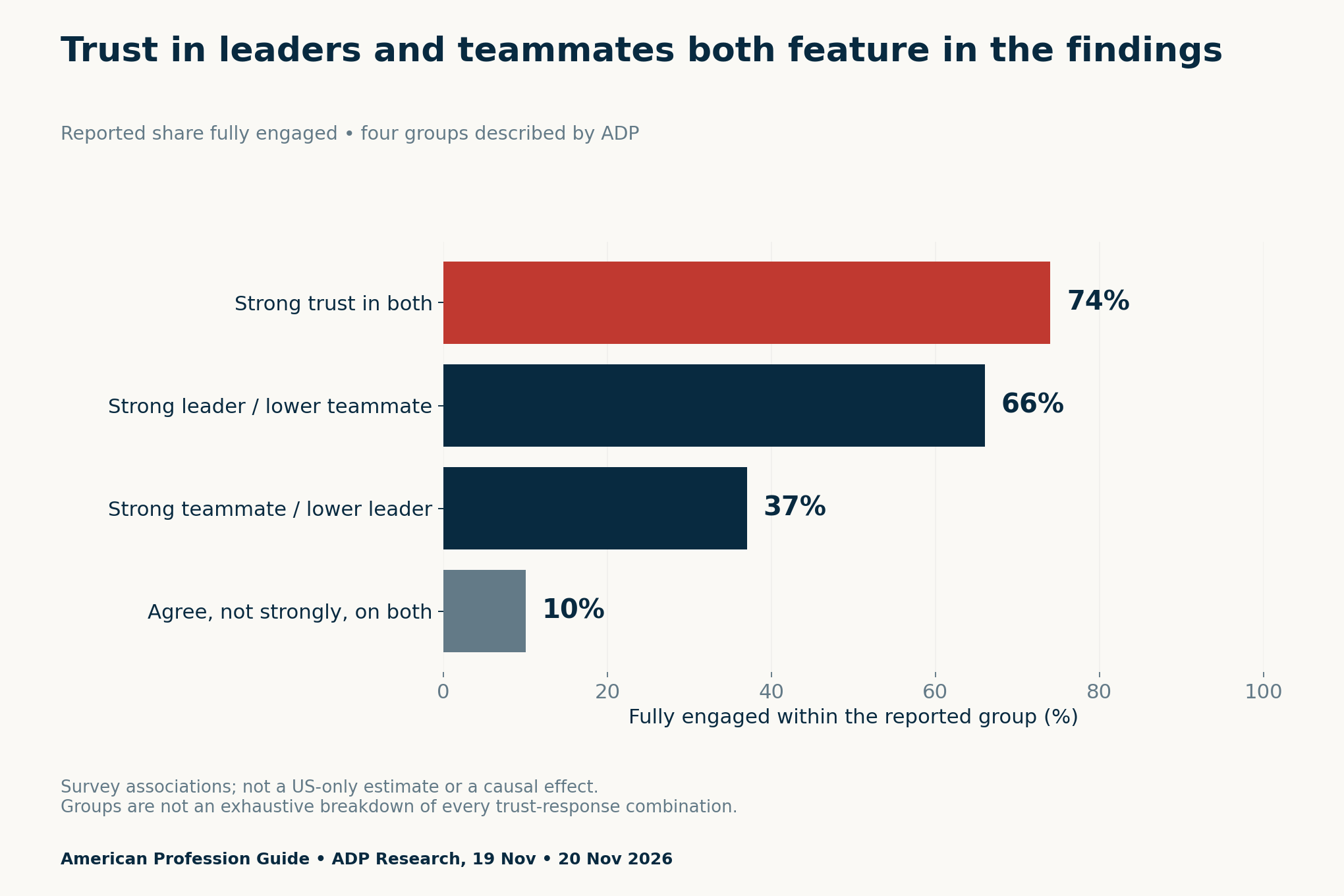
ADP’s 19 November 2026 analysis reports full engagement of 74% among workers strongly trusting both leaders and teammates. It reports 66% with strong leader trust but lower teammate trust, 37% with the reverse pattern, and 10% among those agreeing—but not strongly agreeing—to both trust statements.
Read the findings within their limits
The analysis draws on workforce surveys and discusses global as well as other research contexts. Treat these figures as survey findings, not estimates specific to US managers or your own team. The four displayed groups do not provide every response combination, and the article does not supply their cell counts for an independent weighted calculation.
We reproduce the printed proportions rather than the article’s likelihood multipliers, which cannot be transparently reconciled with those percentages. We do not estimate a causal improvement from a management action. In particular, the proposed exercise below has not been tested as a way to increase trust or engagement.
Choose one recurring handoff to investigate
Start with a routine transfer of work that your team can discuss safely. Examples might include a draft moving to review, a service request moving between roles or a report awaiting approval. Pick a manageable process rather than trying to measure every relationship in the organisation.
Explain the purpose before recording anything: clarify work, surface blockers and improve agreements. Invite voluntary discussion. Do not ask people to rate named colleagues’ trustworthiness or compile a hidden performance ranking. If a concern involves conduct, health or another sensitive matter, use the appropriate existing process instead of a shared research worksheet.
Days 1–7: agree on owner, due date and acceptance
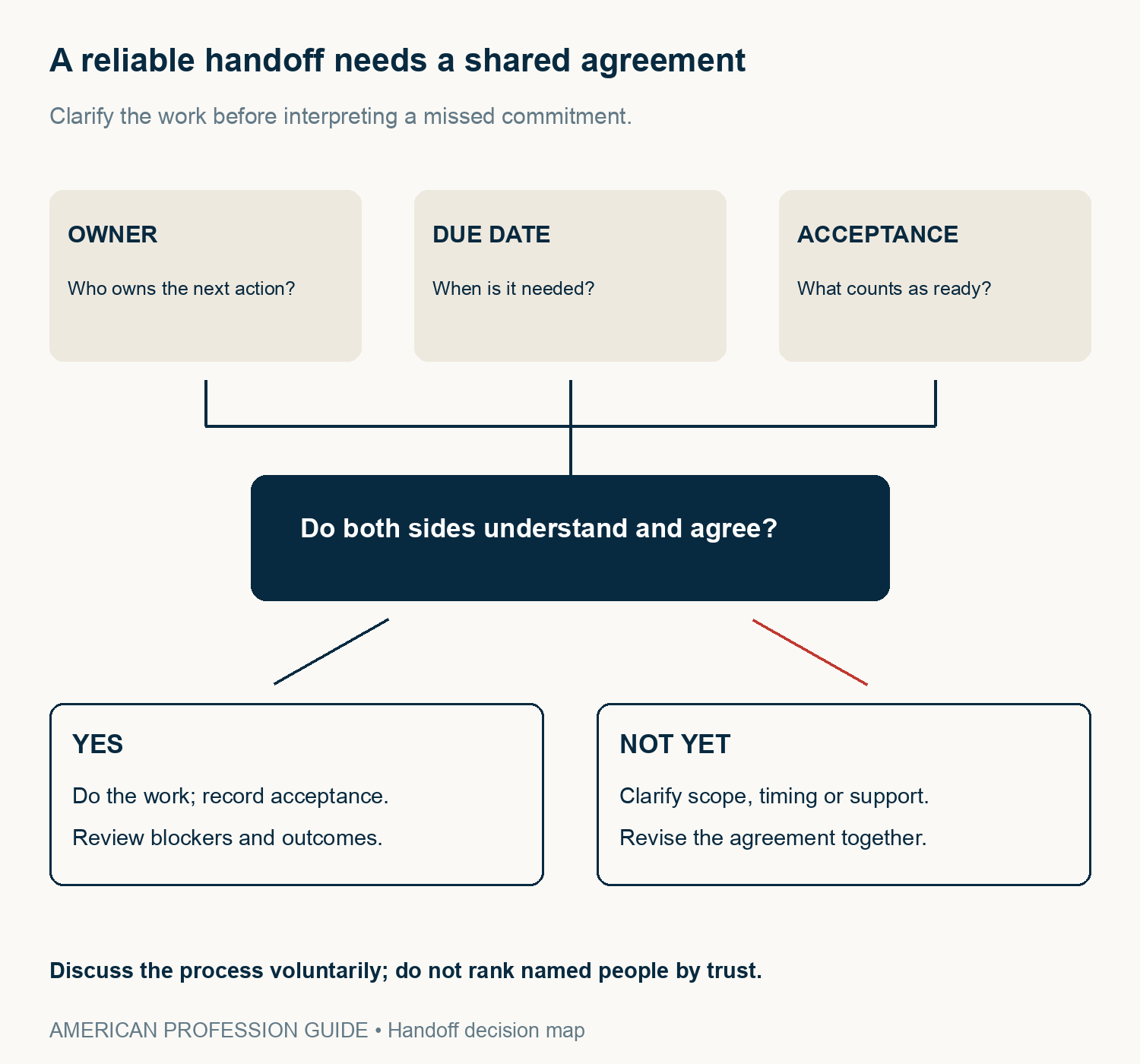
For each work item, identify the role responsible for the next action, the receiving role, the agreed date and what counts as ready. Use a short observable acceptance description. For example, a fictional report handoff might require a checked total and a linked source file, rather than the vague instruction “make it good.”
Check that both sides understand the agreement and have the resources to meet it. A date entered by one person is not automatically a shared commitment. Record uncertainty openly and revise an unrealistic agreement before treating a missed date as an individual failure.
Days 8–21: record outcomes and blockers
Use role labels and work-item identifiers wherever practical. Record acceptance, lateness, unresolved rework and cancellation separately. Keep the original agreed date visible when a date changes, with a brief process reason. That helps distinguish a revised plan from a commitment that was missed without discussion.
A useful blocker note names the issue and next action: a missing input, unclear review criterion or unavailable dependency. Avoid blame, private correspondence and sensitive personal explanations. Restrict access according to your organisation’s normal rules, and do not upload internal work records to public tools.
Days 22–30: review the process together
Choose a review date and keep every logged item in the denominator. Separate items accepted on time from those accepted late. Also retain open work and cancellations so that a neat percentage does not hide incomplete outcomes. Explain the chosen cutoff whenever you share a result.
Discuss one practical change the team wishes to try. It might involve a clearer acceptance note or earlier dependency check. Agree who will act and when you will review it. A before-and-after difference alone would still not prove that the change caused an outcome, especially if the work mix also changed.
A fictional example with twenty handoffs
To illustrate the arithmetic, our invented dataset contains 20 work items: 12 accepted on time, four accepted late, three with unresolved rework and one cancelled. None describes a real employee or team. The example demonstrates denominator choices, not a benchmark that managers should demand.
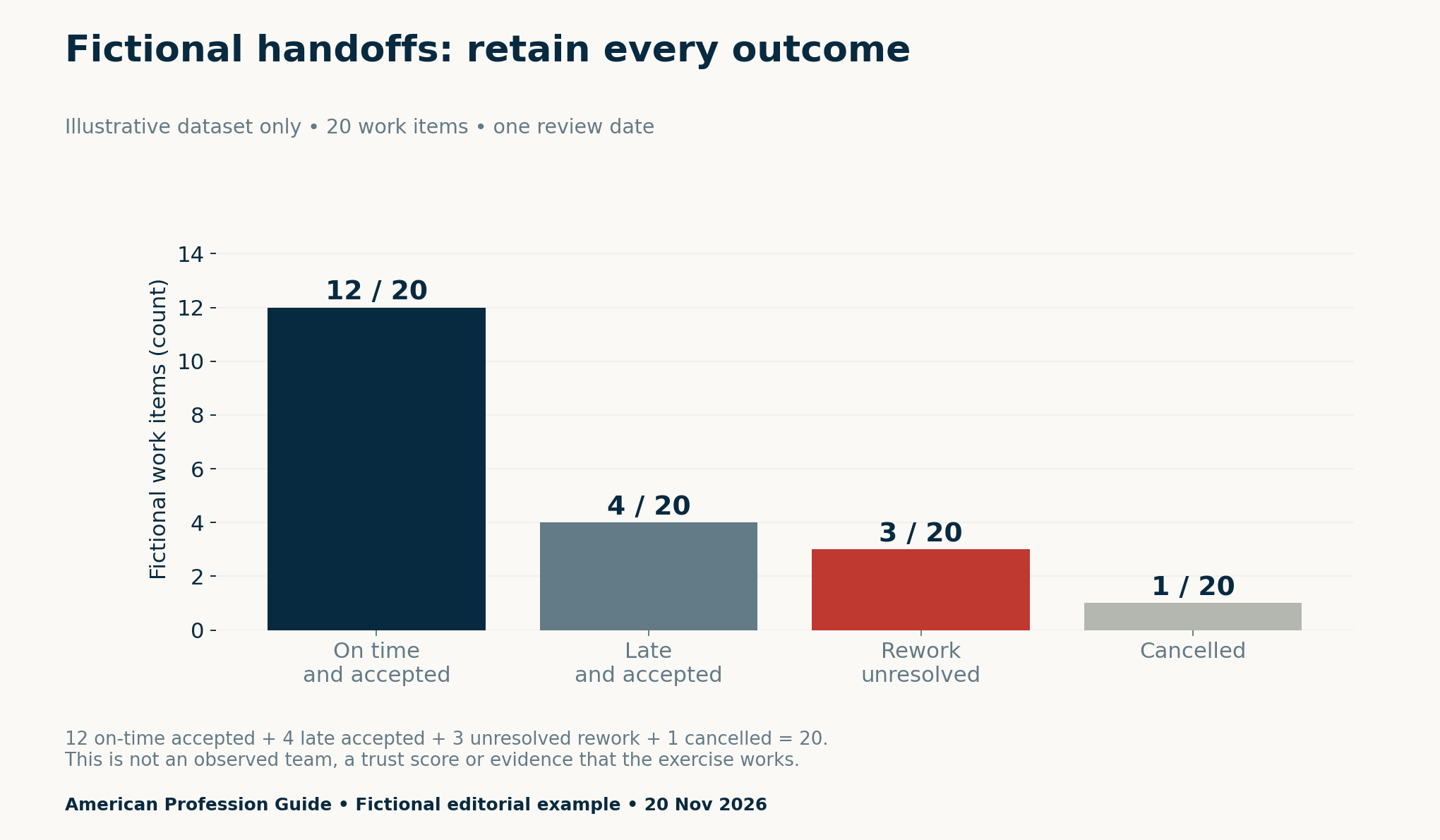
Using all 20 items, the on-time accepted share is 12 ÷ 20, or 60%. The accepted-at-review share is 16 ÷ 20, or 80%, because it includes the four late items. Neither is a trust score. If you report only the second measure, you should still disclose that some accepted work was late.
| Measure | Fictional calculation | Meaning |
|---|---|---|
| All logged items | 20 in fictional example | Includes cancelled and unresolved items |
| On-time accepted share | 12 / 20 = 60% | Denominator is all logged items; no trust or engagement measure |
| Accepted at review share | 16 / 20 = 80% | Includes four late items; not same as on-time share |
| Unresolved rework | 3 / 20 = 15% | Open outcome at chosen review date; not a final failure rate |
| Cancelled | 1 / 20 = 5% | Retained separately; not silently removed |
Use the log without creating a surveillance exercise
Keep the scope narrow, the purpose clear and the conversation voluntary. A process log should help colleagues identify ambiguity and missing support. It should not become a proxy for judging a person’s motives. Share only the level of detail needed to agree the next practical action.
Our productivity evidence guide also separates output, quality and time. That distinction can help a new manager ask whether a handoff was merely fast or actually accepted. Good evidence makes the discussion more specific without pretending to measure every aspect of a working relationship.
Download the survey values and handoff tools
- Reported trust-group engagement values (CSV)
- Twenty fictional handoffs for arithmetic practice (CSV)
- Blank thirty-day handoff log (CSV)
- Handoff measure and denominator definitions (CSV)
Methodology and limits
We checked ADP’s dated analysis on 20 November 2026. Observed survey proportions, our fictional example and proposed management actions remain separate. No US-only estimate, validated trust scale, causal effect or employee ranking is produced. The thirty-day structure is an editorial planning suggestion, not an evidence-based treatment.
Use your organisation’s existing privacy, employment and management processes when deciding whether a work log is appropriate. If the exercise creates discomfort or collects more information than needed, narrow or stop it. The useful outcome is a clearer agreement about work, not a score attached to a colleague.


