




Manufacturing job signals can disagree without making a vacancy meaningless. A business survey may show firmer staffing alongside weaker new orders. For technicians and engineers, the useful question is why a particular employer needs a particular role—and what the written offer confirms.
Manufacturing job signals in the November survey
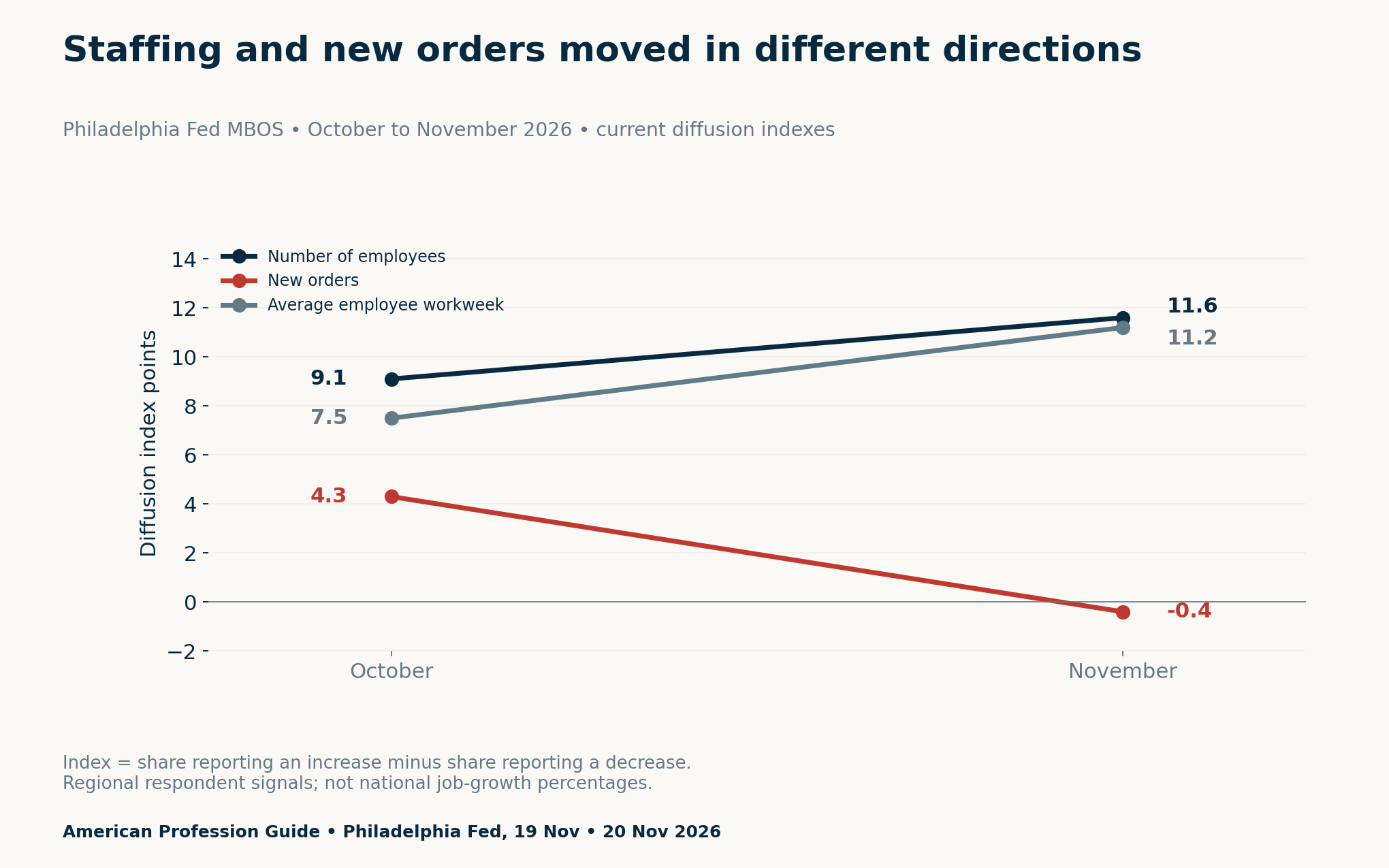
The Philadelphia Fed’s 19 November 2026 report shows the current employment index rising from 9.1 to 11.6. The new-orders index fell from 4.3 to −0.4, while the workweek index rose from 7.5 to 11.2. Responses were collected from 9 to 16 November. These are seasonally adjusted diffusion indexes, not percentages of job growth.
Calculate what the employment index means
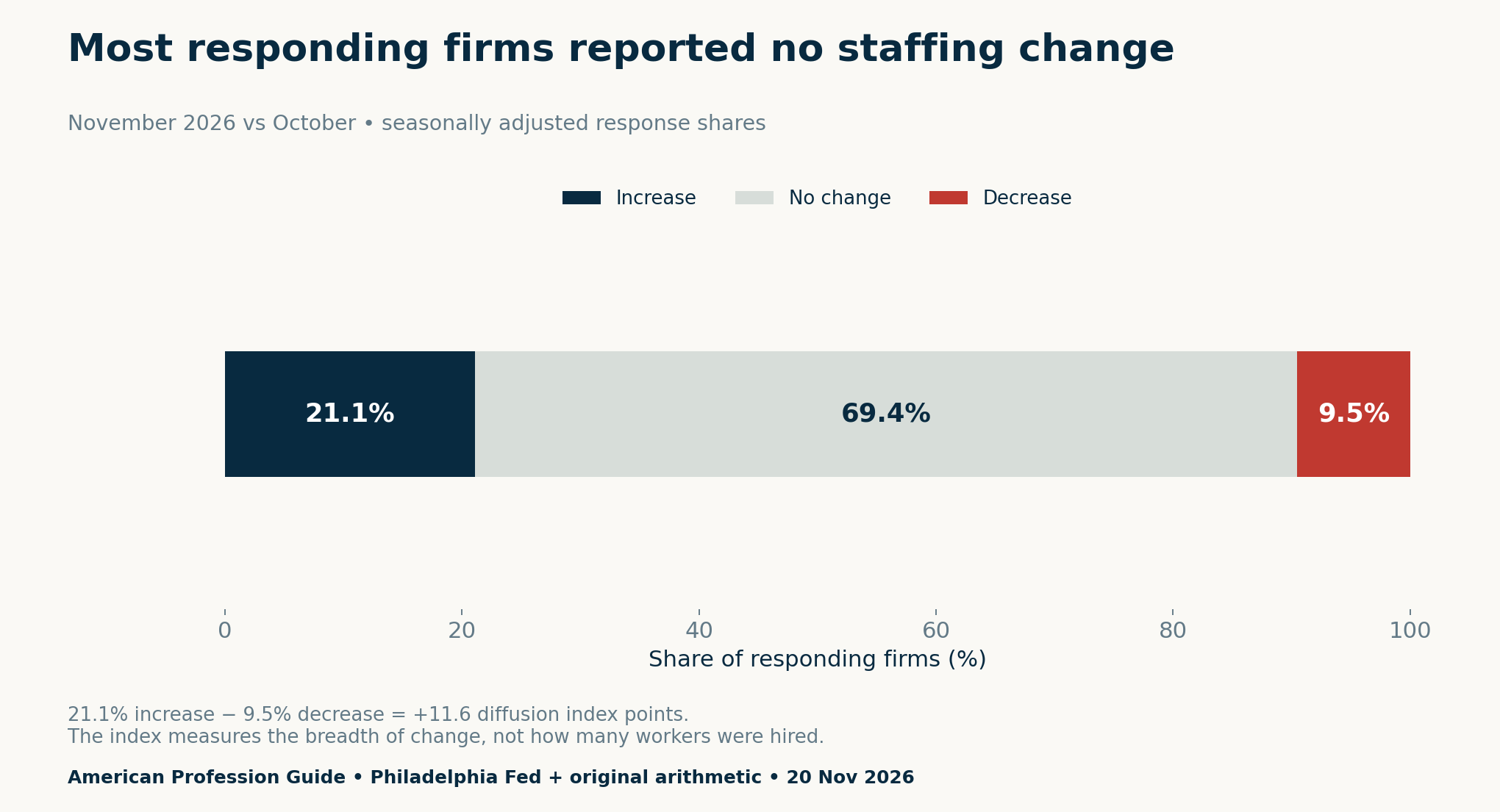
The employment responses were 21.1% reporting an increase, 69.4% no change and 9.5% a decrease. Subtracting the decrease share from the increase share reproduces 11.6 index points. The no-change group is still important: it accounts for most responses even though it is not part of that subtraction.
Keep regional breadth separate from national job counts
The survey overview describes a qualitative monthly survey of manufacturers in the Third District: Delaware, southern New Jersey, and eastern and central Pennsylvania. Executives report the direction of change at their firms. Current responses concern the past month; the future questions concern expectations six months ahead.
A diffusion index measures how widespread reported increases are relative to decreases. It does not give the size of each firm’s change. For example, an increase at a small plant and a decrease at a much larger plant cannot be converted into a net worker count using their response directions alone.
Why staffing and orders can diverge
Orders, staffing and hours describe different decisions and timings. A firm might maintain a specialist role while current orders soften, or adjust hours before changing headcount. These are possible explanations to investigate, not causes established by the November survey. The report does not identify why a specific employer posted an advertisement.
Similarly, a vacancy could replace a departing worker, add capacity or cover a temporary need. A sector headline cannot distinguish those purposes for you. Ask the hiring team how the role fits its current work, then record what is confirmed and what remains uncertain.
Check the purpose of the actual vacancy
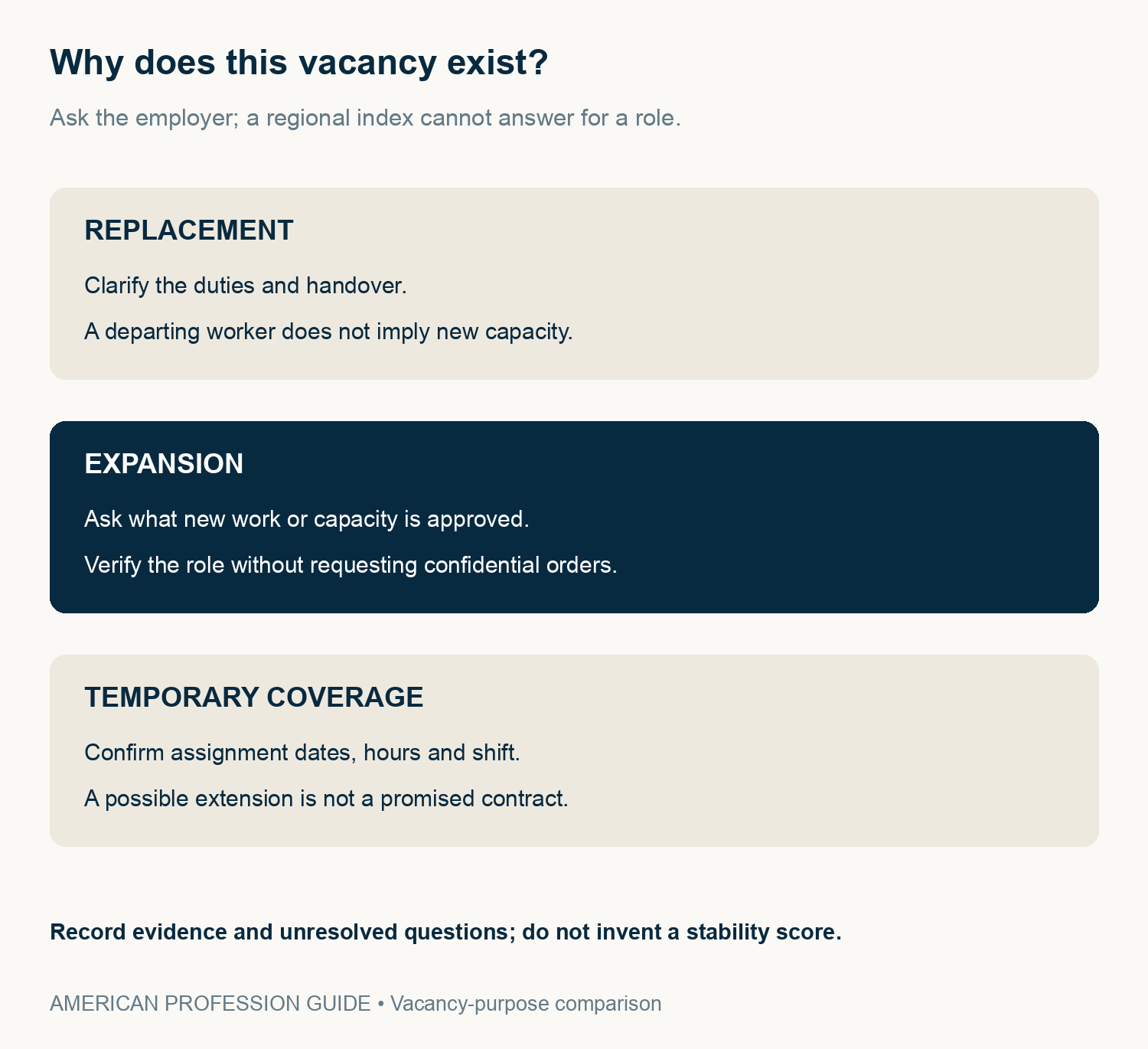
For a replacement role, clarify which responsibilities remain the same and whether a handover is planned. Ask who will review your work during the transition. Avoid assuming that the previous worker’s departure tells you whether the company is growing or shrinking.
For an expansion role, ask which new work, team or capacity the position is intended to support. You can request a clear description of approved duties without asking for confidential order books or customer names. An approved role and a hoped-for future project are different kinds of evidence.
For temporary coverage, confirm the assignment period, normal hours and shift in writing. Ask what happens when the stated work ends. Record possible extensions as possibilities rather than guaranteed employment. If the hiring team cannot yet confirm a term, keep it in the unresolved column.
| Possible purpose | Question to clarify | Useful evidence |
|---|---|---|
| Replacement | Is this replacing an existing role? | Role history, duties and handover arrangements |
| Expansion | What new capacity or work is this role intended to support? | Approved role, team structure and expected tasks |
| Temporary coverage | Is the work time-limited, seasonal or tied to a shift change? | Written assignment dates, hours and renewal terms |
Ask about hours, review and practical responsibilities
A higher workweek index does not tell you the hours in your offer. Ask about the normal schedule, expected overtime, shift rotation and how changes are communicated. Distinguish a recruiter’s description from terms in an actual offer or contract. Seek appropriate advice if those documents are unclear.
Next, connect the position to tasks you can demonstrate. A maintenance candidate might explain how they documented a fault investigation using a harmless training example. A production technician might show a small quality-check record. These fictional examples should fit your own competence and the employer’s stated requirements.
Do not include customer data, production secrets or unsafe operational instructions in a portfolio. A clear description of your reasoning and review process can communicate your contribution without exposing a previous employer’s systems. Only claim qualifications and experience you actually hold.
Use an offer evidence log
Save the official listing URL and the date you checked it. Record the stated vacancy purpose, employment type, shift and hours, then add the relevant document reference. Keep unanswered questions visible so you know what to clarify before making a decision.
For example, a fictional listing might describe expansion while the interview mentions covering an absence. Do not force those statements into one category. Record both and ask which description governs the offer. The log supports a better conversation; it does not produce a validated risk score.
Our related company-stability job-offer guide explains how to examine employer claims beyond a hiring headline. The same principle applies here: a broad signal provides context, while your decision needs role-specific evidence.
Download the figures and vacancy questions
- Current manufacturing indicator register (CSV)
- Employment response shares and arithmetic (CSV)
- Vacancy-purpose question bank (CSV)
- Blank manufacturing offer evidence log (CSV)
Methodology and limits
We checked the primary report and survey overview on 20 November 2026. The charts retain the report’s units and adjustment status. Our arithmetic reproduces the employment diffusion index from the printed response shares. No national vacancy count, employer classification or causal explanation is estimated.
The worksheet is a proposed conversation tool. It has not been validated as a predictor of job security or hiring success. Use the source dates, the actual vacancy and your own constraints together, and preserve uncertainty where an employer has not provided a clear answer.


