




Nursing home job safety deserves a closer look than a falling illness headline. New BLS estimates show fewer reported illnesses in nursing and residential care, while injury cases and their rate were essentially unchanged. For a job seeker, that is a reason to ask better employer questions, not to assume every facility is now safer.
Nursing home job safety: what the new release covers
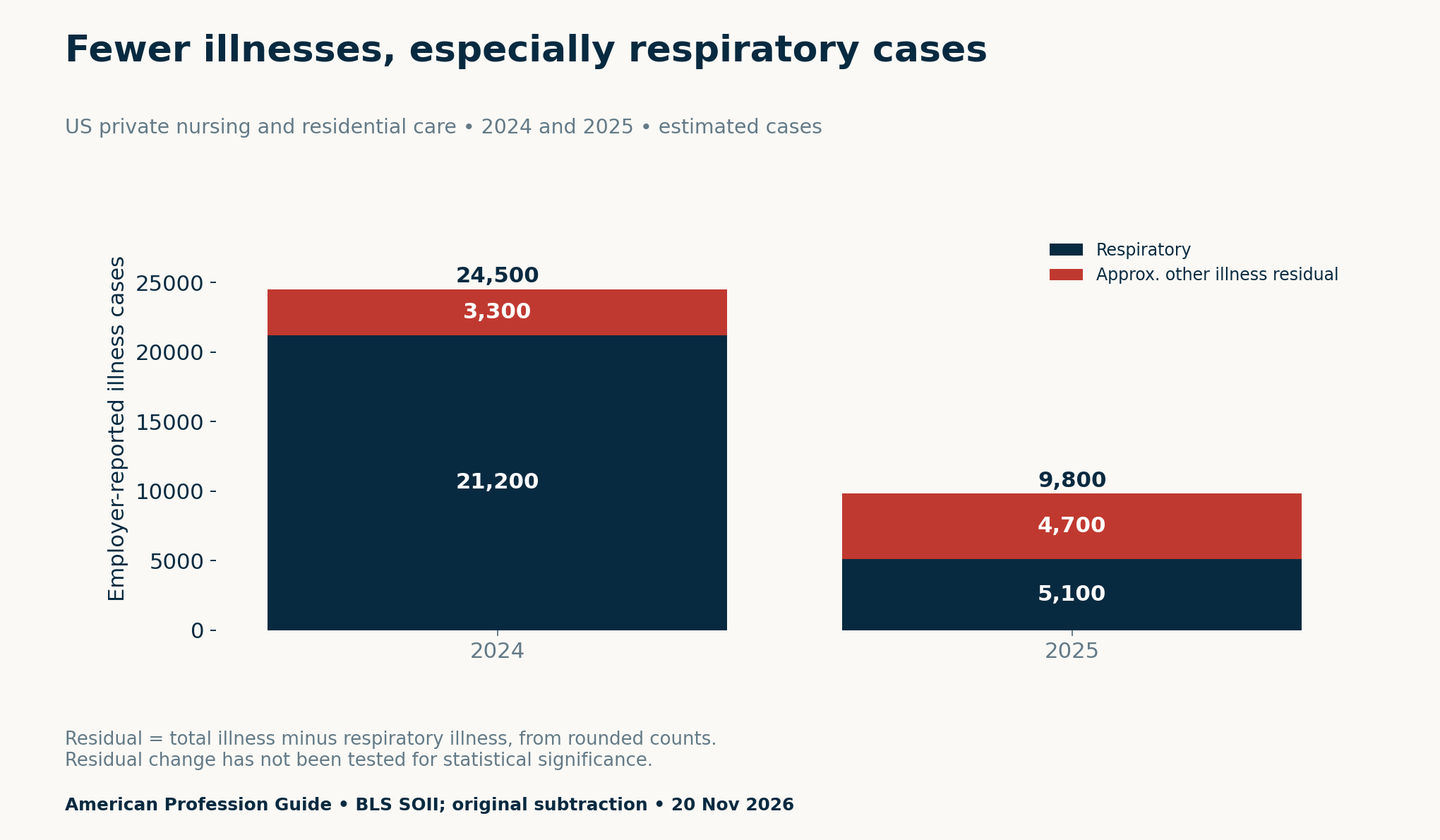
The BLS release of 18 November 2026 covers the 2025 calendar year. For private nursing and residential care facilities, it reports 9,800 illness cases, down from 24,500 in 2024. Respiratory illness cases fell from 21,200 to 5,100. The illness rate declined from 95.7 to 37.0 per 10,000 full-time equivalent workers.
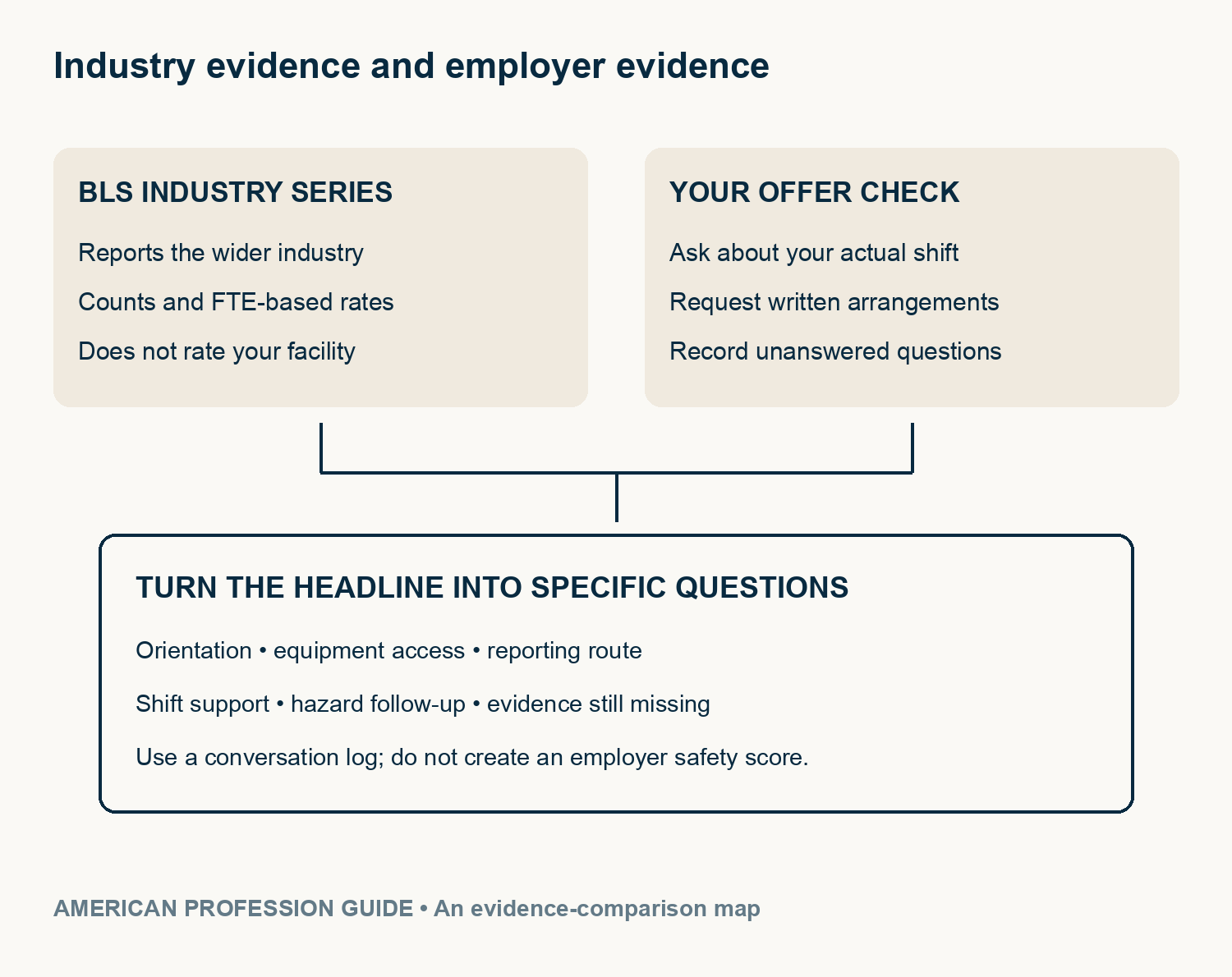
These are employer-reported industry estimates. They do not describe only registered nurses, every care setting or a named employer. A full-time equivalent measures working-time exposure; it is not a count of distinct people.
Separate illness cases from injuries
BLS explicitly says injury cases and their rate were essentially unchanged. Consequently, an illness decline does not establish a comparable improvement in lifting-related injuries or any other particular injury mechanism. Those questions require appropriate evidence about the hazard and workplace.
Read the residual as a calculation, not a new finding
Subtracting the displayed respiratory count from total illness gives an approximate residual of 3,300 in 2024 and 4,700 in 2025. We call it a residual because it combines the remaining illness categories rather than identifying one diagnosis. We have not tested that residual change for significance.
A rounded subtraction can be useful for checking how a total is composed. It cannot establish the cause of a change, classify a particular worker’s condition or replace the source’s statistical testing. Do not turn this derived line into a claim that one hazard rose at every care employer.
Keep rates on their stated denominator
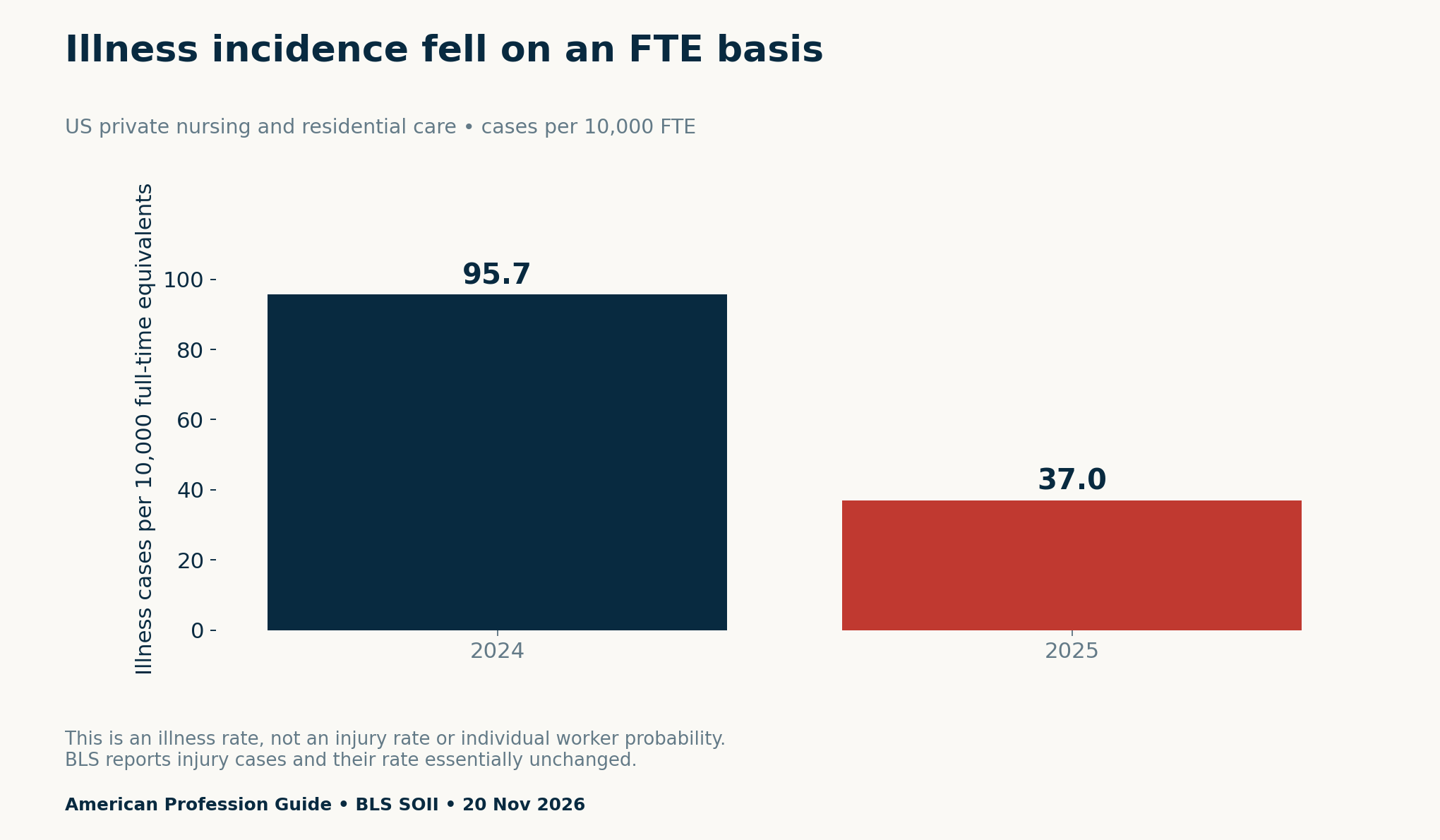
A count describes the estimated number of reported cases. An incidence rate relates cases to working-time exposure. Comparing rates can help when exposure differs, but the rate still depends on scope and case definitions. It is not your personal probability of being injured after accepting an offer.
Before comparing an employer document with a national series, check whether both cover the same year, industry, case type and denominator. An injury-and-illness rate per one hundred workers should not be placed beside an illness-only rate per ten thousand without a clear conversion and definition check.
A smaller respiratory share is not an all-hazards score
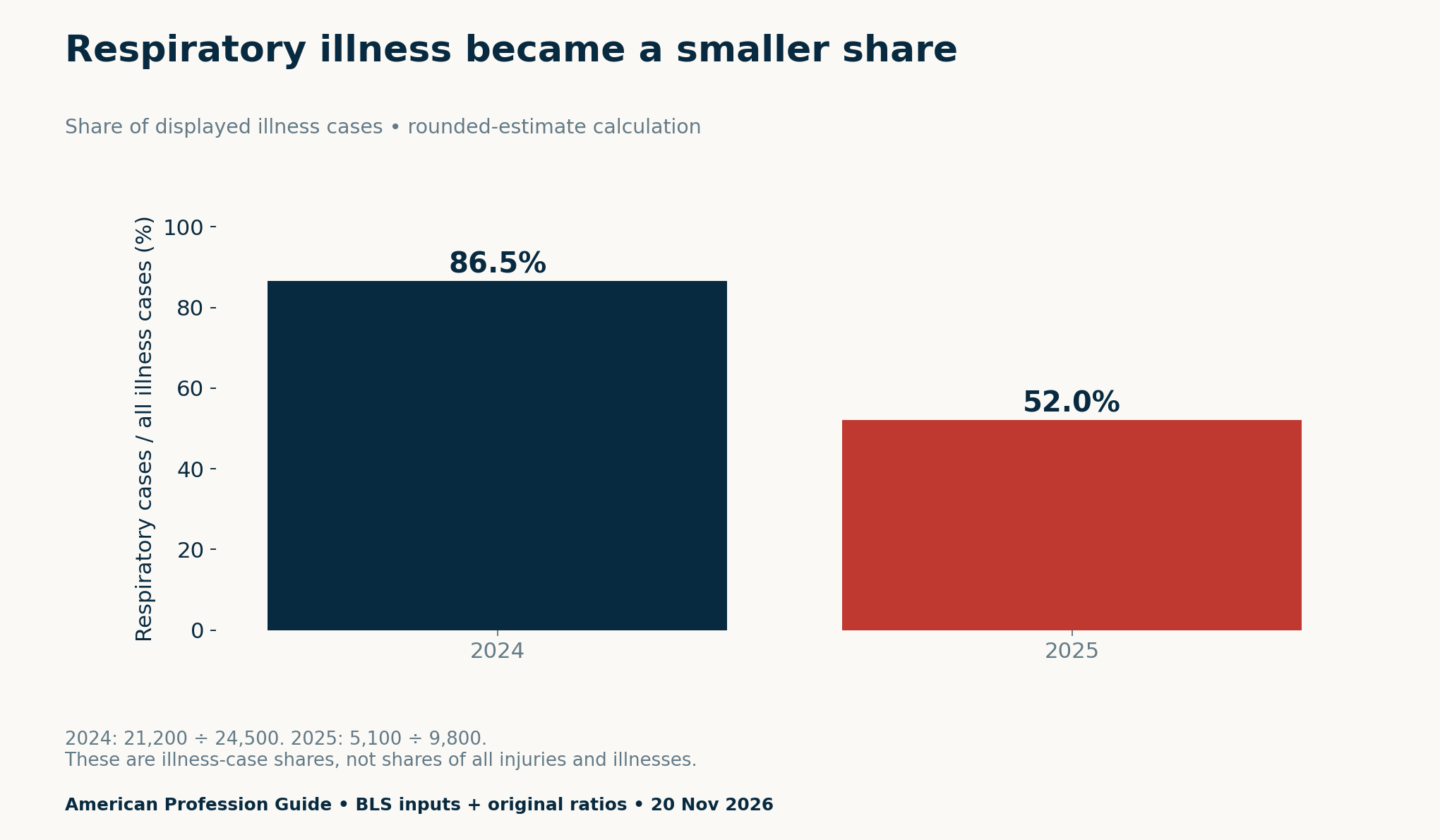
A composition chart answers which part of an illness total is represented by the respiratory category. It does not answer whether the equipment on a night shift is available, whether orientation is thorough or how promptly a reported hazard is addressed. Those are employer-specific questions.
Ask about the actual work before accepting an offer
Start with the role, unit and shift you would join. Ask what orientation occurs before independent duties and who confirms role-specific competence. Request the schedule or process in writing, then note anything that is still unclear. A recruiter’s general reassurance is different from a documented arrangement.
Next, ask how appropriate equipment is available, maintained and accessed during that shift. OSHA’s safe patient handling resource discusses equipment, hazard assessment, staff training and programme review. Use those themes to frame questions; this article does not teach transfers or tell you which device to use for a patient.
Make reporting and follow-up concrete
Ask where a worker reports an injury, illness or hazard, who receives the report and how unresolved concerns are followed up. Request the normal escalation route rather than personal information about staff or residents. A useful answer explains a process and a responsible role.
OSHA’s nursing-home safety programme resources provide broader background on organised prevention and hazard analysis. This is method context, not proof that an employer has implemented a programme. Ask which parts are actually in place and how staff participate.
| Question area | Evidence to request |
|---|---|
| Orientation | Written schedule and role-specific competency process |
| Equipment | Equipment access and maintenance arrangements |
| Reporting | Reporting route, responsible owner and escalation process |
| Support | Named role or shift support route, not patient details |
| Follow-up | De-identified review process and action tracking |
Use a simple written evidence log
For each offer, record the question, answer summary, document reference and follow-up owner. Keep a separate column for what remains unknown. Do not enter patient information, health histories or named colleague complaints into a general comparison worksheet.
For example, an employer may describe an orientation programme but have no confirmed dates for your start. Record the programme description and the missing schedule separately. That makes the next question specific without claiming that missing paperwork proves a safety violation.
Our related healthcare staff feedback follow-up guide explains how to track whether a workplace concern receives a response. Combine a clear reporting route with a practical follow-up record rather than relying on a single headline statistic.
Download the source data and employer questions
- Dated BLS source-value register (CSV)
- Rounded-input calculations and limits (CSV)
- Employer safety question bank (CSV)
- Blank offer evidence and follow-up log (CSV)
Methodology and limits
We checked the release and OSHA resources on 20 November 2026. The charts separate observed source estimates from our subtraction and ratios. The worksheet is an editorial conversation aid; it is not a validated safety assessment, legal compliance audit or clinical training tool.
Industry data cannot verify an individual offer. For a task you are not trained or equipped to perform, use your employer’s appropriate supervisory and safety process. This article gives questions to investigate before starting work, not instructions for handling a resident or diagnosing a work-related condition.


