




Restaurant side work pay in 2026 is back in the news after an October 19 Department of Labor bulletin. The document withdraws older guidance; it does not announce a new federal wage rate. For example, when workers compare offers or read a pay statement, the useful starting point is to separate the source of a rule from the arithmetic of a pay floor.
Research checked October 26, 2026. This report combines a dated source timeline, selected general wage rates and explicitly hypothetical examples. It does not decide whether a particular duty qualifies for a tip credit, resolve a wage dispute or determine an employer’s compliance.
Restaurant side work pay 2026: what changed in October?
The October 19 Field Assistance Bulletin 2026-1 withdraws three opinion letters issued in 1979, 1980 and 1985. It also confirms that WHD withdrew the handbook’s 80/20 guidance on January 14, 2025. That earlier handbook change is not a new October development.
The bulletin describes WHD’s enforcement position. It is different from a statute, a court decision or a regulation. The WHD bulletin directory explains this purpose and points readers to official regulatory sources. Reading the document as a new minimum-wage law would confuse its function with a different kind of authority.
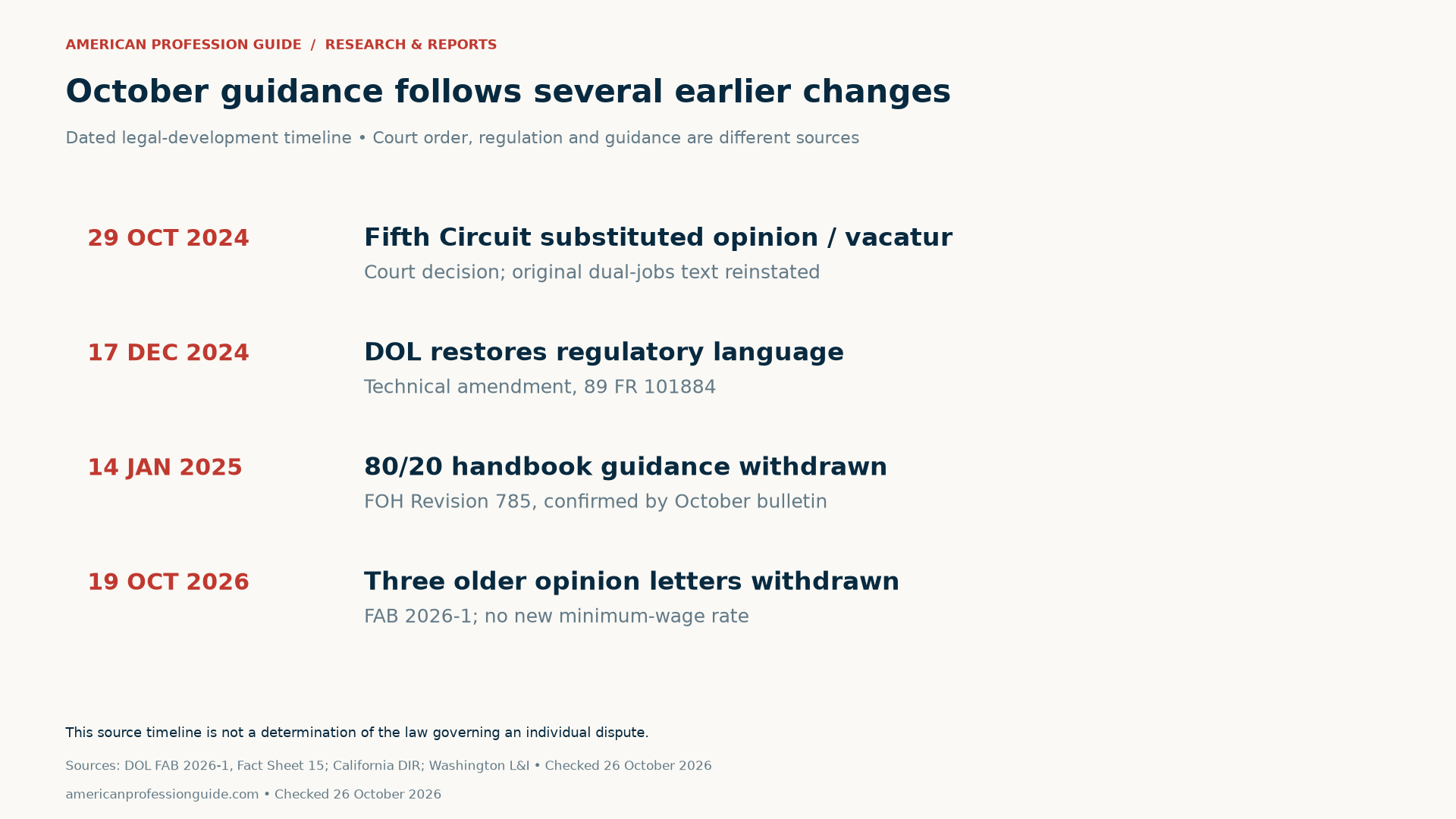
The Fifth Circuit’s October 29, 2024 substituted opinion withdrew its earlier August opinion and vacated the 2021 rule. DOL’s December 17, 2024 technical amendment restored the earlier regulatory language. These events precede the new bulletin. We therefore keep these earlier changes distinct from October’s new guidance.
Related duties and a separate occupation are different questions
The bulletin retains the distinction between duties related to a tipped occupation and work in a separate non-tipped occupation. Its discussion of the dual-jobs regulation uses a hotel worker employed as both a waiter and a maintenance worker. A label such as “side work” does not by itself resolve that distinction.
Consequently, the withdrawal does not establish that every assignment qualifies for a credit. The actual occupation, duties, applicable jurisdiction and other requirements still matter. We do not classify a reader’s work from a short description or provide a universal list of permitted tasks. A qualified adviser needs the relevant facts and dates.
The $2.13 component is not the full federal minimum
DOL’s Fact Sheet 15 describes a conditional federal arrangement: at least $2.13 an hour paid directly by the employer, with a maximum $5.12 tip credit toward the $7.25 minimum. Only actual tips can support the credit, and employers must satisfy the applicable conditions, including notice.
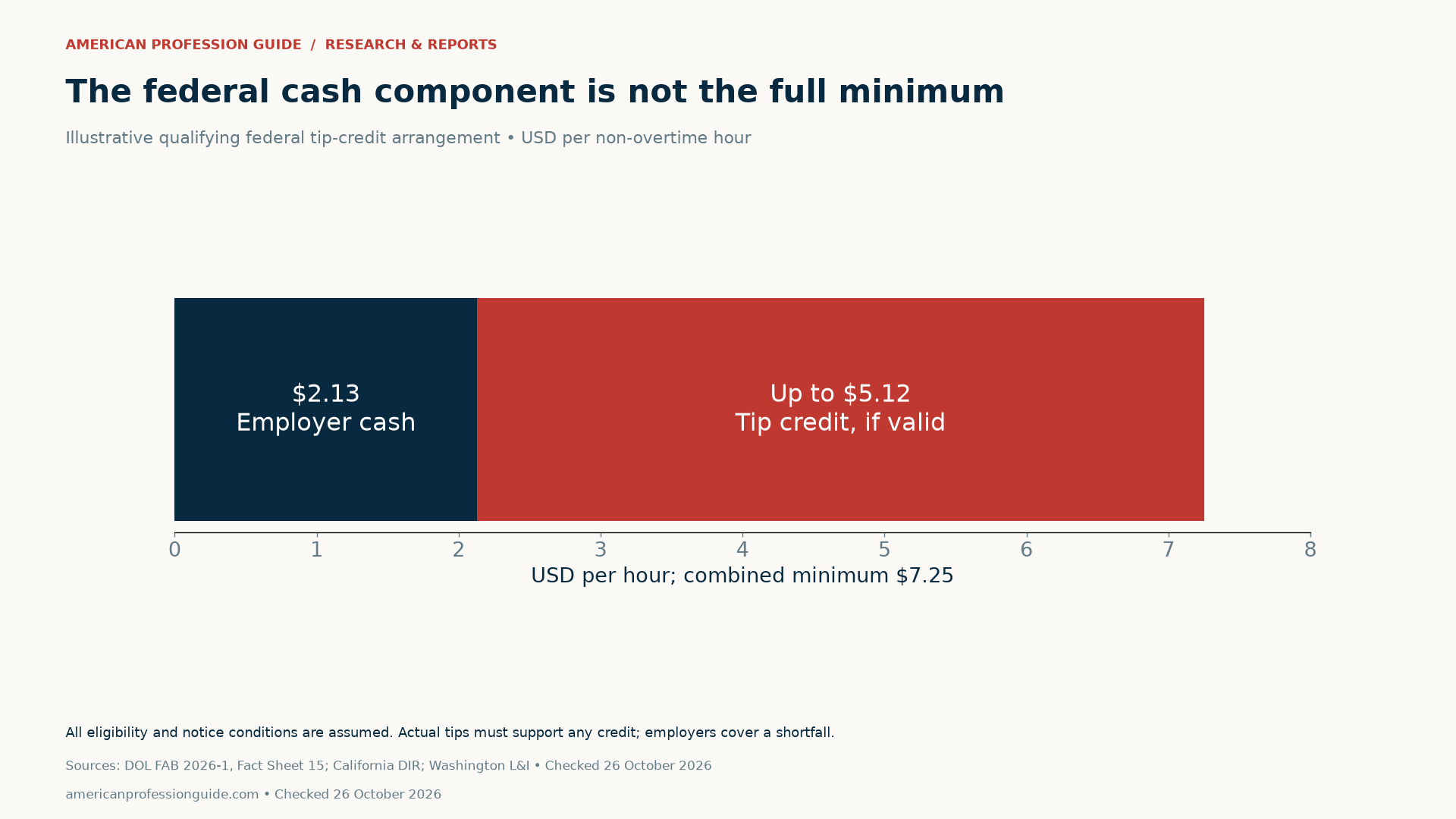
If direct wages plus actual tips do not reach the required federal minimum in the workweek, the employer must make up the difference. Receiving tips does not remove that obligation. The example below assumes eligible non-overtime hours and a valid credit arrangement throughout; it is not a test of whether those assumptions hold at a real workplace.
Restaurant side work pay 2026: state and local checks
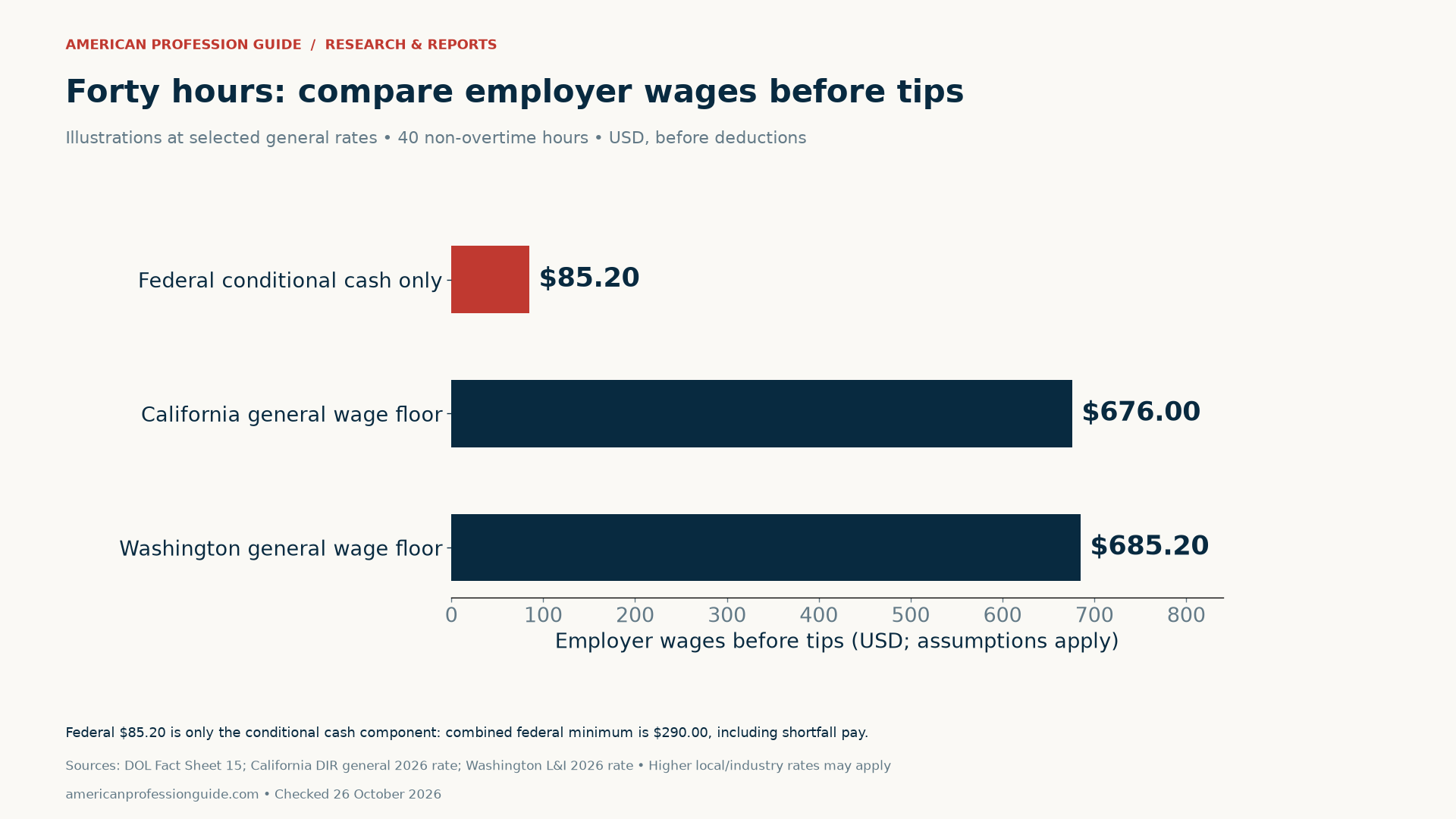
California’s general 2026 minimum is $16.90 an hour. Its tips guidance says an employer cannot use tips as a credit against the minimum wage. The employer’s wage obligation and the worker’s tips therefore remain separate.
Washington’s 2026 general minimum is $17.13 an hour. The state’s tips rules likewise do not permit tips to offset the state hourly minimum. Tips are additional. These selected state examples are not a complete national comparison.
| Illustration, 40 non-overtime hours | Calculation | Meaning |
|---|---|---|
| Federal conditional direct cash | $2.13 × 40 = $85.20 | Only the initial cash component if the credit is valid |
| Federal combined minimum | $7.25 × 40 = $290.00 | Includes actual tips and any required employer shortfall payment |
| California general wage floor | $16.90 × 40 = $676.00 | Employer wages before additional tips |
| Washington general wage floor | $17.13 × 40 = $685.20 | Employer wages before additional tips |
Check the actual worksite and type of employer before using any row. Higher local or industry-specific rates may apply; California’s minimum-wage overview identifies different rates for covered fast-food and healthcare work. Coverage and exceptions also require checking. A general-rate illustration is not an individualized wage determination.
How a hypothetical federal shortfall changes the arithmetic
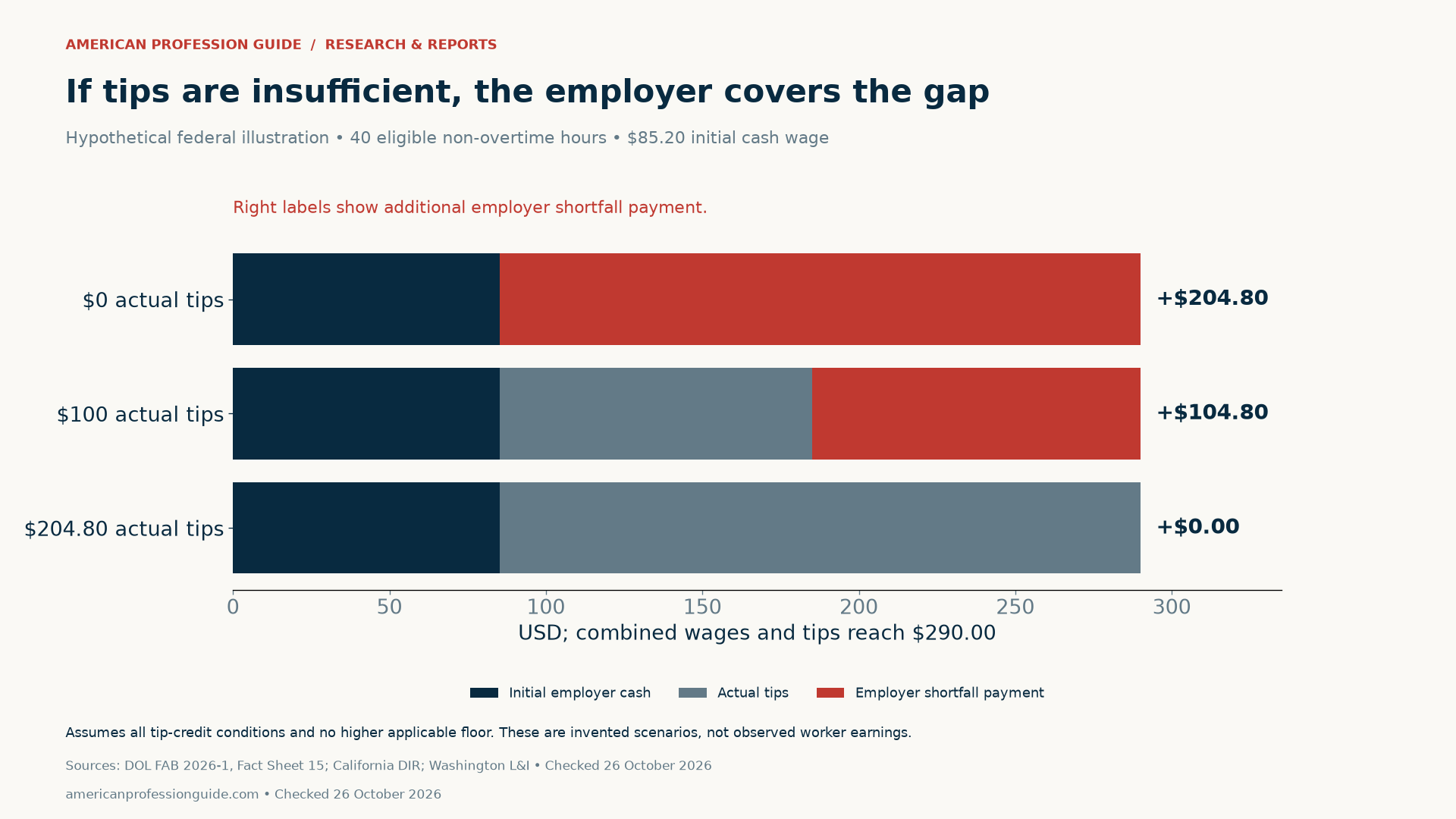
For example, $85.20 initial wages plus $100 actual tips totals $185.20. The remaining amount to reach $290 is $104.80. That gap belongs in the illustration as an additional employer payment, rather than as an acceptable unpaid difference. However, different hours, overtime, an invalid credit or a higher applicable floor would require a different analysis.
In addition, these calculations omit taxes and other deductions. They are not take-home pay estimates or restaurant wage averages. They also do not measure whether one state provides a better overall livelihood. Housing costs, scheduled hours, benefits and actual tips would require separate evidence. Our state job-market report similarly explains why different measures should not be collapsed into a single ranking.
Keep factual records for a qualified review
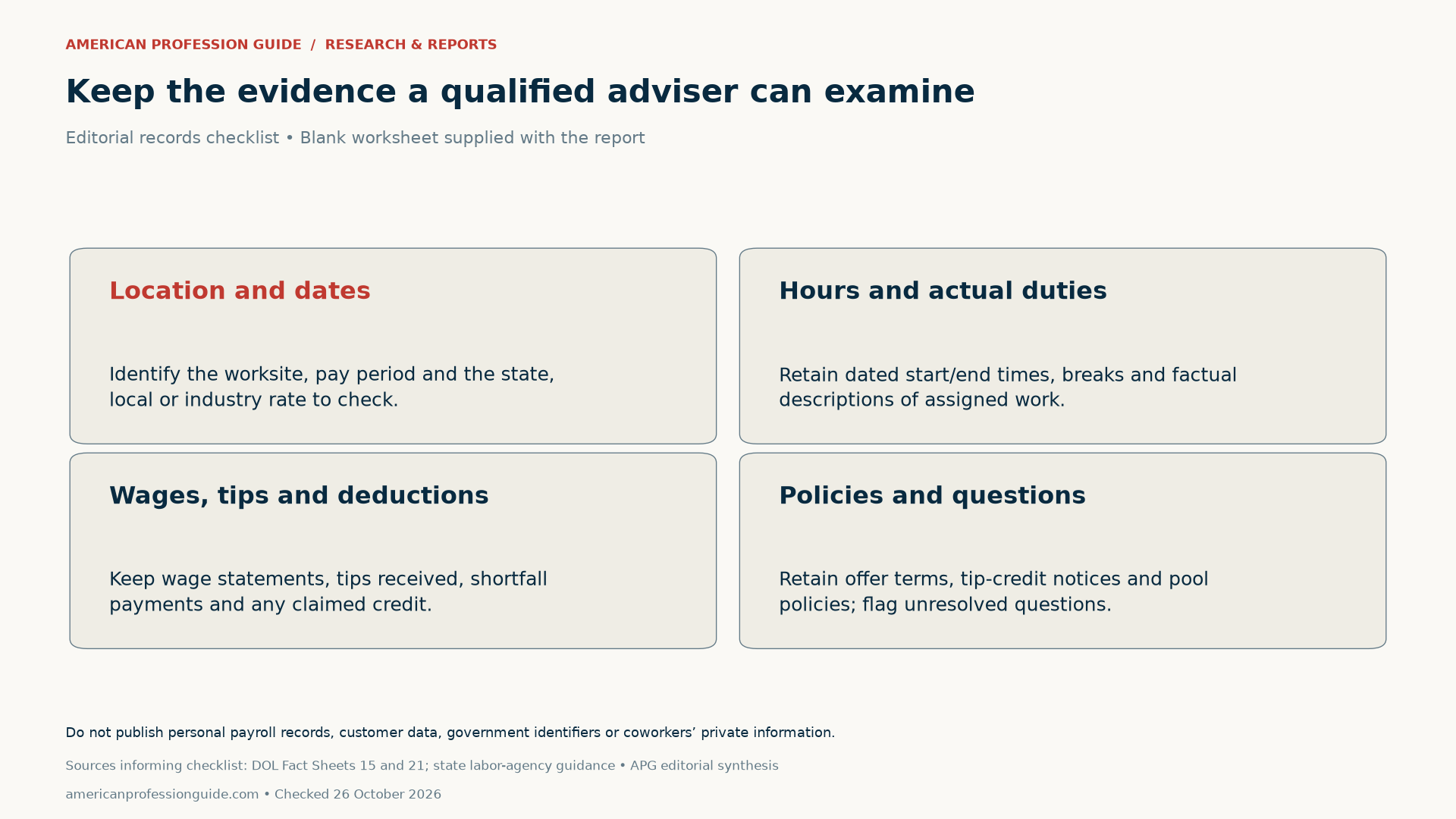
DOL’s recordkeeping fact sheet describes employer records for hours and wages. Our blank worker-research worksheet has a narrower purpose: organize existing documents and questions for a qualified adviser. It does not transfer the employer’s responsibilities to the worker or replace legally required records.
Record what happened, when it happened and where the supporting document is stored. Keep job-offer terms, wage statements, relevant notices and tip-pool policies. Describe duties factually without deciding their legal category in the worksheet. Leave missing information unresolved. Store personal records privately; do not upload identifiers, customer details or coworkers’ records to public comments or social posts.
For questions about a real workplace, consult the Wage and Hour Division, the relevant state labor agency or a qualified employment-law professional. These agency links direct readers to assistance. They are not advertisements or endorsements. More sector context is available in our Service Industry coverage.
Restaurant side work pay 2026: methods and downloads
We read the October 19 bulletin and checked the cited court and regulatory history. We kept the October news date separate from older changes. The rate examples use selected general 2026 rates, a fixed 40-hour non-overtime week and ordinary multiplication. Shortfall scenarios are invented and clearly labelled. No survey sample, national earnings average or workplace compliance result is implied.
Download the restaurant pay-floor illustrations (CSV) and blank restaurant pay-records worksheet (CSV). The source file retains the rate, period, assumptions and official links for each row. Verify rates for the actual location and work period before relying on an illustration.
Suggested citation: American Profession Guide, “Restaurant Side-Work Pay in 2026: What DOL’s October Guidance Actually Changes,” checked October 26, 2026. Cite the named official sources for the rules and APG for the explanatory comparisons. Retain the dates, assumptions and distinction between general guidance and an individual workplace determination.


