




Accounting job postings and wages in 2026 tell different stories. A national decline in advertisements can coexist with rising advertised pay. For a job seeker, the useful next step is to check a defined set of comparable roles, rather than assume that every vacancy pays more or that every accounting career is shrinking.
This analysis separates the two measures, then provides a practical vacancy ledger. It uses three charts and one comparison infographic. The final chart is explicitly fictional: it shows why a higher salary range needs context before you use it in a career decision.
What accounting job postings and wages show in 2026
Indeed Hiring Lab’s 12 November business-to-business update reports accounting postings down 3.2% over the year through 23 October 2026. Banking and finance postings rose 13.2%. These are occupational categories within Indeed’s postings data, not counts of people hired or employed.
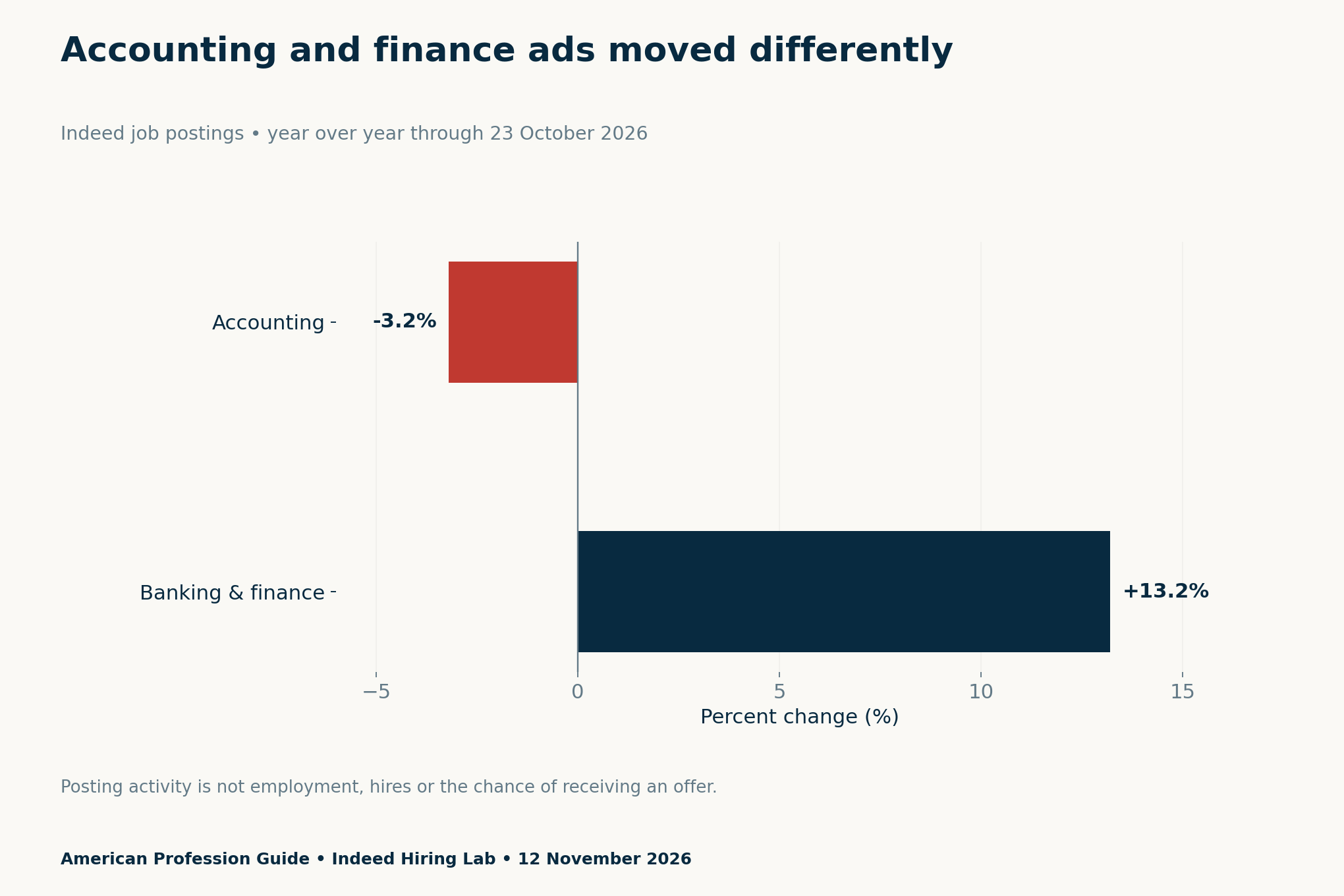
The same update reports accounting posted-wage growth of 3.7% and banking and finance growth of 3.1%. Those figures are year-over-year rates averaged over three months through September. Their dates and measured populations differ from the postings comparison. The four values alone cannot explain what caused either movement.
Why higher posted wages do not promise a raise
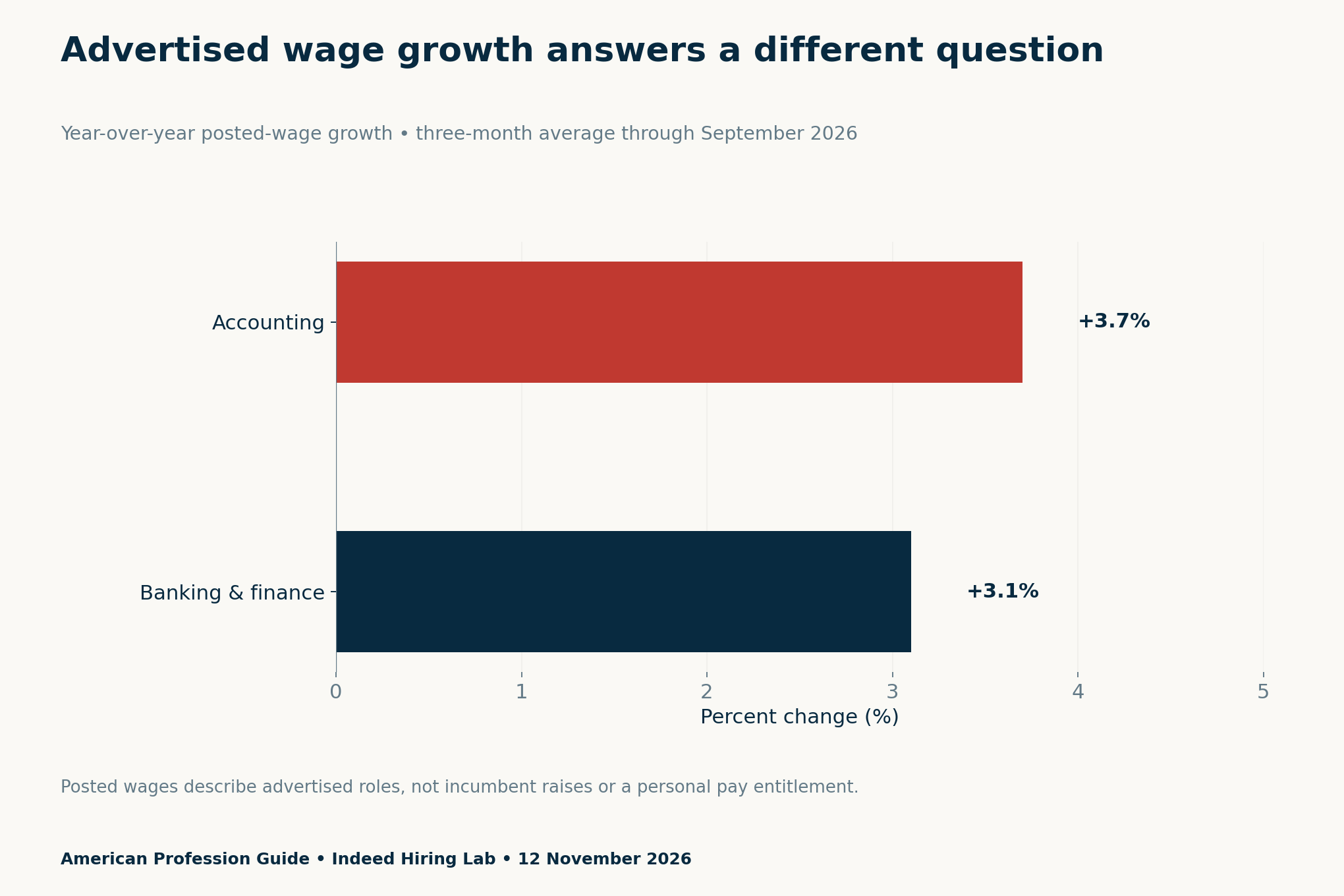
The Indeed Wage Tracker methodology follows job titles rather than individuals. It compares posted pay within title, region and salary-type combinations, then summarizes growth. Its headline series uses a three-month average of year-over-year readings. A category growth rate therefore answers a different question from what a particular employer will offer you.
For example, a 3.7% growth reading does not tell you the dollar salary for a staff accountant in your city. Nor does it establish your current employer’s pay policy. Bring an actual role, location, pay period and scope of responsibility to the comparison before drawing a personal conclusion.
Also keep employment status separate. A permanent employee, a fixed-term employee and an independent contractor can have different compensation structures. Even a correctly quoted annual amount may leave hours, benefits or variable pay unclear. Record those gaps instead of treating the headline number as a complete package.
Start with one accounting role and one search window
Write a narrow research question before collecting advertisements. You might ask what currently advertised staff-accountant roles in one defined commuting area disclose about base pay and duties. Specify the capture date, location rules, work arrangement and level. A clear boundary makes a small comparison easier to reproduce.
Next, retain the employer’s own vacancy URL and requisition identifier where available. Record the date you checked it and whether it was still accepting applications. A copied listing on another board can help you discover a role, but it should not automatically become another observation in your ledger.
Keep the collection method consistent. If you choose a seven-day posting window, apply it to every record and note when a date is missing. If you cannot tell when an advertisement first appeared, label that uncertainty. Avoid silently moving between fresh advertisements and older listings that remain visible.
Match level, duties and location before comparing salary
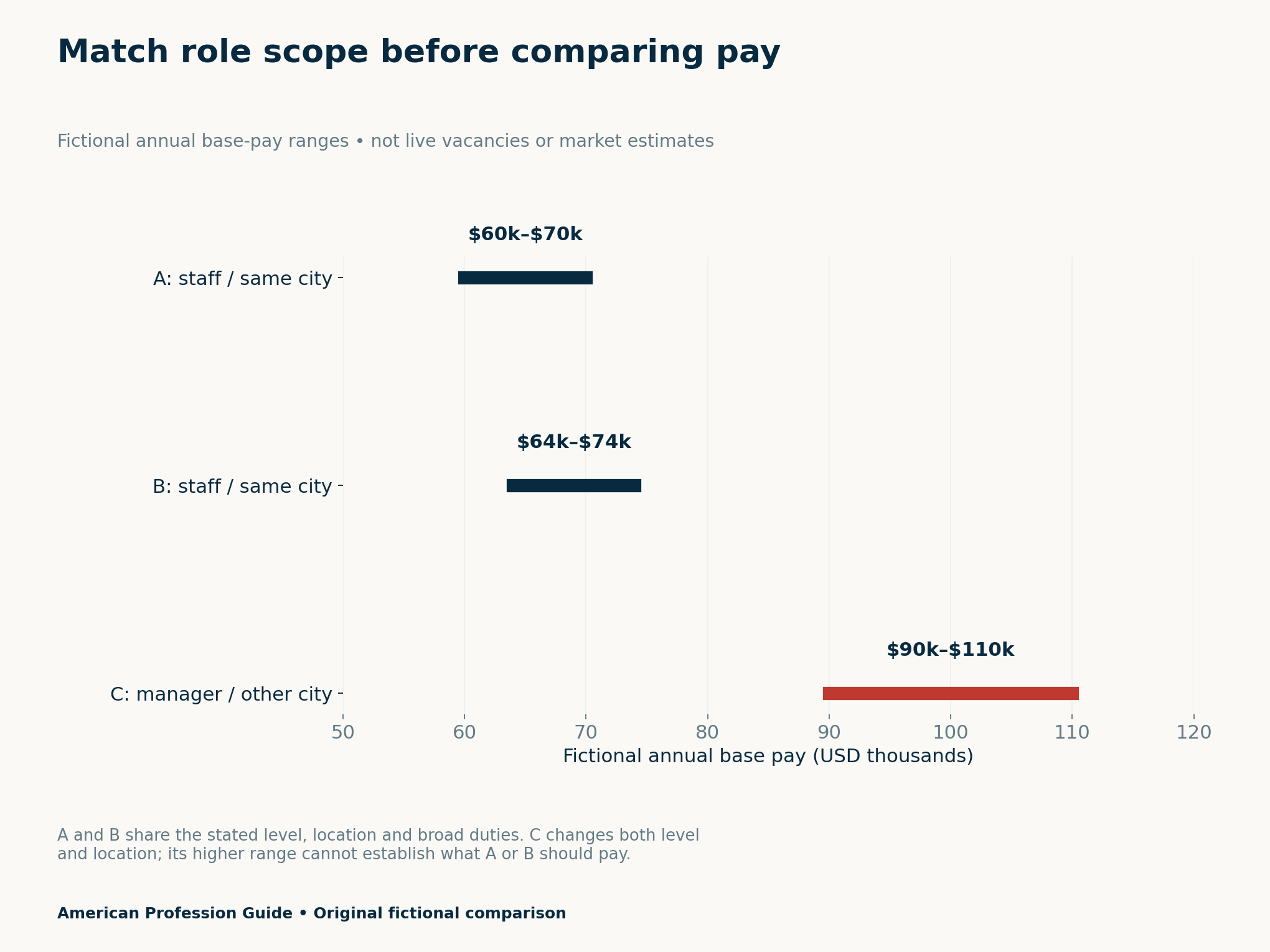
In this fictional example, A and B share a stated level, city and broad duty set. That makes them candidates for a closer comparison, although their complete terms could still differ. C changes both level and location. Its higher advertised range cannot establish that A is underpaid.
A title match is only the beginning. Compare ownership of the close process, review duties, client contact, reporting responsibilities and supervision. A role called “accountant” may contain a different mix of tasks from another advertisement with the same title. Record the differences in plain language.
Keep annual and hourly pay in their original units. If you later build a conversion, disclose the assumed hours and paid weeks and retain the original figure alongside it. A calculation can make an assumption visible; it cannot confirm that an employer offers those hours or that the roles have equivalent benefits.
Use two evidence tracks for a better shortlist
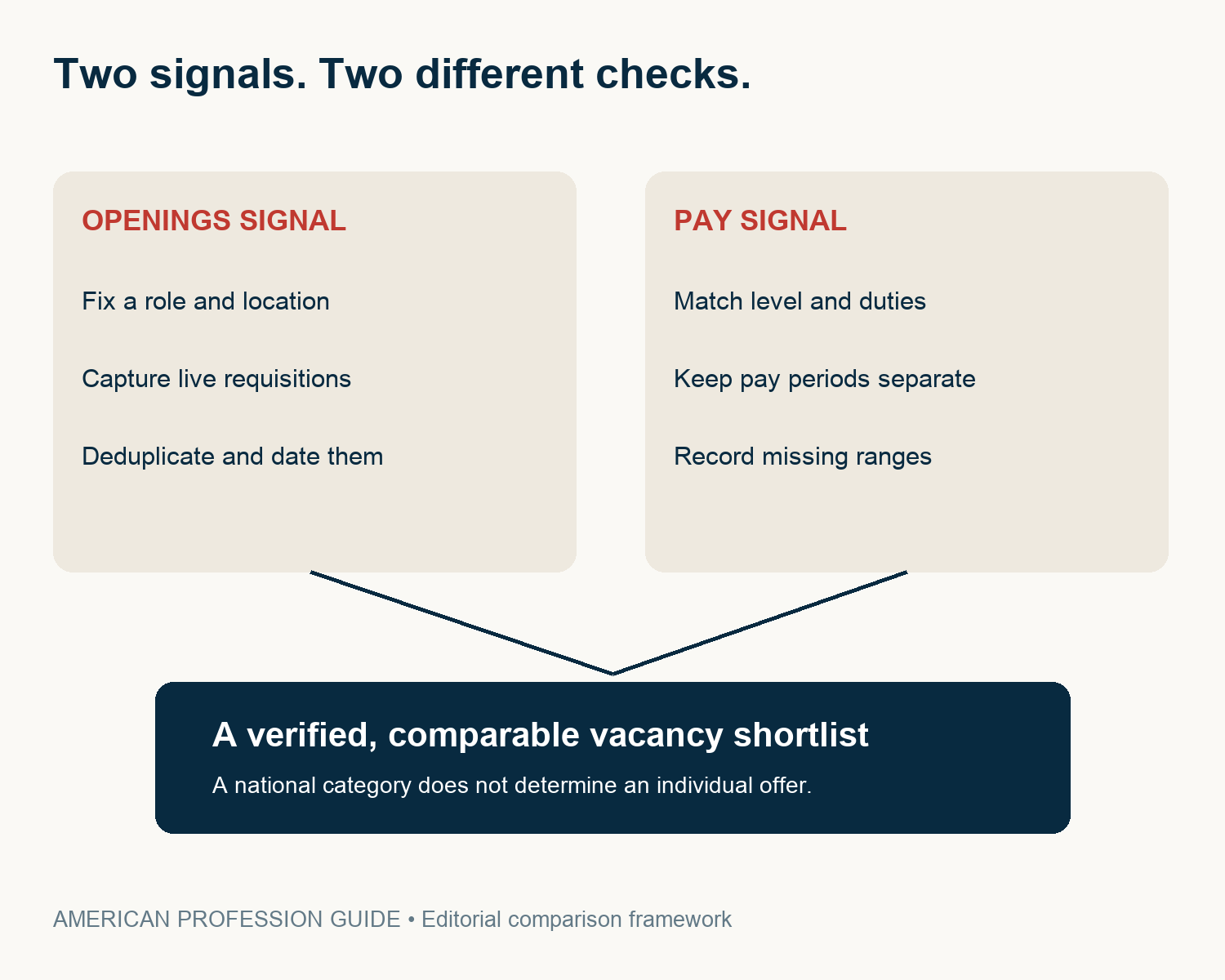
The openings track checks whether the role exists, fits your chosen scope and is still live. The pay track checks whether the disclosed compensation belongs in the same comparison group. A record can pass one track while failing the other. For example, an eligible live vacancy may omit its pay range.
Do not enter zero when pay is missing. Keep an explicit missing-value label and count how many comparable roles disclose a range. A summary based only on disclosed pay describes that subset. It does not automatically describe every employer in your target market.
Likewise, do not merge distinct requisitions merely because the title and employer match. Check location, identifier and scope. Retain a duplicate-group field so another reader can follow your decision. A defensible ledger records why an item was excluded as well as why another was retained.
Turn the evidence into application questions
Use the shortlist to prepare focused questions. Ask which responsibilities belong to the advertised level, what the stated base range covers and whether any variable component is separate. Clarify the work location and hours before comparing the package with a different offer.
For your evidence pack, choose examples that match the actual duties: a reconciliation explanation, a documented review process or a clear treatment of an estimate. Use invented or anonymized material rather than confidential employer records. Our accounting-estimate documentation guide offers a related evidence-pack approach.
Avoid adding unsupported stories about AI, layoffs or applicant competition. The two national indicators do not identify the cause of the accounting movement. They also do not reveal how many qualified people applied to a particular job. Keep causal claims and personal predictions out of a descriptive vacancy review.
Download the source values and comparison tools
- Source values with measures, dates and links (CSV)
- Fictional role and pay-range comparison (CSV)
- Blank matched-vacancy ledger (CSV)
- Field definitions and comparison rules (CSV)
The vacancy ledger is blank. We have not presented it as a completed employer sample or a survey of current local pay. Set your boundaries, retain source links and review your exclusions before calculating a result. More source-linked analyses appear in Research & Reports.
Methodology and limitations
We checked the four selected figures against the two original tables in Indeed Hiring Lab’s dated update on 16 November 2026. We retained their distinct reference periods and consulted the publisher’s Wage Tracker methodology. Our first two charts redraw only those selected values; no employer-level data or individual pay histories were available to us.
The third chart and all associated salary records are invented teaching examples. We did not run a local vacancy audit, estimate a causal relationship, forecast hiring or calculate a recommended salary. Three substantive charts answer the question without multiplying the same four national values into filler graphics. The worksheets support a future, clearly bounded collection exercise.


