






Healthcare staff feedback follow up should make the response visible: who owns a suggestion, when it was acknowledged and what happened next. Feeling able to speak and receiving a clear response are related concerns, but they are not the same measure.
This report reads a new workforce survey carefully, then supplies a nonclinical register for ordinary workflow suggestions. Five charts, a branching process infographic and four free CSV tools separate published findings from a wholly fictional teaching case.
What the new healthcare survey can tell us
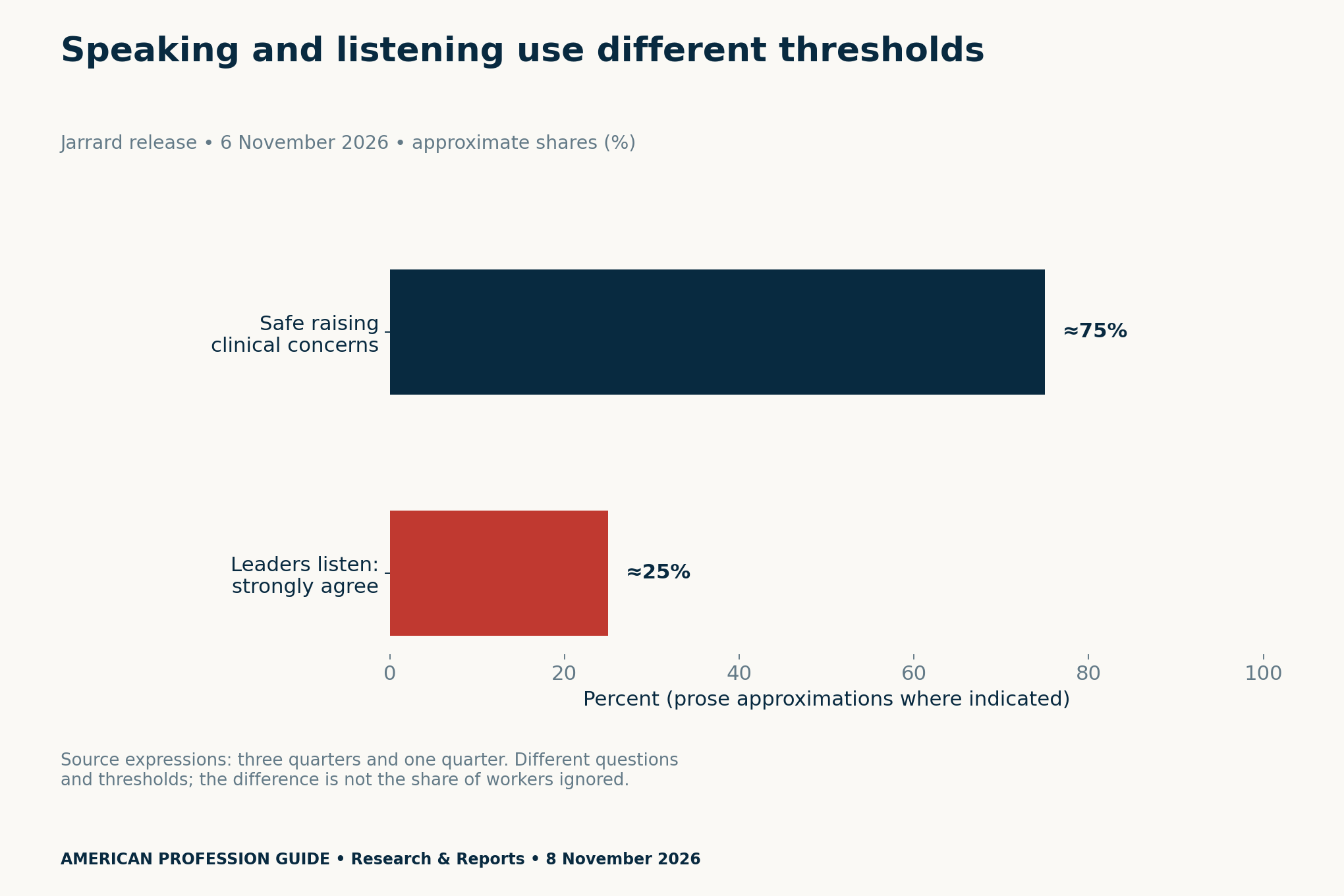
Jarrard’s 6 November 2026 release reports that about three-quarters felt safe raising clinical concerns, while about one-quarter strongly agreed leaders listened to understand. The questions and response thresholds differ. Subtracting them does not reveal the share ignored.
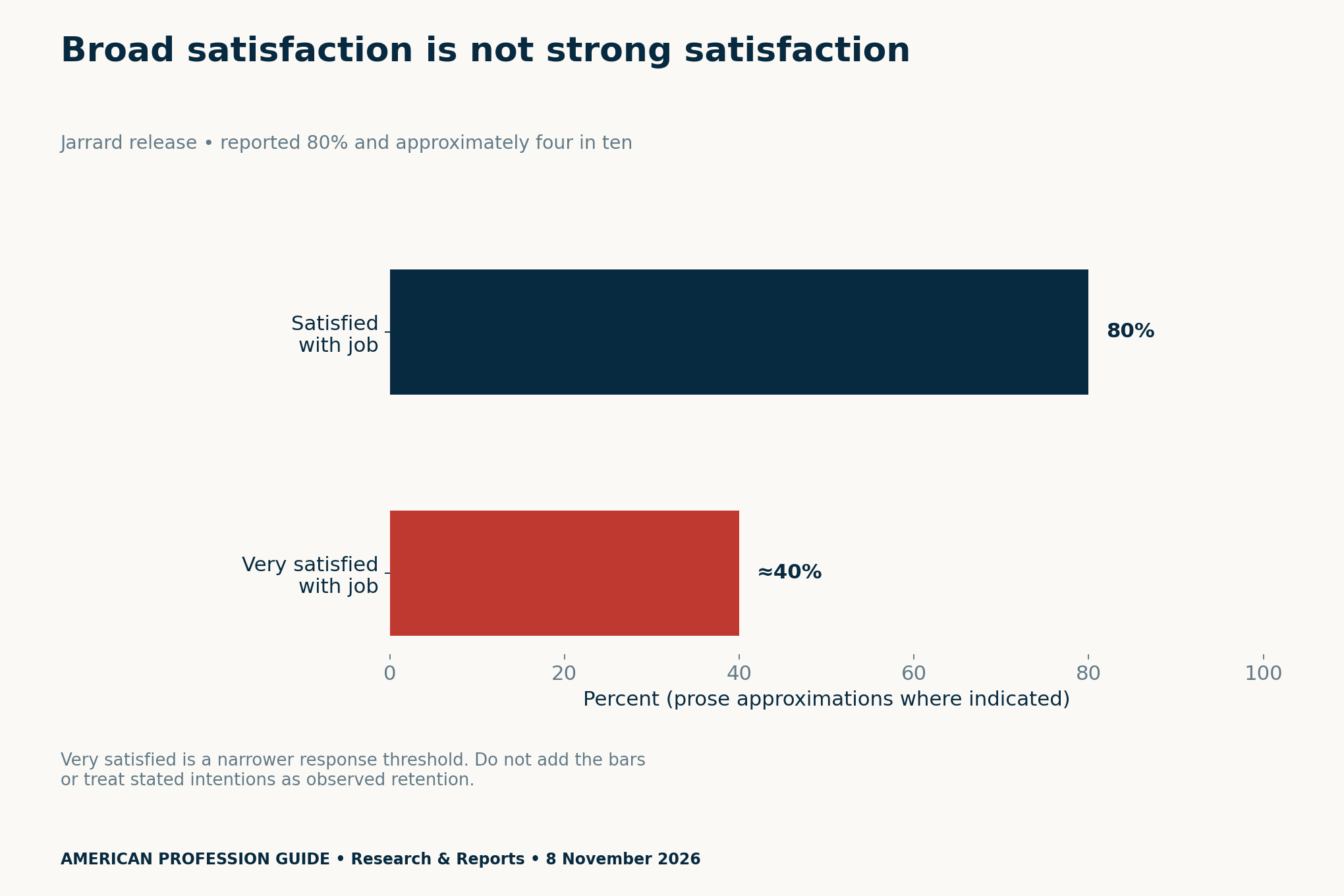
The release also reports 80% job satisfaction and roughly 40% very satisfied. Around four in ten were very likely to remain over the next couple of years. Intention is not observed retention. We do not turn that approximate statement into a precise forecast.
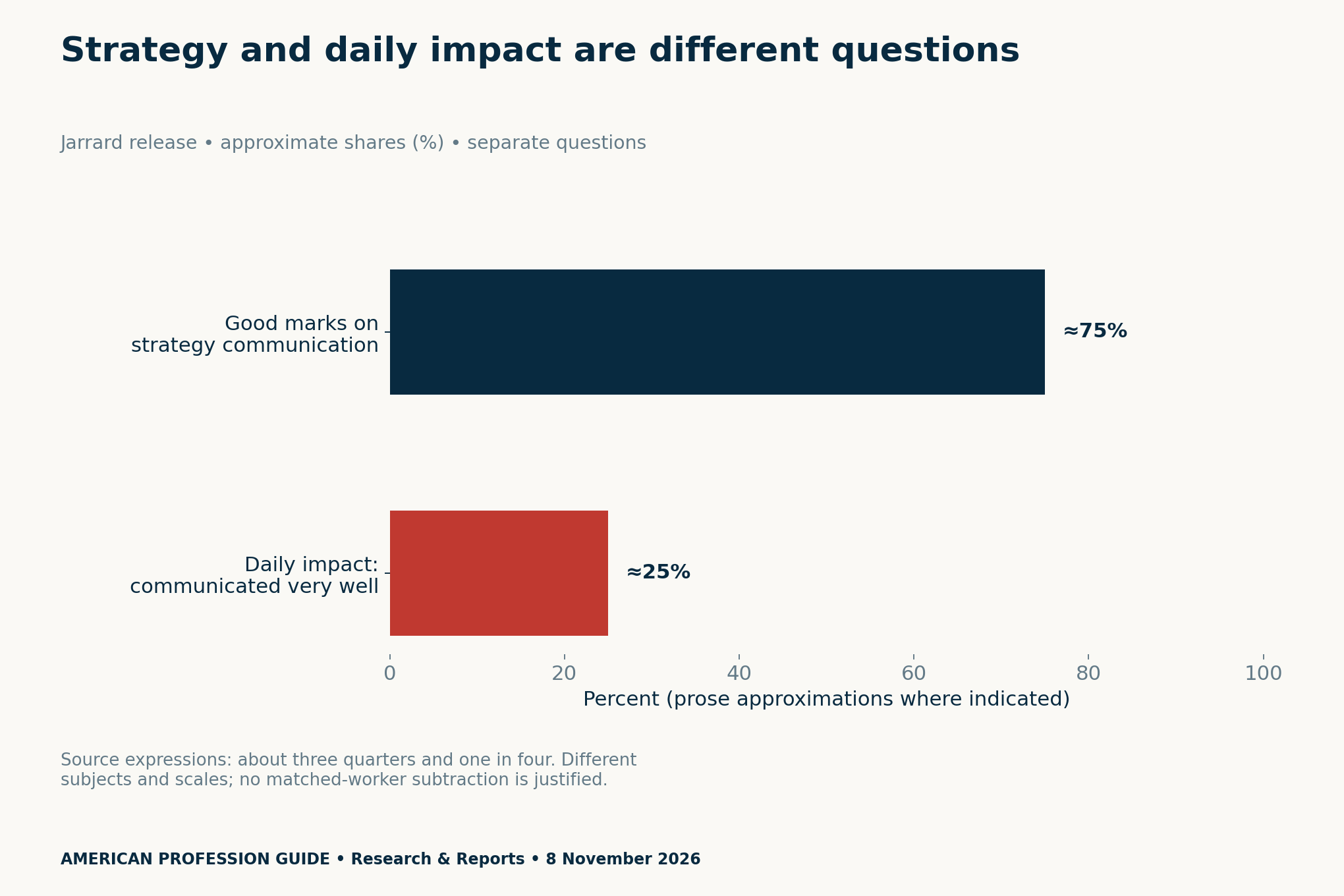
For communication, about 75% gave positive marks on strategy, while about 25% said leaders explained the daily effects of change very well. These are different subjects and scales, rather than a single communication score.
The survey landing page offers fuller findings through a contact form. We did not submit it. Public pages lack enough sample, fieldwork and weighting detail to reproduce population estimates or uncertainty intervals. Treat these findings as directional evidence, not a national census.
Healthcare staff feedback follow up: define the boundary
The template is for ordinary, de-identified workflow improvements: shared-folder naming, meeting agenda formats or clearer training calendars. It is not a clinical record, complaint investigation or replacement for institutional reporting. It provides no medical advice or diagnosis.
Do not enter patient details, medical information, personal allegations or identifiable staff histories. Follow local information-governance rules. Use established urgent safety, incident-reporting and protected escalation channels when relevant. Never wait for a spreadsheet review date to report an urgent concern.
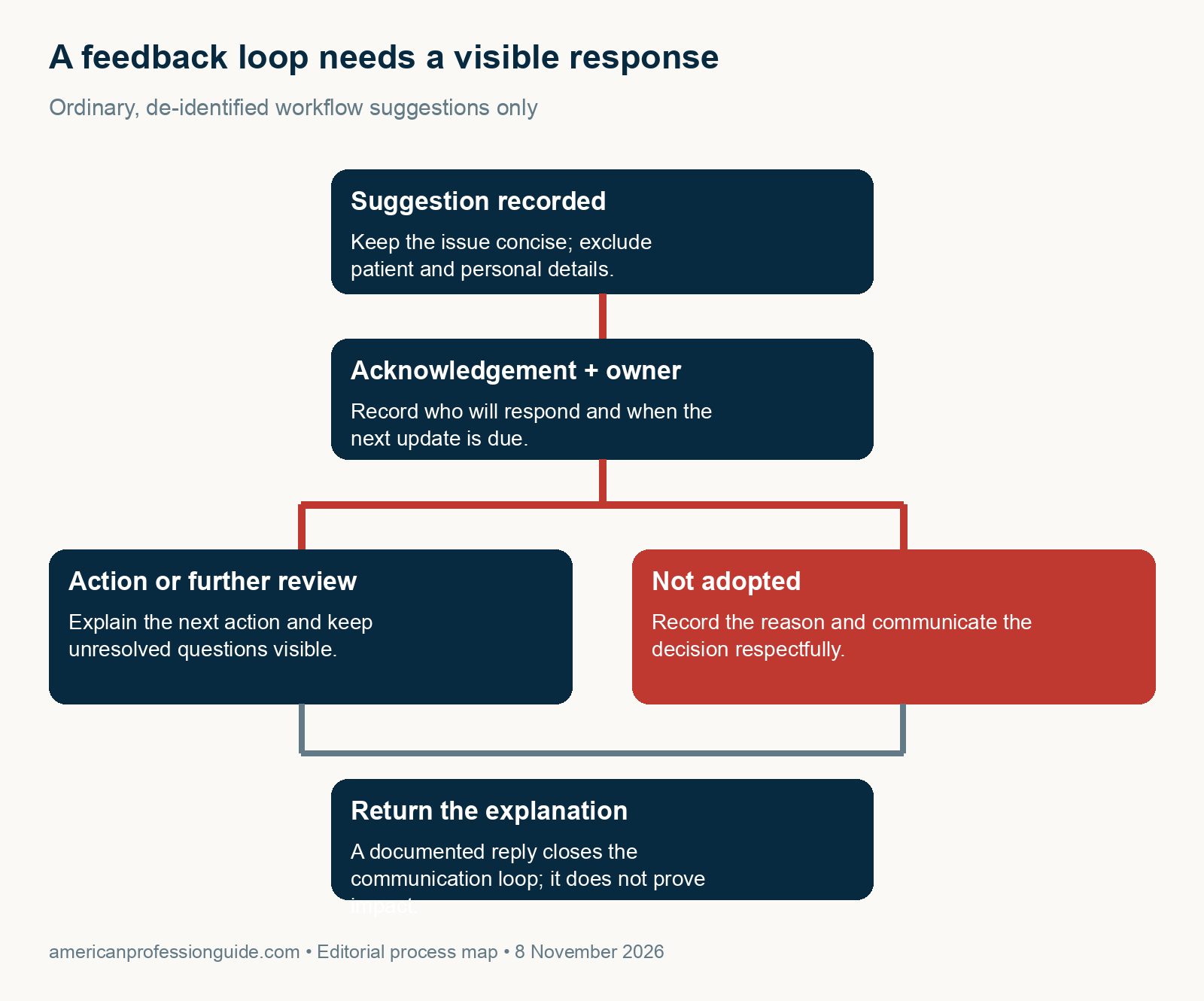
Give each eligible suggestion a traceable record
Start with a neutral identifier, concise ordinary issue and date raised. Add the acknowledgement date, designated owner, agreed next update and next action. Enter an outcome date and explanation only when supported. A blank field means missing information, not completion.
Agree purpose and inclusion rules before collecting anything. A team might include all permitted formatting suggestions received during four weeks. Link duplicates to the original record instead of counting repeated messages as new suggestions. Keep an agreed review cutoff and access rules.
Acknowledgement confirms receipt. Assignment identifies responsibility for the next response. Action records a step taken. Closure records an explanation returned through the agreed channel. These definitions answer different questions. A friendly acknowledgement alone does not establish resolution, and closure does not require every request to be accepted.
Read the fictional register honestly
Our teaching file contains eight invented suggestions, all raised on day zero. Six have acknowledgement dates and named owners. Four have outcome explanations: two adopted and two not adopted, with reasons recorded. Two remain under review and two await acknowledgement.
| Fictional ID | Ordinary issue | Acknowledged day | Outcome |
|---|---|---|---|
| F01 | Storage labels | 1 | Adopted |
| F02 | Meeting agenda | 2 | Not adopted: explanation recorded |
| F03 | Shared folder names | 3 | Under review |
| F04 | Room booking format | 1 | Adopted |
| F05 | Printer location | Missing | Awaiting acknowledgement |
| F06 | Training calendar layout | 4 | Not adopted: explanation recorded |
| F07 | Supply-order template | 5 | Under review |
| F08 | Staff notice layout | Missing | Awaiting acknowledgement |
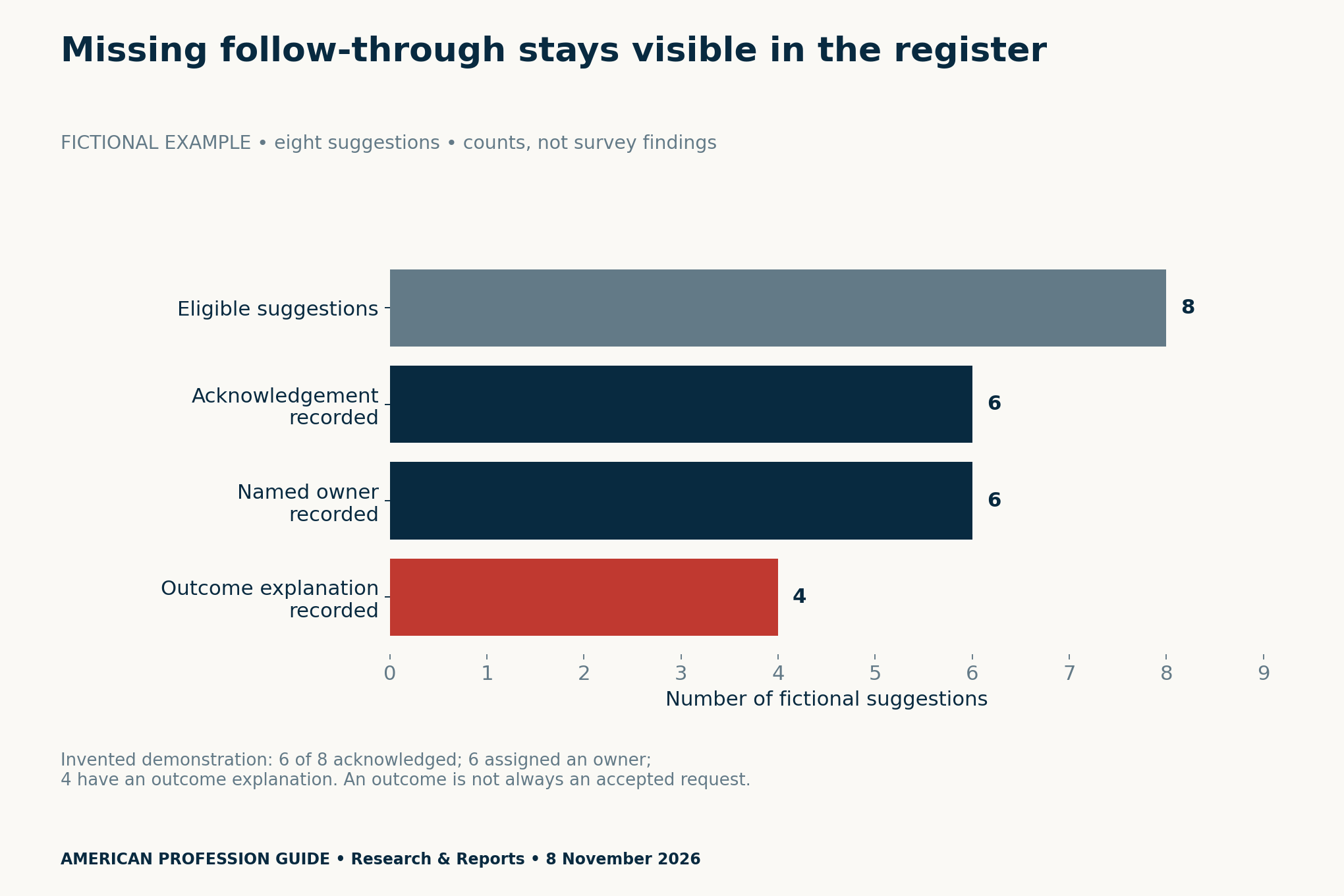
Fictional acknowledgement coverage is 6 ÷ 8 = 75%. Documented-outcome coverage is 4 ÷ 8 = 50%. These invented calculations are separate from the survey. Their similarity to a published percentage is coincidental. Combining the two sources would mislead readers.
Unresolved suggestions still belong in the eligible denominator. Removing them improves the apparent result without changing the work. Likewise, a promise to consider something is not evidence it was adopted. Preserve the original entry and date any later correction.
Measure waiting time and missingness separately
The six recorded fictional lags are 1, 1, 2, 3, 4 and 5 days. The median is the mean of the middle values, 2 and 3: 2.5 days. The other two suggestions have no acknowledgement date. They do not have a zero-day wait.
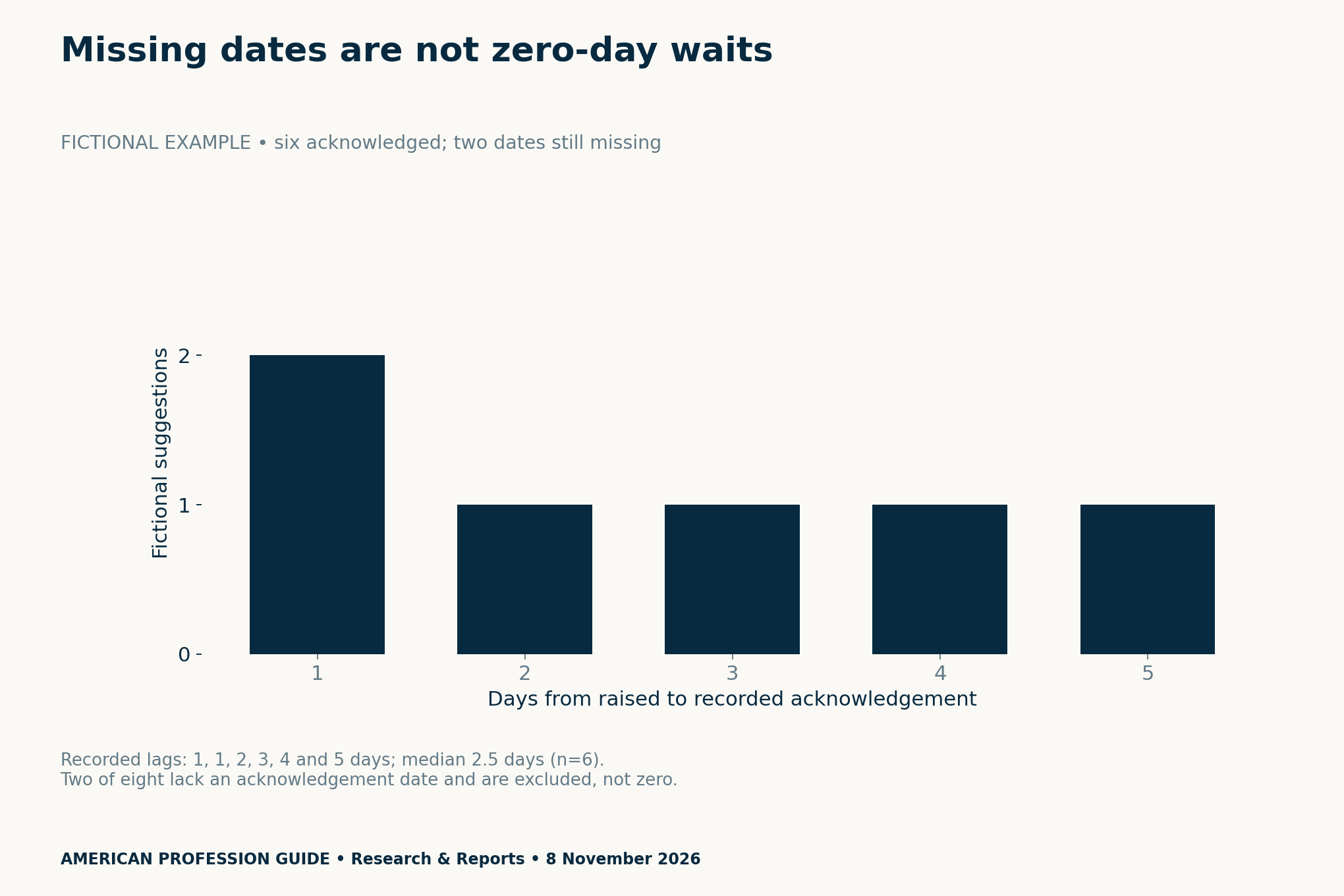
A waiting-time summary needs an observation date. Open suggestions may receive responses after the cutoff, so an early snapshot is incomplete. Record the cutoff, date conventions and missing fields. Avoid comparing teams with different inclusion periods as if their records were equivalent.
Plan a four-week pilot before claiming improvement
No pilot has occurred. A future team could agree permitted topics, storage, ownership and access first. It could then record eligible suggestions for four weeks and review acknowledgement, next updates and explanations. The protocol is an editorial planning aid, not approved institutional policy.
Specify measures before collecting data. Report the number of eligible suggestions and the number with each step, with explicit denominators. For acknowledgement lag, disclose complete date pairs and exclusions. Summarise unresolved items without sensitive details. Add qualitative feedback on whether the reply addressed the original issue.
A short convenience pilot could describe its own records. It could not establish that the register caused better retention, fewer incidents or greater trust. This proposal has no comparison group, random assignment or long follow-up. A recorded closure may still leave someone dissatisfied; invite that distinction rather than hiding it.
Download the feedback-loop tools
- Survey measures and approximation notes (CSV)
- Eight-row fictional nonclinical register (CSV)
- Blank ordinary-workflow feedback register (CSV)
- Prospective four-week measurement protocol (CSV)
No login is required. Retain an untouched teaching file and use a separate blank copy only if your organisation permits it. No patient information is needed. The protocol describes a possible future evaluation, not a completed study, service promise or compliance assessment.
For another transparent evidence exercise, see our guide to tracing inputs, assumptions and review. Our workplace AI questions also distinguish a general expectation from a concrete example and review arrangement.
Methodology, limits and updates
We checked the release and landing page on 8 November 2026 and retained their visible text. The source CSV preserves numerical expressions, plotting values and qualifiers. Approximate prose retains approximate labels. Public information cannot support confidence intervals, national counts or worker-level cross-tabulations.
The register is our original fictional teaching case. We count distinct rows, retain missing dates and calculate the median only among complete acknowledgement-date pairs. No survey microdata, staff records or clinical data were used. These tools cannot assess a particular employer or determine whether a concern was handled lawfully.
When new methods become public, update the source register, captions and measures together. Healthcare staff feedback follow up benefits from clear records and careful interpretation. A single headline percentage cannot show what happened to an individual suggestion.


