




Introduction
Factory work involves the mass production of goods in a manufacturing setting.
Understanding factory roles and responsibilities supports efficiency and safety.
This section covers various factory roles and their corresponding responsibilities.
Evolution of Factory Work
During the Industrial Revolution, factories introduced a new form of employment.
Meanwhile, technological advancements revolutionized production processes inside factories.
Workers operated machinery and mass-produced goods efficiently.
This shift from artisanal work to factory labor created significant changes.
Factories became industrial hubs and created strong demand for labor.
However, early factory workers endured harsh conditions, long hours, and low wages.
Factory work transformed economies and societies worldwide.
Over time, governments implemented labor laws that protected factory workers’ rights.
Modern factories use state-of-the-art technology to support production.
Additionally, automation and robotics have revolutionized manufacturing.
Factory work now requires specialized skills and training.
Today, factory jobs include diverse roles and responsibilities.
Technological Advances in Factory Work
Technology has continually shaped the changing landscape of factory work.
Machinery and automation have increased factory efficiency and productivity.
Robotics and artificial intelligence streamline production and reduce manual labor.
At the same time, technological advances have created new factory job roles.
Workers operate computerized systems and manage complex machinery.
Digitalization has improved communication and data management in factory settings.
Technology has also strengthened safety measures and reduced workplace accidents.
Moreover, technological integration has made factory work more precise and accurate.
Training programs help workers adapt to new technologies.
Consequently, technology has made factory work more sophisticated and dynamic.
Changing Factory Roles and Responsibilities
Factory workers’ roles and responsibilities have evolved significantly over time.
Previously, workers performed manual labor and assembly tasks.
Today, factory employees use technical skills and problem-solving abilities.
Supervisors now oversee production processes and quality control.
Workers must also follow strict safety protocols and regulations.
Furthermore, teamwork and collaboration support efficiency in modern factories.
Employees may maintain equipment, troubleshoot problems, and operate machinery.
Quality assurance and inspection help teams maintain product standards.
Factory managers plan production schedules and optimize workflow.
Finally, continuous training helps workers adapt to changing factory responsibilities.
Production Workers
Production workers assemble products on the manufacturing line.
They follow supervisor instructions to support efficient production.
Additionally, these workers operate machinery while maintaining manual dexterity and attention to detail.
- Production workers assemble products on the manufacturing line.
- They follow instructions from supervisors to support efficient production.
- They operate machinery and equipment to meet production goals.
- These workers need good manual dexterity and attention to detail.
Quality Control Inspectors
Quality control inspectors examine finished products against established quality standards.
They identify defects and report problems for correction.
Transform Your Career Today
Unlock a personalized career strategy that drives real results. Get tailored advice and a roadmap designed just for you.
Start NowMeanwhile, inspectors work with production workers to address quality issues.
- Inspectors examine finished products to ensure they meet quality standards.
- They identify defects or imperfections and report them for correction.
- They perform regular tests and checks to maintain quality control.
- Inspectors work closely with production workers to address quality issues.
Maintenance Technicians
Maintenance technicians repair and maintain factory machinery and equipment.
They troubleshoot mechanical or electrical issues when necessary.
Furthermore, technicians document maintenance activities for future reference.
- Maintenance technicians repair and maintain machinery and equipment in the factory.
- They troubleshoot mechanical or electrical issues as needed.
- They perform preventive maintenance to help prevent breakdowns.
- Technicians keep detailed records of maintenance activities for reference.
Supervisors and Managers
Supervisors and managers oversee daily operations within the factory.
They coordinate workflow and assign tasks to production workers.
They also address workplace issues and report performance to upper management.
- Supervisors and managers oversee daily operations and production goals.
- They coordinate workflow and assign tasks to production workers.
- They address issues or conflicts arising on the factory floor.
- They report performance and challenges to upper management.
Support Staff in Administration and Human Resources
Support staff handle administrative tasks across the factory.
They manage scheduling, record-keeping, hiring, and employee training.
In addition, these employees support departments and help maintain workplace compliance.
- Support staff handle scheduling and record-keeping tasks.
- They manage human resources functions such as hiring and training.
- They provide support to all departments within the factory.
- They help ensure compliance with workplace policies and regulations.
Explore Further: Miner's Handbook: Tips for Newcomers
Production Worker Responsibilities
Production workers help factories turn components into finished products.
They combine equipment use, assembly skills, safety awareness, and timely communication.
Together, these responsibilities support consistent manufacturing operations.
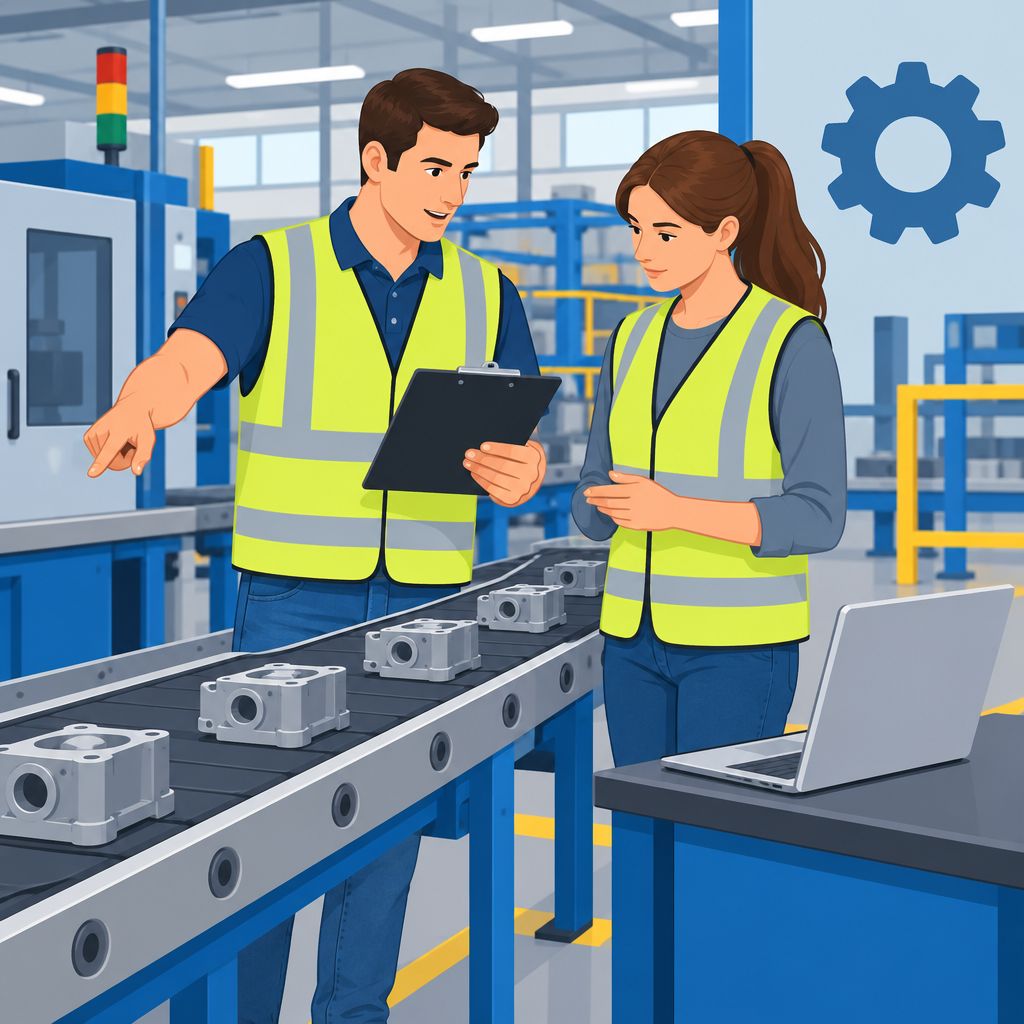
Machine Operation and Product Assembly
Workers set up machinery before beginning assigned manufacturing tasks.
They operate equipment and monitor its performance throughout production.
Additionally, they use hand tools, power tools, and other equipment during assembly.
Accurate Product Assembly
Workers assemble components according to specific instructions and guidelines.
They maintain attention to detail while creating each finished product.
Consequently, careful assembly helps workers complete tasks accurately and efficiently.
Workplace Safety Procedures
Workers follow factory safety procedures to reduce accidents and injuries.
They wear appropriate safety gear and follow required protocols.
Furthermore, they report safety concerns when they identify them.
Production Quotas and Workflow
Production workers often receive quotas that support manufacturing goals.
They maintain a steady workflow and complete tasks within specified timeframes.
By working efficiently, they help the factory maintain planned production.
Reporting Production Issues
When equipment malfunctions, workers report the problem to supervisors.
They also communicate quality control issues and other production obstacles.
Prompt reporting helps supervisors address problems affecting manufacturing.
You Might Also Like: What to Expect During Your First Week as a Mover
Responsibilities of Quality Control Inspectors
Quality control inspectors help ensure that products meet required standards.
They inspect products, compare results with expectations, and record their findings.
Their work also supports issue resolution and customer satisfaction.
Inspecting Products for Defects
Inspectors thoroughly examine products for defects or imperfections.
They look for problems that could prevent products from meeting required standards.
Through careful inspection, they identify quality concerns during the inspection process.
Ensuring Products Meet Quality Standards
They assess products against standards established by the company or industry regulations.
This comparison helps inspectors determine whether products satisfy required expectations.
They apply these standards consistently while reviewing product quality.
Documenting and Reporting Findings
Inspectors accurately document the results of each product inspection.
Transform Your Career Today
Unlock a personalized career strategy that drives real results. Get tailored advice and a roadmap designed just for you.
Start NowThey record defects, imperfections, and other relevant quality findings.
Clear reports help communicate inspection results to production workers.
Collaborating with Production Workers to Address Issues
Inspectors work closely with production workers when inspections reveal defects.
Together, they address issues identified during the inspection process.
This collaboration supports product quality and helps maintain customer satisfaction.
Uncover the Details: The Role of Technology in Power Line Work
Responsibilities of Maintenance Technicians
Being a maintenance technician in a factory involves several responsibilities that support smooth facility operations.
These duties help technicians maintain equipment, address problems, and support reliable production.
Maintenance work also helps reduce interruptions and protect workers from equipment-related hazards.
Performing Regular Maintenance on Machinery
Maintenance technicians conduct routine maintenance on machinery and equipment throughout the factory.
This work keeps equipment functioning effectively and reduces unexpected breakdowns.
They lubricate moving parts, inspect wear and tear, and replace worn components.
Technicians address these conditions before they create more significant equipment problems.
Troubleshooting and Repairing Equipment
When equipment malfunctions, technicians identify the problem and perform necessary repairs.
They use their machinery knowledge to troubleshoot issues and restore operations efficiently.
Technicians may disassemble equipment, replace faulty parts, or recalibrate systems.
Accurate diagnosis helps minimize downtime during the production process.
Keeping Accurate Maintenance Logs
Technicians keep detailed records of maintenance activities for each piece of equipment.
These records include maintenance dates, completed tasks, and replaced parts.
Accurate logs help technicians track machinery condition over time.
They also reveal recurring issues and support preventive maintenance scheduling.
Maintenance history can provide valuable information during future troubleshooting.
Ensuring Workplace Safety Through Equipment Maintenance
Equipment maintenance supports factory operations and worker safety.
Faulty machinery can create serious hazards for employees.
Regular inspections help technicians identify potential risks before they threaten workers.
Technicians address these risks to support a safer work environment.
Together, these responsibilities support factory productivity and safe operations.
Explore Further: Expert Tips for Painting New Construction Homes
Responsibilities of Supervisors and Managers
Supervisors and managers help factories coordinate daily work.
They guide employees, track results, and address workplace concerns.
Moreover, they choose improvements that can strengthen efficiency and productivity.
Overseeing Day-to-Day Operations
They ensure production processes run smoothly each day.
They watch ongoing work and respond to operational needs.
As a result, daily oversight keeps factory activities organized.
Assigning Tasks to Employees
They delegate specific tasks to individual employees.
They consider employee skills and production schedule requirements.
This approach connects available skills with assigned work.
Monitoring Production and Quality Metrics
They monitor output levels and quality control measures.
They compare production results with expected targets.
Therefore, regular measurement shows whether the factory meets its goals.
Transform Your Career Today
Unlock a personalized career strategy that drives real results. Get tailored advice and a roadmap designed just for you.
Start NowHandling Employee Issues and Concerns
They address employee concerns, including workplace conflicts.
They also respond to performance-related issues.
Through this support, managers help resolve problems affecting employees.
Making Strategic Decisions for Improvement
They make decisions intended to improve factory efficiency.
They may implement new processes or technologies.
These choices can support higher productivity when they match production needs.
Together, these responsibilities connect daily supervision with broader factory improvement.
Supervisors and managers influence operations through coordination, measurement, and decision-making.
Their work supports the factory’s overall success.
The Value of Factory Workers and Collaboration
Factory workers make important contributions by helping production processes operate efficiently and effectively.
Furthermore, teamwork and collaboration help employees streamline operations and improve productivity.
When employees pursue shared goals, they achieve stronger results and address challenges more effectively.
Society depends on factory workers to produce many products used in daily life.
Without their dedication and effort, people would lack access to many essential products.
Therefore, their contributions deserve recognition and respect.
Factory workers often work behind the scenes while supporting smooth manufacturing operations.
Their commitment to their responsibilities helps drive progress and innovation across various industries.


