






The most useful questions to ask an employer about AI expectations concern the work itself. Which tasks should use AI? Who reviews an output? What training time is available? Before accepting a hybrid role, ask the manager for an owner, a process and a suitable example. Then record what remains unresolved.
A list of software tools leaves those questions open. This guide pairs dated survey context with an original six-question interview worksheet, two fictional answer examples and a first-month clarification plan. The tools help you document a conversation. They do not score managers, predict job security or certify an employer’s AI practices.
Read the survey periods before interpreting the headline
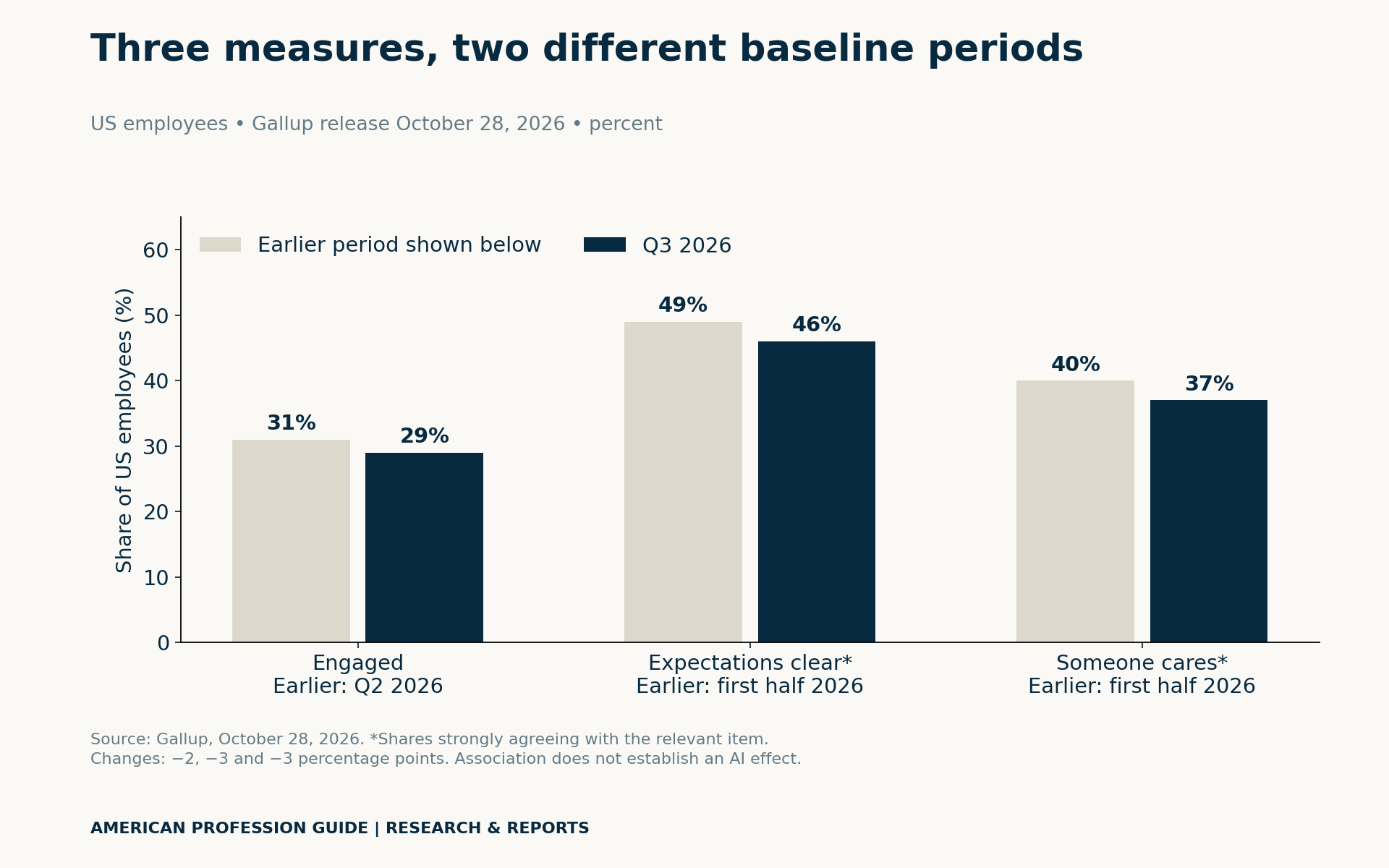
Gallup’s October 28, 2026 release reports US engagement of 29% in Q3, versus 31% in Q2. Strong agreement that expectations were clear fell from 49% in the first half of 2026 to 46% in Q3; the “someone cares” measure moved from 40% to 37% across those same periods. These are two- and three-percentage-point changes, using different baselines.
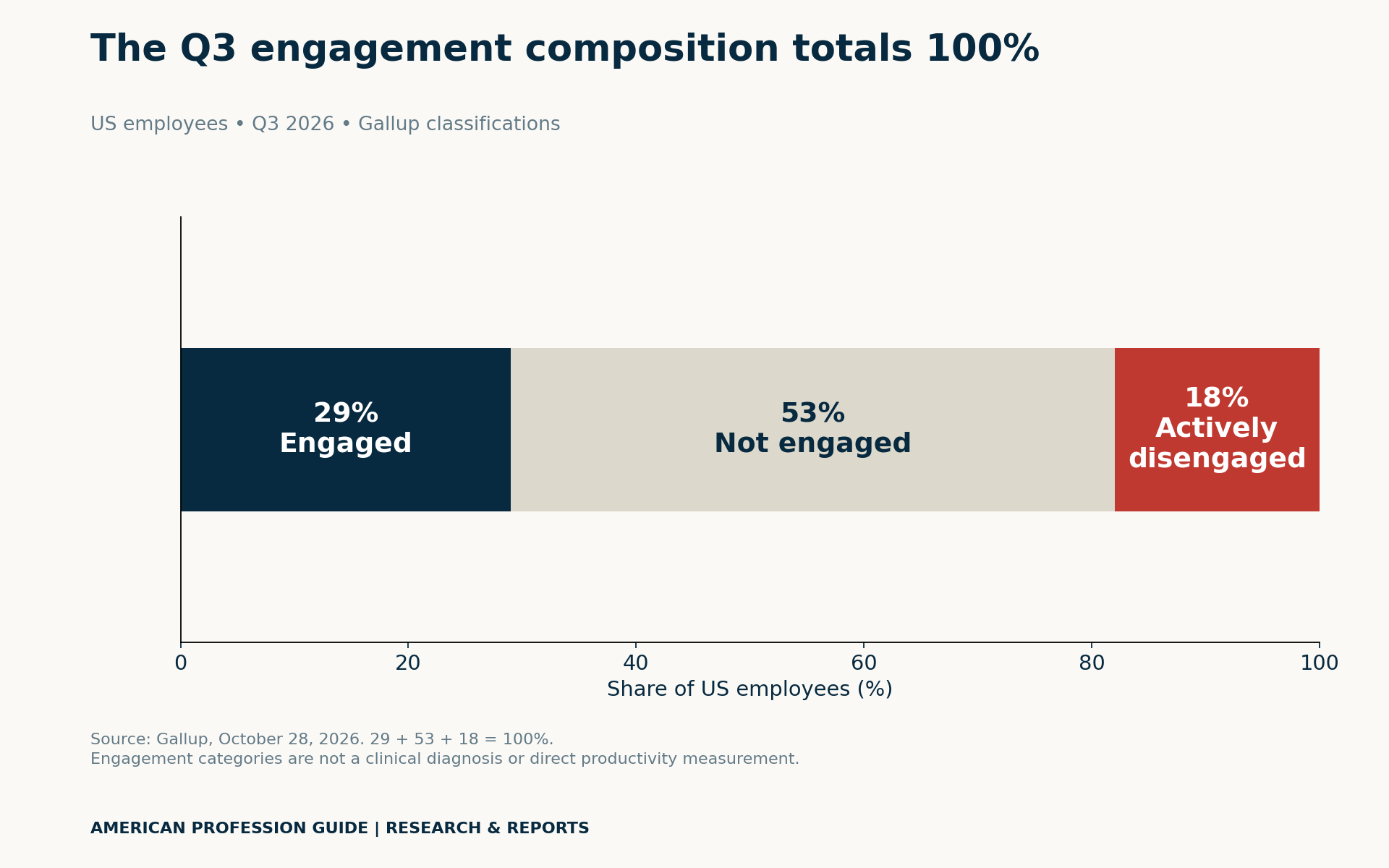
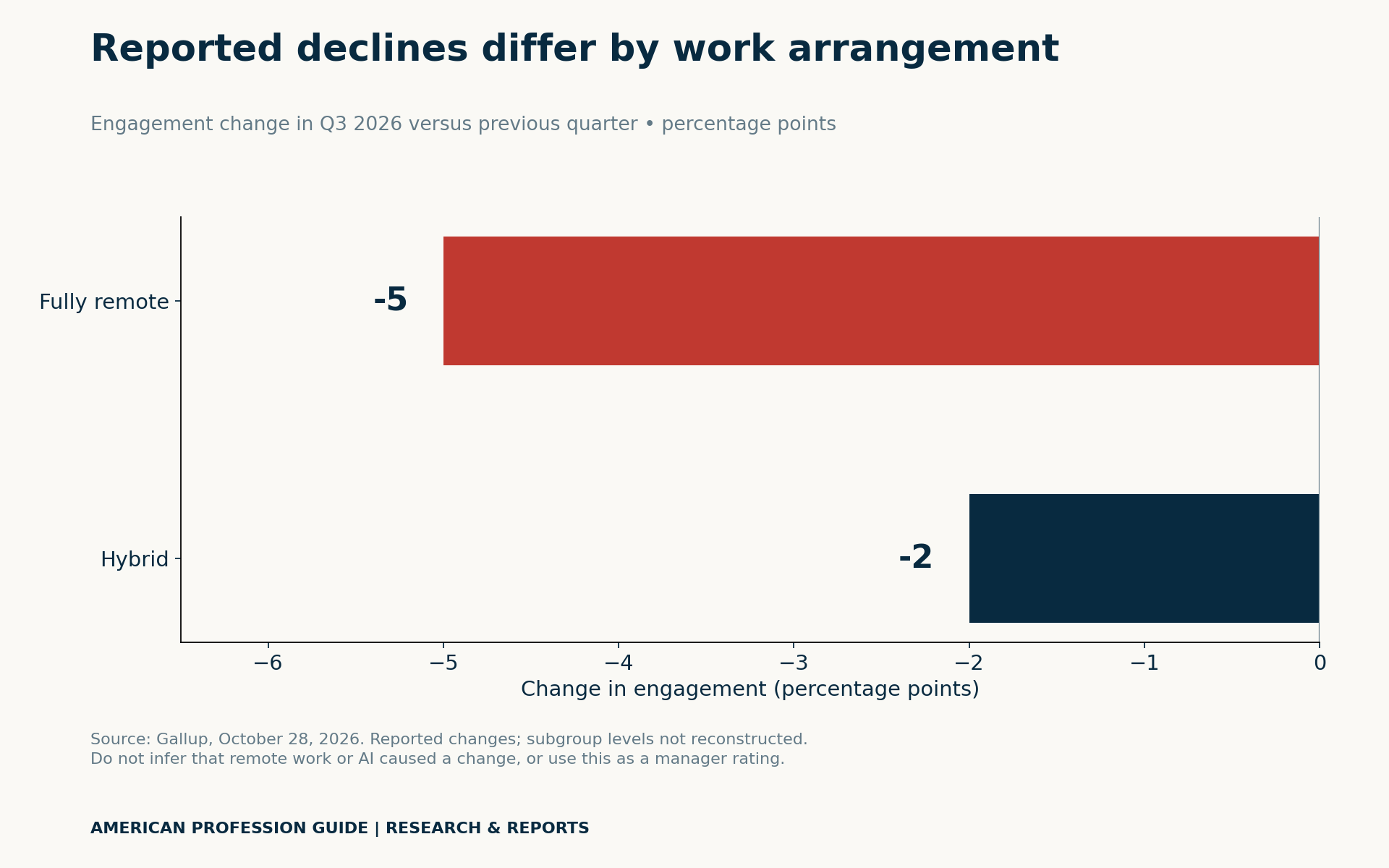
The Q3 categories are 29% engaged, 53% not engaged and 18% actively disengaged. Separately, Gallup reports engagement declines of five points for fully remote employees and two for hybrid employees. These observations do not establish that AI or remote work caused a decline. Engagement is not a clinical diagnosis or a direct productivity measure.
Questions to ask an employer about AI expectations
Start with one task the role actually performs. For example, ask how a draft, analysis or customer response moves from initial work to final approval. A concrete walkthrough can reveal a review step or dependency that a broad culture statement leaves unclear. Request a nonconfidential example that the manager is permitted to discuss.
| Topic | Question to ask | Evidence to record |
|---|---|---|
| Task boundaries | Which tasks should use AI, and which should not? | Role-specific example and approved scope |
| Human review | Which outputs require review, and who approves them? | Named reviewer and review sequence |
| Performance targets | How were the targets set, and when are they reviewed? | Measure definition, assumptions and review date |
| Training and support | What training time and support are funded? | Schedule, support owner and escalation route |
| Tools and information | Which tools and data uses are approved? | Current written policy reference and policy owner |
| Conflicting instructions | Who resolves an uncertain output or competing instruction? | Decision owner, contact route and follow-up timing |
Keep the question proportionate to the interview stage. You do not need access to confidential systems to understand who reviews a deliverable. Similarly, a manager can describe the training process without sharing private employee records. If a document is unavailable, record that limit and ask what suitable evidence could be provided instead.

Use an owner, process and example to clarify an answer
An owner names the role responsible for a decision. A process explains the steps and the point at which an output can be used. An example demonstrates how those steps apply to a realistic task. Together, these details turn an abstract promise into something you can clarify. They still need an appropriate documentary reference where one exists.
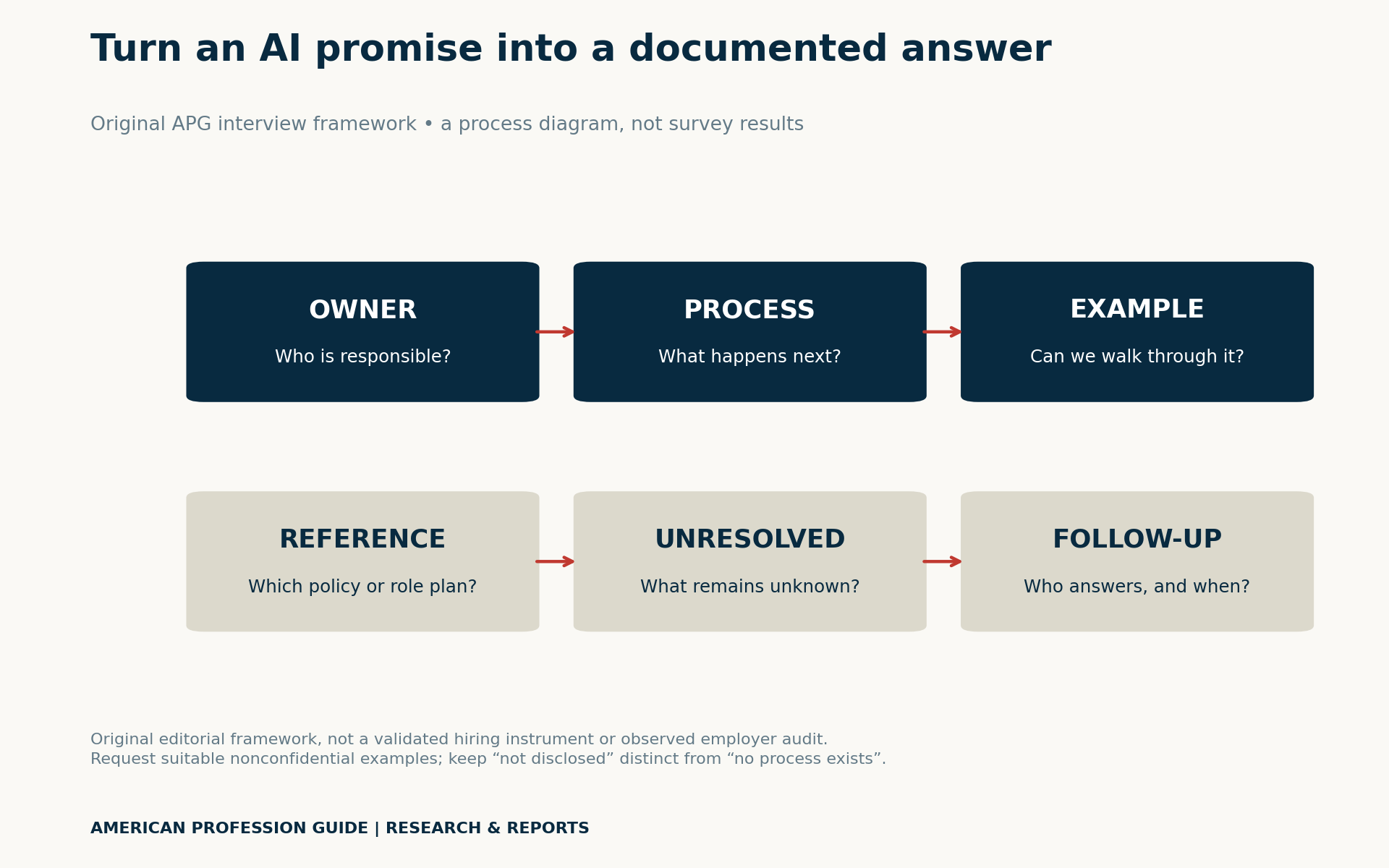
For instance, “we are AI-first” does not identify which work must use a tool. Ask whether the statement concerns optional assistance, a defined workflow or a performance requirement. Then ask who can explain the rule for this role. Avoid assuming that enthusiasm about AI implies a particular workload, level of autonomy or available support.
Also, separate what a person reports from what a document supports. A named reviewer is useful information, but the interview alone may not establish that the process is used consistently. Record the answer as reported until the available evidence supports a narrower claim. “Not disclosed” means you do not have the information; it does not mean no process exists.
Compare two fictional answers without ranking employers
The following examples are invented. In Example A, a manager says the team uses AI but supplies no owner, process, example or written reference. In Example B, a manager identifies a team lead, describes review before client delivery and offers a nonconfidential sample walkthrough. The written policy has not yet been supplied.
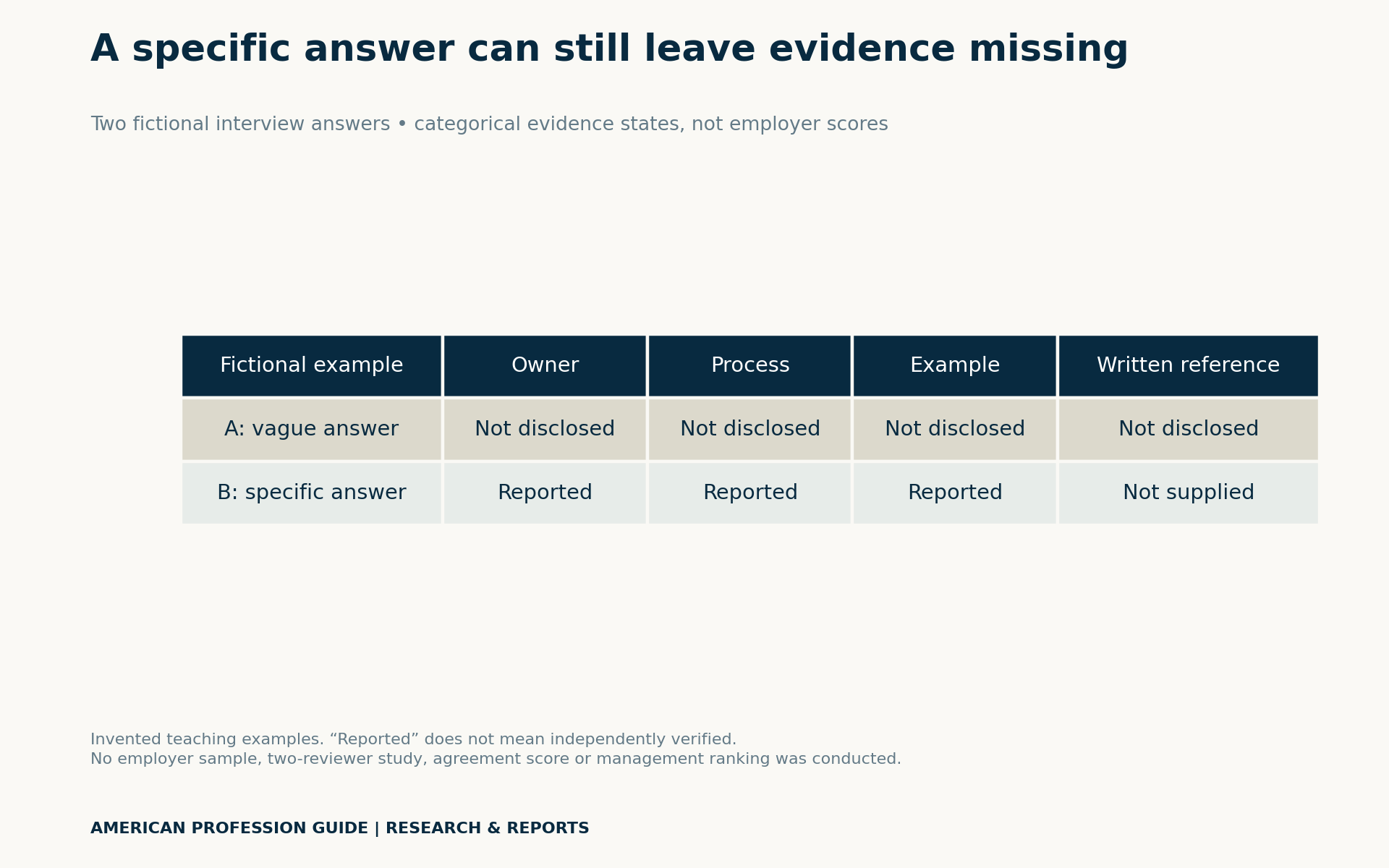
Example B is more specific, yet it still leaves a gap. The next step is to request the relevant policy reference or an explanation of its scope. That observation is different from declaring the employer safe or well managed. The matrix deliberately has no total score, red-flag threshold or probability attached to it.
Use the same restraint when an answer is vague. A person may be limited by confidentiality, interview timing or their own role. Ask who can clarify the issue and when. If the answer conflicts with the written role description, record both versions and seek a consistent explanation before relying on either one.
Agree a first-month clarification plan
If you accept the role, discuss the proposed sequence with your manager. In the first week, confirm task boundaries and approved tools. During the second, walk through a nonconfidential reviewed example. In week three, clarify target definitions, dependencies and training time. By the fourth, reconcile open questions and assign follow-up dates.
This is an editorial planning template, not a guaranteed onboarding timetable. Adapt it to the actual role and agreed work pattern. For a hybrid team, ask where the written record lives and how colleagues working on different days receive the same instructions. Record the contact route for a question that cannot wait for the next shared office day.
For the separate question of whether an employer can support your position, use our company and role evidence register. Keep AI workflow clarity distinct from company stability. Neither a useful demonstration nor a national trend proves how a particular employer will perform in the future.
Download the interview worksheet and source observations
Download the blank six-question AI interview worksheet (CSV), dated survey observations (CSV), fictional answer evidence matrix (CSV), and proposed first-month clarification plan (CSV).
The worksheet has fields for the answer, owner, process, example, policy reference, evidence status and unresolved question. Keep private employer information in an appropriate private record. The public downloads contain no actual employee or employer disclosures. Blank completion fields in the month plan are intentional; they are not recorded outcomes.
Methodology, limits and suggested citation
Research checked November 3, 2026. We retained the primary release, preserved its comparison periods and checked the composition sum and percentage-point arithmetic. The visible source does not provide enough detail to reconstruct every subgroup estimate. Therefore, we have not supplied new sample sizes, confidence intervals, subgroup population counts or significance calculations.
The original worksheet is an editorial proposal. No employer sample, document audit or two-reviewer coding study was conducted. A future consent-based study would need predefined categories, permitted nonconfidential material and independent coding before reporting agreement or disagreement. The fictional matrix here does not stand in for that research.
Suggested citation: American Profession Guide, “Questions to Ask a Manager About AI Before Accepting a Hybrid Job,” November 3, 2026. Attribute survey observations to Gallup’s October 28 release. Identify the interview framework, planning worksheet and fictional examples as APG editorial tools.


