






Searching for candy manufacturing jobs in the USA starts with an industrial map, then a vacancy check. A familiar brand can be a useful lead. However, a production process, a facility location and your own occupation may give you a more precise search. Check the actual job description before assuming a plant needs your skills.
This guide turns a BLS industry snapshot into a practical employer-search worksheet. It includes three statistical figures, two original search diagrams and downloadable data. The employment figures describe March 2026. They do not count today’s openings, reveal the occupation mix or demonstrate a seasonal hiring surge.
Read the manufacturing snapshot without double counting
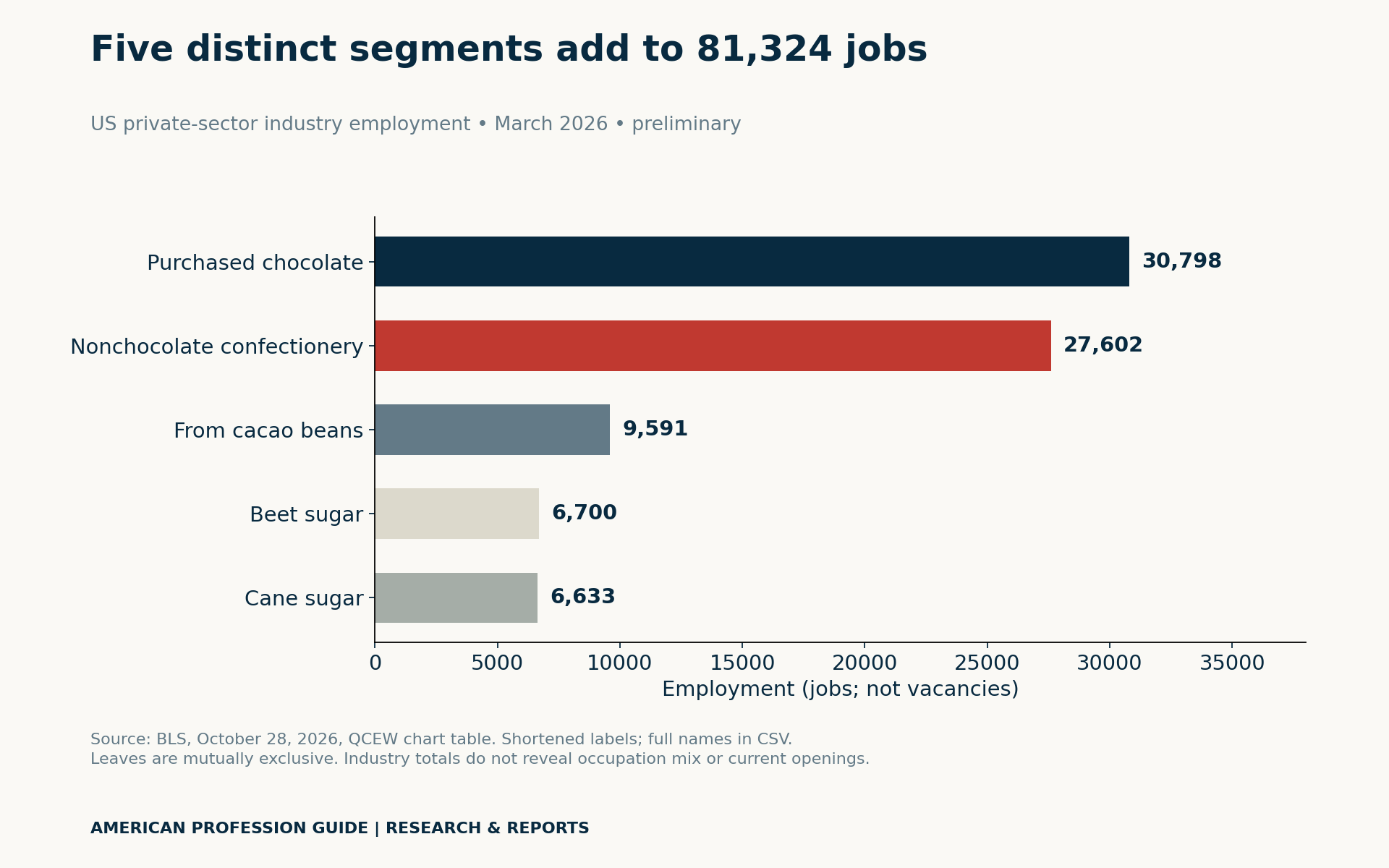
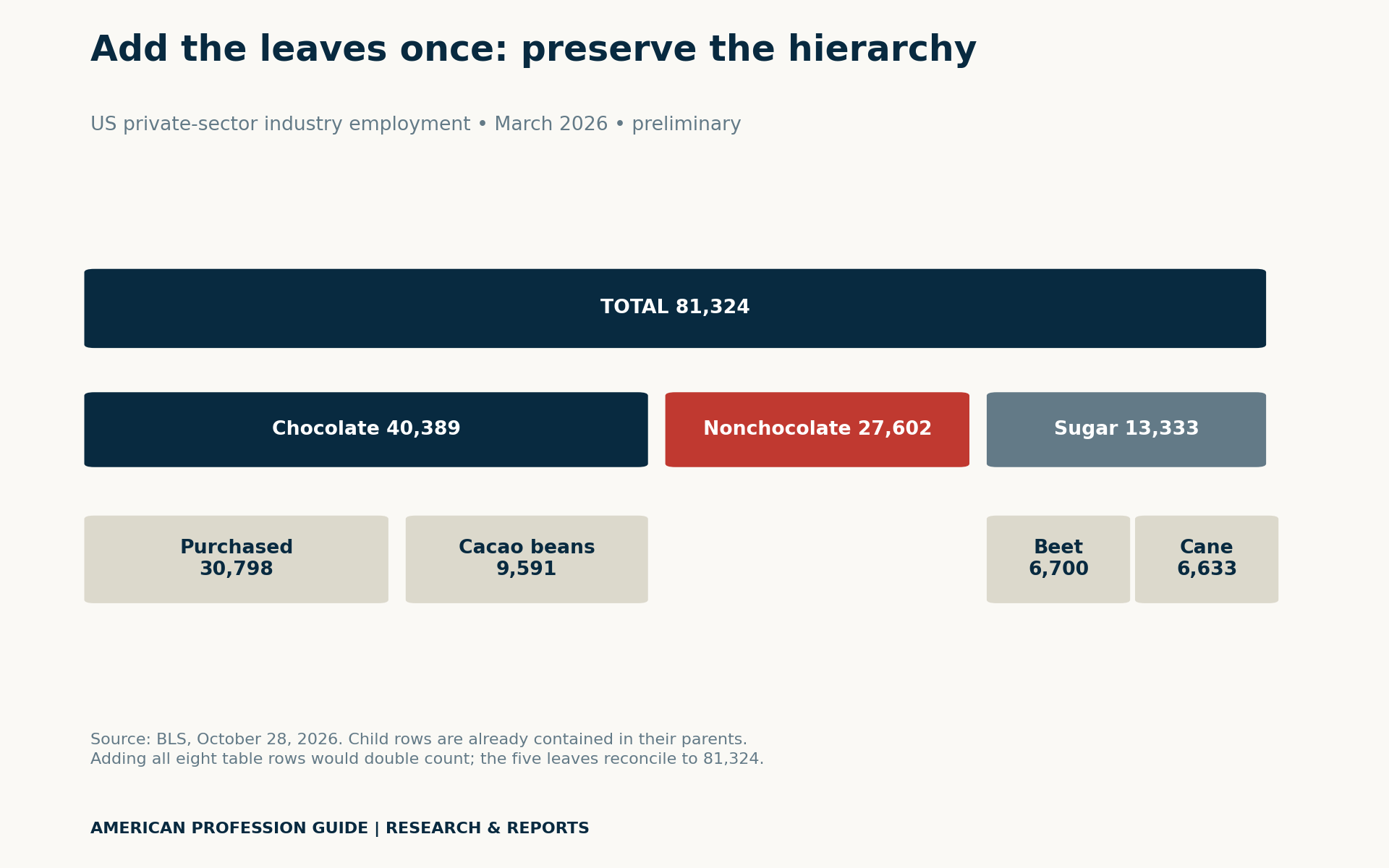
BLS published its sugar and confectionery analysis on October 28, 2026. Its preliminary private-sector March figures total 81,324 jobs. The broad groups are chocolate, nonchocolate confectionery and sugar. Chocolate and sugar each contain smaller categories; adding those children again to the broad groups would overstate the total.
The hierarchy matters whenever you reuse the data. A parent total and its children are alternative levels of detail, not separate additions. Use either the three broad groups or the five leaves for a complete sum. Our CSV retains identifiers, parent links and a leaf marker so that readers can reproduce the reconciliation.
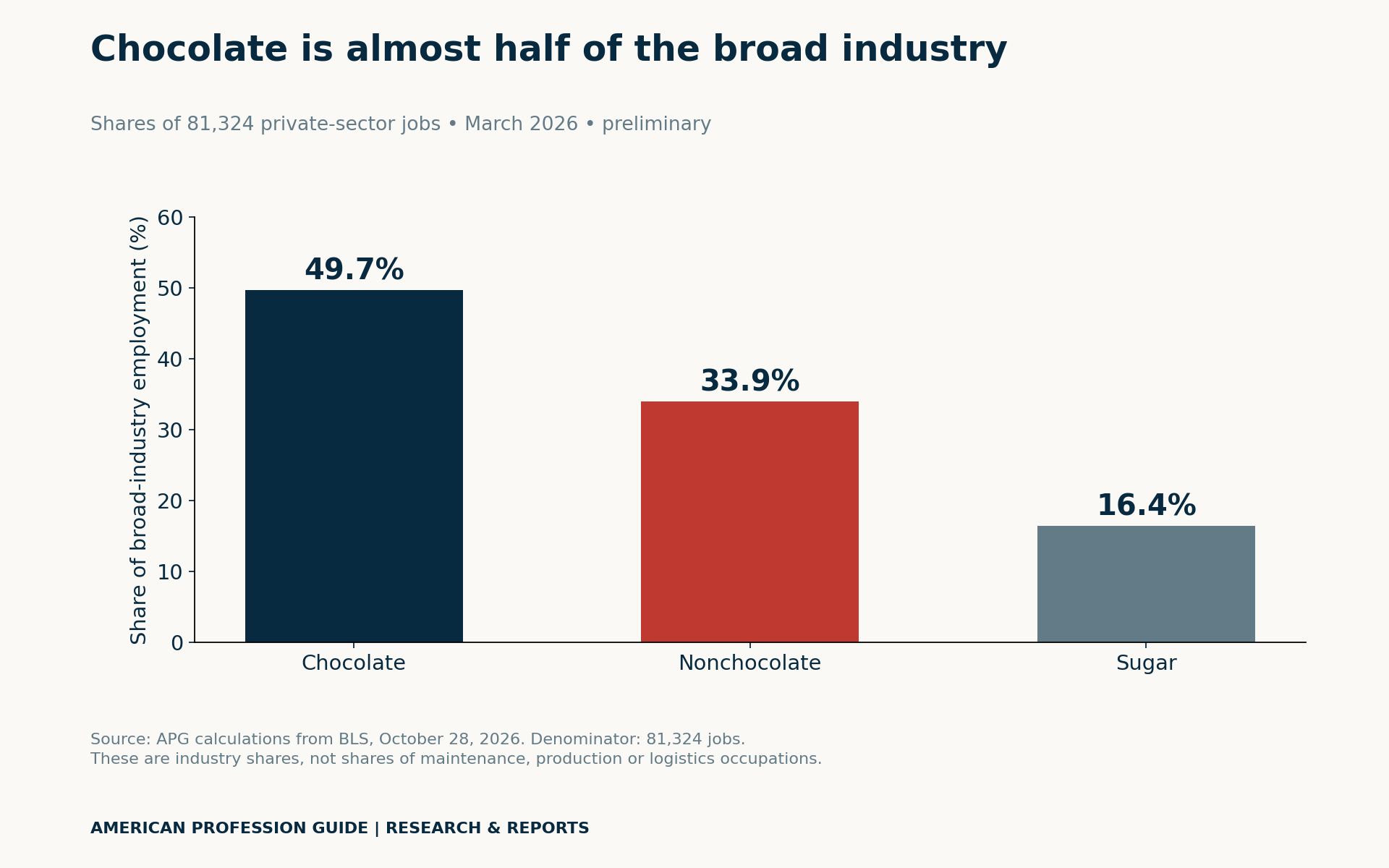
At the broad-group level, chocolate accounts for 49.7% of the total, nonchocolate 33.9% and sugar 16.4%, rounded to one decimal. These are shares of industry employment. They are not the proportions of technicians, production operators or logistics workers. A jobseeker still needs role-specific evidence.
Build searches around process, occupation and location
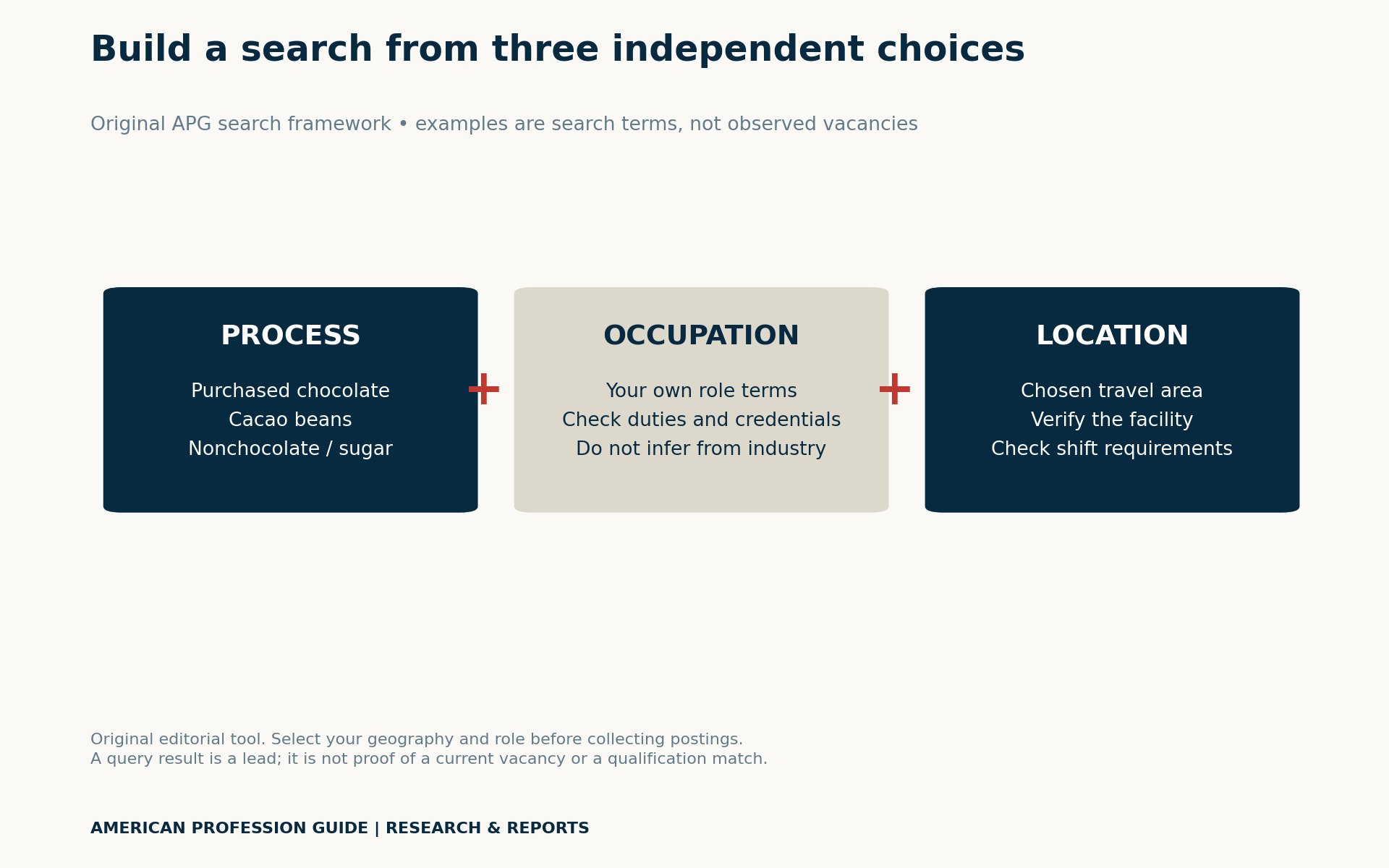
To search for candy manufacturing jobs in the USA, choose your geography first. Define the places you could realistically work, including travel and shift constraints. Next, choose occupation terms that match your experience. Finally, combine those terms with a manufacturing process. Keep a record of the terms used so that you can repeat the search later.
For example, “purchased chocolate” and “cacao beans” describe different industrial branches. They are useful ways to broaden an employer investigation beyond a consumer-facing name. They do not tell you which machines a facility uses or which credentials a specific vacancy requires. Treat each result as a lead until you verify the employer and location.
Start with the employer’s own website and follow its careers link. Some employers use an external recruiting system, so check that the official site links to it. An aggregator can help you discover a lead, but it should not be the only evidence that the vacancy exists. Retain the original requisition number when the employer supplies one.
Also, distinguish a brand owner, a manufacturing site and a staffing firm. Their names may appear together in a search without identifying the same employer. Record who would employ you, where the work occurs and which organization published the vacancy. If the posting leaves that relationship unclear, ask for clarification before relying on it.

Verify the facility and the actual vacancy
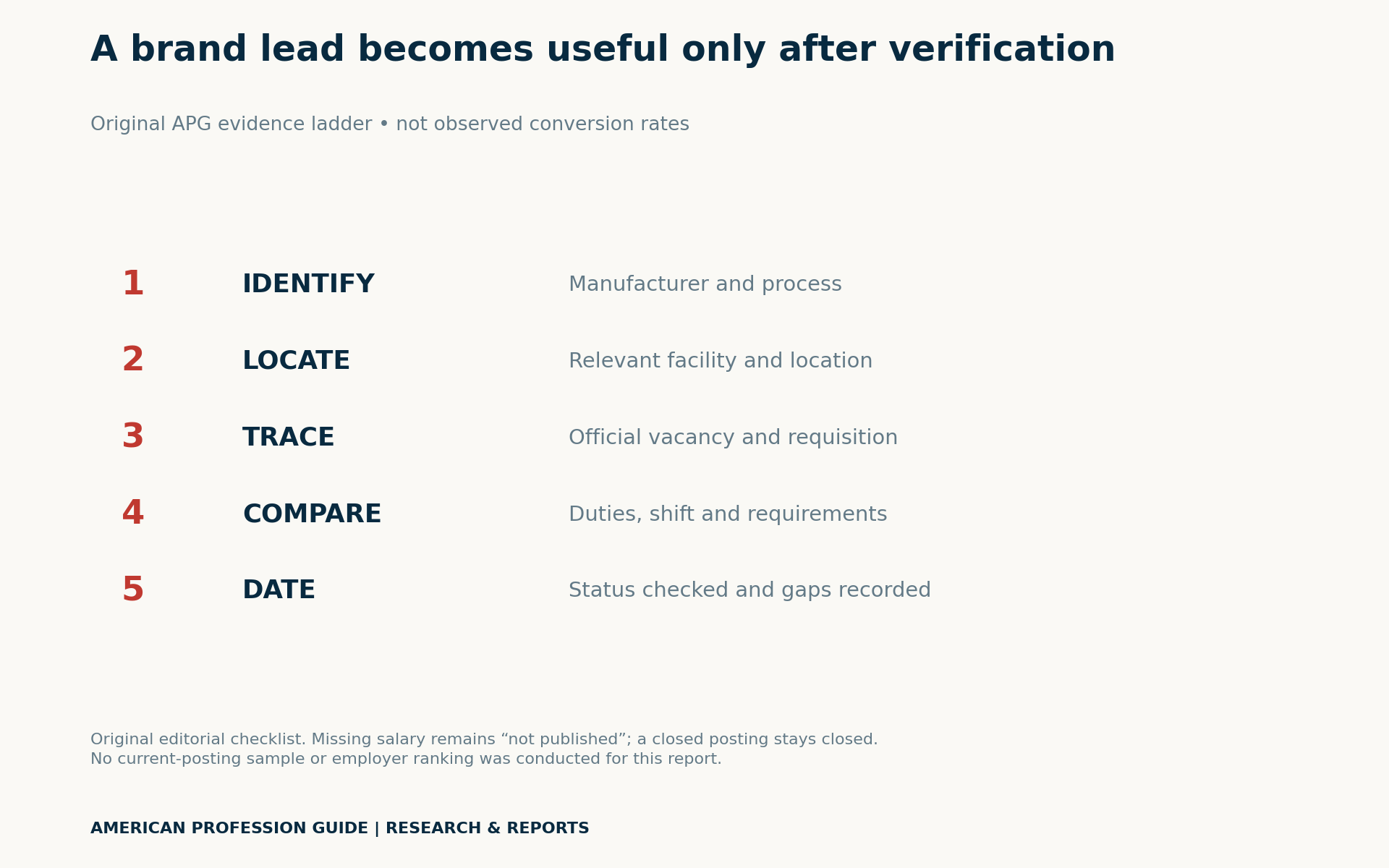
A useful employer record connects the manufacturer to a relevant facility and then to a dated vacancy. Check the job location against the facility you identified. Read the duties rather than relying only on the title. A role at a corporate office can appear on the same careers site as plant-based work.
| Record | What to capture | How to handle a gap |
|---|---|---|
| Employer and facility | Manufacturer, location and industrial segment | Keep the segment unconfirmed until supported |
| Vacancy identity | Official URL, requisition and posting date | Do not replace a missing date with today’s date |
| Work requirements | Duties, shift and required qualifications | Quote or summarize only what the posting states |
| Pay information | Published range, unit, currency and conditions | Use “not published” when the employer omits pay |
| Verification | Date checked and open/closed/unclear status | Retain closed records as history; exclude from current leads |
When comparing requirements, separate essential conditions from preferred experience. Record the employer’s wording and your own evidence of a match in different fields. Do not infer that an industry classification makes skills interchangeable across plants. Similarly, the absence of a requirement from a short posting does not prove that training or certification is unnecessary.
Before applying, review the full vacancy again. A search result can remain visible after the employer closes a role. Save the date you last checked and note any unresolved shift, location or qualification question. Our company and role evidence register can help with a separate assessment of the position’s funding and scope.
Download the employer-search worksheet and source data
Use the blank 30-record employer-search worksheet (CSV), industry hierarchy and employment data (CSV), and five-leaf share calculations (CSV). The blank rows are intentional. They are a collection tool, not a list of verified employers or open roles.
To run a small posting study, define your geography, collection dates, process terms and occupation terms before searching. Include only traceable official employer vacancies within that scope. Deduplicate repeated requisitions, retain missing salary as missing and cap the initial collection at 30 records. Keep an exclusion log so another reader can understand the choices.
Then classify a role as maintenance, operations, quality or logistics only when the actual duties support that label. A single role may combine duties, so define how mixed roles are handled before summarizing the sample. If you report a share, state its denominator. Thirty selected postings would not represent the whole industry, even if every record were verified.
Methodology and limits
Research checked November 3, 2026. We transcribed the eight-row BLS chart table, preserved its preliminary label and reconciled both levels of the hierarchy. Shares equal each category’s employment divided by 81,324, multiplied by 100. The five leaves sum exactly to the total; rounding applies only to displayed percentages.
The QCEW methods overview explains its employer-reported, largely administrative-record basis. It classifies employment by industry and geography. That makes it useful for describing industrial scale, but it does not turn this snapshot into a vacancy survey or an occupation-specific skills analysis.
No current-posting sample was collected for this report. The search framework and blank worksheet are original editorial tools. We do not report employer rankings, salary benchmarks, qualification frequencies or application success rates. A later posting study would need its own dated records and transparent sampling limits.
March employment is not November availability. Nor does a large industrial segment establish job security, hiring difficulty or a seasonal expansion. Use this map to improve the questions you investigate, then rely on the current employer vacancy and written terms for the role you are considering.
Suggested citation: American Profession Guide, “Candy Manufacturing Jobs: Find Industrial Employers Beyond the Brand,” November 3, 2026. Attribute the preliminary employment observations to BLS’s October 28 analysis and identify the worksheet and search diagrams as APG editorial tools.


