




Introduction
Xeriscaping involves designing landscapes to minimize water usage.
It also plays a crucial role in conservation efforts and sustainable landscaping practices.
Furthermore, landscape architects create xeriscaping projects that promote water efficiency.
Understanding Xeriscaping
Xeriscaping is a landscaping method.
It focuses on water conservation and sustainability.
Additionally, it uses drought-resistant plants, improved soil, and less irrigation.
Definition of Xeriscaping
- Xeriscaping promotes water efficiency and reduces the need for supplemental watering.
- It creates attractive landscapes that require minimal water usage.
- The term “xeriscape” comes from the Greek word “xeros,” meaning dry.
Principles of Xeriscaping
- Water conservation reduces usage through efficient irrigation practices and suitable plant selection.
- Plant selection emphasizes drought-resistant plants with minimal water requirements and maintenance needs.
- Soil improvement uses organic matter to retain moisture and support plant health.
Benefits of Xeriscaping
- Xeriscaping conserves water, reduces chemical runoff, and supports local ecosystems.
- Property owners can lower water bills and maintenance costs while increasing property value over time.
- Xeriscapes resist drought conditions and maintain their appearance during water restrictions.
Xeriscaping offers a sustainable landscaping solution for both the environment and property owners.
By following its principles, you can create a beautiful, water-efficient landscape that thrives in arid climates.
The Role of Landscape Architects in Xeriscaping
Landscape architects play a crucial role in designing and implementing water-efficient landscapes.
They use design and planning expertise to create sustainable outdoor spaces.
They also apply environmental knowledge to support resilient landscape designs.
- Landscape architects understand site analysis, plant selection, hardscape design, and irrigation systems.
- They evaluate soil composition, sun exposure, and climate before developing landscape plans.
- These evaluations help landscapes thrive with minimal water usage.
- Xeriscaping principles can reduce water consumption and minimize maintenance requirements.
- Thoughtful designs can also improve landscape resilience and visual appeal.
Additionally, landscape architects collaborate with clients and other professionals throughout each xeriscaping project.
They first discuss the client’s goals, budget, and aesthetic preferences.
This collaboration ensures that the final design reflects the client’s vision and needs.
- Landscape architects work closely with clients to understand project expectations.
- They coordinate with irrigation specialists, contractors, and environmental experts during implementation.
- Collaborative planning helps teams create sustainable, drought-tolerant landscapes.
- These landscapes conserve water while enhancing outdoor beauty and functionality.
Through design expertise, environmental knowledge, and collaboration, landscape architects strengthen xeriscaping projects.
Their integrated approach supports attractive landscapes that require minimal water input.
These efforts demonstrate how landscape architects support water conservation and sustainable landscaping practices.
Explore Further: How to Start Your Career as an Assembler in Construction
Assessing Site Conditions and Climate Factors for Xeriscaping
When designing a xeriscape garden, assess site conditions thoroughly.
Consider sunlight exposure, soil type, and drainage before selecting plants.
These factors help determine which plants will thrive in specific locations.
Sunlight Exposure
Evaluate how much sunlight each garden area receives throughout the day.
This assessment helps you determine which plants will thrive in specific locations.
Plant placement should reflect each area’s available sunlight.
Soil Type
Understand your soil’s composition because it significantly affects plant growth.
Sandy soil drains quickly, while clay soil retains moisture.
Soil composition influences how plants receive and retain water.
Drainage
Ensure that your garden has proper drainage to prevent waterlogged areas.
Incorporate slopes, berms, or French drains to redirect excess water.
Proper drainage supports healthier conditions for xeriscape plants.
Selecting Drought-Tolerant Plants for Xeriscape Gardens
Choose plant species that withstand prolonged drought after becoming established.
Look for native plants adapted to your local climate.
Grouping compatible plants also supports efficient garden management.
Native Plants
Opt for native plants because they suit the natural conditions of your region.
They require less water, pesticides, and fertilizer than non-native species.
Native plants therefore support practical water conservation in the garden.
Drought-Tolerant Varieties
Select plants that evolved to survive in arid environments.
Succulents, ornamental grasses, and Mediterranean herbs suit xeriscape gardens.
These varieties can withstand dry conditions once established.
Grouping Plants
Cluster plants with similar water requirements together.
Transform Your Career Today
Unlock a personalized career strategy that drives real results. Get tailored advice and a roadmap designed just for you.
Start NowThis approach creates efficient irrigation zones and minimizes water waste.
It also promotes consistent plant health within each zone.
Designing Water-Efficient Irrigation Systems
Implementing a water-efficient irrigation system helps maintain a xeriscape garden.
Choose methods that deliver water directly to plant roots.
These methods also reduce evaporation and unnecessary water loss.
Drip Irrigation
Consider installing drip irrigation that releases water slowly at plant bases.
This method reduces water waste and prevents foliage diseases.
Direct application helps water reach plant roots efficiently.
Mulching
Apply organic mulch around plants to retain soil moisture.
Mulching also suppresses weed growth and regulates soil temperature.
It further minimizes evaporation from the soil surface.
Rainwater Harvesting
Collect rainwater in barrels or cisterns for garden watering.
This sustainable practice reduces reliance on municipal water sources.
Rainwater harvesting helps conserve resources in xeriscape gardens.
Find Out More: Interview Tips for Housekeeping Job Seekers
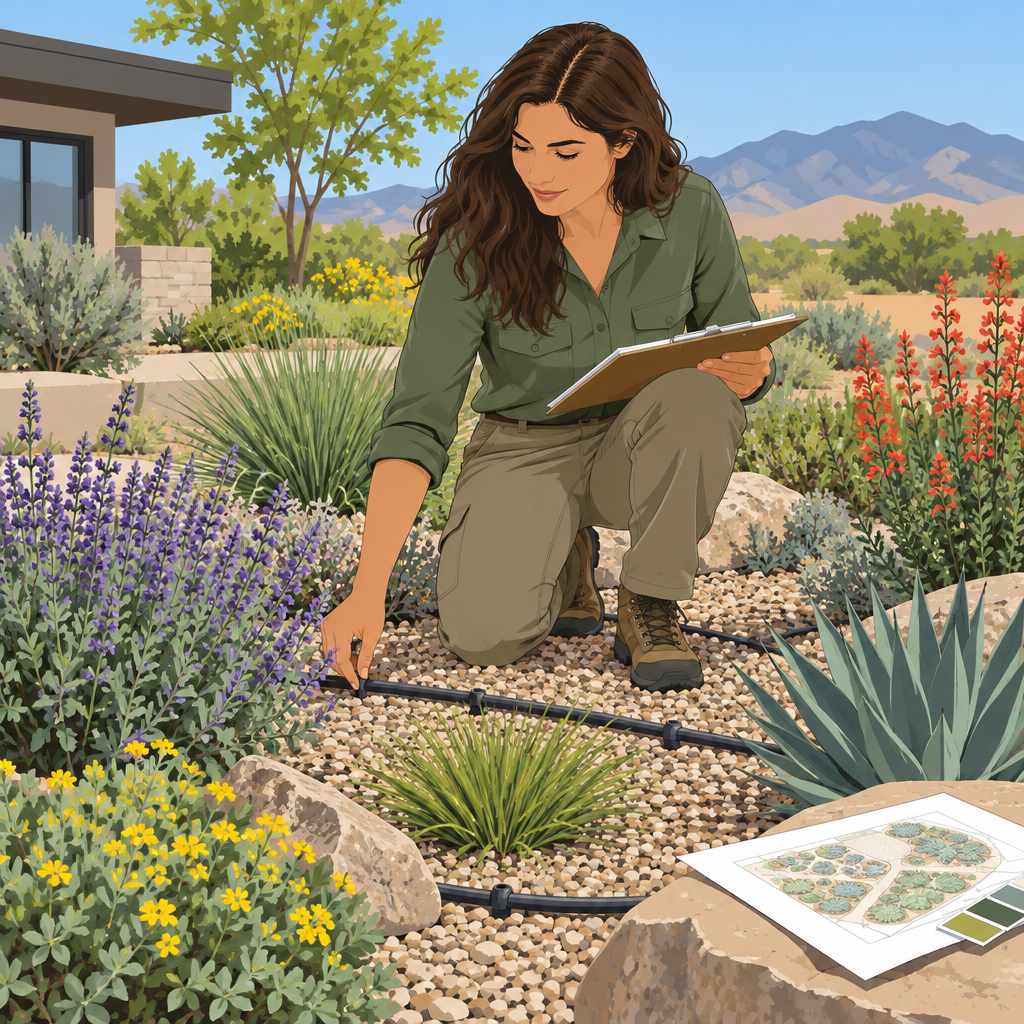
Planning and Executing Xeriscape Features
Landscape architects guide the installation of xeriscape features through detailed planning and careful coordination.
They develop design plans that address site needs and incorporate practical xeriscape principles.
Additionally, they coordinate installation activities to support accurate and efficient project execution.
- Develop a comprehensive design plan that incorporates xeriscape principles and addresses the site’s specific needs.
- Select drought-tolerant plants, suitable materials, and efficient irrigation systems to reduce water usage.
- Consider microclimates, soil conditions, and sun exposure when determining plant placement and irrigation requirements.
- Install pathways, mulch, and rock features carefully to improve water retention and reduce maintenance needs.
- Collaborate with landscape contractors and installers to implement the xeriscape design accurately and efficiently.
Sustainable Practices in Construction and Maintenance
Sustainable construction practices help xeriscape projects conserve resources during installation and ongoing care.
Moreover, thoughtful material selection can reduce waste and support environmentally responsible construction.
Regular maintenance keeps irrigation systems, plants, and water-saving features performing effectively.
- Adopt environmentally friendly construction practices that minimize waste and protect natural resources.
- Use recycled or locally sourced materials for hardscape construction to reduce the project’s carbon footprint.
- Implement drip irrigation or rainwater harvesting to maximize conservation and minimize runoff.
- Maintain and monitor xeriscape gardens regularly to support performance and address issues promptly.
- Educate clients and homeowners about proper watering, mulching, and pruning techniques.
Monitoring and Adjusting Xeriscaping Elements
Continuous monitoring helps landscape architects identify inefficiencies and maintain healthy xeriscape gardens.
Seasonal adjustments align irrigation schedules with weather conditions, plant growth, and soil moisture requirements.
Furthermore, regular evaluation supports water efficiency and long-term sustainability across the landscape.
- Inspect plant health, soil moisture levels, and irrigation systems regularly to identify potential issues.
- Adjust irrigation schedules according to weather conditions, plant growth, and soil moisture requirements.
- Monitor mulch, groundcovers, and other water-saving techniques for moisture retention and weed suppression.
- Use sustainable pest and weed control practices to maintain garden health without harmful chemicals.
- Evaluate xeriscape elements continuously and adjust them to improve water efficiency and sustainability.
Discover More: Roofer Salary and Career Growth Prospects in the USA
Case Studies of Successful Xeriscaping Projects
These case studies showcase real-life xeriscaping projects led by landscape architects.
They highlight design processes, challenges, and achieved outcomes.
They also identify lessons learned and best practices from each project.
- Real-life projects led by landscape architects
- Design processes, challenges, and achieved outcomes
- Lessons learned and best practices from each project
Sustainable Oasis in the Desert
The project transformed a barren desert landscape into a lush oasis using xeriscaping techniques.
The landscape architect selected drought-resistant plants for the harsh desert conditions.
The architect also implemented efficient irrigation systems to minimize water usage.
Despite the difficult conditions, the oasis thrived and required minimal maintenance.
Urban Xeriscaping Revolution
The landscape architect xeriscaped a small urban space in a bustling city.
The design combined raised beds, native plants, and mulch.
These features improved water retention and reduced watering needs.
The project demonstrated xeriscaping’s potential in limited urban spaces.
Transforming a High-Traffic Area
The project addressed erosion and soil degradation in a high-traffic area.
The landscape architect used terracing, native grasses, and rock features.
These elements stabilized the soil and helped prevent erosion.
The project improved aesthetics while reducing maintenance costs and water usage.
Transform Your Career Today
Unlock a personalized career strategy that drives real results. Get tailored advice and a roadmap designed just for you.
Start NowXeriscaping for Coastal Resilience
The coastal project addressed sandy soil and saltwater intrusion.
The landscape architect incorporated salt-tolerant plants into the design.
The project also used rainwater harvesting systems and permeable paving.
These techniques created a resilient and sustainable coastal environment.
The project showed why xeriscaping methods must reflect local climatic conditions.
Community Xeriscaping Initiative
The landscape architect collaborated with a local community to xeriscape a public area.
Community members participated in the design process.
The project also included educational elements about water conservation.
The redesigned space improved its appearance and encouraged sustainable landscaping practices.
This initiative demonstrated the value of community involvement in resilient landscapes.
Gain More Insights: How to Become a Certified Construction Manager
Sustainable Xeriscaping Benefits
Xeriscaping supports sustainable landscaping by reducing water use and advancing environmental conservation.
Moreover, landscape architects shape these projects by designing attractive, water-efficient outdoor spaces.
Therefore, consider xeriscaping when you seek an eco-friendly, sustainable approach for enhancing your outdoor spaces.
Additional Resources
Google search results for Landscape Architect's Guide to Xeriscaping Construction and Manual Labor
Bing search results for Landscape Architect's Guide to Xeriscaping Construction and Manual Labor


