




Entry-level AI exposure is a useful question for a job search, but it is not a layoff counter. The latest ADP update shows weaker employment changes in highly exposed occupations. Use that signal to inspect actual work and demonstrate judgement, rather than to assume a whole career path has disappeared.
Entry-level AI exposure: what October’s figures show
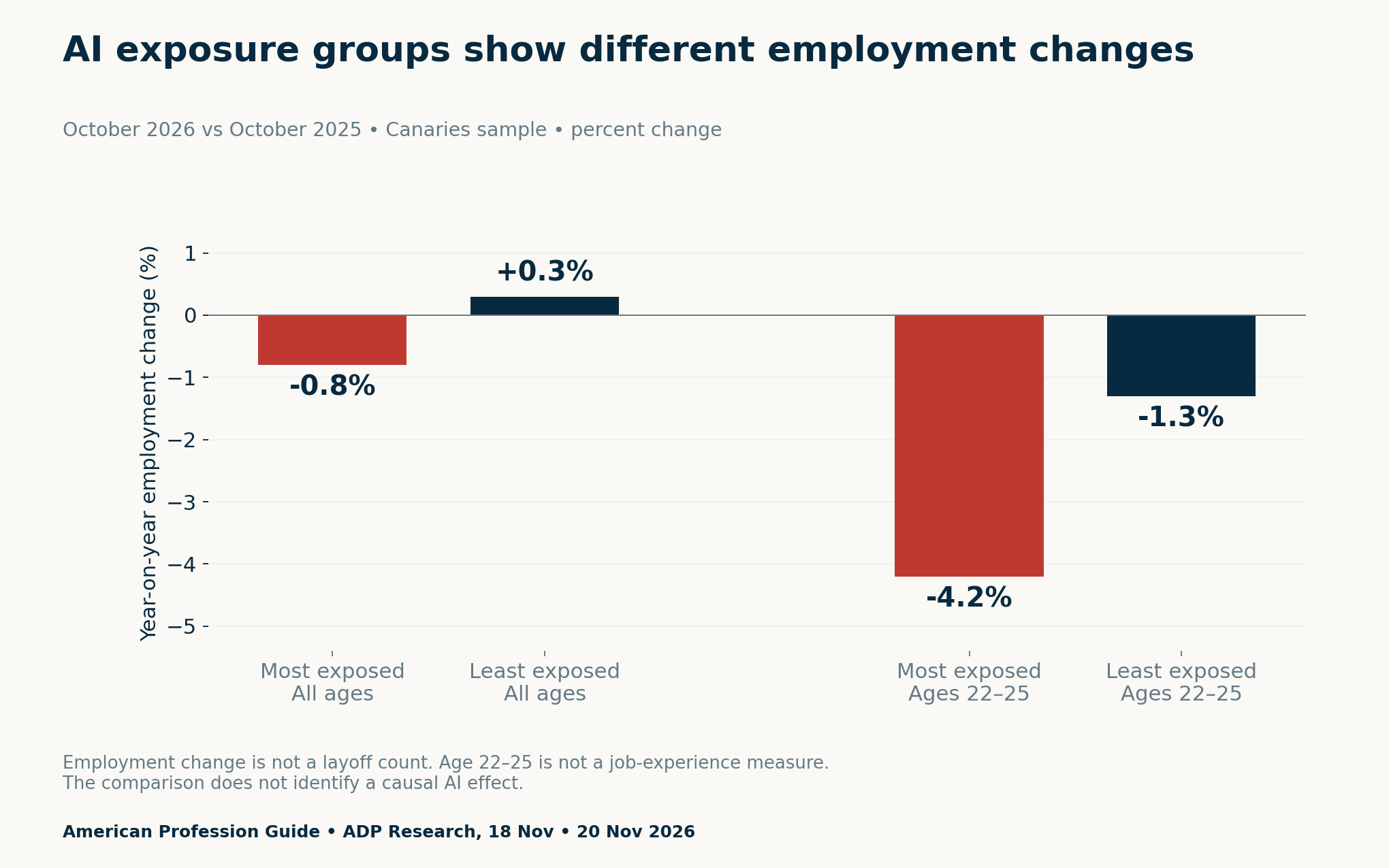
In its 18 November 2026 update, ADP reports October year-on-year employment changes of −0.8% for the most-exposed occupations and +0.3% for the least exposed. Among workers aged 22–25, the corresponding changes were −4.2% and −1.3%. These are changes in employment, not announced layoffs.
Calculate the gaps without changing the unit
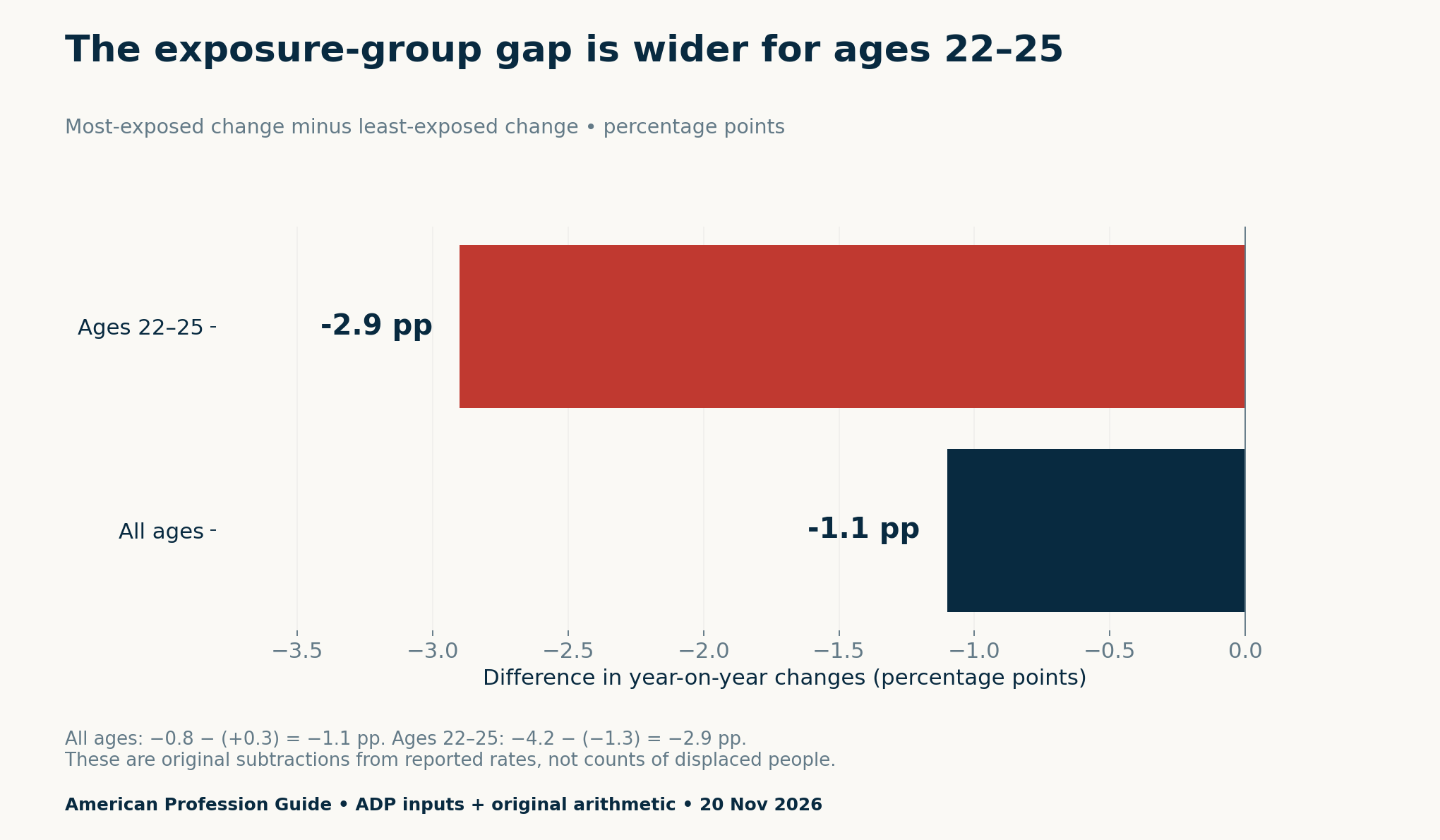
Subtracting the least-exposed change from the most-exposed change gives −1.1 percentage points for all ages and −2.9 points for ages 22–25. These are differences between percentage changes. They are not percentages of workers fired, and they cannot be converted into job-loss counts without suitable employment levels and definitions.
Know which workers the sample represents
Stanford’s Canaries methodology uses a rolling five-year balanced sample of ADP client firms and workers matched to occupation codes. It does not represent the entire US labor market or every ADP client. Keeping firms in a balanced sample also limits what it captures about firms entering, exiting or changing payroll providers.
The dashboard describes associations between occupational exposure and employment trends, rather than a causal estimate. Its sampling differs from ADP’s National Employment Report. Moreover, its age groups do not measure a person’s years of professional experience. A career changer and a recent graduate cannot be treated as interchangeable simply because both seek junior work.
Keep the release date separate from the data period
The November publication discusses October employment compared with a year earlier. It is not a November layoff tally. Our source-value CSV identifies both dates so readers can reproduce the chart. We use the dated ADP release for these values; older dashboard downloads are not relabeled as October observations.
Before sharing a dramatic statistic, write down the unit, comparison period, population and source. If one is missing, pause the interpretation. A percentage can describe a change in a sample, a share of respondents or a forecast. Those measures answer different questions even when their headlines sound similar.
Why contraction does not equal a layoff count
A lower employment total can reflect several flows, including hiring, departures and movement between jobs. A comparison of totals alone does not count each flow. Therefore, a candidate should not turn an exposure-group decline into a claim that a particular employer has dismissed a stated number of people because of AI.
Likewise, a growing group is not a guarantee that a specific vacancy exists. Your next decision concerns an actual role with requirements, location rules and tasks. Treat the broad signal as context for that investigation, alongside your interests, constraints and the evidence an employer asks you to show.
Audit ten real listings using a fixed protocol
Our ten-listing worksheet is a proposed research protocol, not a completed survey. Choose one role family, a US location or clearly stated US remote eligibility, a review date and a junior-entry rule before collecting examples. For instance, include listings that explicitly accept applicants with zero to two years of relevant experience.
Use official employer career pages where possible. Exclude expired or duplicate postings, advertisements with unclear location eligibility and roles that exceed your chosen experience rule. Record each exclusion. Stop at ten unique eligible listings, but report fewer if you cannot find ten; do not quietly relax the rule to fill the sheet.
For each included listing, save the public URL, date, short task quotation and your coding decision. Separate a required task from a preferred tool. If a requirement is ambiguous, preserve that uncertainty instead of guessing. This small convenience sample cannot estimate the prevalence of a skill across the US labor market.
Turn a task into evidence of human judgement
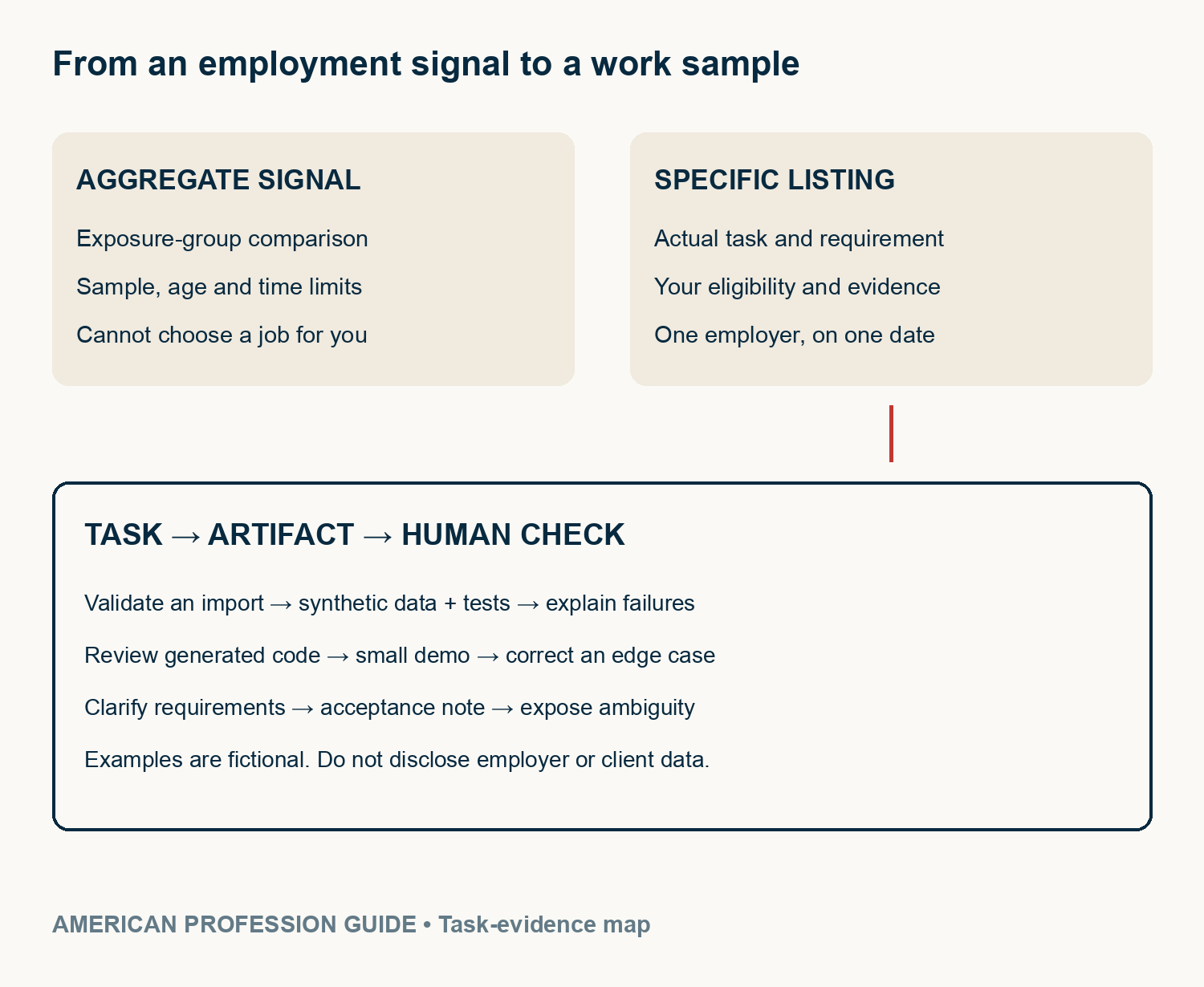
Choose a task that you can demonstrate safely with public or synthetic material. Then build a small artifact that shows the work and a brief explanation of how you checked it. The aim is to make your decisions inspectable, rather than to claim that using an AI tool proves competence.
| Fictional task example | Possible artifact | Judgement to explain |
|---|---|---|
| Validate a data import | Small synthetic CSV plus validation tests | Explain rejected rows and edge cases |
| Review generated code | Tiny public demonstration with tests | Explain one incorrect output and correction |
| Clarify a user requirement | Short acceptance-criteria note | Identify ambiguity and ask a precise question |
For example, a synthetic data-import demonstration could include accepted rows, rejected rows and a reason for each rejection. Explain why a plausible-looking output would still fail your rules. Keep the example small enough that a reviewer can reproduce it without access to private systems.
Ask useful questions about the junior role
During a hiring conversation, ask which tasks a new starter owns, what review they receive and how the team checks tool-assisted output. Request a concrete example of acceptable work. Also clarify whether learning time, test environments and escalation routes are available before you accept responsibility for unfamiliar tasks.
Avoid presenting the employment comparison as a diagnosis of that team. Instead, explain which task you investigated and what your sample demonstrates. Our IT trainer teaching-strategies guide offers related background on explaining technical work clearly. A concise explanation can make your evidence easier to assess.
Download the data and task-audit tools
- October source-value register (CSV)
- Exposure-group gap calculations (CSV)
- Blank ten-listing task audit (CSV)
- Fictional task-evidence examples (CSV)
Methodology and limits
We checked the primary release and methodology on 20 November 2026. The charts reproduce four reported values and two original subtractions. The task audit has not been fielded, and the examples do not establish hiring outcomes. Keep observed figures, calculated gaps and proposed job-search actions separate when citing this guide.
Employment exposure research can sharpen a question without deciding your career for you. Compare the task, your eligibility, the review process and the evidence you can show. Revisit the source dates when new releases arrive, and retain uncertainty where the available data cannot answer an employer-specific question.


