




Precision Agriculture and Irrigation Efficiency
Precision agriculture uses technology to optimize crop production.
Irrigation efficiency matters because agriculture must conserve water resources.
This section explores how precision agriculture methods can improve irrigation efficiency.
What Is Precision Agriculture?
Precision agriculture uses technology to improve farming practices.
It combines data, analytics, and precise equipment.
These tools help farmers use resources efficiently and make informed decisions.
Definition of Precision Agriculture
Precision agriculture applies technology to specific farming practices.
Farmers use this approach to maximize yields and minimize inputs.
Furthermore, data helps reduce environmental impact across different field areas.
- Precision agriculture applies technologies for precise farming practices.
- It aims to maximize yields, minimize inputs, and reduce environmental impact.
- This method tailors farming practices to specific field areas using data.
Technologies Used in Precision Agriculture
Several technologies support precise agricultural decisions.
GPS technology helps farmers map fields and track farming activities.
Meanwhile, monitoring devices measure soil and crop conditions.
- Global Positioning System technology supports mapping and tracking.
- Monitoring devices assess soil moisture, nutrient levels, and crop health.
- Variable rate technology applies inputs with greater precision.
Role of Data and Analytics in Precision Agriculture
Data provides detailed information about changing field conditions.
Analytics convert sensor readings into useful agricultural insights.
Consequently, farmers can make timely decisions using current information.
- Sensors and monitoring devices reveal field conditions.
- Analytics help optimize application rates and farming schedules.
- Real-time data supports timely decisions and better outcomes.
Current Challenges in Irrigation Efficiency
Farmers and agricultural experts face several barriers when they pursue more efficient irrigation.
These barriers affect water availability, farm operations, and environmental protection.
Precision methods can help farmers respond to these challenges while supporting responsible crop production.
- Water scarcity issues in agriculture
- Inefficient water usage practices
- Environmental impact of irrigation
Water Scarcity Issues in Agriculture
Water scarcity creates a serious challenge for farms that depend on irrigation.
Growing demand increases pressure on finite water resources.
Consequently, farmers must protect available supplies while meeting crop water needs.
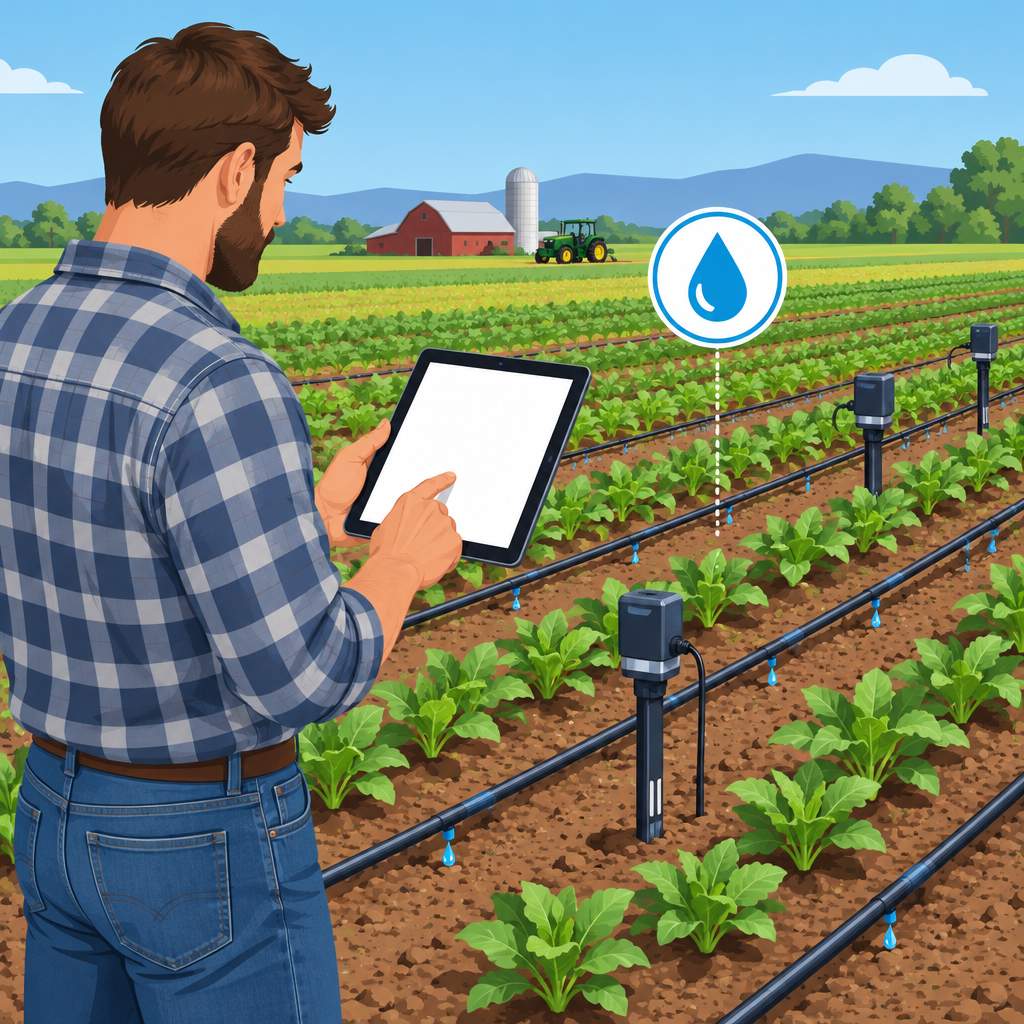
Monitoring soil moisture helps farmers apply only the water crops require.
Inefficient Water Usage Practices
Outdated irrigation methods often waste water and provide crops with uneven amounts.
This waste can also increase operating costs for farmers.
Therefore, precision irrigation systems can match water delivery with current crop needs.
Sensors and data analysis support timely adjustments throughout irrigation.
Automation can improve consistency while reducing unnecessary water use.
Environmental Impact of Irrigation
Traditional irrigation can contribute to water pollution, soil erosion, and habitat destruction.
Runoff may carry agricultural chemicals into surrounding water resources.
Meanwhile, excess water can move chemicals through soil and affect water quality.
Precise irrigation reduces runoff and leaching by controlling application amounts.
Farmers can therefore protect ecosystems while using water more carefully.
Addressing these challenges can help farmers improve irrigation efficiency and support sustainable crop production.
Precision irrigation gives farmers practical tools for managing water and reducing environmental pressure.
Gain More Insights: How to Prevent Common Irrigation System Failures
Benefits of Enhancing Irrigation Efficiency with Precision Agriculture
Precision agriculture can help farmers improve irrigation efficiency across modern farming operations.
These technologies support careful water management while helping farmers meet crop requirements.
Furthermore, efficient irrigation can support sustainable practices, stronger yields, and lower operating costs.
Reduced Water Usage
- Precision agriculture helps farmers use available water more effectively.
- Sophisticated irrigation systems deliver suitable water amounts at appropriate times.
- Consequently, farmers can reduce waste while conserving an important resource.
Increased Crop Yield
- Efficient irrigation can improve crop growth and support higher productivity.
- Precision systems help farmers provide crops with the water they require.
- As a result, farmers may achieve larger harvests and better produce quality.
Cost Savings for Farmers
- Efficient irrigation practices can reduce farmers’ water bills and operating expenses.
- More careful water use helps farmers manage resources with greater financial efficiency.
- Moreover, improved yields can increase farm profits when production performs well.
Gain More Insights: How to Become a Certified Veterinary Technician
Tools and Technologies for Improving Irrigation Efficiency
Several tools can improve irrigation efficiency within precision agriculture.
Transform Your Career Today
Unlock a personalized career strategy that drives real results. Get tailored advice and a roadmap designed just for you.
Start NowThese technologies help farmers manage water use, reduce waste, and support crop production.
They also provide information that supports timely and informed irrigation decisions.
Farmers can combine these tools to manage irrigation more effectively.
Sensor-Based Irrigation Systems
Sensor-based systems monitor soil moisture, temperature, and other important conditions.
These systems give farmers current information about conditions affecting irrigation needs.
Farmers can adjust irrigation schedules according to actual crop requirements.
- Sensors provide real-time data that supports precise irrigation adjustments.
- Farmers can reduce overwatering and underwatering through better scheduling.
- The technology can help identify irrigation system malfunctions promptly.
- Improved monitoring can contribute to significant water savings.
Drones for Aerial Monitoring
Drones help farmers examine irrigation conditions across large areas of farmland.
Aerial images can reveal crop health, water distribution, and irrigation effectiveness.
Farmers can use these observations to target improvements where they matter most.
- Drones provide detailed visual information about crop conditions.
- Farmers can identify areas affected by over-irrigation or drought stress.
- Aerial monitoring helps farmers make informed irrigation decisions.
- Quick assessments can reveal irrigation inefficiencies across broad farmland areas.
Automated Weather Forecasting
Automated forecasting tools give farmers timely information about expected weather conditions.
Farmers can use those predictions to adjust irrigation schedules before conditions change.
This approach helps prevent unnecessary water use while supporting crop needs.
- Forecasting tools consider temperature, humidity, wind speed, and precipitation.
- Weather data helps farmers plan irrigation more efficiently.
- Farmers can respond proactively to upcoming weather conditions.
- Better planning can support water efficiency and crop productivity.
Integrating these technologies can strengthen irrigation management in precision agriculture.
Farmers can improve water management while reducing environmental impacts.
These practices can also support better crop yields through more efficient irrigation.
Gain More Insights: Seasonal Work Patterns for Viticulturists
Case Studies and Examples of Successful Implementation
Successful farms demonstrate how precision agriculture can support irrigation management.
These implementations can improve crop yields while conserving valuable water resources.
Farmers can also learn practical strategies from these successful applications.
Examples of Farms Using Precision Agriculture for Irrigation
Smith Farms in Iowa implemented precision agriculture techniques for irrigation.
The farm reported a 20 percent increase in crop yield.
Similarly, Johnson Family Farm in California reduced water usage by 30 percent.
Positive Effects on Crop Yield and Water Conservation
Accurate soil moisture measurements help farmers apply precise amounts of water.
This targeted approach can improve crop yields by matching irrigation with soil conditions.
Additionally, precision irrigation prevents over-irrigation, saving water and reducing nutrient leaching.
Lessons from Successful Implementations
- Farmers should regularly monitor and calibrate irrigation systems for reliable performance.
- Training helps farmers use technology and interpret data effectively.
- Experts and consultants can provide valuable guidance during implementation.
- Weather data and soil sensors can further improve irrigation efficiency and sustainability.
Discover More: Restoring Degraded Lands: A Conservation Guide
Potential Barriers to Adopting Precision Agriculture for Irrigation
Farmers may face several barriers when adopting precision agriculture for irrigation.
These barriers can affect technology adoption and irrigation improvements.
However, education, support, and suitable resources can help farmers address these challenges.
- Cost of implementing new technologies
- Lack of knowledge and training for farmers
- Resistance to change from traditional farming methods
Cost of Implementing New Technologies
Implementation costs create a significant barrier to precision agriculture adoption.
Farmers may need substantial funds to purchase advanced irrigation systems, sensors, and monitoring equipment.
Small operations or resource-limited farmers may find these upfront expenses prohibitive.
Additionally, maintenance and upgrades can increase the ongoing financial burden.
Lack of Knowledge and Training for Farmers
Limited knowledge and training can also restrict precision agriculture adoption.
Many traditional farmers may lack familiarity with modern technology and its practical applications.
Without suitable training, farmers may struggle to understand precision agriculture benefits.
They may also find it difficult to implement new irrigation practices successfully.
Resistance to Changing Traditional Farming Methods
Some farmers hesitate to replace traditional methods that they have used for years.
This hesitation may reflect uncertainty about unfamiliar technologies.
Furthermore, skepticism can discourage farmers from changing established practices.
Transform Your Career Today
Unlock a personalized career strategy that drives real results. Get tailored advice and a roadmap designed just for you.
Start NowEducation, outreach, and support can help farmers adopt efficient and sustainable irrigation practices.
Government Initiatives and Support for Precision Agriculture
Government support helps farmers adopt precision agriculture practices.
These initiatives can improve irrigation efficiency across farming operations.
Furthermore, public programs can support investment, research, and policy development.
Funding Opportunities for Farmers
Funding programs can help farmers invest in precision irrigation technology.
Additionally, subsidies can reduce costs for water-efficient equipment and systems.
Financial assistance can also support the implementation of smart irrigation solutions.
- Grants for investing in precision irrigation technology
- Subsidies for water-efficient equipment and systems
- Financial assistance for implementing smart irrigation solutions
Research Programs for Sustainable Agriculture
Research programs can connect farmers with agricultural universities and research institutions.
Moreover, researchers can study water management and crop optimization.
Field trials can test new irrigation technologies before broader adoption.
- Collaborative projects with agricultural universities and research institutions
- Funding for research on water management and crop optimization
- Field trials for testing new irrigation technologies
Policies That Encourage Precision Agriculture
Policy changes can encourage farmers to adopt precision irrigation methods.
Regulatory frameworks can promote water conservation within agricultural operations.
Tax benefits can further encourage efficient irrigation practices.
- Incentives for farmers using precision irrigation methods
- Regulatory frameworks promoting water conservation in agriculture
- Tax benefits for implementing efficient irrigation practices
Government initiatives can therefore support the shift toward precision agriculture.
They can also help improve irrigation efficiency throughout the farming sector.
Future Directions for Sustainable Irrigation
Enhancing irrigation efficiency remains crucial for sustainable agriculture.
Precision agriculture helps farmers optimize water use and improve crop yields.
Therefore, farmers should explore technology and data-driven methods to increase productivity while conserving resources.
Meanwhile, ongoing technological advances will continue transforming water management.
As a result, precision agriculture can support more sustainable farming practices.
Additional Resources
Google search results for Precision Agriculture: Enhancing Irrigation Efficiency Agricultural
Bing search results for Precision Agriculture: Enhancing Irrigation Efficiency Agricultural


