




Plant pathologists play a crucial role in crop improvement programs by identifying and managing plant diseases.
Additionally, plant pathology supports healthy crop production through disease diagnosis and recommended control measures.
Moreover, disease surveillance, resistance breeding, and management strategies contribute to crop improvement.
Role of Plant Pathologists
Plant pathologists identify and manage plant diseases effectively.
They study disease-causing organisms and develop practical disease-control strategies.
Their work helps prevent crop losses and supports food security.
Through research, they detect new diseases affecting crops.
They examine factors that contribute to plant disease development.
Additionally, they collaborate with agronomists and farmers on disease-management practices.
Their expertise supports accurate diagnoses and suitable treatment recommendations.
They combine laboratory techniques with field observations to monitor disease progression.
They also investigate environmental influences on crop disease outbreaks.
Furthermore, they help develop crop varieties with disease resistance.
They analyze disease-prevalence data to forecast outbreaks and guide preventive action.
By educating farmers, they improve recognition and management of plant diseases.
Their research advances sustainable agricultural practices for disease control.
They also seek to reduce agriculture’s reliance on chemical pesticides.
Through this work, they support healthier and more productive agricultural systems.
They collaborate with plant breeders to add disease-resistance traits to crop varieties.
They provide policymakers with insights into disease prevention and control strategies.
They conduct surveys to measure plant diseases’ economic effects on crop production.
They communicate findings to scientists and other stakeholders.
Their contributions safeguard crop health and strengthen agricultural sustainability.
Crop Improvement Programs
Plant pathologists support crop improvement programs that develop varieties with stronger disease resistance.
These programs combine disease knowledge, resistance research, and careful evaluation of crop performance.
Furthermore, their contributions help strengthen food security and support sustainable agricultural production.
Collaboration with Plant Breeders
Plant pathologists work closely with breeders to identify and develop disease-resistant crop varieties.
By studying disease characteristics, they help breeders select traits that improve plant resistance.
They also research genes that provide resistance to specific diseases.
Breeders then incorporate those genes into targeted crop improvement programs.
Additionally, plant pathologists screen breeding populations for disease resistance.
They evaluate newly developed varieties under field conditions before recommending further use.
Successful Disease Resistance Programs
One successful program developed wheat varieties resistant to wheat stripe rust.
This effort used a multidisciplinary approach involving disease epidemiology and resistance mechanisms.
Plant pathologists selected resistant lines and monitored disease outbreaks continuously.
As a result, breeders developed wheat varieties that reduced yield losses from stripe rust.
Another program produced soybean varieties resistant to soybean cyst nematode.
This pest causes significant yield losses in soybean crops.
Researchers examined resistance mechanisms and identified genetic markers for breeding programs.
Consequently, breeders developed soybean varieties offering growers an effective management strategy.
Transform Your Career Today
Unlock a personalized career strategy that drives real results. Get tailored advice and a roadmap designed just for you.
Start NowContributions to Sustainable Crop Production
Plant pathologists strengthen crop improvement by supporting the development of disease-resistant varieties.
Their expertise helps crops withstand biotic stresses and maintain productive performance.
Through collaboration with breeders and other stakeholders, they advance innovative disease management solutions.
Ultimately, these efforts contribute to resilient agriculture and more secure food production.
Explore Further: Livestock Housing and Facility Management
Technological Advances in Plant Pathology
Plant pathology has progressed rapidly through the development of advanced detection and analysis technologies.
These tools improve disease detection, management, and prevention across agricultural systems.
They also support crop improvement by revealing disease mechanisms and useful plant traits.
Advanced Technologies for Disease Detection
Remote sensing detects physiological changes that may indicate plant diseases before visible symptoms appear.
Meanwhile, PCR provides rapid and accurate pathogen identification through DNA-based analysis.
Drones equipped with multispectral cameras help locate disease hotspots and guide targeted treatments.
- Remote sensing analyzes plant physiology to support early disease detection.
- PCR identifies pathogens quickly and accurately through DNA-based testing.
- Drones use multispectral cameras to scout fields and locate disease hotspots.
- Next-generation sequencing examines complete pathogen genomes and supports virulence research.
- Machine learning analyzes large datasets and helps predict disease outbreaks.
Genomics and Biotechnology for Crop Improvement
Genomic tools accelerate the identification and selection of traits associated with disease resistance.
Gene editing enables precise changes to plant genomes and supports targeted trait improvement.
Additionally, omics technologies clarify plant-pathogen interactions at the molecular level.
- Marker-assisted selection accelerates breeding decisions using genomic information.
- CRISPR-Cas9 precisely modifies plant genomes to improve selected traits.
- Transgenic crops can express insect resistance and herbicide tolerance traits.
- RNA interference silences pathogen genes as a disease-control approach.
- Transcriptomics and proteomics reveal molecular changes during plant-pathogen interactions.
Plant Pathologists and Technology Adoption
Plant pathologists evaluate emerging technologies for disease management and agricultural applications.
They investigate disease mechanisms and identify suitable targets for technological intervention.
Furthermore, they connect laboratory findings with practical solutions through interdisciplinary collaboration.
- Plant pathologists assess technologies for disease management and agricultural use.
- They study disease mechanisms and identify targets for technological intervention.
- They collaborate with biotechnologists and breeders to develop practical solutions.
- They train farmers to use technologies for disease prevention and sustainability.
- They advise policymakers about technology-driven approaches in agriculture.
Together, these advances strengthen disease monitoring, crop quality, and agricultural sustainability.
Technology adoption therefore supports more informed approaches to plant disease prevention and crop production.
Uncover the Details: How Poultry Scientists Ensure Animal Welfare
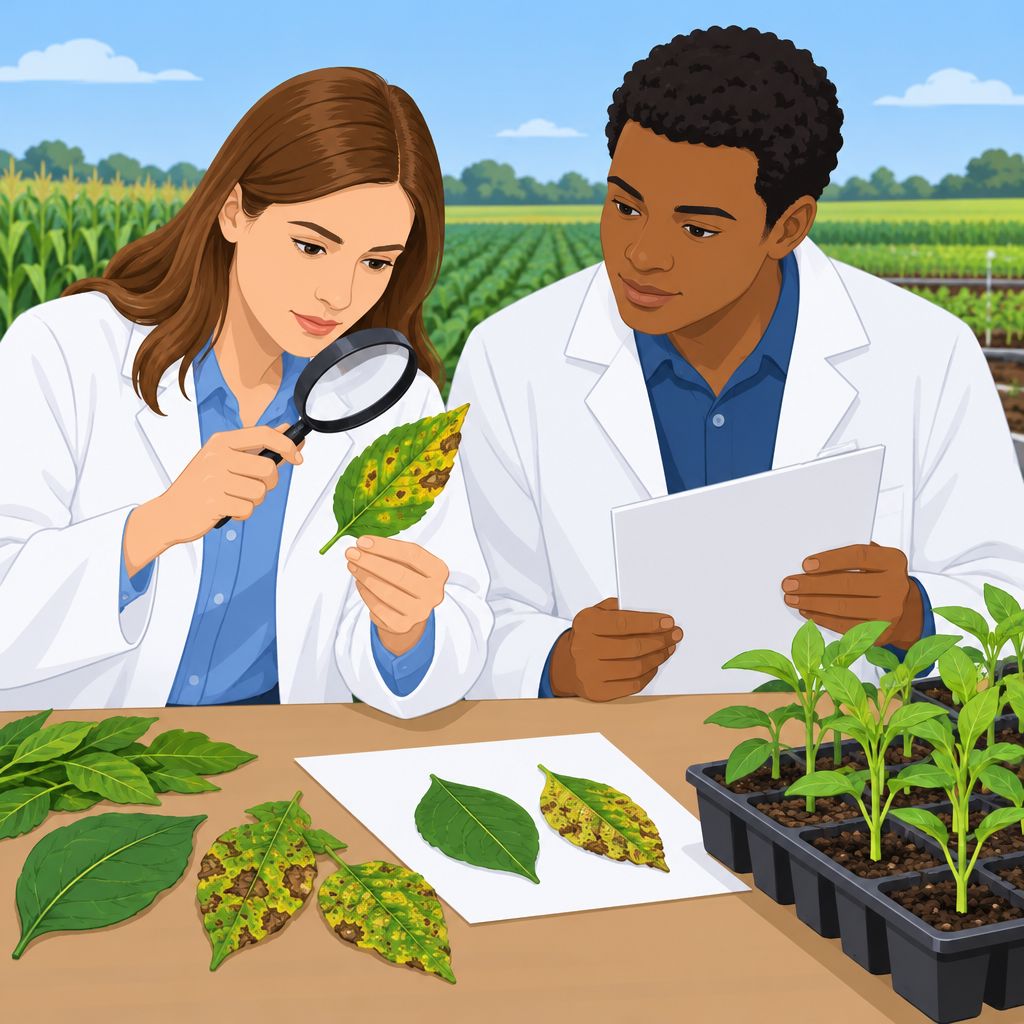
Challenges Faced by Plant Pathologists
Plant pathologists face several challenges while combating emerging plant diseases.
They must adapt disease management approaches as pathogens and environmental conditions change.
Effective solutions require cooperation among researchers, policymakers, farmers, and agricultural extension workers.
Emerging Plant Diseases
- Pathogens constantly evolve, creating significant challenges for plant pathologists.
- Rapid globalization and trade can spread new plant diseases across regions.
- Some pathogens develop resistance to fungicides and other control measures.
- Unknown disease characteristics can make emerging infections difficult to identify and manage.
Impact of Climate Change
- Climate change influences where plant diseases occur and how severely they affect crops.
- Changing temperatures and precipitation patterns create new environments for pathogens.
- Extreme weather events can increase disease outbreaks in crops.
- Climate change alters plant-pathogen interactions and affects disease development.
Collaboration Among Stakeholders
- Plant pathologists collaborate with researchers to understand plant disease mechanisms.
- They partner with policymakers to implement effective disease management strategies.
- They engage farmers and agricultural extension workers to share disease control information.
- International cooperation helps address global challenges in crop improvement programs.
These challenges require coordinated action from researchers, policymakers, and farmers.
By sharing expertise, stakeholders can develop innovative solutions for crop protection.
Such cooperation can help protect crops and support food security for future generations.
Find Out More: Ethical Considerations for Agricultural Loan Officers
Future Trends in Plant Pathology and Crop Improvement
Future plant pathology will increasingly connect rapid detection with proactive disease management.
Meanwhile, genomic analysis will guide breeding for resistance and resilience.
Climate shifts will require stronger surveillance as pathogens emerge and spread into new areas.
- Advanced technologies will improve disease detection and management strategies.
- Genomic tools will strengthen breeding for disease resistance and crop resilience.
- Climate change will encourage new pathogens and expand existing pathogen ranges.
- Big data and artificial intelligence will improve disease prediction and control.
Innovation for Sustainable Agricultural Practices
Innovation can make agricultural production more sustainable while protecting crop performance.
Research can reduce dependence on chemical pesticides through biological control methods.
Furthermore, adaptable varieties can support environmental conservation and long-term food security.
- Innovative breeding can produce crop varieties with stronger disease resistance.
- Biological control research can reduce reliance on chemical pesticides.
- Sustainable practices can conserve resources and support long-term food security.
- Continuous innovation can help crops adapt to changing climate conditions.
Plant Pathology Solutions for Global Food Security
Plant pathologists can connect scientific discovery with practical responses to global food security pressures.
They can help farmers apply disease management strategies that limit crop losses.
Through collaboration, their expertise can strengthen surveillance and implementation across farming systems.
- Plant pathologists can support disease-resistant crop development through innovative research.
- They can promote sustainable farming through practical disease management strategies.
- Their surveillance expertise can help detect threats and prevent crop losses.
- Collaboration with farmers and researchers can improve disease control implementation.
Gain More Insights: How Agricultural Economists Support Farm Businesses
Plant pathologists support crop improvement by identifying and managing diseases.
Additionally, they study pathogens and plant interactions to guide disease-resistant crop development.
Meanwhile, monitoring and research give farmers and agronomists practical disease insights.
Transform Your Career Today
Unlock a personalized career strategy that drives real results. Get tailored advice and a roadmap designed just for you.
Start NowBreeders also work with them to incorporate resistance genes and strengthen crop durability.
Through field surveys, these specialists assess disease prevalence and recommend effective control measures.
Moreover, collaboration with researchers and industry partners helps them track emerging threats.
Their diagnostic and management expertise supports sustainable agriculture and food security.
Consequently, they help maintain healthy and productive crop yields.
Furthermore, their contributions reduce disease risks while improving plant health.
Readers can explore plant pathology to understand its importance in agriculture.
Additional Resources
Google search results for Plant Pathologists and Crop Improvement Programs Agricultural
Bing search results for Plant Pathologists and Crop Improvement Programs Agricultural


