




Introduction to IoT Development
The Internet of Things connects everyday devices to the internet.
This technology enables communication and data exchange between devices.
IoT developers design and implement these interconnected systems.
Responsibilities of IoT Developers
They ensure each component operates seamlessly within its ecosystem.
Developers must possess diverse skills to build effective IoT solutions.
They also coordinate connected components during the development process.
Importance of IoT Hardware Knowledge
Understanding hardware components is crucial for IoT developers.
Each device comprises various hardware elements that function together.
Knowledge of these components allows developers to optimize performance and reliability.
Additionally, it helps developers troubleshoot issues during development.
Hardware Components Covered
Familiarity with hardware can influence design decisions and improve user experience.
This section covers essential hardware components for IoT development.
It explores sensors, microcontrollers, communication modules, and power sources.
Each component supports specific functions within IoT projects.
This knowledge is vital for successful IoT application development.
What Is IoT Development?
IoT development creates connected solutions that combine devices, software, sensors, and networks.
These solutions let devices exchange data and support automated actions.
Moreover, organizations apply IoT across homes, healthcare, manufacturing, and agriculture.
How Internet of Things Systems Operate
IoT devices collect information through sensors and share it across connected networks.
Software processes this information and helps devices respond to changing conditions.
Consequently, connected systems can automate routine tasks and improve operational efficiency.
For example, smart thermostats learn household patterns for heating and cooling.
This capability can reduce energy use within connected environments.
Meanwhile, hospitals use wearable devices to monitor patient health.
Similarly, agricultural systems use sensors to optimize irrigation.
These applications allow organizations to monitor conditions and analyze data in real time.
IoT developers create, connect, test, and maintain the components within IoT solutions.
They coordinate hardware and software work to ensure reliable communication between devices.
Additionally, developers protect connected systems against potential cybersecurity threats.
- Design and Development: Developers design hardware and software components for connected devices.
- Real-Time Data Processing: Developers process and analyze data as systems receive it.
- System Integration: Developers connect devices, platforms, and communication systems.
- Security Implementation: Developers secure devices against potential cyber threats.
- Testing: Developers test devices to confirm reliability and functionality.
- Collaboration: Developers work with hardware engineers and data analysts.
- Documentation: Developers prepare documentation for future development and maintenance.
Therefore, IoT developers need knowledge of hardware, software, communication protocols, and cloud computing.
Evolution of IoT Development Careers
IoT development began as a concept with limited practical applications.
However, expanding technologies have created greater demand for skilled IoT professionals.
Specialized development tools and platforms now support different parts of the IoT ecosystem.
Educational programs and certifications teach programming, data analysis, and networking skills.
As the profession grows, developers can focus on security, data analytics, or hardware interfacing.
Each specialization addresses distinct challenges within connected systems.
Security has become increasingly important as more devices connect to networks.
Developers must prioritize data protection throughout the development lifecycle.
Furthermore, artificial intelligence, big data, and machine learning continue to influence IoT development.
These technologies expand system capabilities and encourage developers to keep learning.
Transform Your Career Today
Unlock a personalized career strategy that drives real results. Get tailored advice and a roadmap designed just for you.
Start NowAs IoT advances, adaptable professionals will continue supporting innovation across many industries.
Essential Hardware Components in IoT
IoT hardware enables devices to collect, process, and exchange data.
These components help connected devices respond to environmental changes.
Understanding their roles helps developers create efficient and reliable IoT solutions.
Overview of IoT Hardware Components
Most IoT systems depend on sensors, actuators, microcontrollers, and communication modules.
Each component performs a specific function within the complete system.
Together, these components collect information, process signals, perform actions, and support connectivity.
Core Hardware Definitions
Sensors gather information from the physical environment.
Actuators respond to commands by creating physical changes.
Microcontrollers manage processing, while communication modules support data exchange.
Sensors for Environmental Data Collection
Sensors detect physical phenomena and convert them into signals.
Microcontrollers or other systems can process and analyze these signals.
Consequently, sensors provide the real-world data that IoT devices need.
- Temperature sensors measure ambient temperature.
- Humidity sensors detect moisture levels in the air.
- Motion sensors identify movement in a specific area.
- Light sensors measure light intensity.
Actuators for Physical Actions
Actuators convert electrical signals into physical actions.
They respond to instructions from sensors or control units.
As a result, actuators help devices interact with their surroundings.
- Motors drive mechanical movements.
- Relays control electrical circuits and loads.
- Servos provide precise control of angular position.
- Solenoids create linear motion through electromagnetic force.
Microcontrollers for Processing and Control
Microcontrollers manage processing and control operations within IoT devices.
A typical microcontroller combines a processor, memory, and input-output ports.
Therefore, the selected microcontroller strongly affects device performance and capabilities.
- Arduino provides an open-source platform for prototyping.
- Raspberry Pi offers a more powerful single-board computer.
- ESP8266 provides a low-cost Wi-Fi microcontroller.
- STM32 variants support various embedded applications.
Communication Modules for Connectivity
Communication modules connect IoT devices to networks.
They transmit data between system components and external systems.
Effective communication supports dependable data transfer throughout IoT ecosystems.
- Wi-Fi supports widely used, high-speed internet connections.
- Bluetooth supports short-range connections.
- Zigbee supports low-power, low-data-rate scenarios.
- Cellular connectivity supports applications requiring wide-area coverage.
Hardware Selection for Successful IoT Projects
Developers must select hardware that supports the project’s functional requirements.
Each component affects system integration, performance, cost, and long-term reliability.
Careful selection reduces technical challenges and supports successful project development.
- Compatibility: Components should integrate smoothly and communicate effectively.
- Power consumption: Low-power components can prolong battery life.
- Cost: Developers should balance functionality with budget constraints.
- Scalability: Components should support future project growth.
- Availability: Readily available components can reduce supply chain problems.
Additionally, a well-planned hardware setup can improve the user experience.
Quality components can help devices respond faster and more accurately.
These qualities strengthen user trust in device reliability.
Meanwhile, developers should monitor emerging sensors and communication modules.
New hardware can provide opportunities to improve IoT functionality.
By combining suitable components, developers can create efficient and dependable IoT solutions.
Uncover the Details: Common IT Support Specialist Interview Questions
Sensor Types in IoT Systems
Sensors capture specific environmental measurements for connected devices.
They help devices recognize changes and respond appropriately.
Therefore, developers select sensors according to each application’s requirements.
- Temperature Sensors: These sensors measure ambient temperature for weather stations and HVAC systems.
- Humidity Sensors: These sensors measure air moisture for agriculture and climate control systems.
- Motion Sensors: These sensors detect movement for security systems, smart lighting, and fitness trackers.
- Proximity Sensors: These sensors measure distances between themselves and nearby objects.
- Light Sensors: These sensors measure light intensity for automated lighting systems.
- Gas Sensors: These sensors detect gases for industrial safety and pollution monitoring.
- Accelerometers: These sensors measure acceleration forces for smartphones and automotive applications.
- Sound Sensors: These sensors detect sound intensity and frequency for noise monitoring.
How Sensors Collect IoT Data
Sensors collect relevant information continuously and support real-time device operations.
They improve reliability by providing timely information about changing conditions.
Additionally, connected systems can combine sensor readings for broader environmental awareness.
- Real-time Monitoring: Sensors provide immediate environmental information for prompt decisions.
- Automated Processes: Continuous readings help systems automate tasks and reduce manual intervention.
- Predictive Analysis: Historical sensor data supports forecasts and future planning.
- Environmental Awareness: Sensor readings help devices understand surrounding conditions.
- Data Aggregation: Multiple sensors provide comprehensive information and improve monitoring accuracy.
Popular Sensors and Their Applications
Manufacturers offer many sensors for different monitoring and automation needs.
Each sensor provides measurements that support specific applications and workflows.
Transform Your Career Today
Unlock a personalized career strategy that drives real results. Get tailored advice and a roadmap designed just for you.
Start NowFor example, developers can combine several sensor types within one connected solution.
- DHT11/DHT22: These sensors measure temperature and humidity for weather stations, greenhouses, and HVAC systems.
- PIR Sensors: These sensors detect motion for security, automatic lighting, and energy management.
- MQ Series Sensors: These sensors detect gases for air quality monitoring and industrial safety.
- HC-SR04: This ultrasonic sensor measures distance for robotics and object avoidance systems.
- TSL2561: This digital light sensor regulates lighting according to ambient light levels.
- BME280: This sensor measures temperature, humidity, and pressure for climate monitoring applications.
- ADXL345: This accelerometer tracks movement and orientation in smartphones and fitness trackers.
- MPU6050: This combined gyroscope and accelerometer supports motion tracking in drones and gaming devices.
Sensors as the Foundation of Connected Solutions
Sensors form the information-gathering foundation of many IoT solutions.
They convert environmental conditions into data that connected devices can use.
Consequently, developers can create responsive systems for cities, healthcare, and manufacturing.
Sensor integration also supports automation, connectivity, and predictive analytics.
These capabilities help devices deliver more informed and responsive experiences.
As IoT applications expand, developers must understand sensor capabilities and limitations.
See Related Content: Cloud Security Practices for Engineers
Microcontrollers in IoT Solutions
Microcontrollers provide the processing foundation for many IoT devices.
They combine processing, memory, and input/output functions on one chip.
Consequently, they help connected devices collect, process, and exchange information efficiently.
Microcontroller Functions in IoT Devices
Microcontrollers read sensor data and process information for connected applications.
They also execute commands that control attached actuators.
Moreover, these components support real-time data processing within IoT devices.
Microcontrollers can execute algorithms that manage device operations.
They support Wi-Fi, Zigbee, and Bluetooth communication in suitable applications.
Therefore, devices can exchange information with cloud systems or other connected devices.
Low power consumption also makes microcontrollers suitable for battery-operated equipment.
Popular Microcontroller Platforms
Developers choose microcontroller platforms according to project requirements and experience.
Each platform offers different capabilities, development tools, and connectivity options.
The following platforms support a wide range of IoT development tasks.
- Arduino: Arduino offers user-friendly boards, including the Uno and Nano, for straightforward prototyping.
- Its software development environment helps developers create projects efficiently.
- A large community provides support for Arduino users.
- Raspberry Pi: Raspberry Pi provides higher processing power than typical microcontroller boards.
- It runs a full operating system, such as Linux.
- Its versatility supports multiple programming languages and complex IoT applications.
- ESP8266: ESP8266 provides inexpensive Wi-Fi connectivity with full TCP/IP stack support.
- Developers often select it for internet-connected projects with limited budgets.
- It also offers efficient power consumption for suitable applications.
- ESP32: ESP32 improves on ESP8266 capabilities with dual-core processing and Bluetooth support.
- It supports applications ranging from simple sensors to complex smart devices.
- STM32: STM32 platforms provide performance, flexibility, and extensive peripheral options.
- They suit power-sensitive applications with varied configuration requirements.
Factors for Selecting a Microcontroller
Developers should match each microcontroller with the specific needs of their IoT project.
Project requirements determine the necessary processing, memory, connectivity, and physical characteristics.
Careful evaluation helps developers balance technical performance, cost, and implementation needs.
- Processing power: Select enough processing capacity for the application algorithms and required task complexity.
- Memory: Provide sufficient RAM and flash memory for sensor data and program operations.
- Input/output pins: Check the number and types of pins needed for sensors and actuators.
- Power consumption: Choose sleep modes and power-saving features for battery-operated devices.
- Connectivity: Confirm support for Wi-Fi, Bluetooth, Zigbee, LoRa, or other required protocols.
- Development environment: Review available tools, libraries, debugging features, and community support.
- Cost: Balance the required performance against the available project budget.
- Size: Ensure the microcontroller fits within the device design and available space.
- Availability: Verify reliable component supply to protect project schedules from shortages or discontinuation.
Microcontrollers as IoT Control Centers
Microcontrollers coordinate data collection, processing, communication, and device responses.
Their integrated design supports efficient operation across many IoT applications.
By selecting suitable platforms, developers can build capable and efficient connected solutions.
Delve into the Subject: Telecommunications Specialist: Balancing Work and Life
Connectivity drives IoT innovation.
Communication modules let devices exchange data across networks.
Developers need to understand available technologies before selecting communication methods.
Communication Technologies for IoT Networks
IoT networks use several communication technologies.
Each option offers distinct strengths and limitations.
Developers compare these characteristics when designing connected systems.
- Wi-Fi: Wi-Fi provides high-speed connectivity for substantial data transfers, but its power consumption challenges battery-operated devices.
- Bluetooth: Bluetooth supports short-range communication, while Bluetooth Low Energy extends battery life for IoT devices.
- Zigbee: Zigbee supports low-power, low-data-rate applications and creates mesh networks for home automation and industry.
- LoRa: LoRa enables low-power, long-range communication for remote sensors and agricultural applications.
- NFC: NFC enables very short-range communication for payment systems, authentication, and smart devices.
- Cellular: Cellular technologies, including 4G and 5G, provide broad coverage and high-speed data transfers.
Roles of Communication Modules in IoT Systems
Communication modules bridge IoT devices and networks.
They allow devices to transmit data to cloud services or other devices.
These modules also support control, monitoring, interoperability, security, and network growth.
- Data Transmission: Modules send and receive data packets across varying distances and conditions.
- Device Control: Modules enable users to manage connected appliances and systems remotely.
- Real-Time Monitoring: Modules deliver sensor data promptly, enabling timely responses.
- Interoperability: Modules support protocols that help devices from different manufacturers communicate.
- Data Security: Many modules use encryption protocols to protect transmitted information.
- Scalability: Modules support adding devices as IoT networks expand.
Selecting Communication Methods for Project Requirements
Project requirements determine which communication method best supports an IoT solution.
Developers should compare range, power use, data rate, environment, cost, and security.
These factors help teams create effective and efficient communication strategies.
Transform Your Career Today
Unlock a personalized career strategy that drives real results. Get tailored advice and a roadmap designed just for you.
Start Now- Range: Choose LoRa for long distances and Bluetooth for short-range connections.
- Power Consumption: Choose Zigbee or Bluetooth Low Energy for battery-operated devices.
- Data Rate: Choose Wi-Fi or cellular networks for high data rates, and LoRa or Zigbee for lower rates.
- Environment: Consider interference and physical barriers when selecting a communication technology.
- Cost: Account for subscription fees associated with cellular communication methods.
- Security Requirements: Select technologies with security features that match the project’s needs.
For example, Zigbee suits smart homes because it uses little power and supports mesh networking.
Meanwhile, LoRa suits city-wide sensor networks because it supports long-range communication.
Communication modules remain pivotal to connected systems.
They enable devices to connect, communicate, and collaborate in real time.
Developers who understand these technologies can make informed decisions about effectiveness, scalability, and project success.
Delve into the Subject: Penetration Testing Tools: Free vs. Paid Options
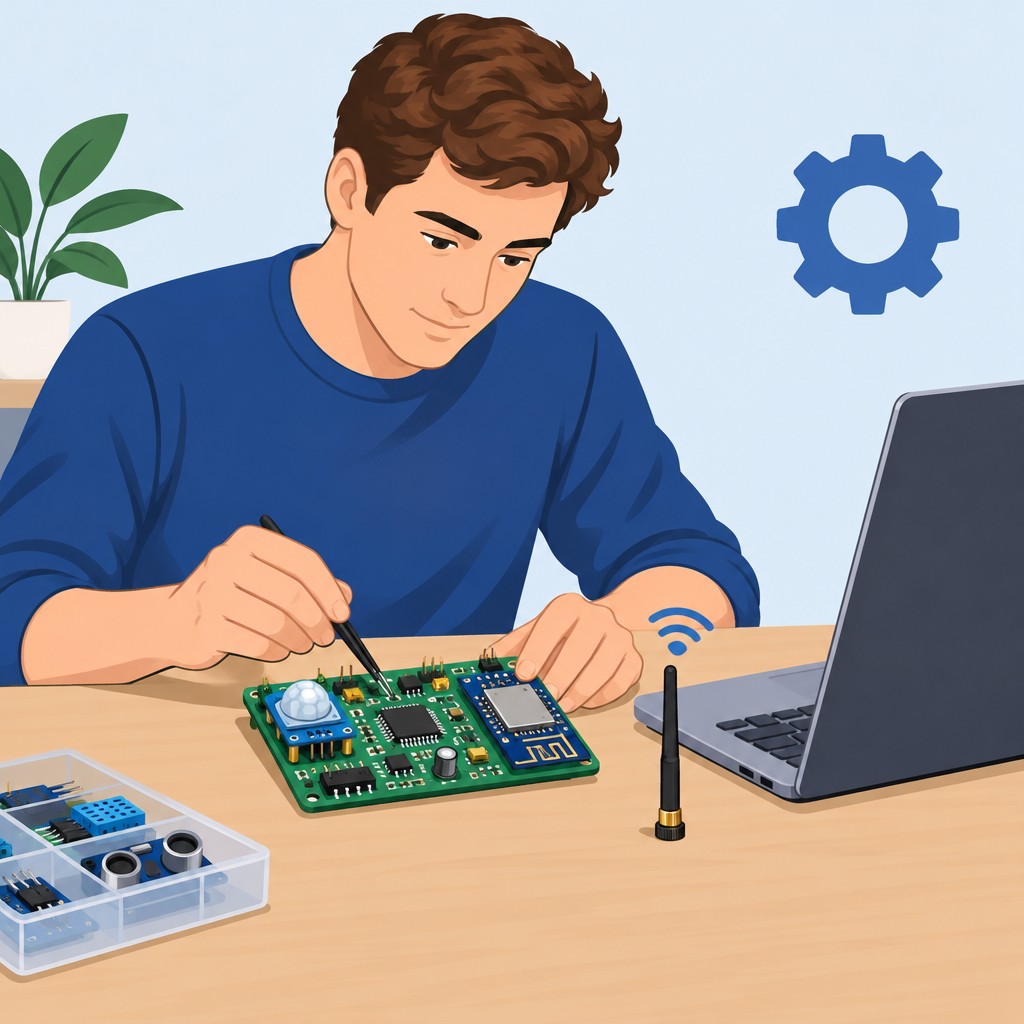
Importance of Power Management in IoT Devices
Power management helps IoT devices operate effectively in remote locations.
These locations often provide limited access to electrical outlets.
Therefore, efficient power use extends device lifespan and prevents service interruptions.
IoT devices use sensors, actuators, and wireless communication technologies.
Continuous interaction with these components requires careful power management.
- Longevity: Efficient power use reduces frequent battery replacements in hard-to-reach areas.
- Efficiency: Lower energy consumption reduces operational costs.
- Reliability: Consistent power increases uptime and improves user experiences.
- Sustainability: Reduced battery waste supports environmentally friendly practices.
Power Sources and Battery Options
IoT devices can use several power sources to maintain consistent operation.
Each option offers different benefits for specific applications.
Consequently, developers should match the power source to the device requirements.
Battery Power
Batteries remain common because they provide flexibility and portability.
Different battery chemistries support different power demands and product designs.
Developers can select from several established battery options.
- Alkaline Batteries: These affordable batteries suit low-drain devices.
- Lithium-Ion Batteries: These rechargeable batteries provide high energy density for long-term use.
- Lithium Polymer Batteries: These lightweight batteries suit compact devices and flexible designs.
- NiMH Batteries: These batteries offer decent performance and lower energy density than lithium options.
Solar Power
Solar energy provides a renewable option for powering IoT devices.
It can reduce dependence on traditional batteries.
Moreover, solar systems can support independent operation in suitable environments.
- Self-sufficiency: Solar-powered devices can operate independently and require less maintenance.
- Lower operational costs: Solar energy reduces battery replacement and energy expenses.
- Integration: Manufacturers can integrate solar panels into products for seamless operation.
Energy Harvesting
Energy harvesting captures ambient energy from surrounding environments.
These techniques can provide power without relying entirely on traditional batteries.
However, each method depends on an available environmental energy source.
- Thermal Energy Harvesting: This method converts temperature differences into electricity.
- Vibration Energy Harvesting: This method captures kinetic energy from movement or vibrations.
- RF Energy Harvesting: This method captures radio frequency signals to generate power.
Sustainable Power Management Practices
Growing IoT demand makes sustainability increasingly important.
Manufacturers and developers must consider energy use throughout device development.
Sustainable practices can reduce waste while supporting reliable device operation.
Efficient Device Design
Energy-efficient designs minimize power consumption during device operation.
Developers can combine efficient components with carefully planned software.
Additionally, sleep modes can limit power use during inactive periods.
- Low-power Components: Energy-efficient microcontrollers and sensors reduce consumption.
- Sleep Modes: Sleep and standby settings reduce usage when devices remain inactive.
- Smart Algorithms: Optimized algorithms improve data transmission and processing efficiency.
Renewable Energy Utilization
Renewable energy can reduce the battery burden for IoT devices.
Developers can select renewable options according to environmental conditions.
Hybrid systems can combine several sources to support continuous operation.
- Solar Panels: Panels can extend battery life in sunny locations.
- Wind Turbines: Small turbines can generate supplemental power in windy areas.
- Hybrid Systems: Solar, wind, and battery systems can provide continuous power.
Lifecycle Management
Lifecycle management supports sustainable production and responsible disposal.
Manufacturers can consider sustainability from construction through end-of-life handling.
Repairable designs can also extend product usefulness and reduce waste.
- Material Selection: Recyclable or biodegradable materials support responsible construction.
- End-of-life Programs: Take-back programs help recycle old devices properly.
- Remanufacturing: Repairable products support refurbishment and upcycling.
User Education and Responsible Use
User education helps people understand sustainable power management.
Clear guidance encourages responsible use and lower energy consumption.
Feedback also helps developers improve future power management practices.
- Informational Campaigns: Social media and newsletters can share sustainable usage tips.
- User Guides: Clear instructions can explain energy-saving features and maintenance.
- Feedback Mechanisms: User suggestions can guide future improvements.
Power Management for Reliable and Sustainable IoT Devices
Power management supports effective IoT device operation.
Developers should select power sources that match each application’s requirements.
Transform Your Career Today
Unlock a personalized career strategy that drives real results. Get tailored advice and a roadmap designed just for you.
Start NowThey should also combine efficient designs with sustainable lifecycle practices.
As IoT systems evolve, innovative power solutions will remain essential.
These solutions can help maintain efficiency, reliability, and sustainability.
Introduction to Prototyping Tools and Their Significance
Prototyping tools help developers experiment with IoT ideas before full-scale production.
They support rapid development and streamline design and testing processes.
This approach saves time and reduces costs associated with traditional development methods.
Developers can visualize concepts and assess their feasibility with these tools.
Furthermore, iterative testing reveals potential challenges early in development.
Companies can then adapt their projects according to prototype feedback.
Overview of IoT Development Kits
Development kits combine essential hardware and software tools in comprehensive packages.
These packages help developers create IoT products quickly.
They also provide practical resources for testing connected-device concepts.
Particle Development Boards
Particle provides IoT development boards and modules for connected-device integration.
Its cloud platform helps developers manage and monitor devices.
The Particle ecosystem includes several connectivity-focused boards.
- Particle Photon: This small Wi-Fi development board connects to the Particle cloud.
- Particle Boron: This cellular-enabled board supports remote connectivity.
- Particle Argon: This board provides Wi-Fi and mesh networking capabilities.
Adafruit Development Platforms
Adafruit offers components designed for makers and developers.
Its development kits support various IoT applications.
The product range includes platforms for connectivity, education, and prototyping.
- Adafruit Feather: This versatile platform includes Wi-Fi, Bluetooth, and LoRa boards.
- Adafruit Circuit Playground: This educational board supports hands-on coding and electronics practice.
- Adafruit Metro: This breadboard-compatible board offers various connectivity options.
BeagleBone Development Boards
BeagleBone boards support advanced users developing high-performance IoT solutions.
Their processing power suits complex applications.
Developers can select among several boards for different project requirements.
- BeagleBone Black: This single-board computer includes an ARM processor and numerous GPIO pins.
- BeagleBone Green: This enhanced version integrates additional elements, including a Grove connector.
- BeagleBone AI: This board includes machine learning capabilities for advanced projects.
Benefits of Development Kits for IoT Projects
Development kits offer several advantages for IoT projects.
They combine practical resources that support faster experimentation.
They also help developers manage project costs and complexity.
Faster Development Cycles
Development kits accelerate the prototyping phase.
Integrated hardware and software tools simplify testing.
Consequently, developers can build and refine projects quickly.
This speed supports a faster path toward market readiness.
Community Support
Most development kits have active online communities.
Developers can share experiences and troubleshoot problems together.
Additionally, community resources can strengthen learning and collaboration.
Cost-Effective Project Development
Development kits can reduce expenses over the long term.
Companies can avoid some research and development costs.
Many kits include essential features without requiring extra components.
This streamlined approach makes project budgeting easier.
Practical Learning Opportunities
Development kits provide useful educational resources for aspiring IoT developers.
They offer hands-on experience with real-world applications.
Developers can explore technologies without significant financial risk.
This experience supports skill development in a changing field.
Flexible Hardware Integration
Development kits often include sensors, modules, and connectors.
Transform Your Career Today
Unlock a personalized career strategy that drives real results. Get tailored advice and a roadmap designed just for you.
Start NowThese integrated components simplify hardware connections.
Developers can test different configurations and project scenarios quickly.
Such flexibility supports the design of complex IoT solutions.
Documentation and Tutorials
Reputable development kits include extensive documentation and tutorials.
These resources guide developers through setup and programming tasks.
Clear instructions reduce confusion and development errors.
Therefore, strong documentation improves the overall user experience.
Cloud Connectivity
Many development kits provide built-in cloud connectivity.
This capability supports integration with cloud platforms.
Developers can monitor and control IoT devices remotely.
Such connectivity supports modern IoT applications.
Applying Prototyping Resources to IoT Projects
Prototyping tools and development kits give IoT developers accessible paths toward innovation.
They support faster development, practical learning, and efficient project management.
Moreover, their hardware, software, documentation, and cloud features simplify experimentation.
Developers can use these resources to manage IoT project complexity with greater confidence.
Keeping current with available tools and technologies supports continued development success.
Key Hardware Components for IoT Development
This section recaps essential hardware components for IoT development.
Microcontrollers, sensors, and actuators each support successful IoT devices.
Connectivity modules help devices communicate across networks.
Meanwhile, power supplies support continuous operation.
Communication protocols promote standardized exchanges.
Therefore, developers need component knowledge for effective IoT design.
Benefits of Hardware Knowledge for IoT Developers
Strong hardware knowledge helps IoT developers innovate.
Understanding each component improves troubleshooting and supports new solutions.
Furthermore, this knowledge helps developers create efficient and effective IoT applications.
It also enables quick iterations during prototyping.
Continuous Learning and Experimentation in IoT
IoT continues to evolve and expand.
Therefore, developers must keep learning about new technologies and trends.
Experimenting with different hardware configurations can reveal new approaches.
Moreover, challenges can encourage creative problem-solving.
Online IoT communities and forums provide insights and collaboration opportunities.
Dedicated learning and curiosity can make IoT development rewarding.
Additional Resources
Google search results for IoT Developer: Key Hardware Components to Know Information Technology
Bing search results for IoT Developer: Key Hardware Components to Know Information Technology


