




Introduction to Plant Pathology
Plant pathology examines plant diseases affecting crops.
It helps agriculture identify problems that threaten plant health.
Therefore, this field supports efforts to manage diseases in crop production.
Bacterial Diseases in Plants
Bacterial diseases threaten plant health and agricultural production.
These diseases can cause yield losses and economic damages.
Consequently, effective management requires accurate information about bacterial pathogens.
Agricultural Importance of Plant Pathologists
Plant pathologists help protect food security by identifying diseases affecting crop plants.
They study bacterial diseases through surveys, laboratory tests, and field experiments.
Additionally, their work examines disease development and spread.
Disease Diagnosis and Management
Accurate diagnosis helps specialists choose effective disease management strategies.
Plant pathologists study pathogen biology and epidemiology to understand disease behavior.
As a result, they can develop sustainable practices that reduce crop losses.
What Are Bacterial Diseases in Plants?
Harmful bacteria infect plant parts and cause symptoms that damage crops.
These infections can weaken plants and interfere with normal growth.
Disease signs vary according to the affected tissue and bacterial condition.
Common Bacterial Diseases Affecting Plants
Several bacterial diseases affect leaves, stems, fruits, and other plant structures.
Each disease produces distinct symptoms that can interfere with plant development.
Farmers can observe these symptoms when assessing plant health and crop damage.
- Bacterial Leaf Spot causes dark leaf lesions that reduce photosynthesis and weaken the plant.
- Bacterial Soft Rot breaks down stems and fruits, causing a foul smell and crop loss.
- Crown Gall Disease creates tumor-like stem growths that affect nutrient uptake and plant growth.
- Fire Blight affects fruit trees by causing wilting, blackened shoots, and eventual plant death.
Effects on Crop Yield and Quality
Bacterial diseases can reduce crop yields by damaging plant health and productivity.
They can also lower the quality of harvested fruits and vegetables.
Consequently, farmers and agricultural industries may face financial losses and higher management costs.
- Reduced yield limits the amount of produce that farmers can harvest.
- Lower quality can reduce market value and affect consumer perception.
- Economic losses can affect farmers and agricultural industries.
- Management requires additional resources and expenses during crop production.
- Increased pesticide use may cause environmental pollution and ecosystem disruption.
Plant pathologists study bacterial diseases that affect plants.
Their expertise supports crop protection and food security.
Plant Pathologists’ Role in Bacterial Disease Research
Plant pathologists investigate the causes of bacterial diseases in plants.
They also develop strategies that prevent and manage these diseases.
Additionally, they teach farmers and agricultural professionals about disease control.
- Researchers examine bacterial diseases and their causes.
- They develop methods that help minimize crop losses.
- They explain disease identification and control methods to agricultural professionals.
Identifying and Diagnosing Bacterial Diseases
Plant pathologists first examine symptoms on affected plants.
Next, they collect samples from infected plant tissues.
Laboratory tests then help them isolate and identify bacterial pathogens.
- They assess plant symptoms for signs of bacterial infection.
- They analyze collected samples through laboratory testing.
- Careful analysis helps identify the responsible bacterial species.
Microscopes and Molecular Techniques in Disease Research
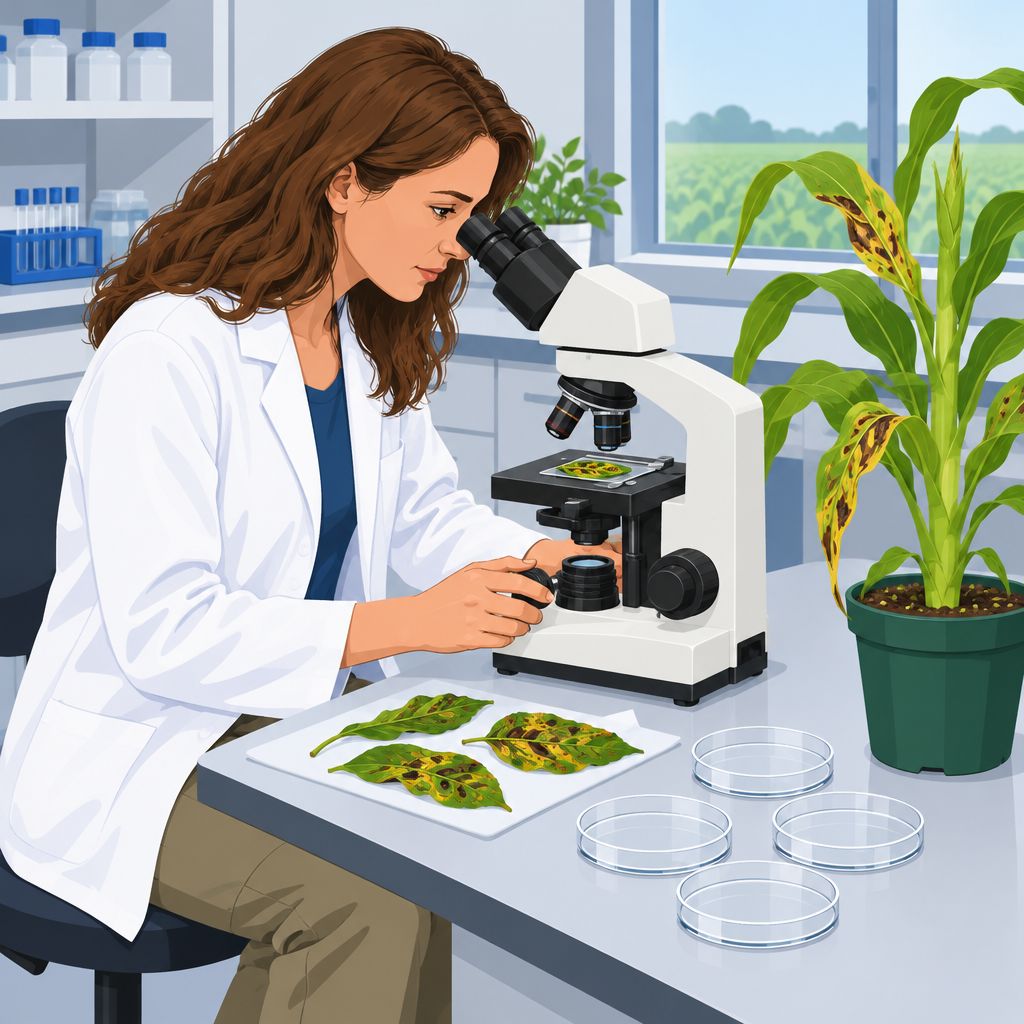
Microscopes allow researchers to observe bacterial structures in infected tissues.
Meanwhile, molecular techniques detect bacterial DNA in collected samples.
Researchers combine traditional observations with advanced methods for accurate diagnoses.
- Microscopes reveal bacterial structures and characteristics.
- PCR helps detect and identify bacterial DNA.
- Combined methods improve bacterial disease diagnosis.
Through research and diagnosis, plant pathologists help manage bacterial diseases effectively.
Explore Further: Precision Agriculture: Improving Water Management
Fieldwork Conducted by Plant Pathologists
Plant pathologists investigate bacterial diseases affecting plants through field observations, sample collection, and data analysis.
Their fieldwork helps identify bacterial pathogens and supports efforts to reduce disease damage.
They also gather evidence that guides disease management in agricultural and natural ecosystems.
Plant Sample Collection in the Field
Pathologists begin by selecting plants that show symptoms associated with possible bacterial diseases.
They collect samples from multiple plant parts to support comprehensive laboratory analysis.
Furthermore, they document field conditions and symptoms alongside each collected sample.
Transform Your Career Today
Unlock a personalized career strategy that drives real results. Get tailored advice and a roadmap designed just for you.
Start Now- Pathologists select plants showing symptoms that may indicate bacterial disease.
- They collect leaves, stems, roots, and fruits from several plant parts for comprehensive analysis.
- They use sterile scissors, containers, and gloves to reduce contamination during collection.
- They record locations, environmental conditions, and observed symptoms to help trace pathogen spread.
Analysis of Samples for Bacterial Pathogens
Laboratory analysis begins by preparing collected material for careful examination.
Pathologists combine microscopy and molecular methods to identify pathogens accurately.
Results help characterize disease conditions and assess their nature and severity.
- Pathologists clean and sterilize samples to remove external contaminants.
- Microscopes reveal cellular changes, lesions, or bacterial colonies in plant material.
- PCR and DNA sequencing identify specific bacterial pathogens in samples.
- Pathologists compare symptoms with identified pathogens to characterize each disease.
- They interpret findings to understand pathogen effects and guide control efforts.
Uncover the Details: Precision Agriculture: Leveraging Machine Learning
Laboratory Research on Bacterial Diseases
Plant pathologists study bacterial diseases through controlled laboratory research.
They examine interactions between plants and pathogenic bacteria.
Controlled experiments reveal how bacteria infect plants and produce disease.
Researchers also analyze infection mechanisms and disease development.
Furthermore, they isolate bacteria, analyze genetic information, and study host-pathogen interactions.
These investigations help researchers identify targets for disease management strategies.
Experiments Used to Study Bacterial Diseases
Plant pathologists conduct experiments to understand bacterial disease spread, infection, and plant damage.
They compare disease responses under controlled conditions.
Additionally, researchers use several experimental approaches to examine bacterial behavior.
- Pathogenicity assays involve infecting plants and observing symptoms and infection severity.
- Transmission studies examine bacterial movement between plants, insects, and other disease vectors.
- Host range tests measure susceptibility among different plant species and bacterial strains.
Methods for Isolating and Culturing Bacteria
Plant pathologists isolate and culture bacteria for detailed laboratory analysis.
They collect material from infected leaves, stems, roots, and soil.
Next, researchers sterilize samples to remove contaminants before isolating target bacteria.
They grow the bacteria on culture media that supports bacterial development.
Moreover, researchers identify isolates through microscopy, molecular biology, and biochemical tests.
- Pathologists collect samples from infected plant tissues and surrounding soil.
- They sterilize collected material to reduce contamination during bacterial isolation.
- Researchers select culture media that supports bacterial growth and observation.
- They identify and characterize isolates using laboratory and molecular techniques.
Controlled cultures help researchers examine bacterial growth and behavior.
These observations reveal factors that contribute to disease development.
Consequently, researchers can design management strategies for bacterial diseases in plants.
This laboratory work improves understanding of plant-pathogen interactions and supports sustainable disease management.
See Related Content: The Journey from Vineyard to Wine Bottle
Plant pathologists monitor bacterial diseases and guide actions that protect plant health.
They combine field observations, diagnostic testing, and environmental information to track disease activity.
Their recommendations also help reduce pathogen buildup and limit bacterial spread.
Monitoring Disease Outbreaks
- Plant pathologists inspect crops for wilting, leaf spots, and discoloration.
- They use ELISA and PCR tests to identify bacteria in plant tissue.
- Additionally, they monitor weather conditions and local disease history.
- This information helps them predict potential disease outbreaks.
Controlling Bacterial Diseases
Plant pathologists recommend several strategies to control bacterial diseases in crops.
These measures target pathogens in soil, infected plant material, and affected crops.
Farmers can combine these approaches to reduce bacterial disease risks.
- Crop rotation reduces pathogen buildup in the soil.
- Resistant varieties can withstand bacterial infections more effectively.
- Good sanitation, including debris removal, helps prevent bacterial spread.
- Finally, copper-based fungicides can address severe bacterial infections as a last resort.
Discover More: Collaboration Between Food Safety and Other Departments
Collaborations With Farmers and Agricultural Industry
Plant pathologists collaborate with farmers and agricultural industries to identify, diagnose, and manage bacterial crop diseases.
This partnership supports effective disease control while strengthening food security and agricultural sustainability.
Together, these groups develop practical strategies that prevent disease spread and protect crop productivity.
Importance of Plant Pathologists Working With Farmers
Close collaboration gives farmers access to expert knowledge about identifying and managing bacterial diseases.
Plant pathologists help farmers diagnose crop problems accurately and select suitable treatments.
Moreover, proactive partnerships support integrated disease management strategies tailored to local needs and circumstances.
Impact of Research on Sustainable Agriculture Practices
Research by plant pathologists strengthens sustainable agricultural practices.
By studying bacterial diseases and their crop effects, they develop innovative, environmentally responsible control solutions.
These strategies help farmers protect yields, reduce chemical use, and maintain productivity and profitability.
Consequently, farmers can reduce chemical pesticides and fertilizers while limiting environmental impacts.
Transform Your Career Today
Unlock a personalized career strategy that drives real results. Get tailored advice and a roadmap designed just for you.
Start NowSupporting Future Crop Health
Plant pathologists, farmers, and agricultural industries must continue working together to manage bacterial crop diseases effectively.
Their collaboration promotes sustainable practices that support food security and environmental stewardship.
Research-based disease management helps preserve healthy, productive crops for future generations.
Methods for Identifying Bacterial Pathogens
Plant pathologists isolate and identify bacterial pathogens to determine which organisms cause plant infections.
They also examine environmental conditions that encourage disease spread among plant populations.
Moreover, molecular techniques reveal bacterial genetic makeup and clarify mechanisms that increase virulence.
Field surveys track disease prevalence and distribution across different plant populations.
These methods help researchers understand bacterial infections and develop effective management strategies.
Research Applications for Crop Protection
Pathologists collaborate with breeders to develop plant varieties that resist bacterial diseases.
They evaluate chemical and biological treatments through experiments against bacterial pathogens.
Additionally, researchers use these results to guide effective disease management.
Their findings explain how bacterial infections affect plants and support crop protection efforts.
This research helps maintain crop health and increase agricultural productivity.
Understanding infection factors supports sustainable solutions, food security, and sustainable farming practices.
Additional Resources
Google search results for How Plant Pathologists Study Bacterial Diseases Agricultural
Bing search results for How Plant Pathologists Study Bacterial Diseases Agricultural


