




Highway WORKS training apprenticeship searches can lead to a funding announcement rather than a course application. The first question is who must apply. A state transportation department’s funding deadline is not your enrollment deadline, start date or job offer.
This report separates the state, provider and individual lanes. It uses two fictional candidate interests to show which records remain missing. Four editable CSV tools help you track real evidence before paying, traveling or changing your work schedule.
Highway WORKS training apprenticeship: identify the applicant
FHWA’s November 18, 2026 announcement describes a $26 million initiative with up to $500,000 per state. It names January 31, 2027 for state transportation departments to apply. Its examples include trade academies, advanced surveying, heavy equipment operation and digital construction management.
The linked call for statements of work is addressed to state DOTs. It describes submission of a plan and budget for review and approval. It is not an individual training application. A published federal opportunity does not establish that a particular state, provider or learner has already received funding.
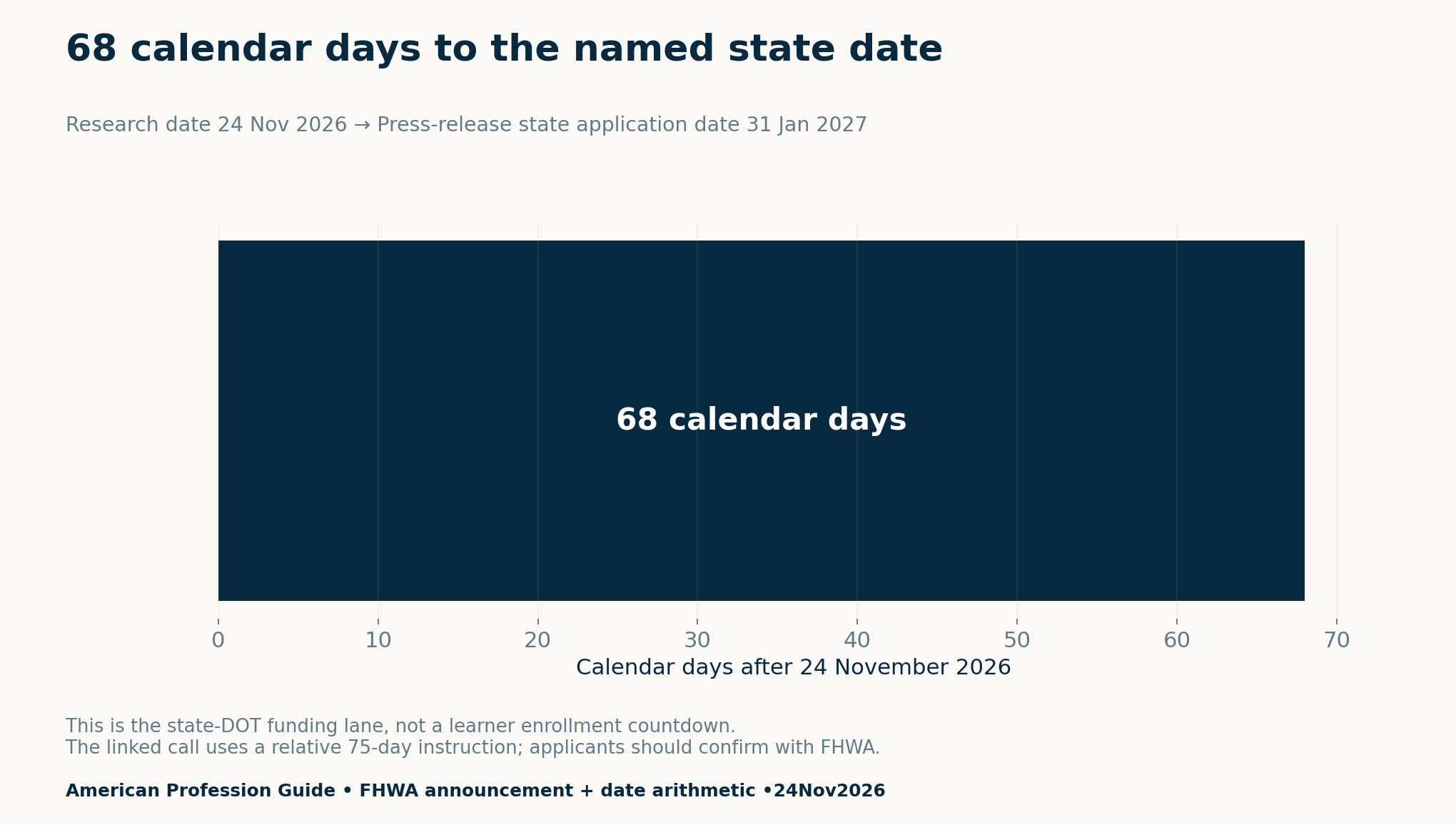
Keep both forms of the schedule visible. The press release supplies a calendar date, while the call uses a relative period from publication. Do not guess the publication anchor to resolve that wording. A learner should seek the local cohort’s own dated notice instead of borrowing either state-funding instruction.
Lane one: funding is a program-level record
For a state funding claim, record the agency, dated official source and precisely what that source confirms. A proposal is not approval, and approval is not a personal entitlement. If no dated state confirmation has been located, write “not found” for the search performed rather than “no funding exists.”
Likewise, the overall amount and maximum allocation do not establish a payment to you. Do not divide the total by an assumed learner count or describe the state maximum as a personal training grant. The evidence needs to match the level of the claim.
Lane two: find an actual provider and cohort
Next, look for a dated local notice naming the provider, location and training period. Ask who owns enrollment and which requirements apply. A skill area mentioned in the federal announcement is an example of possible activity, not proof of a nearby cohort.
For a real option, save the provider’s course or cohort reference and the date checked. Confirm whether applications are open, which documents are required and who can answer questions. If the provider cannot yet give a start date, keep it unresolved. Do not substitute a planned program period for class hours.
Lane three: your admission and paid-work terms
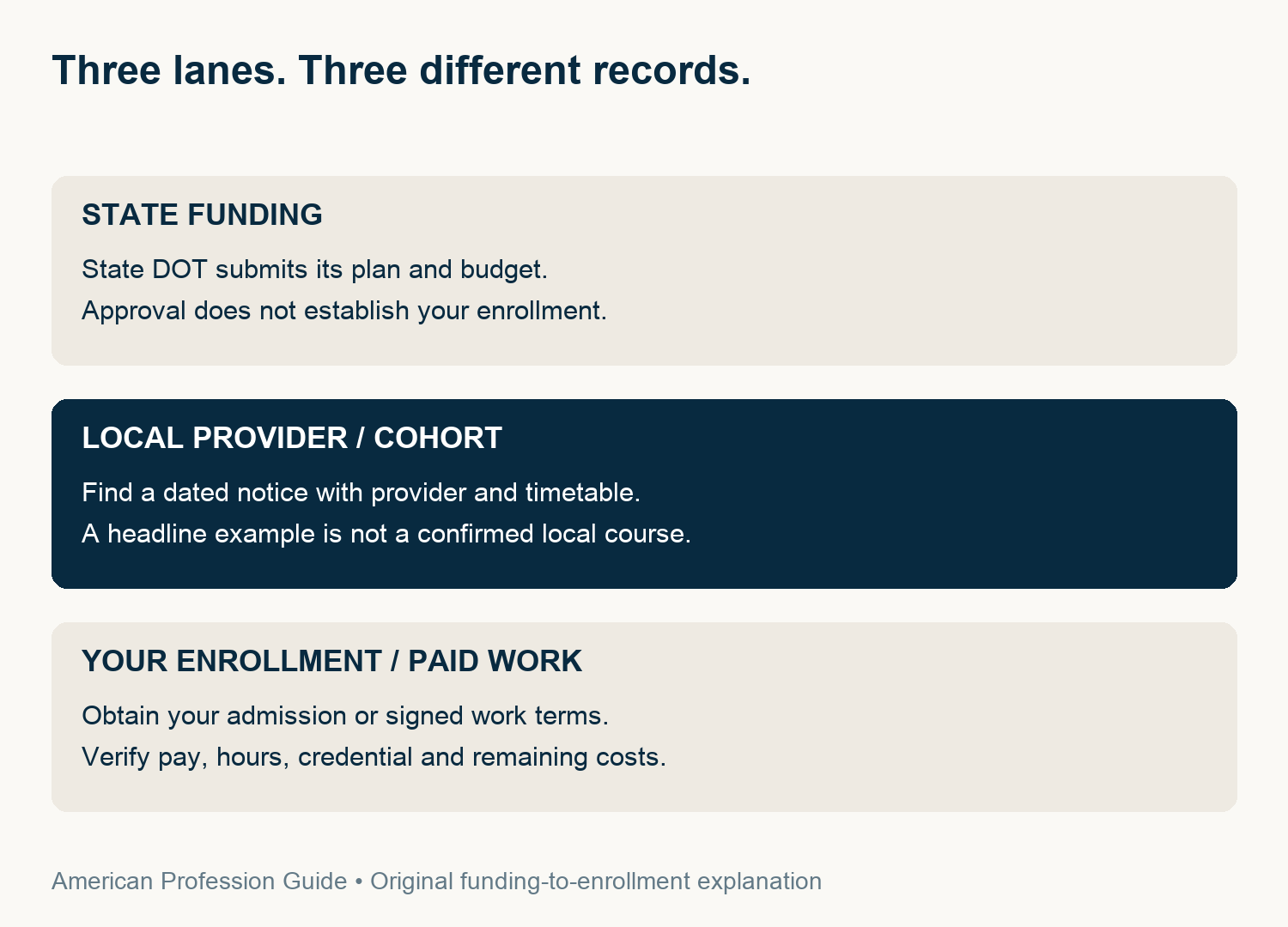
Before changing work or making a payment, obtain the written terms for your own place. Check admission, class hours, location, credential, remaining costs and any attendance conditions. If paid work is part of the offer, verify the named employer, pay terms and expected hours separately.
A general pathway-to-jobs statement does not give an individual a signed offer. Ask what evidence confirms your status and which organization is responsible for each promise. Keep a dated copy of the answer, using secure storage for any personal application documents.
An academy is not automatically a Registered Apprenticeship
The official Apprenticeship Finder is a separate route to investigate advertised opportunities. Read the individual result and its registration-related labels carefully, then verify the exact employer or sponsor and program terms. A course title containing “apprenticeship” should not replace that check.
The DOL apprenticeship introduction directs career seekers to apply with the employer or sponsor for a specific opportunity. This is different from applying to FHWA for state program funding. Record the actual application route rather than merging the two processes.
Two fictional interests, with no offer inferred
| Fictional interest | Local cohort notice | Personal enrollment or offer |
|---|---|---|
| Surveying | Not found in this teaching case | Not found |
| Equipment operations | Not found in this teaching case | Not found |
Both fictional candidates begin with a relevant interest, not a verified opportunity. The next useful action is to identify the state contact and a specific provider notice. Pay, credential and remaining costs stay unverified until a dated source supplies them. Empty fields are more useful than invented details.
For the separate question of what a training record may mean to another employer, see our credential-transfer evidence guide. Here the focus is establishing that the funding, cohort and personal offer are different records in the first place.
Methods and reusable tools
We checked the FHWA release, linked call and official apprenticeship resources on November 24, 2026. The date chart calculates the interval to the calendar date in the release. The three-lane framework and candidate tracks are original teaching aids, not a search census of funded states or providers.
No funded local seat, wage, individual grant, approval or apprenticeship placement is inferred. We use one dated interval chart and one explanatory map because extra charts would imply outcomes the sources do not measure. Recheck current official notices before relying on a schedule.
- Dated funding scope and schedule notes (CSV)
- Two fictional candidate-interest records (CSV)
- Blank three-lane evidence tracker (CSV)
- Blank enrollment and work-terms questions (CSV)
Suggested citation: American Profession Guide, “Highway WORKS Training: Find the Applicant Behind the Announcement,” November 24, 2026. Cite FHWA for funding details and this report for the original verification framework.


