




Drones in Modern Irrigation
Drones, also known as unmanned aerial vehicles, have revolutionized various industries with their capabilities.
In agriculture, modern irrigation practices play a crucial role in ensuring optimal crop growth and yield.
This article examines how drones enhance modern irrigation practices.
Overview of Drones
Drones are flying devices equipped with cameras and sensors.
Operators can control them remotely or program them to operate autonomously.
Additionally, drones capture data and monitor different environments.
Importance of Modern Irrigation Practices
Modern irrigation practices support sustainable agriculture.
They help farmers optimize water usage and improve crop productivity.
These practices apply water precisely, reduce wastage, and ensure efficient use.
Drones in Modern Irrigation Practices
Drones have become valuable tools in modern irrigation practices.
They provide farmers with real-time data on crop health, soil moisture levels, and irrigation needs.
Farmers can therefore make informed decisions about water allocation and distribution.
Consequently, drones improve efficiency and support higher yields.
History of Irrigation Practices
- Brief history of irrigation practices
- Traditional methods used for irrigation
- Introduction of modern irrigation practices
Throughout history, humans developed irrigation techniques to support crops and maintain a stable food supply.
Ancient civilizations, including the Sumerians, Egyptians, and Chinese, practiced irrigation.
Traditional methods relied on manual labor to move water across agricultural fields.
For example, workers dug trenches or carried buckets to transport water.
However, these methods required substantial labor and often distributed water unevenly.
They also caused water wastage, which reduced their overall efficiency.
Meanwhile, technological advances introduced modern irrigation practices.
These practices use innovative tools and techniques to optimize water usage.
Consequently, modern systems can support improved crop yields.
Importance of Modern Irrigation
Efficient irrigation helps maximize crop yields, conserve water resources, and support food security.
Modern irrigation also helps farmers manage water supplies more effectively.
Additionally, sustainable practices protect agricultural productivity and environmental resources.
- Significance of Efficient Irrigation
- Impact on Agriculture and Food Production
- Need for Sustainable Water Management
Efficient irrigation techniques help farmers optimize water usage and minimize waste.
As a result, farmers can achieve higher productivity with available water supplies.
Proper irrigation provides crops with adequate moisture for healthy growth and increased yields.
Moreover, modern practices reduce labor costs and improve overall agricultural efficiency.
Modern irrigation methods allow farmers to cultivate crops in arid regions.
Increased water access has expanded farmland and encouraged crop diversification.
Improved technologies also help farmers reduce risks from drought and climate variability.
Sustainable water management ensures the long-term availability of irrigation resources.
Efficient practices can reduce water scarcity and prevent excessive groundwater extraction.
Finally, sustainable management protects ecosystems and helps maintain water quality.
See Related Content: Role of an Agricultural Loan Officer Explained
Role of Technology in Agriculture
Technology has transformed agriculture by addressing longstanding farming challenges.
Modern tools improve farming efficiency, productivity, and sustainability.
Moreover, digital systems help farmers manage field conditions with greater precision.
Drone-Based Irrigation Management
Drones provide accurate, real-time information that helps farmers improve irrigation decisions.
Transform Your Career Today
Unlock a personalized career strategy that drives real results. Get tailored advice and a roadmap designed just for you.
Start NowSensors measure soil moisture, crop health, and irrigation needs across farmland.
Consequently, farmers can respond precisely to changing crop and environmental conditions.
Data analysis creates customized irrigation schedules that support efficient water use.
Drones identify over-irrigated and under-irrigated areas before those conditions damage crop development.
Therefore, farmers can reduce water waste while supporting consistent crop growth.
Field mapping helps farmers detect irrigation problems early and take timely action.
Additionally, drones can water selected zones according to crop needs and environmental conditions.
This targeted approach can save water, reduce labor costs, and increase crop yields.
Farmers can also manage water resources more effectively and reduce crop water stress.
As a result, drone technology supports more informed and sustainable irrigation management.
Explore Further: How Agricultural Loan Officers Support Farmers
Drone-Based Irrigation Monitoring
Drones now help farmers monitor crops and manage irrigation more precisely.
They provide timely field information that supports better irrigation decisions.
Farmers can also use drone data to identify changing crop and soil conditions.
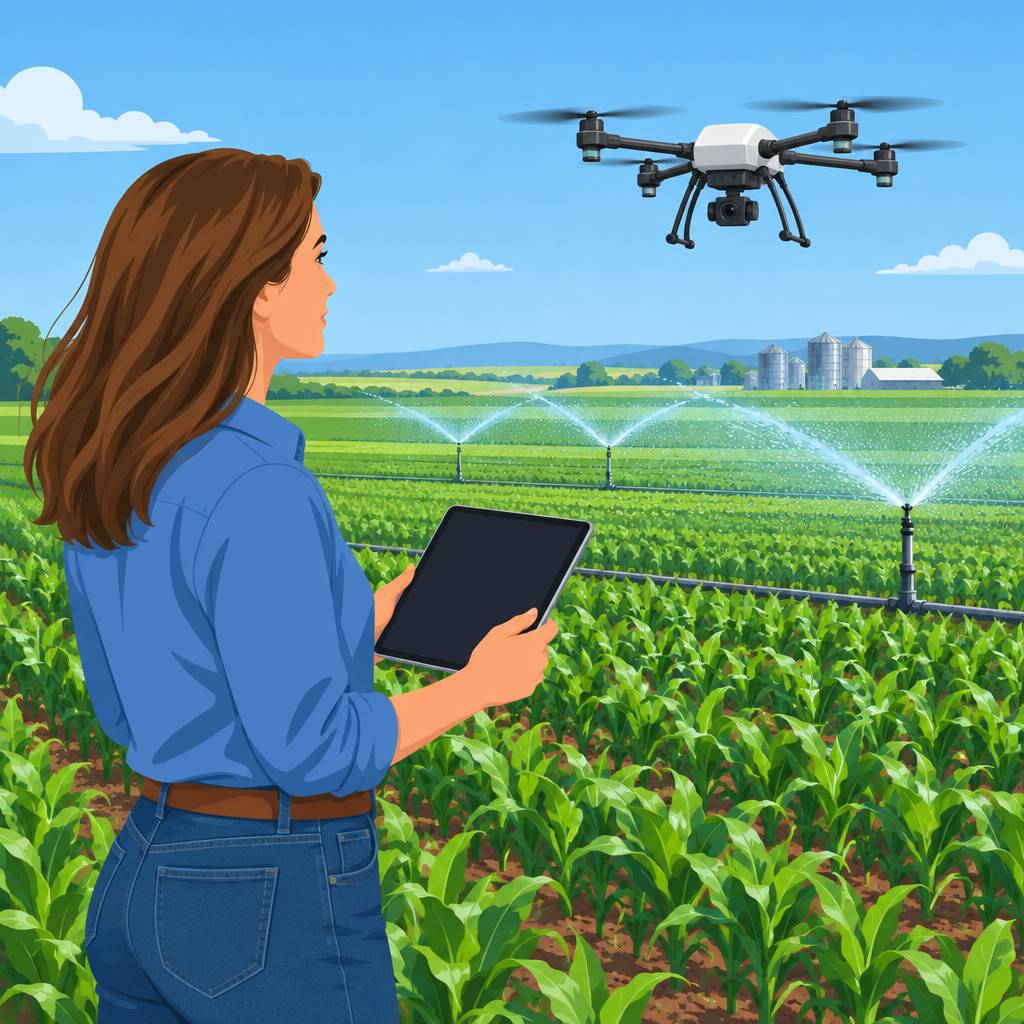
How Drones Support Irrigation Decisions
Equipped with sensors, drones fly over fields and collect soil moisture data.
Farmers analyze this information to determine irrigation needs across specific field areas.
Additionally, drones monitor crop health, pest infestations, and general field conditions.
- Drones collect soil moisture data across agricultural fields.
- Farmers analyze the data to identify areas requiring irrigation.
- Drone surveys reveal crop health issues and changing field conditions.
Benefits of Drone-Based Irrigation Management
Real-time information helps farmers apply water according to actual irrigation requirements.
Consequently, targeted irrigation can reduce water waste and support cost savings.
Timely interventions can also improve crop yield and quality.
- Farmers improve water efficiency by responding to current irrigation needs.
- They can reduce waste while optimizing fertilizer and pesticide applications.
- Drone-collected data supports timely actions that enhance crop yield and quality.
Examples of Drone Applications in Agriculture
Farmers in California use drones to monitor vineyards and improve irrigation schedules.
In Japan, drone surveys help identify rice paddies that need additional water.
Australian farmers use drones to map fields and develop irrigation plans.
- California vineyards use drone monitoring to support irrigation scheduling.
- Japanese rice growers use drones to detect paddies requiring more water.
- Australian farmers use drone maps to plan irrigation and manage crops.
These applications give farmers accurate and actionable information for irrigation management.
Furthermore, drone monitoring helps connect field conditions with practical farm decisions.
As a result, drones can support more responsive irrigation and stronger crop productivity.
Learn More: Agricultural Consultants: Key Trends in Crop Management
Advantages of Drones in Irrigation
Drones support precise irrigation decisions across agricultural fields.
They help farmers target water delivery while reducing unnecessary use.
These advantages can improve irrigation management, affordability, and adaptability.
- Increased efficiency and precision
- Reduction of water usage
- Cost-effectiveness and scalability
Increased Efficiency and Precision
Drones can follow programmed flight paths across fields.
This control supports targeted water distribution for individual crop areas.
Consequently, plants can receive suitable amounts of water for growth and yield.
Reduced Water Usage
Drones can map moisture levels across soil and crop areas.
Farmers can then identify where and when irrigation requires water.
This targeted approach conserves water and helps prevent overwatering.
Cost-Effectiveness and Scalability
Drones offer a cost-effective option for large-scale agricultural operations.
Automation can reduce manual labor and equipment requirements.
Additionally, scalable technology can support different field sizes and crop types.
Together, these benefits help farmers pursue higher productivity and sustainable irrigation practices.
Transform Your Career Today
Unlock a personalized career strategy that drives real results. Get tailored advice and a roadmap designed just for you.
Start NowFind Out More: Environmental Scientists: Guardians of Agricultural Health
Challenges of Implementing Drones in Irrigation
Drones offer many benefits for modern irrigation practices.
However, farmers must address several challenges before widespread adoption can occur.
These challenges involve regulations, training requirements, and financial commitments.
- Regulatory restrictions can limit drone use in irrigation practices.
- Specialized training helps farmers operate drones effectively.
- Initial purchasing and maintenance costs can challenge many farmers.
Regulatory Hurdles and Restrictions
Government regulations create one of the primary challenges for agricultural drone operations.
Authorities may impose complex and strict requirements on drone use.
For example, farmers may need permits, licenses, and compliance with airspace restrictions.
Farmers must understand these requirements before operating drones legally and safely.
Failure to follow regulations can result in fines or other penalties.
Specialized Training Requirements
Farmers also need specialized training to use drones for agricultural purposes.
Effective drone operation requires skills and knowledge that farmers may not initially possess.
Training programs can cover drone operations, maintenance, and data analysis.
Furthermore, trained operators can use drone technology more effectively.
Proper training can help farmers optimize water usage in agriculture.
Initial Investment Costs
Purchasing drones and related equipment can require a significant initial investment.
Consequently, many farmers may hesitate to make this financial commitment.
Farmers must also budget for training, maintenance, and technology upgrades.
Securing financing or grants may prove difficult for small-scale farmers.
Limited resources can make these expenses especially challenging to manage.
Nevertheless, addressing these barriers can help farmers adopt drone technology.
Drones can improve water efficiency, crop yields, and agricultural sustainability.
Future Directions for Drones in Irrigation
Drones already provide real-time irrigation data and analysis to farmers.
Future advances may make these tools more efficient and effective.
These developments could expand drone use across sustainable agricultural practices.
- Further advancements in drone technology
- Expansion of drone applications in agriculture
- Predictions for drones in future irrigation practices
Potential Advancements in Drone Technology
Technology continues to advance rapidly, creating new possibilities for agricultural drones.
Future drones may fly longer and collect information through improved sensors.
Researchers may also improve precision agriculture techniques through continued development.
Expanding Agricultural Applications
Farmers already use drones for crop monitoring, pest detection, and soil analysis.
Moreover, artificial intelligence and machine learning may expand irrigation applications.
Algorithms could optimize irrigation schedules, detect plant water stress, and improve water management.
The Future Role of Drones in Irrigation
Drones may become essential tools for farmers and irrigation specialists.
Their timely aerial data could help farmers reduce water waste and increase crop yields.
Additionally, drones could monitor water distribution, detect leaks, and assess irrigation infrastructure.
Sustainable Implications of Drone-Assisted Irrigation
Drones provide real-time data on crop health and water distribution.
Consequently, they improve irrigation efficiency and support more sustainable agricultural practices.
Their use can reduce costs, improve crop yields, and conserve water.
However, regulations, limited battery life, and high initial costs can hinder widespread adoption.
Therefore, continued research can improve practical drone applications for irrigation.
Data-driven tools can strengthen food production while reducing agriculture’s environmental impact.
Meanwhile, farmers can integrate drone technology into irrigation systems as its capabilities continue to improve.
Transform Your Career Today
Unlock a personalized career strategy that drives real results. Get tailored advice and a roadmap designed just for you.
Start NowThis approach can support a more efficient and sustainable agricultural industry.
Additional Resources
Google search results for The Role of Drones in Modern Irrigation Practices Agricultural
Bing search results for The Role of Drones in Modern Irrigation Practices Agricultural


