




Introduction
Dairy science labs and facilities play a crucial role in advancing the dairy industry.
These spaces support research, testing, and innovation.
Their work strengthens knowledge and progress within the dairy sector.
Brief Overview
Dairy science labs use specialized equipment to analyze milk quality and study dairy products.
Researchers also conduct experiments that improve production processes.
Meanwhile, dairy facilities process, pasteurize, and package milk for consumers.
Importance in the Dairy Industry
These labs help ensure the safety and quality of dairy products.
They support new product development and improve existing products.
Additionally, research advances dairy technology and helps optimize production processes.
Their work enhances product quality and supports regulatory compliance.
Furthermore, facilities educate students and professionals in dairy science.
This education fosters innovation and supports growth within the sector.
They also contribute to sustainability in the dairy industry.
Role of Dairy Science Labs
Dairy science labs research various dairy products.
Researchers develop products that reflect changing consumer preferences.
They test product quality and safety before market release.
They also analyze nutritional content for accurate product information.
Importance of Dairy Science Labs and Facilities
These facilities support continuous improvement across the dairy industry.
They help producers respond to demand for healthier dairy options.
Additionally, their testing strengthens quality and safety standards.
Nutritional analysis supports informed food choices and public health.
Research on Dairy Products
Labs conduct detailed studies of dairy product composition.
This work clarifies product properties and potential applications.
Moreover, researchers use current trends and technologies to develop dairy solutions.
Their findings help shape future industry practices.
Development of New Dairy Products
Labs create formulations that address consumer needs and preferences.
They combine ingredients and processing methods in new ways.
Consequently, product development introduces novel dairy offerings.
A broader product range can attract more customers.
Quality and Safety Testing
Quality and safety testing protects consumers from product problems.
Labs check dairy products for contaminants and pathogens.
They also identify issues that could affect product quality.
Strict controls support safe, high-quality dairy offerings.
Nutritional Analysis of Dairy Products
Labs measure macronutrients and micronutrients in dairy products.
This analysis gives consumers accurate nutritional information.
It also supports informed dietary choices.
Therefore, nutritional profiles encourage healthier eating habits.
Benefits of Dairy Science Labs
Dairy science labs support the dairy industry through quality, efficiency, competitiveness, and innovation.
They help prepare dairy products for consumers by evaluating important product standards.
Additionally, their research supports farmers and dairy companies.
Transform Your Career Today
Unlock a personalized career strategy that drives real results. Get tailored advice and a roadmap designed just for you.
Start Now- Ensuring high-quality dairy products: Dairy science labs conduct quality control tests, ensuring products meet regulatory standards and remain safe for consumption.
- Improving production efficiency: Research on breeding, nutrition, and disease prevention helps farmers increase productivity and profitability.
- Enhancing global competitiveness: Dairy science labs help companies develop products, processes, and technologies that meet market demands.
- Promoting innovation: These labs research improved methods for dairy production, preservation, and packaging.
You Might Also Like: Entomology Internships: Gaining Practical Experience
Types of Dairy Science Facilities
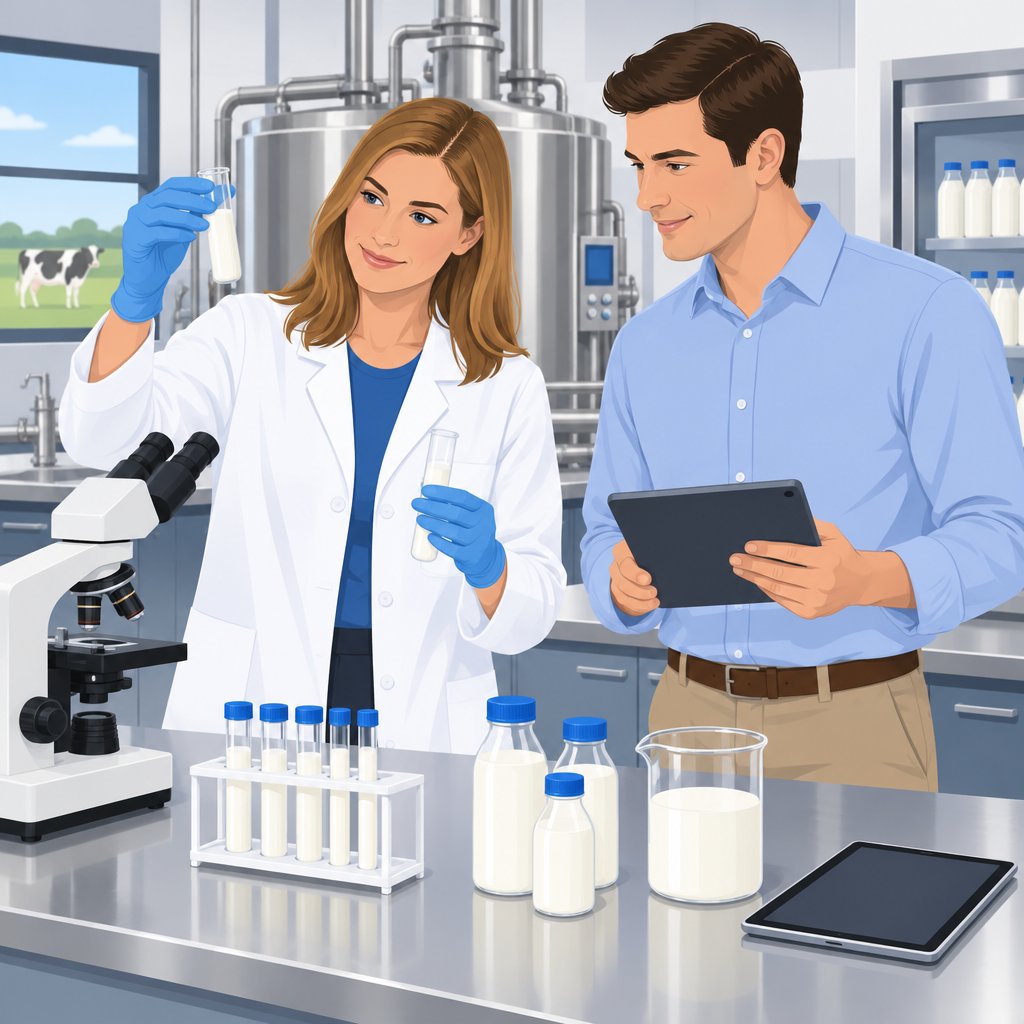
Dairy science facilities support several specialized activities within the dairy industry.
Each facility focuses on a distinct function that supports dairy product development and production.
Together, these facilities address testing, research, production trials, and professional training.
- Testing labs for quality control
- Research labs for product development
- Pilot plants for small-scale production
- Training facilities for industry professionals
Testing Labs for Quality Control
Testing labs evaluate dairy products against established quality and safety standards.
Laboratory staff measure fat content, protein levels, microbiological safety, and sensory attributes.
These evaluations help companies meet regulatory requirements and consumer expectations.
Research Labs for Product Development
Research labs develop new dairy products and improve existing formulations.
Researchers also examine ingredients, processing techniques, and production methods.
Additionally, these labs study consumer preferences, industry trends, and emerging technologies.
This work helps companies strengthen their product development and market competitiveness.
Pilot Plants for Small-Scale Production
Pilot plants test new dairy products and processes on a small production scale.
They connect laboratory experiments with full-scale manufacturing operations.
Companies can adjust formulations, refine processes, and evaluate new product concepts.
As a result, pilot plants help reduce risks, control costs, and support commercialization.
Training Facilities for Industry Professionals
Training facilities prepare professionals for technical responsibilities across the dairy sector.
They provide hands-on training, workshops, and seminars covering important industry topics.
Common subjects include food safety, quality assurance, dairy processing, and product development.
Furthermore, these facilities help professionals build expertise, follow industry trends, and connect with stakeholders.
They therefore support the development of a skilled workforce for the dairy industry.
Delve into the Subject: Poultry Scientist's Role in Sustainable Farming
State-of-the-Art Equipment
Modern equipment helps dairy science labs perform tests accurately and efficiently.
It also supports sophisticated analyses and precise measurements.
Therefore, technological investment helps laboratories deliver reliable services and maintain high standards.
Ensuring Accurate and Reliable Test Results
Dairy science labs test products for safety, quality, and regulatory compliance.
Producers, processors, and consumers all depend on dependable results.
Advanced equipment and methods can identify small impurities or contaminants.
Consequently, laboratories help prevent health hazards and protect product quality.
Enhancing Research Capabilities
Advanced equipment expands research capabilities within dairy science labs.
Researchers can investigate new questions and conduct detailed studies.
They can also develop solutions for emerging challenges in dairy science.
As a result, laboratories support scientific progress and industry advancement.
Facilitating Product Development and Innovation
Labs use state-of-the-art equipment to support dairy product development.
They can run experiments, trials, and analyses for new or improved products.
Furthermore, researchers can refine formulations, flavors, textures, and packaging options.
This process helps the industry respond to consumer demands and market trends.
Meeting Industry Standards and Regulations
Dairy science labs help organizations meet industry standards and regulations.
They conduct compliant tests, audits, and assessments with specialized equipment.
Cutting-edge technology improves precision, consistency, and accuracy during analyses.
Thus, laboratories support safety and integrity throughout the dairy supply chain.
Transform Your Career Today
Unlock a personalized career strategy that drives real results. Get tailored advice and a roadmap designed just for you.
Start NowGain More Insights: How Animal Nutritionists Support Farm Management
Collaboration with Industry Partners
- Working with dairy farmers for product testing
- Partnering with dairy companies for research and development
- Collaborating with government agencies for regulatory compliance
- Engaging with academia for knowledge exchange
Dairy science labs foster collaboration that advances innovation across the dairy industry.
First, researchers work with dairy farmers to test products under real-world conditions.
This testing helps researchers match new dairy products with consumer needs and preferences.
Meanwhile, collaboration reveals farming challenges and supports practical operational solutions.
Additionally, dairy companies support research and development for new products, processes, and technologies.
These partnerships can benefit the entire dairy supply chain.
They can also support healthier, more sustainable, and more efficient dairy products.
Furthermore, government agencies help laboratories address regulatory compliance.
Researchers monitor regulatory requirements and work with regulatory bodies.
This cooperation helps dairy products meet safety and quality standards.
Therefore, laboratories support public health and safety through compliance efforts.
Finally, academic partnerships promote knowledge exchange in dairy science.
Researchers access current scientific knowledge, technologies, and methodologies through these relationships.
This exchange helps them advance research and develop solutions for the dairy industry.
Uncover the Details: The Role of Drones in Modern Irrigation Practices
Training and Education Opportunities
Dairy science labs and facilities provide important training and education opportunities.
These opportunities connect academic learning with practical dairy science activities.
Students and researchers gain hands-on experience while applying theoretical knowledge to practical situations.
- Providing hands-on experience for students and researchers
- Offering workshops and seminars for industry professionals
- Supporting internship programs for aspiring dairy scientists
- Contributing to the development of future leaders in the dairy industry
Furthermore, workshops and seminars help industry professionals stay updated on dairy science advancements.
These events promote continuous learning and encourage improvement across the field.
Internship programs give aspiring dairy scientists valuable real-world experience.
They also help participants bridge the gap between academia and industry.
Finally, these facilities help develop future dairy industry leaders.
They nurture talent, provide mentorship, and foster an environment for growth and innovation.
Future Priorities for Dairy Science Facilities
Dairy science labs and facilities advance the dairy industry through research, quality control, and dairy product innovation.
These facilities provide essential environments for testing, analysis, and development.
Consequently, their work improves dairy product quality and safety for consumers.
This progress also supports the dairy industry’s long-term sustainability.
Continued investment in dairy science research and development will address changing consumer preferences and technological advancements.
Furthermore, ongoing innovation will help the dairy industry improve its products and practices.
Continued support can keep dairy science labs at the forefront of industry advancements.
This commitment can help deliver safer, more sustainable, and higher-quality dairy products.
Additional Resources
Google search results for Importance of Dairy Science Labs and Facilities Agricultural
Bing search results for Importance of Dairy Science Labs and Facilities Agricultural


