




Sheet Metal Workers and Welders
Comparing sheet metal workers and welders requires understanding the differences between these essential metalworking professions.
Both roles support construction and manufacturing, yet each profession requires distinct skills and expertise.
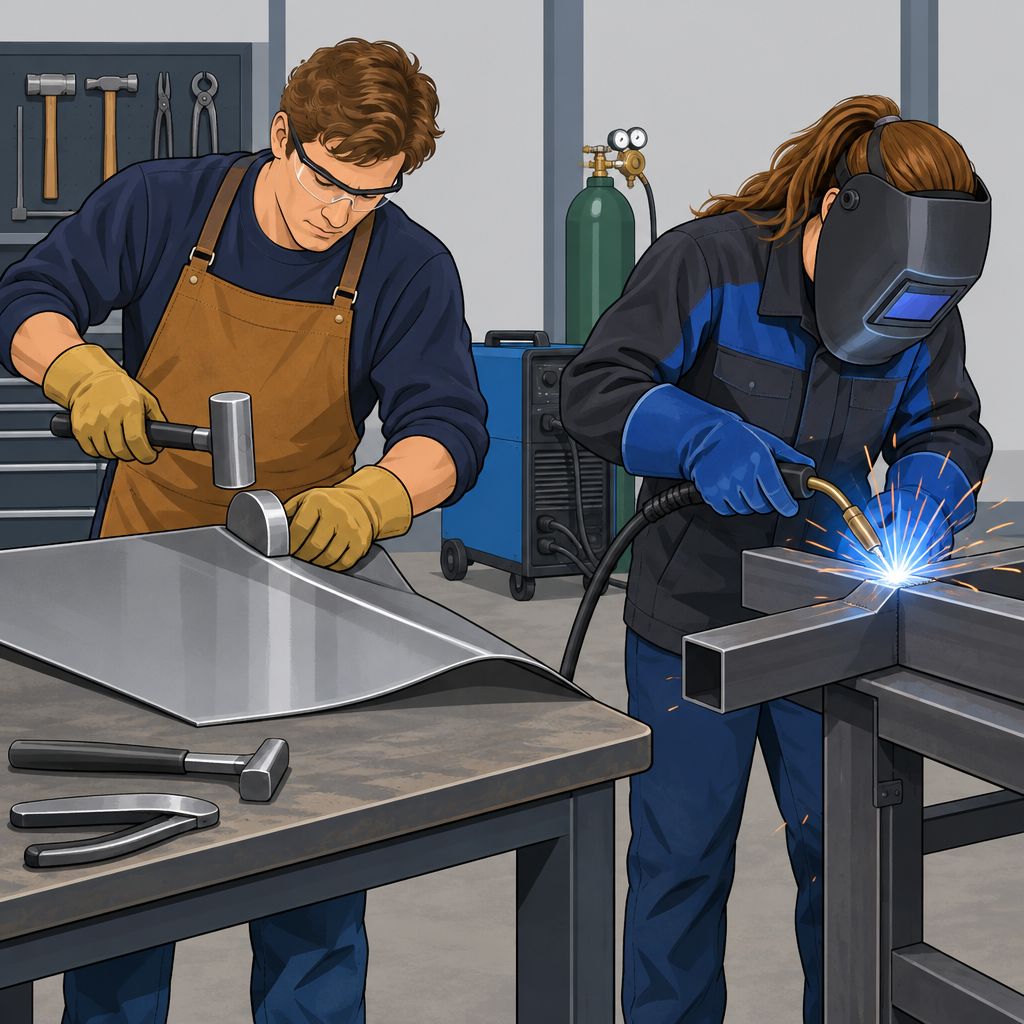
Sheet metal workers fabricate and install metal sheets for structures such as HVAC systems, ductwork, and roofing.
They work with stainless steel, aluminum, and copper.
Additionally, they cut, bend, and shape metal to achieve precise dimensions and angles.
Welders join metal components using heat and pressure.
They use MIG, TIG, and stick welding to create strong, durable connections.
Furthermore, they often work on pipelines, bridges, and automotive parts.
These projects demand precision and close attention to detail.
Therefore, aspiring metalworkers can compare these professions before choosing a career path.
Each field offers unique challenges and opportunities for growth.
Personal interests and skills can guide this decision.
Sheet Metal Worker Responsibilities
- Sheet metal workers fabricate, assemble, and install sheet metal products.
- They work with aluminum, steel, and copper to create various structures.
- Using specialized tools, sheet metal workers cut, bend, and shape metal according to specifications.
- They read blueprints, drawings, and technical documents to determine project requirements.
Skills and Knowledge for Sheet Metal Work
- Sheet metal workers need hand-eye coordination and manual dexterity for precise work.
- They must use strong mathematical skills to complete accurate calculations and measurements.
- Attention to detail helps workers ensure that finished products meet quality standards.
- Knowledge of welding techniques and equipment supports success in sheet metal work.
Welders play important roles in manufacturing, construction, automotive, and other industries.
They join materials through welding to create structures, machinery, and products.
Their work requires technical knowledge, specialized equipment, precision, and consistent attention to safety.
Primary Responsibilities of Welders
Welders interpret project requirements before preparing materials and equipment.
They select suitable welding methods and maintain equipment throughout each project.
Additionally, welders inspect finished joints and follow procedures that protect workplace safety.
- Welders read blueprints, schematics, and drawings to determine project layouts.
- They select and set up welders, gas cylinders, and consumables according to project requirements.
- Welders clean materials by removing dirt, rust, grease, and other contaminants.
- They adjust and maintain welding equipment for proper performance and safe operation.
- Welders join materials using MIG, TIG, stick, or flux-core welding techniques.
- They inspect and test welded surfaces against project specifications and quality standards.
- Welders repair metal components and structures by cutting, bending, and reshaping materials.
- They follow safety guidelines and procedures to help prevent workplace accidents.
Specialized Skills and Techniques for Welding
Successful welders understand how materials, equipment, and welding methods work together.
They apply technical skills while working in different positions and orientations.
Moreover, welders use precision and problem-solving abilities to produce reliable welded joints.
- Welders interpret blueprints, schematics, and drawings to understand welding requirements.
- They use MIG, TIG, stick, and flux-core welding according to project needs.
- Welders operate welding equipment and tools efficiently and accurately.
- They apply knowledge of metallurgy and materials when choosing processes and electrodes.
- Welders work in overhead, vertical, and horizontal positions as required.
- They maintain precision and attention to detail when producing welded joints and surfaces.
- Welders troubleshoot problems and adjust techniques to achieve desired results.
- They follow safety procedures and regulations to reduce workplace accidents and injuries.
Welders support fabrication and construction by joining materials into useful structures, machinery, and products.
The profession requires specialized skills, technical knowledge, and familiarity with multiple welding processes.
Individuals can pursue welding careers across various industries by developing these abilities and techniques.
You Might Also Like: Career Advancement Opportunities for Pipelayers
Educational Requirements for Sheet Metal Workers
A career as a sheet metal worker requires education, practical training, and appropriate industry credentials.
Most candidates begin with a high school diploma or an equivalent credential.
This foundation supports further instruction and skill development in sheet metal work.
- High School Diploma or Equivalent: Candidates typically earn a high school diploma or GED before pursuing specialized training.
- Trade School or Vocational Training: Trade schools provide hands-on instruction in sheet metal fabrication techniques and processes.
- Apprenticeship Programs: Apprenticeships combine classroom lessons with supervised, on-the-job training.
- Certifications and Licenses: Depending on location, workers may need certifications or licenses demonstrating relevant skills and knowledge.
These pathways help candidates build practical abilities for fabrication and installation work.
Industry credentials can also demonstrate a worker’s skills and knowledge.
Together, education and training create a strong foundation for sheet metal fabrication and installation careers.
Find Out More: Pathway to Becoming a Construction Manager
Training and Education for Welders
Most employers require a high school diploma or equivalent credential for entry-level welding work.
Vocational schools and community colleges provide hands-on welding programs for aspiring professionals.
These programs teach students to operate welding equipment and apply various welding techniques.
- Some employers may prefer an associate degree in welding technology for advanced roles.
- Additionally, apprenticeship programs let aspiring welders gain practical experience while working.
Certifications and Qualifications for Welders
Welders often need certification in specific processes, including stick, MIG, or TIG welding.
Organizations such as the AWS or NCCER usually provide these certifications.
Applicants may also pass a welding performance test to demonstrate their practical skills.
- Furthermore, employers may require additional certifications for specialized tasks or specific industries.
- Welders should pursue continuing education to maintain qualifications and stay current with industry advancements.
Explore Further: Mover Salary Guide: How Much Can You Earn?
Work Environment for Sheet Metal Workers
Sheet metal workers perform their duties in several work environments.
Transform Your Career Today
Unlock a personalized career strategy that drives real results. Get tailored advice and a roadmap designed just for you.
Start NowTheir settings depend on their specialization and the type of project.
These environments require physical strength, careful attention, and consistent safety practices.
Typical Work Settings for Sheet Metal Workers
Construction sites employ sheet metal workers to install and repair metal components in various structures.
Meanwhile, manufacturing plants use their skills to fabricate metal parts and assemblies for different products.
Additionally, some workers focus on HVAC systems or architectural sheet metal applications.
- Construction sites require workers to install and repair sheet metal components.
- Manufacturing plants employ workers to fabricate metal parts and assemblies.
- HVAC specialists design, fabricate, and install ductwork for heating, ventilation, and air conditioning systems.
- Architectural specialists fabricate and install metal roofs, siding, and decorative building elements.
Physical Demands and Job Conditions
Sheet metal work requires workers to lift materials, climb ladders, and enter cramped spaces.
Depending on the setting, workers may encounter extreme temperatures, loud noises, and other environmental hazards.
Therefore, workers must follow safety protocols and use suitable tools to complete their duties safely.
- Physical strength helps workers handle heavy materials and demanding positions.
- Environmental conditions may expose workers to extreme temperatures and loud noises.
- Safety protocols help workers prevent injuries and accidents on job sites.
- Workers use power tools, welding equipment, and measuring devices during their duties.
Learn More: Painting Techniques for High-Traffic Areas in Your Home
Work Environment for Welders
Welders may work in various settings depending on their projects.
These environments can differ in pace, conditions, and safety requirements.
Each setting requires welders to adapt their methods and protective practices.
- Welders often work in manufacturing plants, refineries, and construction sites, where conditions can be noisy and fast-paced.
- Structural steel and bridge projects may require welders to work at heights, on scaffolding, or in cramped spaces.
- Automotive and aerospace welders may work in clean, controlled environments that support precision and quality.
- Shipbuilding welders work in shipyards and may encounter changing weather while working on large vessels.
- Pipeline welders work outdoors in remote locations with rough terrain and challenging weather conditions.
These environments also expose welders to several common workplace hazards.
Welders should understand these risks and apply appropriate safety measures during every project.
- Welding produces fumes and gases that can harm welders who inhale them.
- Welders should use well-ventilated areas and proper respiratory protection to reduce exposure.
- High-voltage equipment creates electric shock risks, so welders need insulation and proper safety procedures.
- Intense welding light and sparks can injure the eyes without suitable goggles or shaded helmets.
- Heat and sparks can cause fires or explosions, so welders should follow safety protocols.
- Fire extinguishing equipment should remain nearby during welding operations.
- Heavy lifting and awkward positions can cause back injuries and repetitive strain.
- Proper lifting techniques and ergonomic practices can help prevent these injuries.
- Noise from welding processes can contribute to hearing loss over time.
- Welders should wear ear protection to reduce the risk of hearing damage.
By recognizing these hazards, welders can select suitable precautions for each work environment.
These practices help welders protect themselves and maintain a safe, productive work experience.
Salary and Job Outlook for Sheet Metal Workers
Sheet metal workers fabricate, install, and maintain sheet metal products across several industries.
Their earnings depend on experience, location, and industry sector.
Demand remains steady across construction, manufacturing, and HVAC industries.
Average Salary Range for Sheet Metal Workers
Sheet metal workers typically earn between $40,000 and $60,000 annually.
Top earners can make more than $70,000 each year.
Entry-level workers usually earn less than experienced professionals.
- Entry-level sheet metal workers can earn approximately $30,000 to $40,000 annually.
- Experienced professionals can earn more than $80,000 annually.
- Benefits may include health insurance, retirement plans, and paid time off.
Job Growth and Demand for Sheet Metal Workers
The job outlook remains positive for sheet metal workers.
Construction, manufacturing, and HVAC employers continue to seek skilled workers.
Specialized skills can improve job prospects and earning potential.
- The Bureau of Labor Statistics projects eight percent employment growth from 2020 to 2030.
- This projected growth exceeds the average for all occupations.
- New construction, renovations, and infrastructure upgrades support continued demand.
- Welding and HVAC expertise can create stronger employment opportunities.
These salary levels and employment trends make sheet metal work a promising career option.
A strong work ethic and technical skills can support long-term career development.
Salary and Job Outlook for Welders
Welders and sheet metal workers earn different wages because their roles require distinct skills and expertise.
Several factors influence compensation in both professions.
Industry demand and specialized training also shape their career opportunities.
Average Salary
- The Bureau of Labor Statistics reported a $42,490 median annual wage for welders in May 2020.
- By comparison, sheet metal workers earned a $50,400 median annual wage during the same period.
- This wage difference reflects the specific skills and expertise required for each profession.
Job Prospects and Industry Trends
- Welding remains essential across construction, manufacturing, and aerospace industries.
- As infrastructure projects expand, employers will continue seeking skilled welders.
- Advancements in automation and robotics may change welding job opportunities.
- Sheet metal workers fabricate, install, and maintain sheet metal products.
- Construction activity and HVAC, roofing, and ventilation demand influence their job prospects.
- Green building initiatives and energy-efficient structures may create additional opportunities.
- Certifications and specialized training help both professions remain competitive.
- Both careers offer opportunities for advancement in specialized areas of expertise.
Distinct Roles and Career Paths in Metalworking
Sheet metal workers cut, shape, and install metal sheets for structures.
Welders join metal pieces with heat and pressure.
These roles differ in their primary tasks and responsibilities.
Additionally, sheet metal workers read blueprints, fabricate metal, and apply installation techniques.
Welders, however, use MIG, TIG, and stick welding processes.
Sheet metal workers can pursue jobs in construction, manufacturing, and HVAC.
Welders can find opportunities in construction, automotive, aerospace, and fabrication.
Therefore, each profession serves different industries and project needs.
Both professions require specialized training and certification.
Together, these workers create and maintain structures that use metal components.
Transform Your Career Today
Unlock a personalized career strategy that drives real results. Get tailored advice and a roadmap designed just for you.
Start NowTheir distinct expertise makes both professions essential to metalworking.
Additional Resources
Bing search results for Sheet Metal Worker vs. Welder: Key Differences Construction and Manual Labor


