




International admissions careers need a careful reading of enrollment headlines. Fewer enrolled students can coincide with continuing recruitment priorities and different case complexity. The new IIE releases provide context, but they do not count admissions jobs or determine how much work a particular office must handle.
International admissions careers: separate the two releases
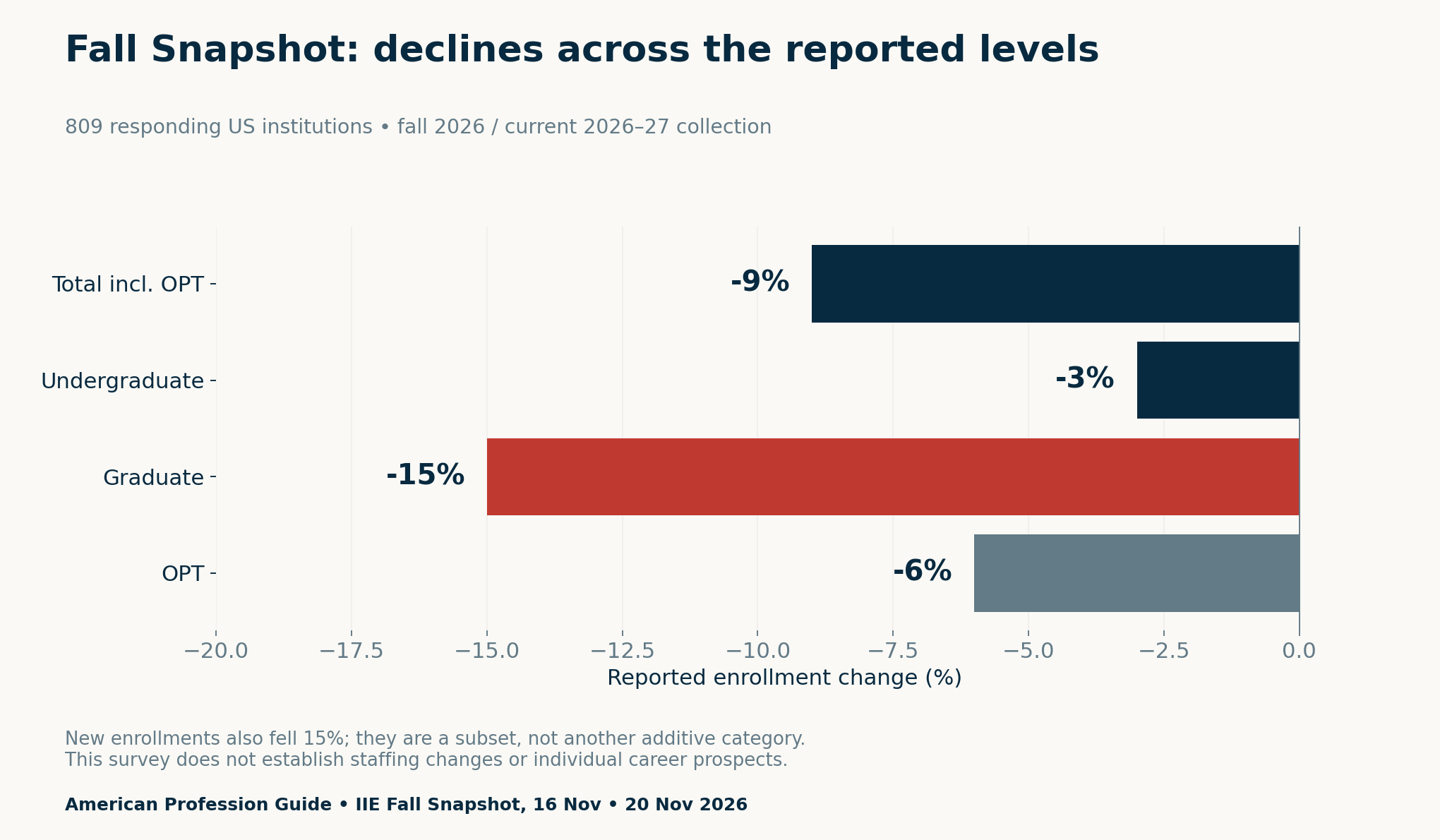
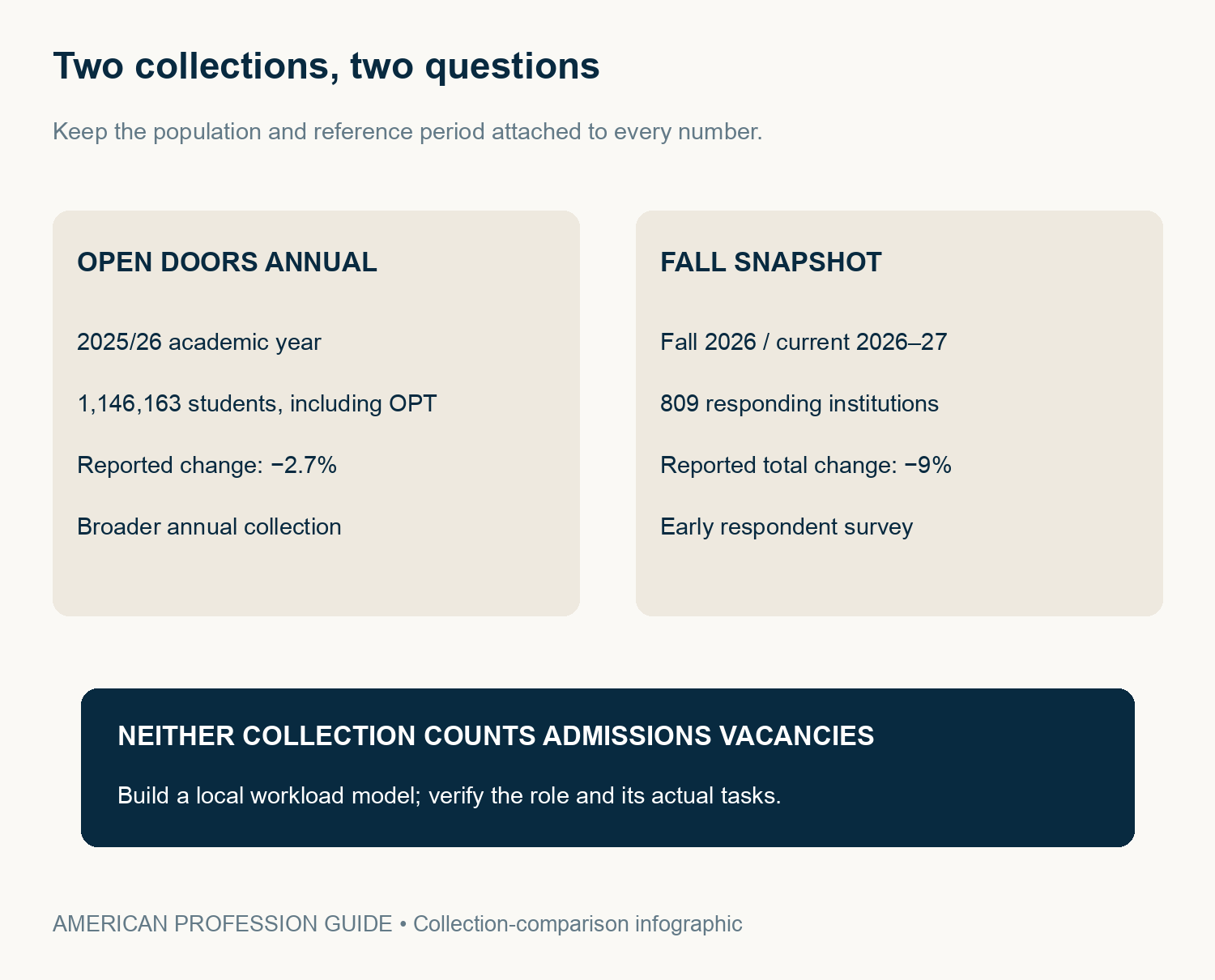
IIE’s Fall 2026 Snapshot covers 809 responding US higher education institutions and current patterns in 2026/27. Its key findings report total international student numbers down 9%, undergraduate numbers down 3%, graduate numbers down 15% and OPT down 6%. New enrollments fell 15%; these are a subset, not an extra category to add.
Recruitment priorities are not staffing promises
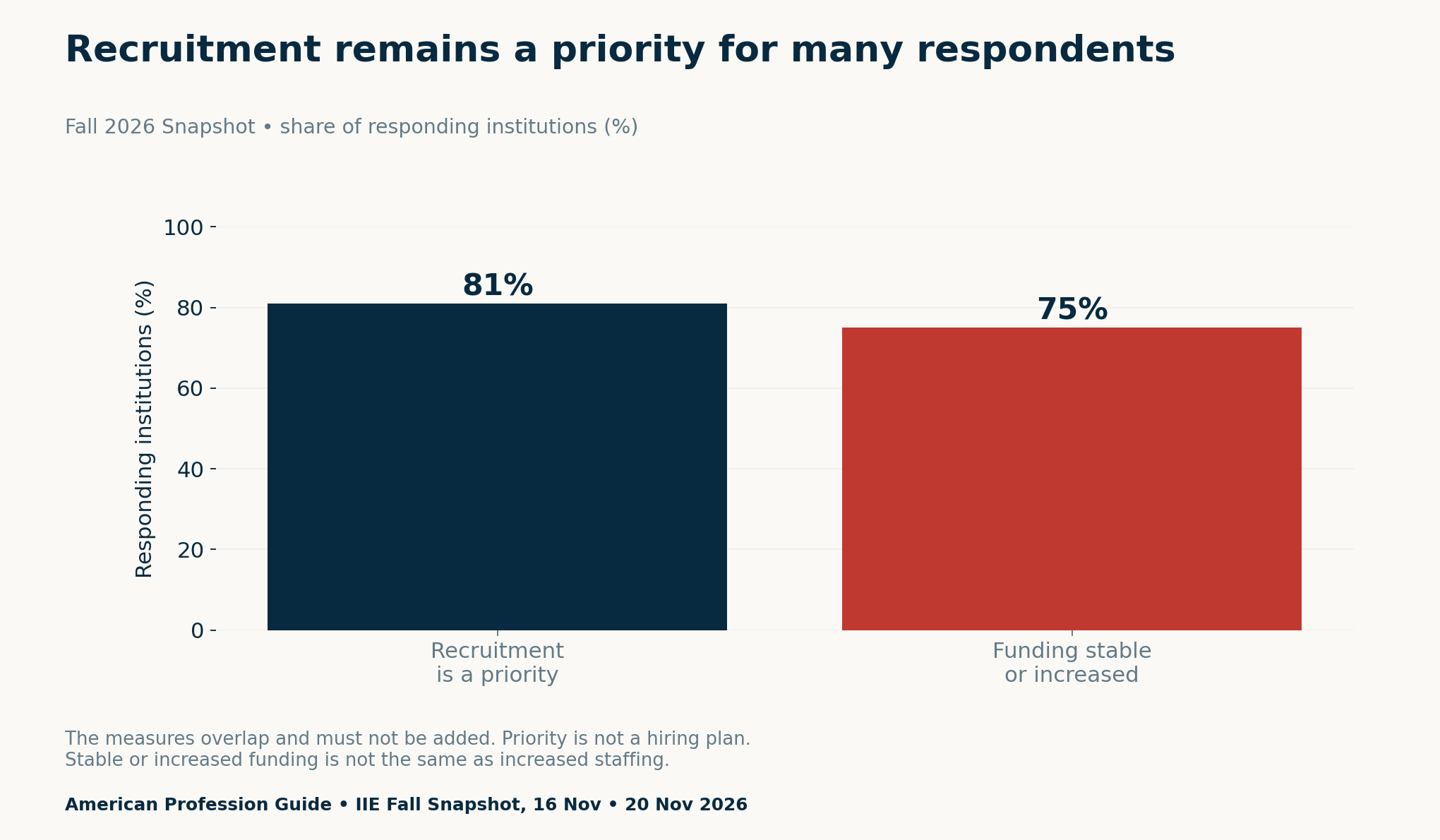
The same key findings say 81% of responding institutions prioritise international recruitment, while 75% report stable or increased recruitment funding. These measures can overlap. They do not identify how many offices are hiring, what they pay or whether a particular position has been approved.
Keep the annual Open Doors figures on their own timeline
The Open Doors 2026 Fast Facts reports 1,146,163 international students, including OPT, for 2025/26, compared with 1,177,766 in 2024/25. Its table gives a 2.7% decline, described as about 3% in the headline. That annual comparison is distinct from the early fall survey.
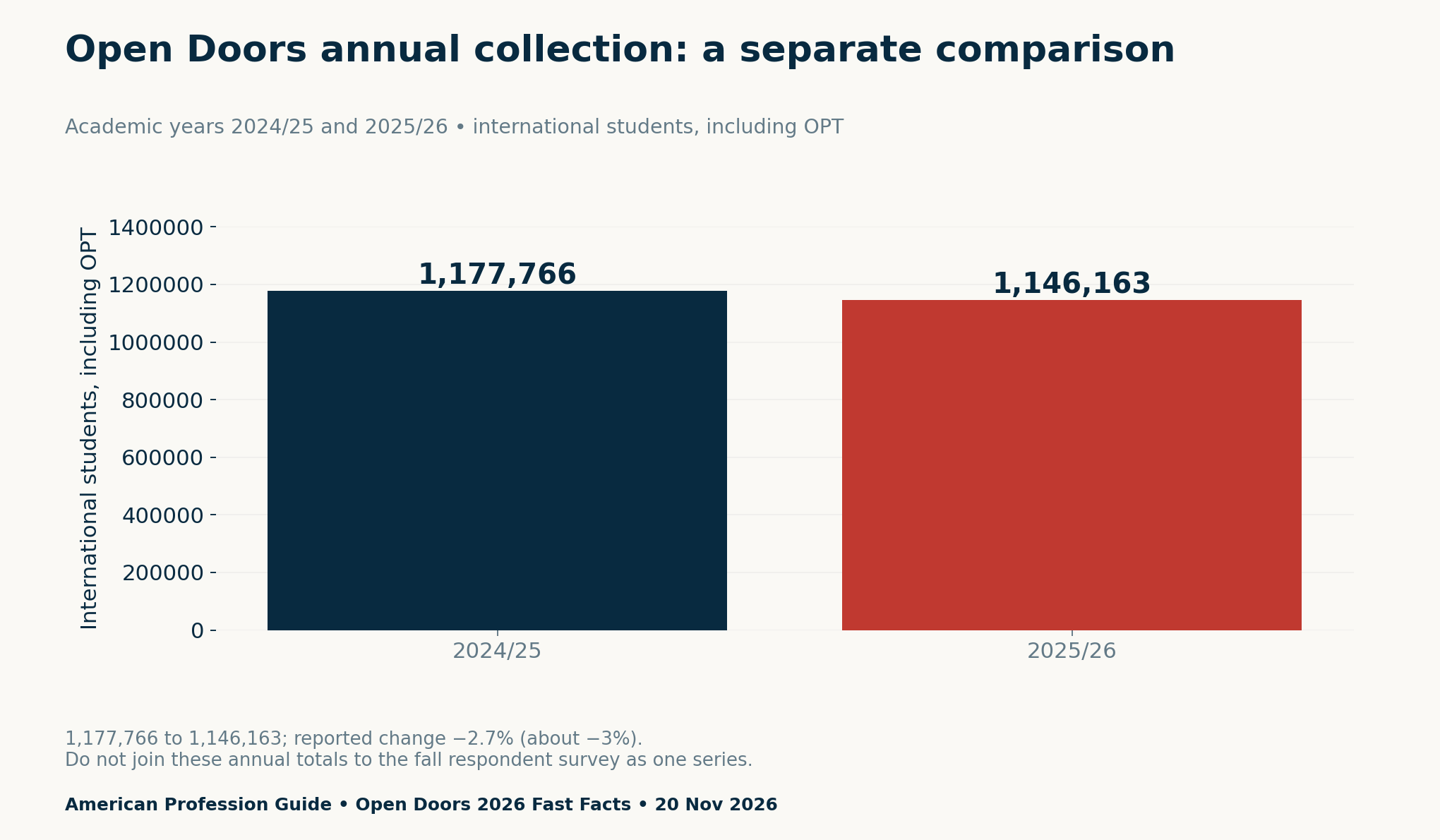
A publication date is not the same as a reference period. Do not place the annual decline and the fall decline on a single trend line or subtract them as though they cover the same institutions and collection. Label the source, population and period whenever you reuse a figure.
Why enrollment and workload are different questions
An admissions office handles work before, during and after enrollment. Enquiries, application reviews and enrolled-student support involve different activities. One person can generate several work items, so a case count is not necessarily a count of unique people. A smaller student total alone does not tell you the handling time per item.
For a useful local model, choose a defined period and categories that do not double count the same task. State what is included in each category. Then separate the number of work items from their average handling time and from work you have excluded, such as meetings or system maintenance.
A fictional workload example, not a staffing forecast
Scenario A invents 100 enquiries at ten minutes each, 50 applications at thirty minutes and forty support items at twenty minutes. That is 3,300 handling minutes, or 55 hours. Scenario B invents eighty enquiries at twelve minutes, forty-five applications at forty minutes and thirty support items at thirty minutes: 3,660 minutes, or 61 hours.
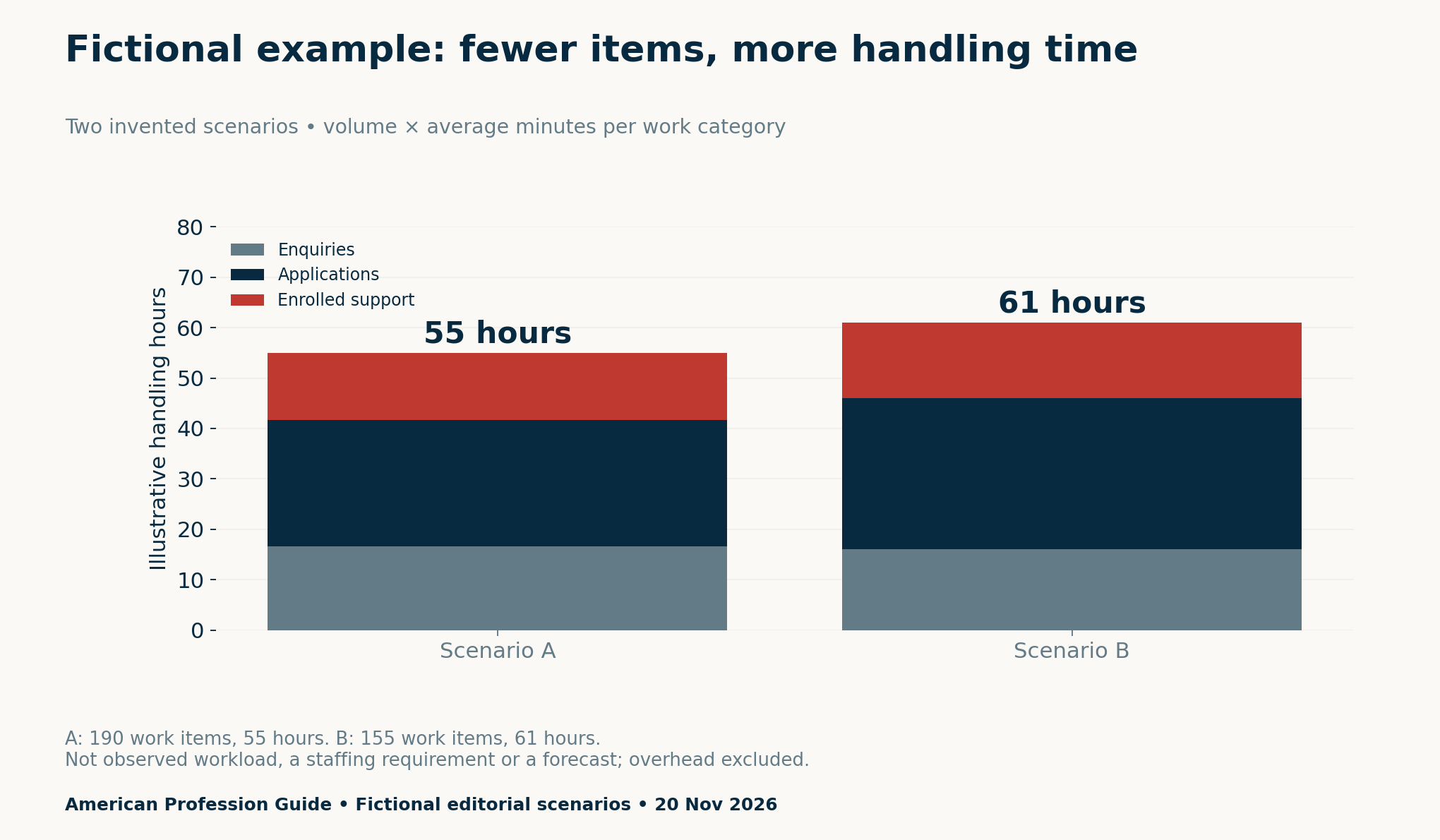
The example demonstrates arithmetic only. It does not establish that real admissions cases became more complex, that staff should work those hours or that a university needs more employees. Real planning would require authorised local evidence, suitable categories and a review of the work omitted from the model.
Try the editable handling-time calculator
Start with the fictional Scenario A inputs, then change the work-item counts or minutes. The total is the sum of count multiplied by minutes, divided by sixty for hours. Inputs stay in your browser; this tool does not send them to a server. Use non-sensitive estimates rather than student records.
Handling-time calculator
Fictional defaults. Handling time only; excludes meetings, leave, systems work and other overhead. This is not a staffing recommendation.
3,300 handling minutes · 55.00 handling hours · 190 work items
Work items may involve the same person more than once. Do not interpret the result as unique students or full-time-equivalent staff.
Build a work sample that shows your reasoning
An admissions candidate could prepare a small synthetic workload sheet with a data dictionary, formula check and short explanation of exclusions. Show how a change in one assumption affects the total. Make every invented value visible and avoid presenting the result as a benchmark for an actual institution.
For example, explain why application reviews and enrolled support need separate handling assumptions. Describe how you would check for duplicate task counts before adding them. A reviewer can then assess your reasoning without seeing applicant names, immigration documents, grades or other private records.
Questions to ask an employer
Ask which part of the student journey the role covers, which systems it uses and who reviews difficult cases. Clarify seasonal peaks, handoffs, training and the boundaries of your responsibilities. A recruitment-priority headline cannot answer those questions for a particular office.
Also ask how the team defines completed work and handles missing information. Our team-trust handoff guide offers a related way to clarify owner, due date and acceptance. Apply that process to a role-specific conversation, rather than inferring an employer’s staffing plans from national enrollment news.
Download the source registers and workload planner
- Fall Snapshot values and units (CSV)
- Separate Open Doors annual values (CSV)
- Fictional workload scenarios and calculations (CSV)
- Blank admissions workload assumption planner (CSV)
Methodology and limits
We checked the IIE overview and both primary data summaries on 20 November 2026. The charts keep the annual and fall collections separate. The calculator and scenario CSV use invented inputs to demonstrate a transparent volume-times-minutes model; they do not estimate vacancies, layoffs, hiring odds or required staffing.
The fall survey provides an early respondent picture, not a complete current-year census. Local workload can differ from both national collections. Keep source evidence, fictional examples and employer-specific questions distinct when using this guide for international admissions careers.


