







Wondering how to research company stability before accepting a job? Start with the particular role: why it exists, who funds it, what happens after the first project and what remains conditional. A recruitment announcement is a lead to investigate. It does not establish that your team is expanding or that your future position is secure.
The newest Business Employment Dynamics release illustrates the distinction between a small net change and large movements underneath it. We pair those verified national figures with a six-question evidence register and a wholly fictional company example. The tool organises uncertainty; it does not predict layoffs or rank employers as safe.
What the latest job-flow figures say
In the BLS release dated October 28, 2026, Table A records 7.381 million gross private-sector job gains and 7.293 million gross losses. Their difference is 88,000 net jobs. The reference period is December 2025–March 2026, not October recruitment. All figures in this section are seasonally adjusted.
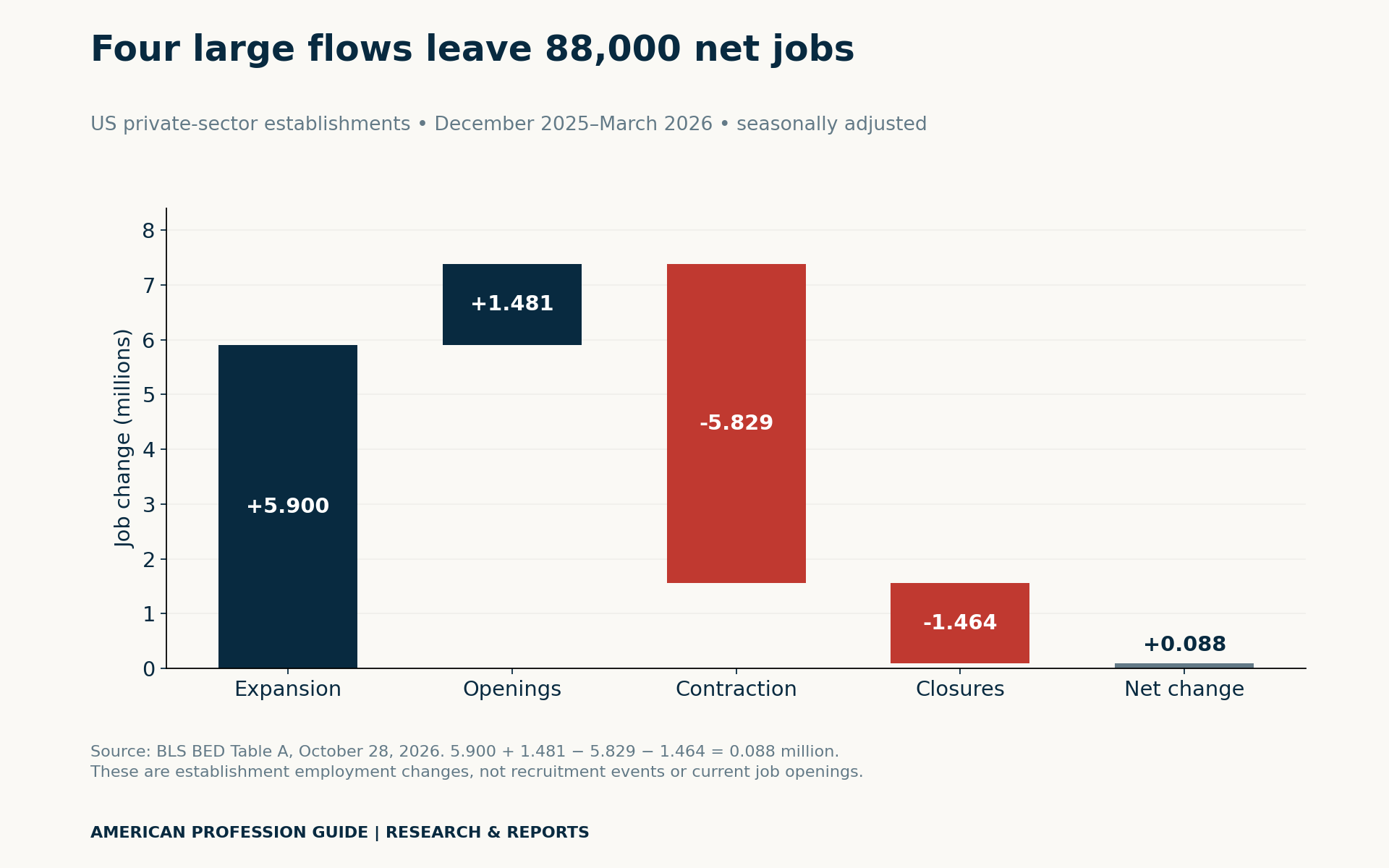
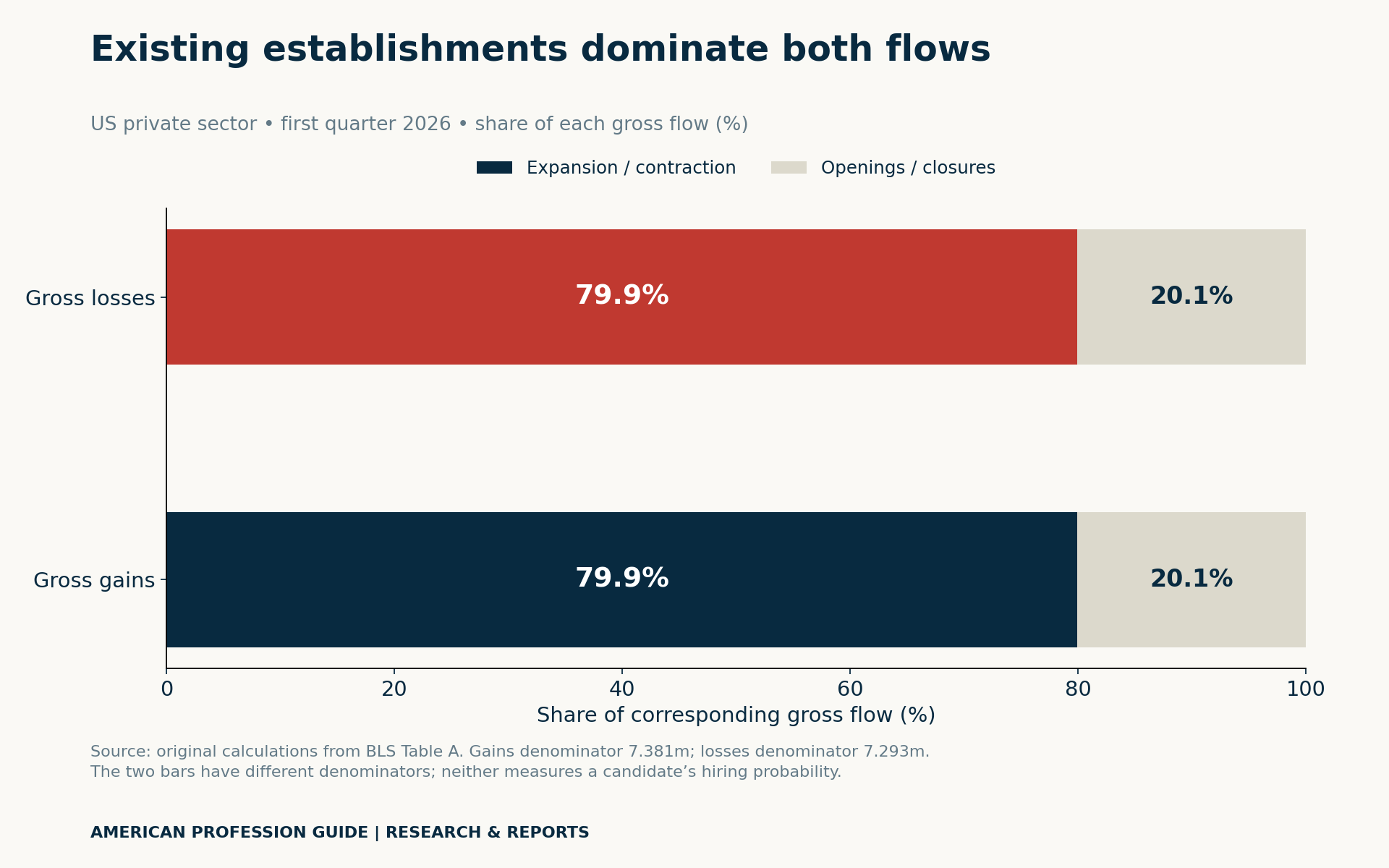
Expanding establishments accounted for 5.900 ÷ 7.381 = 79.9% of gross gains, rounded. Contracting establishments accounted for 5.829 ÷ 7.293 = 79.9% of gross losses. The matching rounded shares have different denominators. Neither share is a candidate’s chance of finding work.
The BLS technical note describes linked establishment records. A workplace’s employment change is not the number of recruitment events: people can leave and be replaced without changing its total. An establishment is also not necessarily the whole company. These distinctions matter when you read a hiring headline.
Use a consistent vintage when comparing quarters
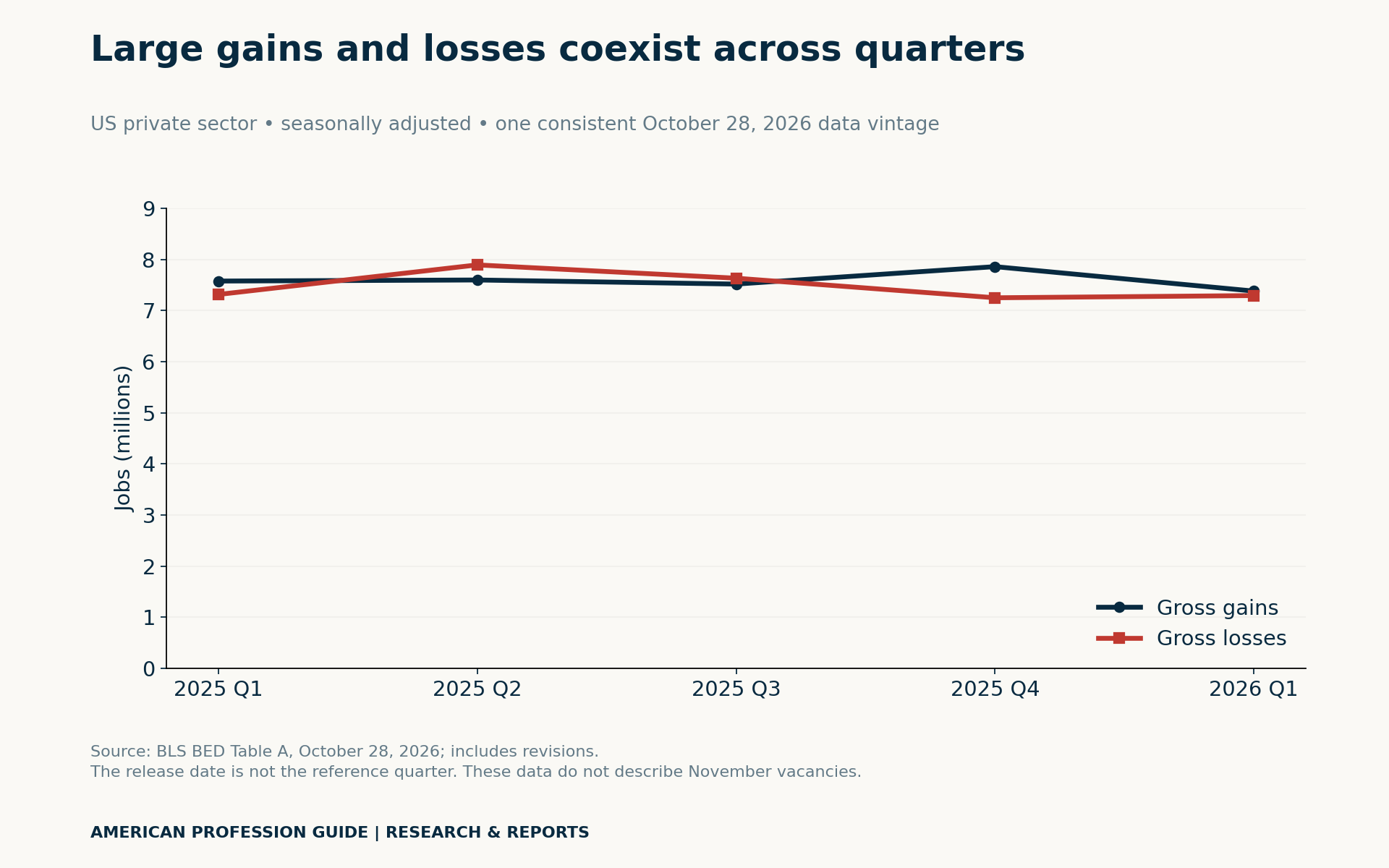
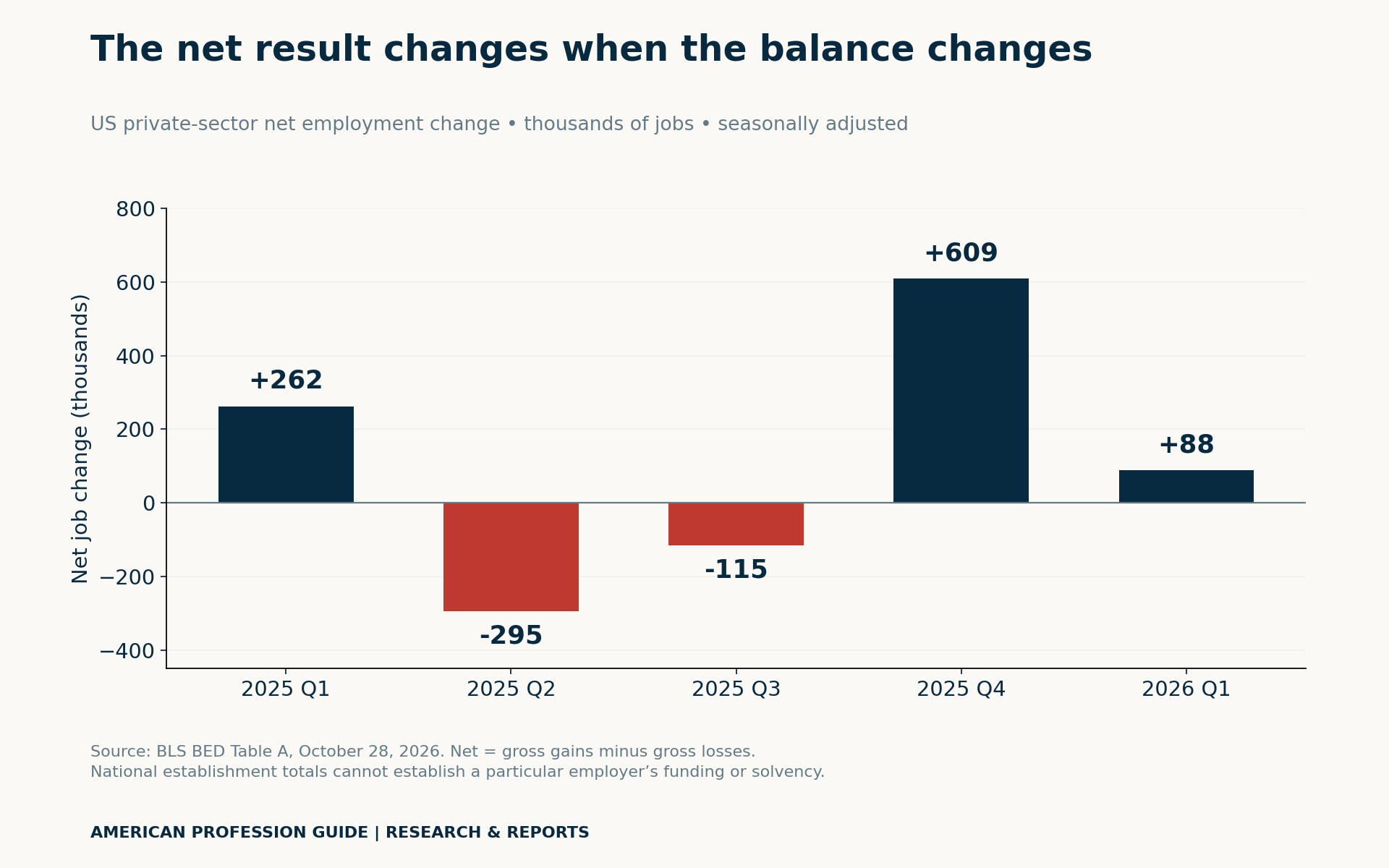
The following charts keep all five quarters in the October 28 release vintage. The release incorporates revisions, so combining a previously published quarter with the new one can create an inconsistent comparison. Large gross flows persist even when their net balance changes sign.
How to research company stability before accepting a job
Begin with the employer’s official description and the written offer. Save the date and exact scope of each claim. Where available, read dated company filings and official business announcements. Then ask the manager how the role connects to those documents. Keep a company-wide statement separate from an answer about your specific team.
A document can verify that management reported a number without proving what caused it. For example, a disclosed employee total may cover several countries or include an acquired business. Record the reporting period, geography and any acquisition or disposal notes. Do not relabel a change as organic hiring unless the evidence supports that conclusion.
This article does not present a sampled comparison of real companies. Such a study would need predefined selection rules and comparable disclosures. Instead, the blank register lets you investigate an employer relevant to your own offer without turning a convenience sample into a ranking.

Six questions that produce useful evidence
| Question | Evidence to request | What an unanswered question means |
|---|---|---|
| Is this expansion or replacement? | Reason for the vacancy and any change in scope | The vacancy alone cannot resolve the distinction. |
| Which budget funds the role? | Approver, funding period and any project conditions | Funding remains unverified; that is not proof it is absent. |
| Who owns the work after the project? | Named owner and continuing responsibilities | The longer-term mandate needs clarification. |
| What counts as six-month success? | Specific outcomes and the dependencies required | The performance expectations remain unclear. |
| Which dependencies affect delivery? | Staffing, systems, client or approval dependencies | The role may depend on work outside its authority. |
| What is conditional in the written offer? | Outstanding checks, approvals and agreed start conditions | Record the unresolved condition and who can confirm it. |
Treat these as a conversation, not a demand for confidential material. A manager may be unable to share an internal budget. They can still explain the approval process, duration and role owner at a suitable level. Record the limit honestly. Avoid requesting client secrets, personal employee information or unpublished financial records.
For each answer, capture its source and date. Classify it as verified against available evidence, company-reported without independent support, or unknown. An interview answer can be useful while remaining company-reported. “Unknown” means you lack sufficient evidence; it is not a negative finding about the employer.
Why a company-wide headcount can miss your team
Consider a fictional employer with three sites. Site A grows from 50 to 70 jobs, Site B falls from 100 to 80, and Site C stays at 50. The company total remains 200. This arithmetic example is invented and makes no claim about an actual business.
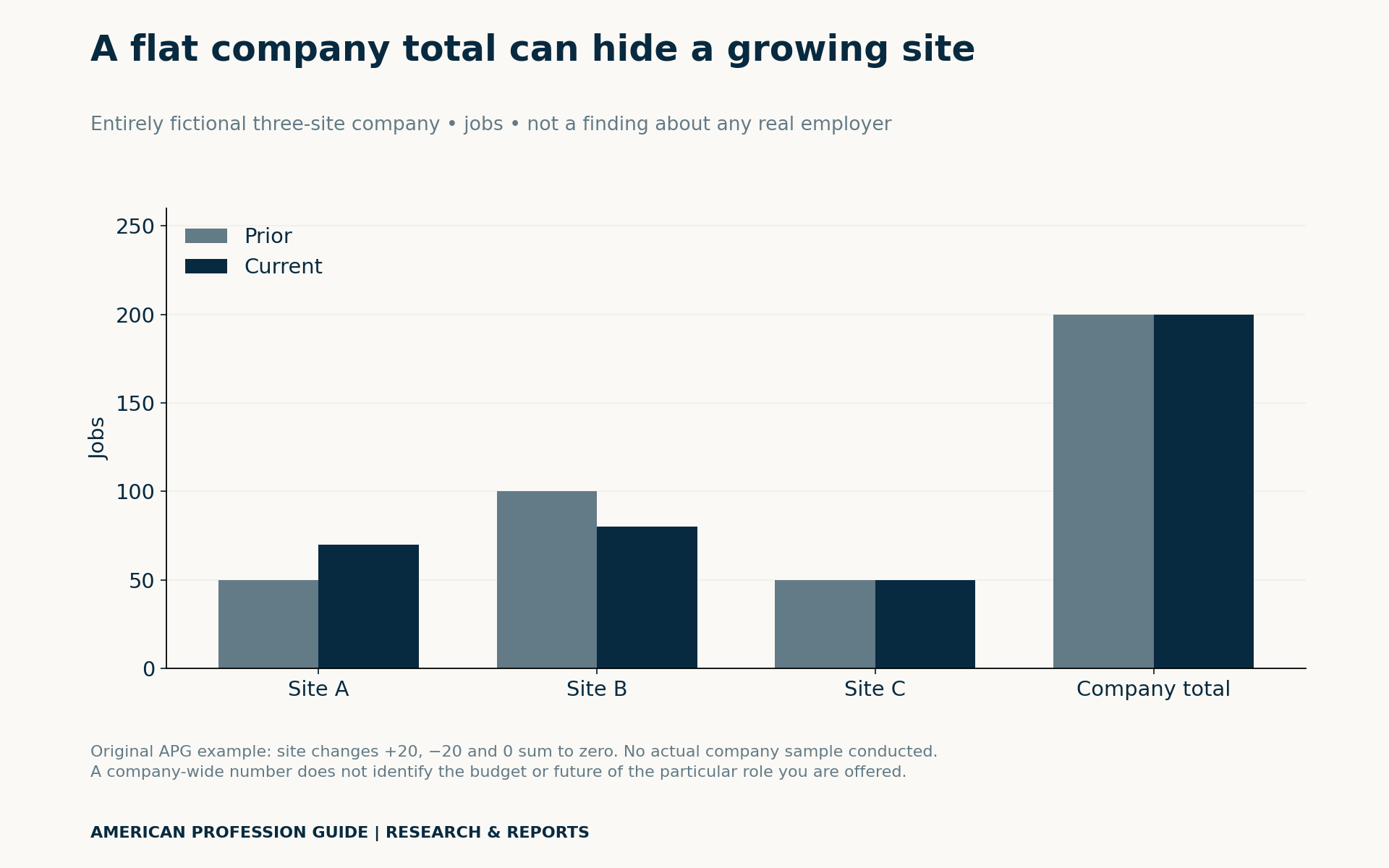
A flat total therefore does not establish that every site is static. Equally, a larger total does not establish that every team is growing. Ask where the position sits and which activities it supports. Keep that answer linked to the actual role rather than importing a national or company-wide trend.
A fictional evidence register: keep the gaps visible
The downloadable worked register contains six fictional questions. One answer has documentary support within the invented scenario, two are manager-reported and three remain unknown. Those counts describe the exercise only. They are not a research finding, employer score or likelihood of redundancy.
In the example, the role letter specifies a six-month deliverable. That supports what the letter says, but it does not prove future funding or shared-team capacity. The sensible next step is to clarify those dependencies. It would be misleading to mark the whole offer “verified” because one well-written document exists.
Before making your decision, review unresolved items with the person who can answer them. Decide which facts you need confirmed and which uncertainties you can tolerate. If an answer contradicts the written offer, seek clarification in writing. The checklist supports your judgement; it cannot remove normal business risk.
For geographic context, see our state job-market comparison using unemployment and payroll evidence. Its aggregate measures also need to be kept separate from the question of whether a particular employer can support your position.
Download the evidence tools and source data
Download the same-vintage BLS Table A observations (CSV), blank six-question employer evidence register (CSV), fictional worked evidence register (CSV), and fictional three-site ledger (CSV).
The blank register records the question, claim, evidence status, source, date, scope, owner, contradiction and next check. Keep missing fields blank until resolved. Store any completed private employer investigation securely; the public download contains no real applicant or employer records.
Methodology, limits and citation
Research checked November 3, 2026. We transcribed 35 observations from the five quarters and seven measures in Table A. Scripts check that expansion plus openings equals gains, contraction plus closures equals losses, and gains minus losses equals net in every quarter. Charts preserve thousands or millions explicitly. Shares use unrounded source values, then round to one decimal place.
BED is a lagged, revisable national establishment series. It cannot establish an employer’s solvency, future staffing intentions or your job security. The fictional site ledger and evidence register are original teaching tools, not validated prediction instruments. No current company audit or representative employer sample was conducted.
Suggested citation: American Profession Guide, “Is a Company Really Growing? Job-Offer Checks Beyond the Hiring Headline,” November 3, 2026. Attribute national observations to BLS BED Table A, October 28, 2026, and identify the company example as fictional.


