




Introduction
Machine Learning: Machine learning enables computer systems to learn and improve through experience without explicit programming.
IoT: The Internet of Things connects physical devices to the internet for collecting and exchanging data.
Together, these technologies help organizations use data and improve decision-making processes.
Growing Importance Across Industries
The growing importance of machine learning and IoT appears across various industries.
Healthcare, manufacturing, agriculture, and transportation industries increasingly use these technologies.
Meanwhile, businesses use machine learning algorithms to analyze data and make predictions.
IoT devices also provide real-time data that supports business analysis and planning.
Revolutionizing Living and Working
The intersection of machine learning and IoT continues to transform how people live and work.
Machine learning algorithms bring advanced analytics to IoT devices and improve decision-making processes.
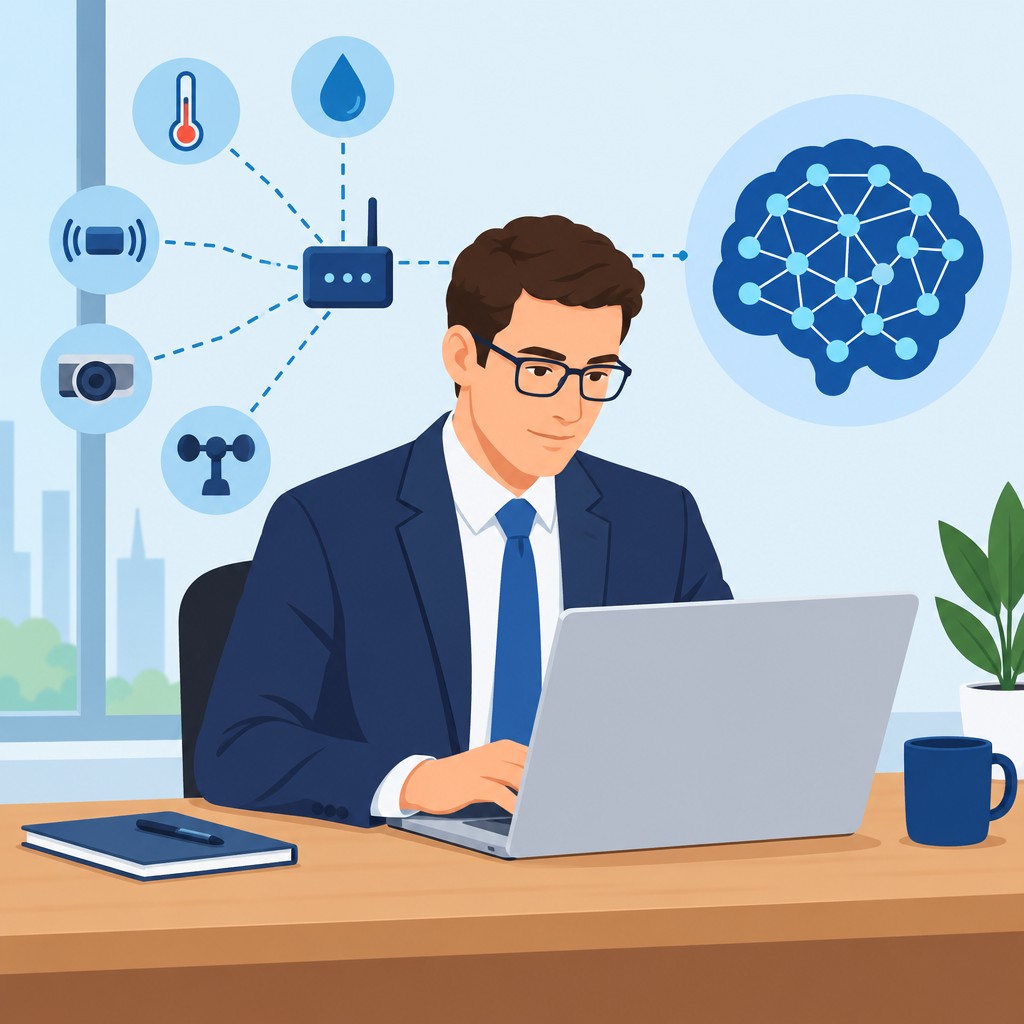
IoT devices gather information from the physical world.
Machine learning algorithms analyze that information and derive useful insights.
This synergy enables smart homes, connected factories, predictive maintenance, and personalized healthcare.
By combining these technologies, businesses can automate processes, reduce costs, and improve efficiency.
Overview of Machine Learning
Machine learning is a subset of artificial intelligence that enables algorithms to learn from data.
These algorithms identify patterns and make predictions without requiring explicit programming for every decision.
Consequently, machine learning now supports many applications across industries and everyday digital services.
- Machine learning definitions and applications
- How algorithms learn from data and make predictions
- Everyday examples, including recommendation systems and predictive analytics
Machine Learning Applications
Machine learning algorithms improve through experience by analyzing data and adjusting their predictions.
Healthcare organizations use these systems to analyze medical images and predict patient outcomes.
Additionally, healthcare providers can use machine learning to personalize treatment plans.
Financial organizations use machine learning to detect fraud and forecast market trends.
They can also provide personalized investment advice through data analysis.
How Algorithms Learn and Make Predictions
Machine learning algorithms recognize relationships and patterns within collected data.
Developers train these algorithms with historical data to identify trends and useful insights.
The algorithms then apply those insights when predicting future events or outcomes.
For example, e-commerce platforms analyze customer behavior to recommend relevant products.
These systems learn from previous purchases and browsing history.
As a result, they can predict which products may interest each customer.
Machine Learning in Everyday Life
Machine learning increasingly supports everyday applications that improve user experiences and operational efficiency.
Common examples include recommendation systems, predictive analytics, and natural language processing.
Streaming services use recommendation systems to analyze preferences and behavior.
For instance, Netflix and Spotify recommend movies, television shows, or music.
These recommendations help users discover content that matches their interests.
Furthermore, predictive analytics helps companies forecast sales and predict customer churn.
Businesses also use these systems to optimize marketing campaigns and make informed decisions.
By analyzing past data and trends, companies can improve their overall performance.
Overview of the Internet of Things
The Internet of Things connects physical devices that communicate and share data.
These devices include sensors, actuators, and communication hardware.
Sensors collect information about conditions such as temperature, humidity, and motion.
- Connected devices: IoT devices communicate through wired or wireless protocols.
- Data exchange: Devices send information to hubs or cloud servers for processing.
- Smart homes: Thermostats, lights, and cameras help homeowners control and monitor their homes remotely.
- Wearable devices: Fitness trackers and smartwatches collect health and activity data for user insights.
Explore Further: Real-World Applications of Network Security Engineering
Machine Learning Applications for IoT Data
Machine learning algorithms analyze the extensive data generated by connected devices.
Transform Your Career Today
Unlock a personalized career strategy that drives real results. Get tailored advice and a roadmap designed just for you.
Start NowThese systems identify anomalies, patterns, and trends that support timely decisions.
Consequently, organizations can improve performance by applying predictive insights to IoT operations.
Algorithms for IoT Data Analysis
Regression models examine relationships within IoT datasets and support numerical predictions.
Classification techniques assign data to categories, while clustering reveals naturally occurring groups.
Deep learning models process complex information and help organizations evaluate data in real-time.
Operational Benefits of Machine Learning
Machine learning improves analysis by processing large datasets more efficiently.
It also supports predictive maintenance, which can reduce downtime and maintenance expenses.
As a result, organizations can increase productivity and make more informed operational decisions.
Improved Data Analysis
Machine learning processes massive IoT datasets and reveals relationships within operational information.
These methods help businesses understand their activities and evaluate customer preferences more effectively.
Furthermore, automated analysis can uncover insights that manual review might miss.
Predictive Maintenance
Machine learning models examine historical IoT data to estimate equipment failures.
Maintenance teams can then schedule service activities before serious problems occur.
This proactive approach helps limit unplanned downtime and control maintenance costs.
Practical Uses Across Industries
Organizations apply machine learning and IoT technologies across transportation, healthcare, manufacturing, and urban services.
Each application uses connected data to improve planning, monitoring, or resource management.
These examples demonstrate how data-driven systems can address practical operational challenges.
Traffic Management
Traffic systems analyze sensor and camera data to identify changing road conditions.
Machine learning models predict traffic patterns and help adjust signals in real-time.
These actions can reduce congestion and support safer, more efficient transportation.
Healthcare Monitoring
Healthcare providers use connected devices to monitor patient conditions and biometric information.
Machine learning can detect unusual readings and alert providers to possible health concerns.
It can also support personalized treatment recommendations based on available patient data.
Supply Chain Optimization
Supply chain systems collect information from RFID tags and connected sensors.
Machine learning identifies inefficiencies in inventory management, logistics, and delivery processes.
Therefore, organizations can reduce lead times and improve overall operational efficiency.
Business Value from Connected Intelligence
The combination of machine learning and IoT creates new opportunities for data analysis.
Organizations can use these capabilities to improve maintenance planning and operational efficiency.
Ultimately, effective data use can support innovation and strengthen competitive advantage.
Explore Further: Common Challenges Faced by IT Change Managers
Challenges and Limitations
Combining Machine Learning with IoT creates important challenges involving privacy, security, data quality, and processing capacity.
Furthermore, IoT devices generate data that traditional Machine Learning models may process inefficiently.
Therefore, noisy, incomplete, unstructured, and rapidly changing data can limit model performance.
- One key challenge involves protecting the privacy of data collected through IoT devices.
- IoT data creates security concerns because it may contain sensitive information.
- Current Machine Learning algorithms may struggle with the vast data volumes generated by IoT devices.
- Models designed for traditional datasets may not perform effectively with IoT data.
- IoT data often contains noise, missing values, and unstructured information.
- Traditional algorithms may not handle the real-time demands of IoT data streams.
Potential Solutions
Several approaches can address the privacy, security, processing, and data quality challenges affecting Machine Learning and IoT.
Additionally, edge computing and specialized algorithms can support faster processing of IoT data.
Privacy-preserving methods can also enable collaboration while protecting sensitive information.
- Advanced encryption techniques can protect sensitive IoT data and address privacy concerns.
- Algorithms tailored for IoT data can improve Machine Learning processing efficiency.
- Edge computing can preprocess data on devices before sending information to the cloud.
- Anomaly detection algorithms can identify and help mitigate security threats within IoT networks.
- Federated learning can support collaborative training without exposing the underlying data.
- Robust data validation can improve the quality and integrity of IoT data.
See Related Content: SOC Analyst Job Interview: Common Questions and Answers
Future Directions for Machine Learning and IoT
Organizations will integrate Machine Learning more deeply with IoT devices in the coming years.
These systems will analyze data and make decisions with greater speed and autonomy.
Consequently, connected technologies will support smarter and more efficient operations across various industries.
Transform Your Career Today
Unlock a personalized career strategy that drives real results. Get tailored advice and a roadmap designed just for you.
Start NowEdge Intelligence and Predictive Maintenance
Edge computing will process information closer to its source within IoT systems.
This approach can reduce latency and improve overall system efficiency.
As models grow more complex, edge devices will help manage increasing computational demands.
Meanwhile, predictive maintenance systems will analyze sensor data to identify possible equipment failures.
Companies can schedule service before failures occur, potentially saving time and money.
Innovation Opportunities Across Industries
Smart cities will use connected devices to collect data about traffic, energy use, and other operations.
Machine Learning can help cities optimize services and improve residents’ quality of life.
In healthcare, connected monitoring can track vital signs and support personalized, proactive treatment.
Smart homes can automate tasks, optimize energy use, and improve convenience through household data.
Businesses and entrepreneurs can create products and services across these expanding application areas.
Research and Development Priorities
Research and development will help companies advance Machine Learning and IoT technologies.
Researchers will design efficient algorithms that process growing IoT data quickly and accurately.
These algorithms must handle increasing data volumes while maintaining reliable performance.
Additionally, researchers will strengthen security and privacy protections for connected devices.
More connected devices increase cyber-attack risks, so robust safeguards remain essential.
Continued investment can expand innovation and create new opportunities within this field.
Explore Further: Salary Expectations for Systems Administrators in USA
Strategic Value of Connected Intelligence
Machine learning and IoT now reshape how people interact with technology.
Together, they help businesses make informed decisions and improve operational efficiency.
Moreover, connected systems collect, analyze, and use large data volumes in real time.
This capability supports innovation across multiple industries.
Machine learning algorithms interpret sensor data and support predictive maintenance.
They also enable personalized user experiences and smart automation.
Consequently, consumers gain convenience while businesses optimize processes and offerings.
This intersection can reshape industries, encourage economic growth, and improve quality of life.
Continued research will help organizations unlock more value from these technologies.
The field remains dynamic, with many possibilities for connected and intelligent systems.
Therefore, organizations that combine both technologies can support future innovation.
Additional Resources
Google search results for The Intersection of Machine Learning and IoT Information Technology
Bing search results for The Intersection of Machine Learning and IoT Information Technology


