




Role of K-9 Units in Law Enforcement
K-9 units play a crucial role in law enforcement agencies.
These units support agencies by using specially trained dogs.
Their dogs assist officers with several important operational tasks.
Functions of K-9 Units
K-9 units consist of police dogs trained for specialized duties.
These dogs detect drugs and explosives during law enforcement operations.
They also search for missing persons and apprehend suspects.
Collaboration Between K-9 Units and Law Enforcement Agencies
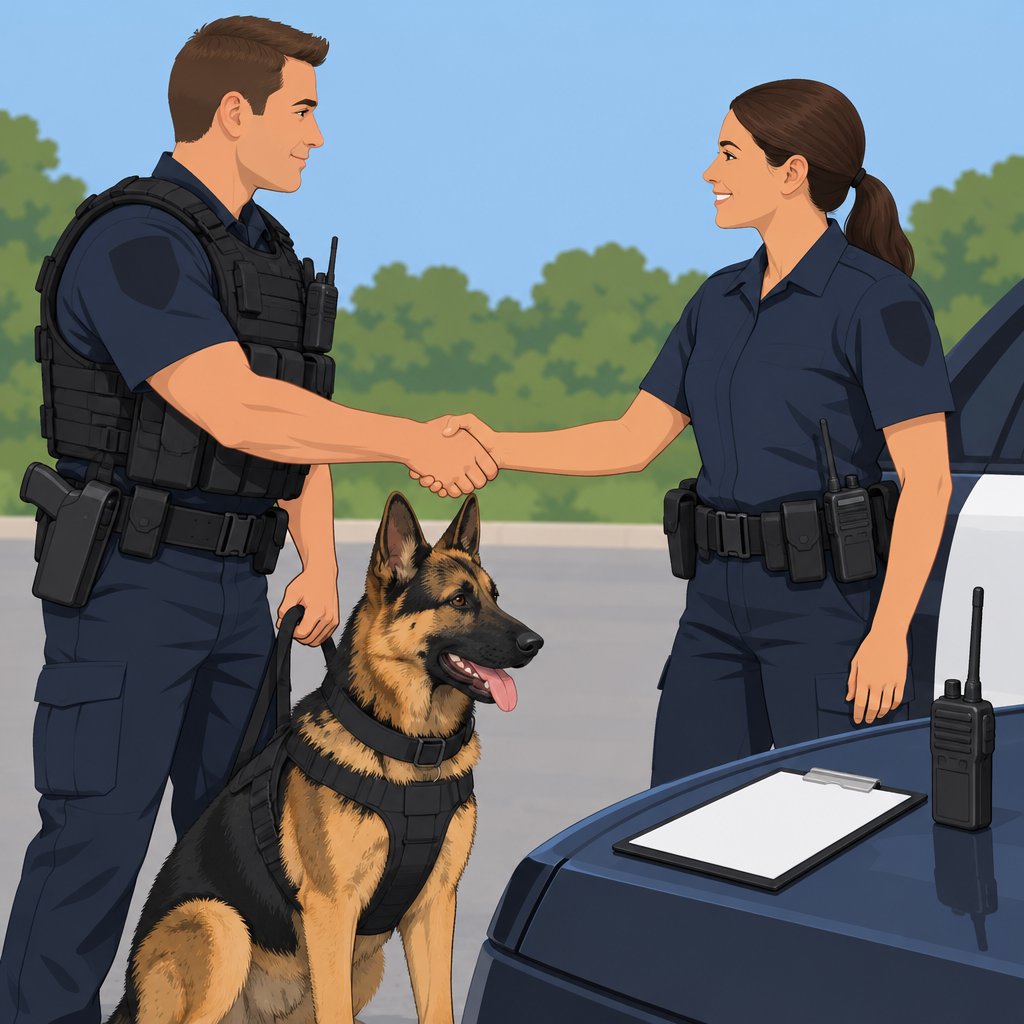
Collaboration between K-9 units and other law enforcement agencies enhances operational effectiveness.
Furthermore, cooperation supports specialized tasks that require trained dogs.
It also provides additional resources for law enforcement operations.
Reported Results of Collaborative K-9 Operations
Research shows that K-9 units achieve stronger results through collaboration with other law agencies.
Collaborative units have higher success rates in solving cases and conducting searches.
They also report higher success rates when apprehending suspects.
Benefits of K-9 Units in Law Enforcement Situations
K-9 teams provide distinct advantages across several law enforcement situations.
Their enhanced detection abilities help officers identify relevant items or substances.
Additionally, these teams can increase officer safety during operations.
They also support search and rescue operations and help officers apprehend suspects.
- Enhanced detection abilities
- Increased officer safety
- Improved search and rescue operations
- Effectiveness in apprehending suspects
Specialized Skills of Different K-9 Units
Different K-9 teams develop specialized skills for specific law enforcement needs.
Patrol teams track and apprehend suspects during law enforcement operations.
Meanwhile, explosives and narcotics teams detect their respective targets.
Search and rescue teams support efforts to locate people.
- Patrol K-9 units for tracking and apprehension
- Explosives detection K-9 units
- Narcotics detection K-9 units
- Search and rescue K-9 units
Collaborations Between K-9 Units and Law Enforcement Agencies
K-9 teams often work with other law enforcement agencies during operations.
For example, they join FBI efforts on high-profile cases.
They also support local police outreach, border patrol interdiction, and TSA airport screenings.
- Joint operations with FBI for high-profile cases
- Collaborations with local police for community outreach events
- Assistance to border patrol for drug interdiction efforts
- Partnerships with TSA for airport security screenings
Training K-9 Units and Their Handlers
Effective K-9 training prepares handlers and dogs to coordinate during demanding law enforcement operations.
Handlers train alongside their dogs, which strengthens their bond and establishes reliable communication.
Through this process, both partners develop the discipline needed for coordinated fieldwork.
Training develops odor detection, tracking, and apprehension skills through structured practice.
Repeated drills help dogs respond consistently when handlers issue commands.
Real-life scenarios further test their readiness for situations they may encounter during operations.
Ongoing Training for Interagency Effectiveness
Ongoing instruction helps K-9 teams preserve their abilities and learn updated techniques.
Regular practice also reinforces communication between handlers and their dogs.
As a result, teams can maintain consistent performance during operations.
Joint assignments require teams to adapt while working beside personnel from other agencies.
Continued preparation builds confidence and supports efficient cooperation during shared operations.
Furthermore, familiar training routines can promote smoother coordination between participating teams.
Collaboration During Training Exercises
Training exercises let K-9 units practice with officers from other law agencies.
These sessions recreate operational conditions and allow teams to test their capabilities.
Meanwhile, agencies can exchange knowledge and professional expertise during the exercises.
Working together improves interagency communication and coordination.
It also helps teams build trust and camaraderie before future joint operations.
Transform Your Career Today
Unlock a personalized career strategy that drives real results. Get tailored advice and a roadmap designed just for you.
Start NowDiscover More: Steps to Become a Sheriff's Investigator
Challenges Faced When K-9 Units Collaborate with Other Law Agencies
- Agencies may misunderstand one another when they lack clear communication channels.
- Different training methods and standards can make joint work more difficult.
- Financial constraints may reduce the resources available for collaboration.
- Furthermore, conflicting priorities and objectives can hinder joint operations.
- Cultural differences may also affect working relationships and mutual trust.
Strategies to Overcome Collaboration Challenges
- Agencies should establish regular communication channels and meetings to keep everyone informed.
- Cross-training can help K-9 units understand other agencies’ practices.
- Additionally, agencies should allocate enough funding and resources for collaborative efforts.
- Partners can develop shared missions and goals to align priorities and strengthen teamwork.
- Team-building exercises and cultural awareness training can improve relationships.
Importance of Communication and Coordination
- Clear communication enhances efficiency and effectiveness during joint operations and investigations.
- Open coordination promotes transparency and trust among team members.
- Moreover, coordinated agencies can respond more quickly during critical incidents.
- Agencies can maximize resources and expertise by working together.
- Effective coordination supports seamless integration and teamwork toward common goals.
You Might Also Like: Top Bodyguard Agencies in the United States
Specialized Operations Supported by K-9 Teams
K-9 teams support specialized law enforcement operations requiring detection, tracking, and rapid field response.
Their capabilities help agencies address varied operational demands in controlled and active environments.
For example, officers deploy these teams during drug detection, searches, rescues, and suspect apprehension.
During drug detection, trained dogs locate illegal substances through their highly developed sense of smell.
Meanwhile, search and rescue teams use K-9 units to cover large areas while seeking missing persons.
In apprehension operations, K-9 units track fleeing or concealed suspects and support successful arrests.
Interagency Coordination During Field Operations
Agencies coordinate K-9 resources when an operation extends beyond one department’s capacity.
Local police departments may request support from federal K-9 units during complex investigations.
Joint task forces can combine K-9 teams with DEA and ATF personnel against drug trafficking.
Additionally, K-9 units work with search and rescue teams during urgent missions.
This cooperation allows participating agencies to share specialized resources during critical operations.
Results From Coordinated K-9 Deployments
Several examples illustrate how K-9 teams assist agencies during demanding operations.
One K-9 unit detected a large drug shipment at a border crossing, leading to multiple arrests.
In another case, a K-9 unit tracked and apprehended a dangerous suspect who evaded capture for weeks.
Search and rescue teams have also relied on K-9 units to locate missing persons.
Those missions brought missing individuals back to safety during critical situations.
Uncover the Details: Historical Evolution of the Border Patrol Agency
Successful Collaboration Case Studies
One notable case study involved a local police department and its K-9 unit tracking a dangerous criminal.
The K-9 unit located the suspect hiding in a densely wooded area.
Consequently, officers arrested the suspect without harming officers or civilians.
This partnership combined resources and expertise to achieve a shared objective.
Another case study featured the FBI and a specialized K-9 explosives detection unit.
During a high-profile event, the FBI asked the unit to search for dangerous substances.
The team’s quick response and accurate detection prevented a potentially catastrophic situation.
This outcome demonstrated collaboration’s value in preventing crime and protecting public safety.
Collaborative Impact on Crime and Public Safety
These collaborations have significantly improved crime-solving and public safety.
By combining capabilities, agencies have conducted faster and more efficient investigations.
Those investigations have produced more arrests and convictions.
K-9 teams track suspects, detect drugs or explosives, and search for missing persons.
Their specialized abilities have supported various law enforcement operations.
Moreover, their shared visibility can deter criminal activity and strengthen community trust.
Citizens gain reassurance when teams work together to protect their neighborhoods.
Success stories reinforce teamwork and coordination’s importance in fighting crime.
Recognition for Collaborative K-9 Work
K-9 units and handlers have received numerous awards for collaborative efforts.
These honors recognize their dedication, skills, and contributions to law enforcement agencies.
Awards such as “K-9 Team of the Year” recognize exceptional teamwork and results.
Other honors, including “Excellence in Cooperation,” recognize effective joint operations.
Handlers also receive commendations for strong bonds and communication with their dogs.
Transform Your Career Today
Unlock a personalized career strategy that drives real results. Get tailored advice and a roadmap designed just for you.
Start NowThat partnership supports successful collaboration with other law enforcement personnel.
Handlers earn recognition by following protocols and applying their partners’ specialized skills effectively.
These awards honor their work and encourage excellence in future collaborative efforts.
Uncover the Details: Public Safety Officer: Navigating Emergency Situations
Collaborative Support for K-9 Units
K-9 units strengthen public safety when they collaborate with other law enforcement agencies.
Moreover, these partnerships strengthen enforcement efforts and improve efficiency in crime detection.
Therefore, government officials and community members should provide K-9 units with resources and training.
Continued support helps these units maintain effective collaborations that promote a safer society.
Additional Resources
Google search results for How K-9 Units Collaborate with Other Law Agencies Protective Services
Bing search results for How K-9 Units Collaborate with Other Law Agencies Protective Services


