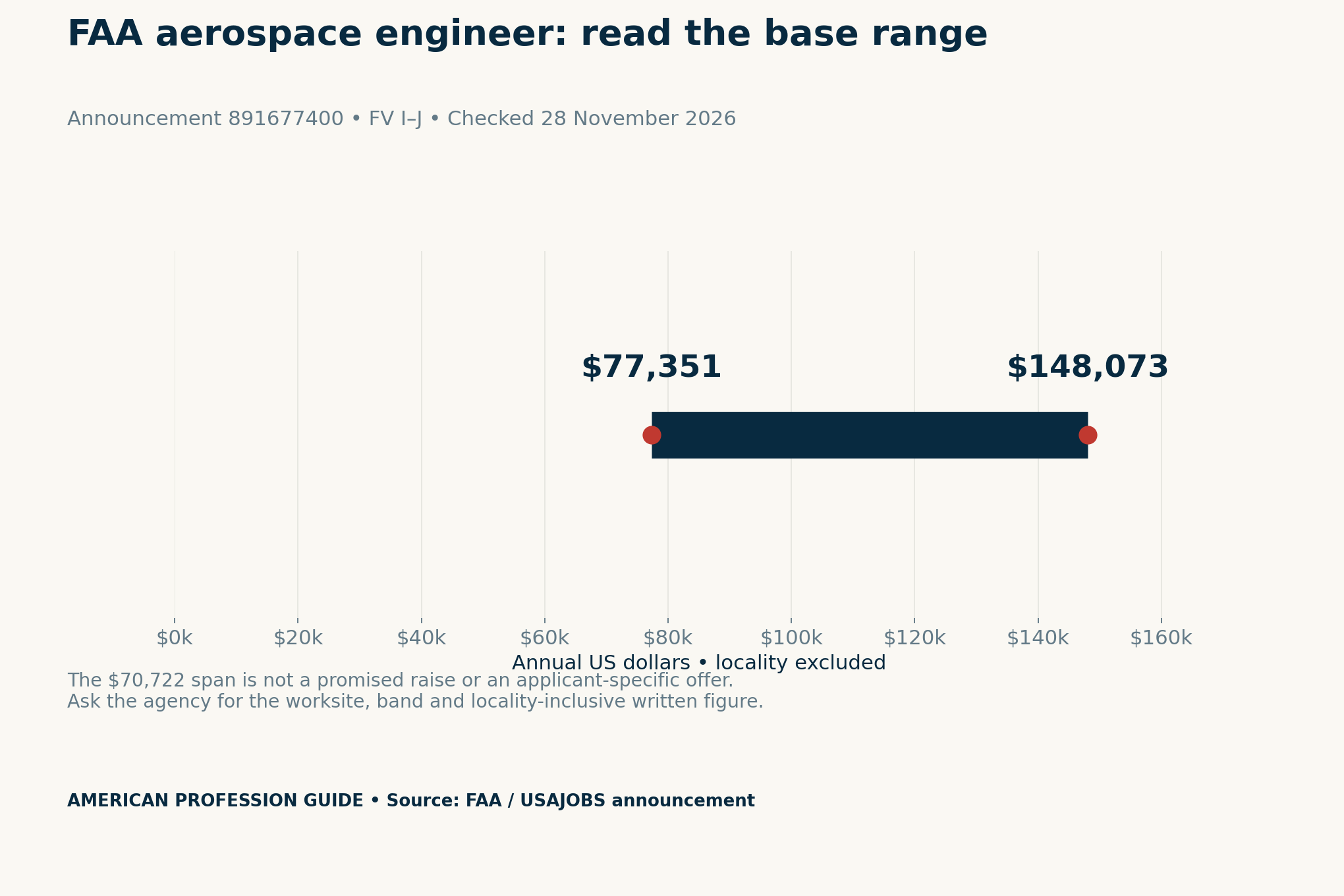
FAA aerospace engineer pay locality questions start with one distinction: the advertised range excludes locality. For this commercial-space vacancy, the range is $77,351–$148,073 a year before that component. Your duty station and the agency’s written offer matter more than a private-sector salary headline.
This report annotates one live announcement, rather than estimating a market average. Use the range chart, three-folder infographic and four CSV tools to separate published facts from answers you still need. The salary span does not tell you where an individual applicant will start.
FAA aerospace engineer pay locality: the dated vacancy snapshot
The FAA’s USAJOBS announcement 891677400 was accepting applications when checked on 28 November 2026. It lists 5 November–4 December 2026 as its application period. Reopen the official page before applying because status and terms can change.
| Field | What the posting says | Question to resolve |
|---|---|---|
| Pay | FV I–J; $77,351–$148,073 before locality | Which band, duty station and final annual figure? |
| Appointment | Permanent, full-time; Excepted Service | What does the written offer specify? |
| Work arrangement | Situational telework may be permitted | What attendance pattern applies to this role? |
| Travel | Up to 25% | How are trips scheduled and expenses handled? |
| Relocation | Expenses not reimbursed | What move would you need to fund? |
What the $70,722 range actually tells you
Subtracting $77,351 from $148,073 gives a span of $70,722. That calculation describes the distance between advertised endpoints. It is not a forecast of your earnings growth, the value of locality pay, or an amount available for negotiation. Keep the subtraction’s meaning next to the number.
For a practical comparison, create separate rows for advertised basic pay, the agency-confirmed locality component and confirmed gross annual pay. Leave a row blank when the evidence is missing. A blank is more useful than a precise-looking number built on an unverified assumption.
Do not apply a General Schedule table merely because the specialized-experience section names a GS comparison level. The vacancy uses FV bands. Ask the listed hiring contact which pay information applies to the actual duty station and appointment. Save the dated reply with the written offer.
Choose a worksite before building a relocation budget
The posting lists seven locations: Los Angeles County, Vandenberg AFB, Washington, DC, Cape Canaveral AFS, Patrick AFB, Houston and Wallops Island. A list of possible locations does not reserve a place for you. Confirm the location of the position under consideration before comparing housing or commuting costs.
Our worksite CSV retains each listed location, with blank columns for a confirmed pay quote, telework terms and travel pattern. Complete those fields only from a dated source. If two locations are possible, maintain two budget versions instead of blending their costs into a fictional average.
For example, an applicant could compare two housing quotes and two commuting routes while leaving the pay quote unresolved. That is a planning exercise, not evidence that either location is available. Mark each cost as a quote, estimate or confirmed commitment, and record the date.
Situational telework needs a separate answer
Situational telework is not a promise that the job can be performed from anywhere. Ask what on-site attendance the team expects, which duties require a site visit and how travel fits the schedule. A short written answer can prevent a much larger mismatch after accepting an offer.
Likewise, a ceiling of up to 25% travel is not a prediction that every month has the same travel share. Do not multiply it by a calendar year to announce a guaranteed number of days away. Ask about trip length, notice, location and any role-specific requirements.
Match the evidence to the band
The announcement requires basic engineering education evidence and band-specific specialized experience. FV-I calls for 52 weeks at a level comparable to FV-H or FG/GS-12; FV-J calls for 52 weeks comparable to FV-I or FG/GS-13. Read the detailed examples and education alternatives on the official page.
The equal duration does not make the two bands equivalent. A useful personal evidence note records the problem, your responsibility, the technical method and the result. Distinguish work you led from work you supported. Never replace missing experience with an inflated title or a borrowed team outcome.
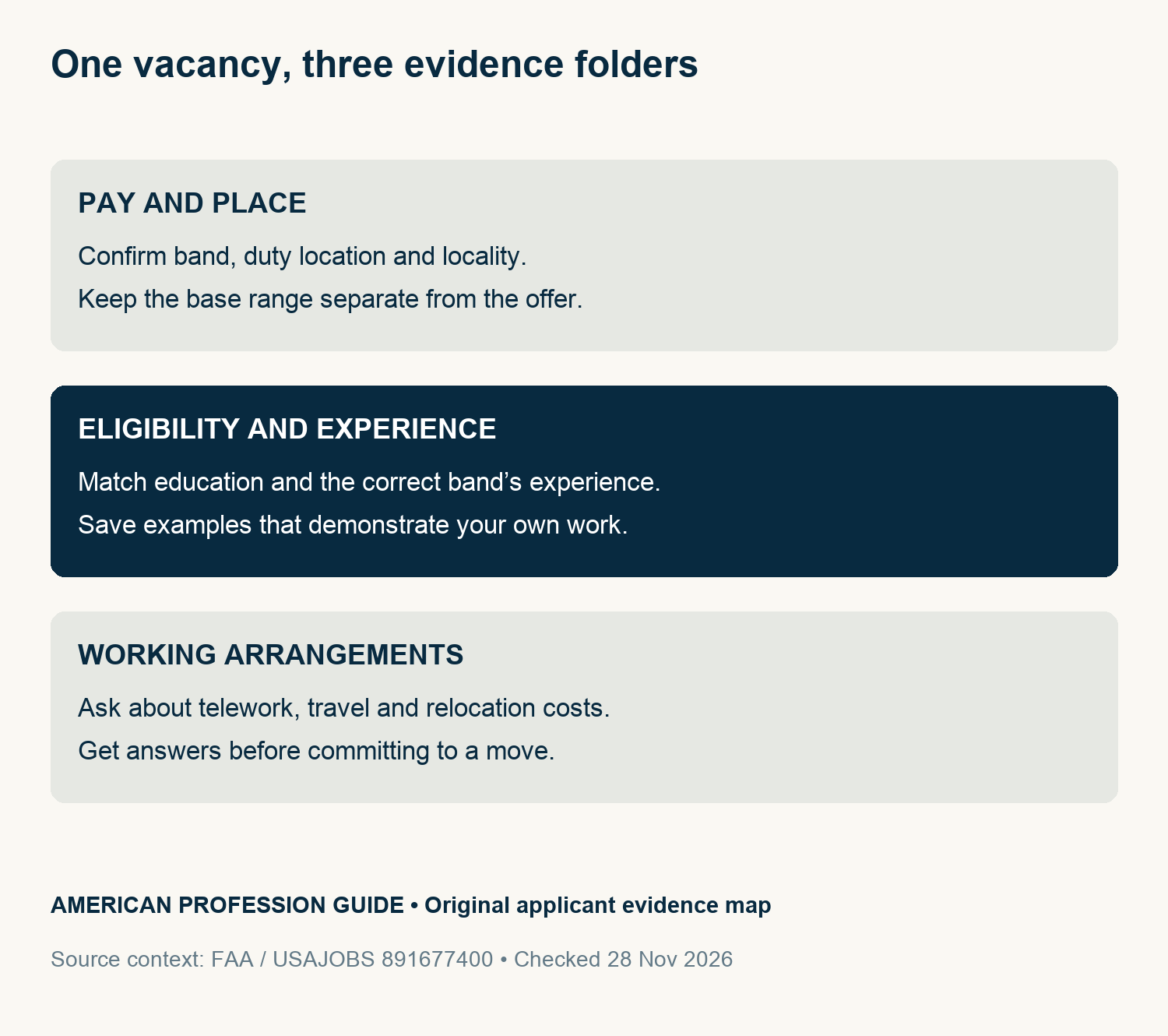
Keep transcripts, relevant experience notes and the announcement identifier together. Then compare the submitted materials with the current required-documents section. The worksheet is not a substitute for the agency’s eligibility decision, and completing it does not predict selection.
The information session has already passed
The 24 November FAA information session provides the timely hook for this guide. It has passed; it is not a future event to book. The event page points applicants towards the December application deadline. Use the live announcement for the actual application conditions.
For broader context, see our aerospace engineering job-market overview and aerospace versus aeronautical engineering guide. Neither general guide replaces this vacancy’s pay or eligibility fields.
Download the vacancy and applicant worksheets
- Dated announcement fields (CSV)
- Seven-worksite confirmation sheet (CSV)
- Band-specific evidence worksheet (CSV)
- Blank offer and relocation budget (CSV)
Method, limits and citation
Researched on 28 November 2026. American Profession Guide checked the official announcement and event page, transcribed the fields and calculated the range span. We do not estimate locality percentages, take-home pay, selection chances or a private-sector median.
Suggested citation: American Profession Guide, “FAA Aerospace Engineer Jobs: Base Pay, Locality and Worksite,” 28 November 2026. Credit FAA / USAJOBS for the announcement and American Profession Guide for the annotated comparison, original graphics and reusable tools. Targeted archive checks are not exhaustive.