




Court Security and the U.S. Marshals Service
The U.S. Marshals Service has a rich history dating back to 1789.
Court security remains vital for maintaining order and protecting everyone present.
U.S. Marshals ensure the safety of judges, jurors, and witnesses.
Responsibilities of U.S. Marshals
They provide courtroom security through screenings, patrols, and responses to threats.
Additionally, U.S. Marshals transport prisoners to and from court appearances.
Their presence deters potential threats and promotes secure legal proceedings.
In high-profile cases, U.S. Marshals may implement additional security measures.
They work closely with federal, state, and local law enforcement agencies.
These agencies coordinate their security efforts to protect courthouse operations.
U.S. Marshals receive specialized training for handling various security scenarios.
Furthermore, their quick responses to emergencies help prevent courtroom disruptions.
They prioritize the safety and well-being of everyone inside the courthouse.
Beyond physical security, their role supports the integrity of the judicial process.
U.S. Marshals uphold the rule of law and protect the rights of participants.
Ultimately, their dedication to court security strengthens the justice system’s credibility.
Operational Responsibilities in Court Proceedings
U.S. Marshals support safe court proceedings.
Their duties protect people and preserve order inside courthouses.
They also manage security concerns involving defendants and courtroom conduct.
Protection Within the Courthouse
U.S. Marshals protect judges, jurors, and witnesses during court proceedings.
They help keep these individuals safe while they remain inside the courthouse.
This protection supports secure and orderly judicial proceedings.
Security Screening at Courthouse Entrances
U.S. Marshals screen people entering the courthouse.
They search for weapons or contraband that could create security risks.
These measures help prevent potential threats from entering the courtroom.
Transporting High-Risk Defendants
U.S. Marshals escort high-risk defendants to court appearances.
They also escort those defendants away from court after proceedings.
This responsibility helps prevent security breaches or incidents during transit.
Maintaining Courtroom Order
U.S. Marshals help maintain order during courtroom proceedings.
They enforce rules that support a safe and respectful environment.
As a result, everyone can participate in proceedings under controlled conditions.
Collaboration with Local Law Enforcement
- Work closely with local police departments to provide additional security measures.
- Coordinate efforts during high-profile trials or dangerous situations.
- Share intelligence and information to strengthen security protocols.
U.S. Marshals collaborate with local law enforcement agencies to strengthen security during court proceedings.
This partnership helps protect courtrooms, judges, jurors, and everyone involved in legal proceedings.
Additionally, local police departments provide support that helps prevent threats and disruptions.
These agencies coordinate their responses to emergencies and security threats.
During high-profile trials, U.S. Marshals and local officers work together to maintain courtroom order.
Likewise, they coordinate security efforts when dangerous situations could threaten people or disrupt proceedings.
Furthermore, U.S. Marshals share intelligence with local law enforcement agencies.
This information exchange helps agencies prepare for potential security threats.
As a result, coordinated teams can respond more effectively to emergencies.
Learn More: How DEA Agents Combat Drug Trafficking and Cartels
Transform Your Career Today
Unlock a personalized career strategy that drives real results. Get tailored advice and a roadmap designed just for you.
Start NowTraining and Expertise
- Rigorous training programs focused on court security
- Specialized skills in threat assessment and de-escalation
- Firearms training and emergency response readiness
U.S. Marshals complete rigorous programs focused on effective court security.
These programs cover security protocols and procedures for courtroom environments.
Additionally, the training prepares Marshals to manage varied security challenges.
Threat assessment training helps Marshals identify potential risks inside and outside courtrooms.
This expertise allows them to address security concerns before they escalate.
Furthermore, Marshals learn de-escalation techniques for managing tense courtroom situations.
These techniques help them handle confrontations calmly while maintaining order.
Firearms training also develops proficiency in firearm usage, safety, and marksmanship.
Consequently, Marshals can respond decisively when violent threats arise.
Marshals also maintain constant readiness for emergencies and potential security threats.
They assess situations quickly and take appropriate action when necessary.
Through this preparation, Marshals help preserve safety during court proceedings.
You Might Also Like: TSA Officer Training: Classroom vs. On-the-Job Experience
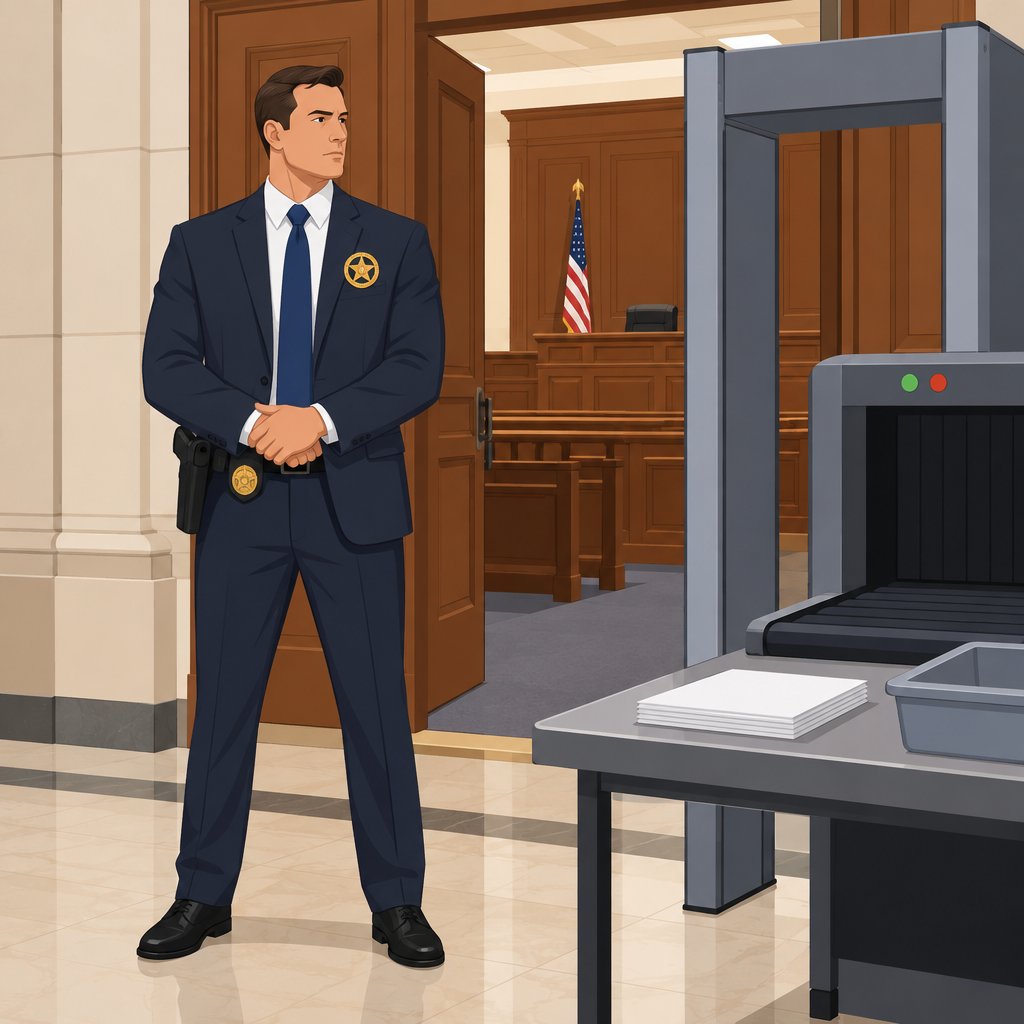
Advanced Security Systems
Court security uses metal detectors and x-ray machines to screen people and belongings before entry.
These systems help stop weapons and prohibited items from entering the courthouse.
As a result, screening supports safety for everyone inside.
Surveillance Cameras and Alarms
Surveillance cameras monitor activity in and around courthouses.
Meanwhile, alarms alert U.S. Marshals and other security personnel to suspicious behavior or security threats.
They can then respond quickly when an alert identifies a possible threat.
Technology for Communication and Coordination
Technology enables smooth communication and coordination between U.S. Marshals and other security personnel during court proceedings.
For example, radios and smartphones let them relay information quickly.
They can also coordinate responses during emergency situations.
Gain More Insights: Counterterrorism Specialist: Analyzing Threats and Risks
Challenges Faced by U.S. Marshals in Court Security
U.S. Marshals must balance courthouse security with public access to justice.
They create secure environments without causing unnecessary inconvenience for courthouse visitors.
Therefore, effective protocols must protect court facilities while preserving public access.
Meanwhile, evolving threats include cyber attacks and domestic terrorism.
Marshals must monitor emerging risks and adopt proactive measures to protect court security.
These measures include stronger cybersecurity practices and improved intelligence-gathering capabilities.
Limited resources and personnel also challenge comprehensive courthouse security.
Strategic resource allocation helps marshals maintain adequate coverage despite staffing constraints.
Additionally, staff training and cooperation with other law enforcement agencies strengthen security efforts.
Learn More: Cybersecurity Specialist: Trends in Cybersecurity Education
U.S. Marshals’ Role in Judicial Safety
U.S. Marshals help secure courts through their visible presence.
Their expertise and dedication support a safe judicial environment.
These qualities strengthen security throughout judicial proceedings.
Additional Resources
Google search results for U.S. Marshals' Duties in Court Security Explained Protective Services
Bing search results for U.S. Marshals' Duties in Court Security Explained Protective Services


