




Introduction
Precision agriculture uses technology to improve crop yields while minimizing resource use.
Real-time data collection provides farmers with current information for better decisions.
This approach combines digital tools with practical farming methods.
Precision Agriculture Practices
Precision agriculture uses GPS, sensors, and other technologies to analyze field variability.
Farmers can then adjust their practices according to specific field conditions.
Consequently, they use water, fertilizers, and pesticides more efficiently.
Importance of Real-Time Data Collection
Real-time data collection helps farmers make informed decisions immediately.
Accurate crop health information supports timely adjustments to farming practices.
For example, farmers can modify irrigation schedules according to soil moisture levels.
They can also adjust nutrient applications and pest control measures using current conditions.
Furthermore, farmers can detect potential problems before those issues damage crops.
This technology also supports precise monitoring of crop growth and development.
As a result, farmers can improve yield predictions and plan harvests more effectively.
Precision agriculture can increase productivity, reduce costs, and support environmental sustainability.
By adopting these technologies, farmers can increase yields and reduce waste.
Therefore, they contribute to a more efficient and sustainable food production system.
Understanding Real-Time Data Collection
Real-time data collection gathers and analyzes information as it develops.
This process continuously monitors data from various sources.
It processes information immediately, enabling timely insights and decisions.
Types of Data Collected in Precision Agriculture
Precision agriculture collects several data types to improve farming practices.
These data types include weather conditions, soil moisture, crop health, and yield information.
Additionally, farmers use this information to understand field conditions and crop performance.
Tools and Technologies for Real-Time Data Collection
Several tools support real-time data collection in precision agriculture.
For example, weather stations measure conditions, while soil sensors monitor field characteristics.
Furthermore, drones, GPS technology, and remote sensing provide detailed field information.
- Weather stations collect temperature, humidity, wind speed, and precipitation in real-time.
- Soil sensors monitor moisture, nutrients, and compaction, providing insights for crop management.
- Drones capture high-resolution field images, helping farmers monitor crop health and detect issues early.
- GPS technology tracks field activities and equipment locations, supporting precision agriculture practices.
- Remote sensing uses satellites and aerial imagery to provide crop health, growth, and yield data.
As a result, farmers can make informed decisions, improve efficiency, and maximize crop yields.
Benefits of Real-Time Data Collection in Precision Agriculture
In precision agriculture, real-time data supports efficient and sustainable farming practices.
Farmers can respond quickly when current information reveals changing field conditions.
These timely insights strengthen crop management while supporting productive resource use.
Improved Decision-Making
Farmers can use current information to make timely and informed management choices.
Weather, soil, and crop data help them adjust strategies as conditions change.
Consequently, responsive management can improve yields and produce quality.
- Real-time data gives farmers up-to-date information for prompt decisions.
- Farmers can analyze weather patterns, soil conditions, and crop performance as they develop.
- This information helps farmers refine crop management practices.
Increased Efficiency and Productivity
Real-time monitoring helps farmers manage equipment, crops, and other resources efficiently.
Prompt alerts can reveal equipment problems and crop concerns before they worsen.
As a result, farms can reduce downtime and maintain productive operations.
- Farmers can optimize resources using continuously updated information.
- Monitoring equipment performance helps identify operational issues promptly.
- Monitoring crop health supports timely responses and higher productivity.
Cost Reduction
Farmers can use real-time information to apply inputs only when necessary.
Data-driven decisions help limit wasted fertilizer, pesticides, water, and other resources.
Therefore, precise resource use can improve the financial viability of farming operations.
- Real-time data helps farmers target fertilizer applications more accurately.
- Farmers can use pesticides according to current crop and field needs.
- Efficient input use can reduce waste and support cost savings.
Environmental Sustainability
Real-time information helps farmers adopt practices that reduce environmental impact.
Monitoring moisture, nutrients, and weather conditions supports more careful resource use.
Transform Your Career Today
Unlock a personalized career strategy that drives real results. Get tailored advice and a roadmap designed just for you.
Start NowThus, data-guided farming can conserve natural resources and support long-term sustainability.
- Soil moisture monitoring helps farmers manage water use more carefully.
- Nutrient data helps farmers limit unnecessary chemical applications.
- Current weather information supports more environmentally responsible farming decisions.
Data-driven farming connects timely observation with practical agricultural action.
This approach supports efficient operations and agriculture’s future viability.
See Related Content: How to Start a Career in Seed Technology
Challenges of Real-Time Data Collection in Precision Agriculture
Real-time data collection has changed how farmers manage precision agriculture operations.
It helps farmers make informed decisions, optimize resources, and improve crop yields.
However, several obstacles limit timely data collection and prevent the technology from reaching its full potential.
- Connectivity issues in remote areas
- Data integration and management
- Security and privacy concerns
- High initial investment
Connectivity Challenges in Remote Areas
Remote farms often lack reliable network coverage.
Consequently, sensors may struggle to transmit information as conditions change.
This delay can slow analysis and weaken timely farm decisions.
Data Integration and Management Requirements
Precision agriculture combines information from sensors, satellites, drones, and other devices.
Farmers must integrate these varied sources into a clear operational view.
Moreover, they must maintain accurate, current, and manageable datasets.
Security and Privacy Risks
IoT devices create security risks during real-time agricultural data collection.
Unauthorized access and cyber-attacks can expose sensitive farm information.
Therefore, farmers need strong protections that preserve data privacy and stakeholder trust.
Costs of Initial Implementation
Real-time collection systems require substantial upfront spending.
Farmers may purchase hardware and software, build infrastructure, and train personnel.
Thus, limited resources can make adoption difficult for small-scale farmers.
Approaches for Addressing Adoption Barriers
Improving connectivity, integrating data, strengthening security, and reducing costs can address these obstacles.
These measures can help farmers use real-time information more effectively.
They can also support sustainable agricultural practices.
You Might Also Like: Career Pathways for Agricultural Educators
Real-Time Data Collection in Precision Agriculture
Precision agriculture now uses real-time data collection to help farmers manage crops.
Farmers use drones, sensors, and GPS to monitor fields with precision and accuracy.
These technologies provide information that supports data-driven farming decisions.
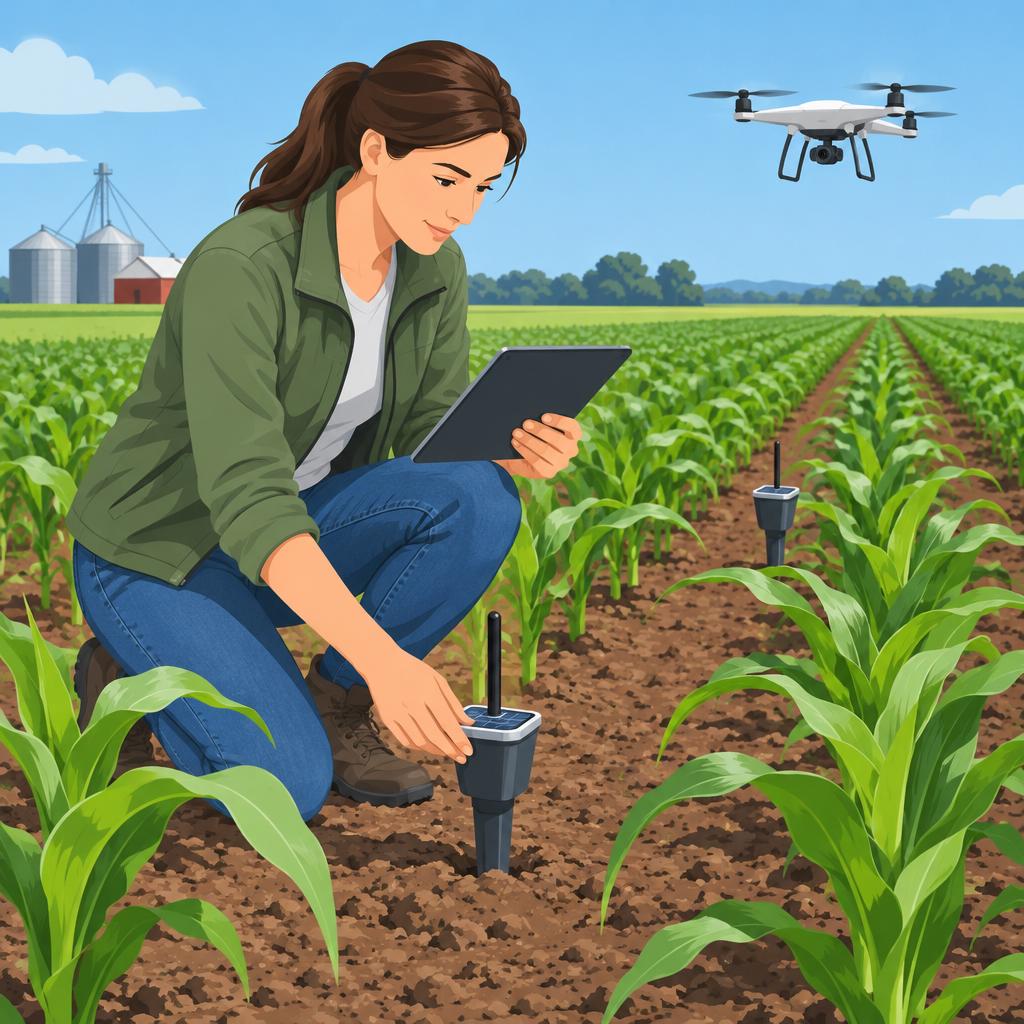
Drone-Based Crop Monitoring
Drones help farmers survey fields from above.
They collect real-time data about crop health, irrigation needs, and pest infestations.
Equipped with sensors, drones generate detailed field maps and reveal areas needing attention.
Soil Moisture Monitoring with Sensors
Soil sensors provide real-time information about moisture levels.
Farmers use these readings to optimize irrigation and prevent overwatering or underwatering.
Continuous monitoring helps crops receive appropriate water while reducing water usage.
This approach can improve yields and reduce water consumption.
GPS-Guided Precision Planting
GPS technology supports precise planting practices.
GPS-guided equipment places seeds at optimal spacing and depth.
This accuracy encourages uniform crop emergence and stronger yield potential.
Farmers can also map fields precisely and track planting progress.
These maps support informed decisions during future seasons.
Data-Supported Farm Management
Together, drones, sensors, and GPS give farmers detailed field information.
Farmers can use this information to monitor crops with greater accuracy and efficiency.
Transform Your Career Today
Unlock a personalized career strategy that drives real results. Get tailored advice and a roadmap designed just for you.
Start NowThese tools support increased productivity and sustainability in agriculture.
Gain More Insights: Agricultural Economists: Impact on Food Distribution Networks
Future Trends in Real-Time Data Collection for Precision Agriculture
Technology continues to shape the future of real-time data collection in precision agriculture.
Emerging tools will change how farmers collect, analyze, and use information during farming operations.
These developments can support more efficient, sustainable, and data-driven farming practices.
Integration of Artificial Intelligence and Machine Learning
Artificial intelligence and machine learning will analyze large amounts of information from various agricultural sensors.
These technologies can help farmers interpret current conditions and choose suitable actions quickly.
As a result, farmers can optimize crop yields while minimizing resource waste.
- AI algorithms will analyze data collected from multiple sensors.
- Machine learning will support real-time, data-driven farming decisions.
Expansion of Internet of Things in Agriculture
The Internet of Things will connect more devices across agricultural operations.
These devices will collect information from fields, livestock, and farming machinery.
Consequently, interconnected equipment will provide farmers with a broader real-time view of farm activities.
- IoT devices will gather information from fields and livestock.
- Connected machinery will contribute information about farming operations.
Development of Advanced Data Analytics Tools
New software applications will process agricultural information more effectively.
Improved visualization tools will help farmers understand operational data more clearly.
Therefore, farmers can gain useful insights and respond promptly to changing conditions.
- Advanced tools will process information from agricultural operations.
- Data visualization will support faster and more informed decisions.
Adoption of Blockchain Technology for Secure Data Sharing
Blockchain technology will support secure and reliable data sharing among agricultural stakeholders.
It can help protect the security and integrity of information exchanged between participants.
Farmers may use this technology to share information with researchers, suppliers, and other partners.
- Blockchain can strengthen the security of shared agricultural data.
- Farmers can share information with trusted stakeholders more securely.
Together, AI, IoT, analytics tools, and blockchain will influence future data collection practices.
These technologies will shape how farmers collect, analyze, and share information.
Farming operations can become more efficient, sustainable, and responsive as these developments advance.
See Related Content: Career Outlook for Food Safety Specialists
Long-Term Value of Data-Driven Farm Management
Real-time data collection helps farmers make informed decisions as field conditions change.
By using current information, farmers can optimize resources and improve productivity.
Furthermore, precise input application can reduce costs while supporting environmental sustainability.
Technological advances can therefore transform how farmers manage crops and allocate resources.
Adopting real-time tools also supports more efficient crop management practices.
As a result, data collection offers significant value for modern agricultural operations.
Farmers can integrate these technologies into their operations to support long-term success.
Ultimately, embracing innovation and using data can support a more sustainable agricultural future.
Additional Resources
Google search results for Precision Agriculture: Real-Time Data Collection Agricultural
Bing search results for Precision Agriculture: Real-Time Data Collection Agricultural


