




Teamwork in Boilermaking
Boilermaking projects succeed when teams coordinate their efforts.
Moreover, teamwork helps workers share responsibilities and pursue common goals.
Consequently, teams can increase efficiency and improve productivity.
Effective collaboration also helps members combine their strengths and expertise.
As a result, workers can overcome challenges more effectively.
They can also deliver high-quality results within the specified timeframe.
Definition of Boilermaking
Boilermaking involves assembling, installing, and maintaining boilers, tanks, and other vessels.
Workers handle steel plates, tubes, fittings, and welding materials during these projects.
Precision and safety help prevent accidents and support proper equipment function.
The Importance of Teamwork in Boilermaking
Teamwork supports successful boilermaking through collaboration, communication, and coordination.
These practices help workers complete tasks efficiently and effectively.
Team members combine their skills while pursuing shared project goals.
Improved Efficiency
Team members can complete tasks more quickly when they work toward a common goal.
Each worker contributes unique skills and expertise to the project.
Consequently, coordinated efforts can improve project efficiency.
Enhanced Safety
Working in teams promotes a stronger culture of workplace safety.
Team members can watch for hazards and encourage compliance with safety protocols.
Effective communication helps workers identify and address potential dangers promptly.
Quality Assurance
Teamwork strengthens the quality of work in boilermaking projects.
Workers can review each other’s work to support accuracy and precision.
Furthermore, collaboration allows teams to make feedback-based adjustments.
Problem Solving
Boilermaking projects often present challenges that require creative solutions.
Team members can brainstorm ideas and develop innovative responses together.
By pooling their knowledge, workers can address issues efficiently.
Building a Positive Work Environment
Teamwork fosters a positive environment where workers feel supported and motivated.
Collaboration builds camaraderie and unity among team members.
Shared efforts allow workers to celebrate successes and overcome challenges together.
Professional Development
Teamwork creates opportunities for professional growth in boilermaking.
Workers can learn from one another and share knowledge and skills.
Through collaboration, team members can broaden their expertise and gain valuable experience.
Importance of Communication
Effective communication keeps boilermaking teams informed and aligned throughout each project.
It conveys instructions, safety guidelines, and important project information to every team member.
Clear messages help each worker understand responsibilities and complete assigned tasks correctly.
- Clear instructions prevent misunderstandings, costly mistakes, and workplace accidents.
- Open communication helps teams allocate tasks and coordinate work efficiently.
- Team members can share ideas, concerns, and feedback more freely.
- Prompt discussions help workers resolve challenges and conflicts before delays develop.
- Safety communication reinforces protocols and supports a safer working environment.
Consequences of Communication Breakdowns
Communication breakdowns can disrupt schedules and affect project completion dates.
When workers misunderstand requirements or changes, they may make mistakes and create rework.
Likewise, poor coordination can separate tasks and slow project progress.
- Missed information can cause teams to overlook important deadlines.
- Unclear messages can create confusion, rework, and workflow disruptions.
- Limited coordination may cause departments to work separately.
- Missing quality information can produce subpar workmanship and costly rework.
- Inadequate hazard communication can expose workers to dangerous situations.
Therefore, clear communication supports safe and efficient boilermaking project delivery.
Open dialogue helps projects meet quality, schedule, and safety expectations.
Teams that prioritize accurate communication can avoid costly mistakes and deliver timely results.
Uncover the Details: Top Skills Every Professional Roofer Should Master
Transform Your Career Today
Unlock a personalized career strategy that drives real results. Get tailored advice and a roadmap designed just for you.
Start NowDivision of Labor in Boilermaking
Division of labor gives each boilermaking team member a defined role.
This structure reduces confusion and prevents workers from duplicating tasks.
As a result, the team can complete assigned work with greater control and consistency.
Clear Roles and Responsibilities
First, assigning responsibilities shows each person what the team expects.
Furthermore, defined duties support smoother coordination during project tasks.
They also make individuals accountable for completing their assigned work.
- Specific assignments prevent confusion and reduce overlapping tasks.
- Clear expectations help each worker understand personal responsibilities.
- Accountability encourages ownership and dedication toward assigned duties.
Efficiency Through Specialization
Specialized roles help workers develop proficiency in their assigned tasks.
Consequently, workers spend less time attempting unfamiliar duties.
The team can therefore complete more work within the available time.
- Workers become more skilled when they regularly perform designated tasks.
- Specialization lets individuals focus on their strongest abilities.
- Dividing duties according to expertise can increase productivity.
Specialization and Team Performance
Finally, specialization allows each member to deepen relevant skills and knowledge.
When workers perform roles well, they strengthen the team’s performance.
For instance, a welding specialist can complete welding tasks with precision and quality.
- Focused practice helps workers become experts in specific areas.
- Strong individual performance raises the team’s quality standards.
- Welding specialists can improve precision across welding tasks.
Clear labor assignments help boilermaking teams work in an organized manner.
Specialized contributions support efficient task completion and consistent project quality.
Defined roles help teams pursue their goals with dependable results.
Discover More: Sheet Metal Worker vs. Welder: Key Differences
Collaboration and Problem-Solving
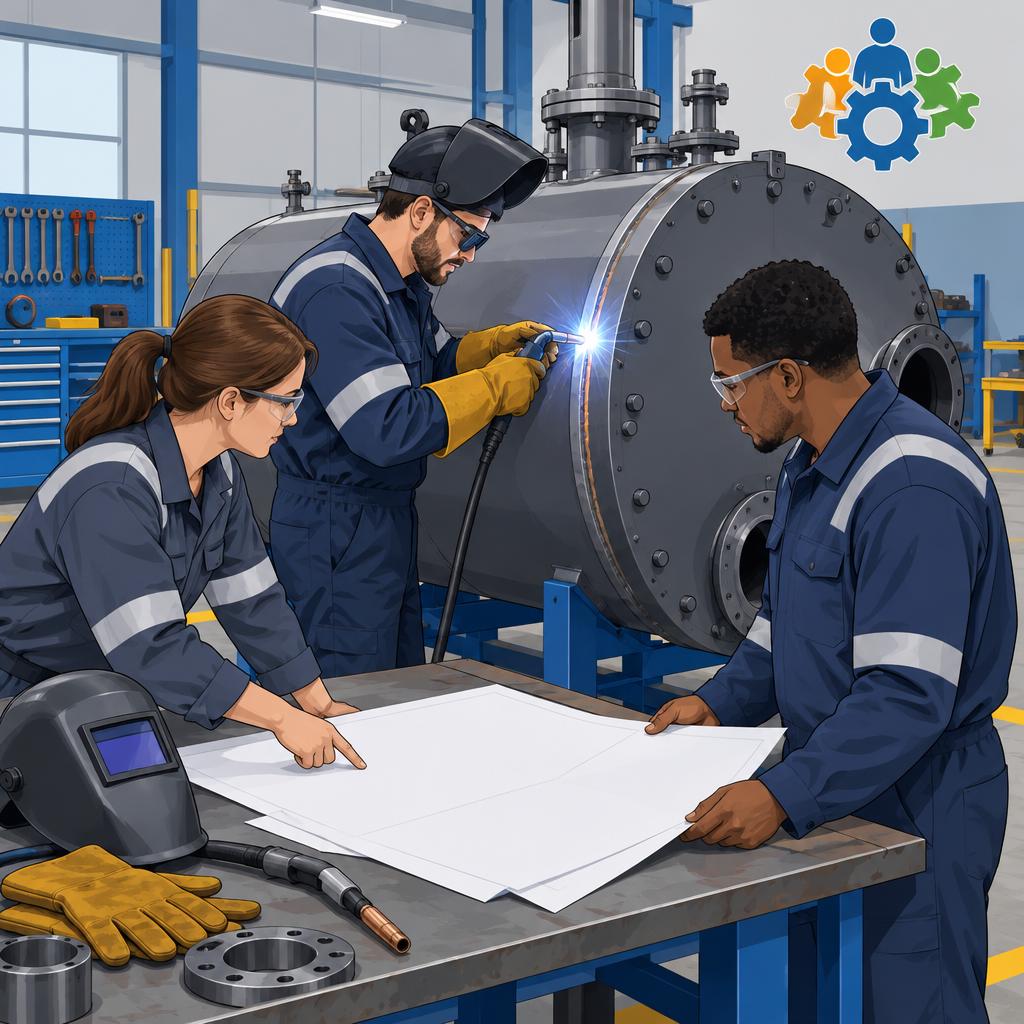
Effective boilermaking requires skilled workers to address challenges together.
Moreover, collaborative work encourages practical solutions when projects become complex.
Team members can combine their knowledge to resolve issues more effectively.
Shared Expertise in Boilermaking
Boilermaking projects often involve welding, drafting, and project management expertise.
Each specialist contributes valuable knowledge to the collective effort.
As a result, the group can examine challenges from several professional perspectives.
Creative Approaches to Complex Challenges
Collaboration creates opportunities for team members to brainstorm possible solutions.
Furthermore, different viewpoints can reveal options that one person might overlook.
This exchange of ideas strengthens the team’s ability to solve difficult problems.
Applying Collective Insight
For example, a boilermaking team may investigate the root cause of a project issue.
Workers can then combine their expertise to develop a strategic response.
Through this process, the team can achieve a successful project outcome.
Innovation Through Collaborative Work
Teamwork also encourages workers to explore new ideas and techniques.
Consequently, experimentation can improve design, efficiency, and safety measures.
Collaborative innovation can help boilermaking teams create more effective project solutions.
Discover More: Career Advancement Opportunities for Pipelayers
Support and Encouragement in Boilermaking Teams
- Team support plays a crucial role in boosting morale and motivation.
- Supported team members are more likely to remain motivated.
- A positive work environment helps foster teamwork.
- Additionally, a supportive atmosphere encourages collaboration and communication within the team.
- Encouragement from peers and leaders can greatly improve job satisfaction.
- Recognizing and appreciating team members’ efforts boosts morale.
- Furthermore, encouragement can increase job satisfaction and retention rates.
- Valued team members are more likely to remain committed.
- Constructive feedback and praise can motivate team members.
- Finally, open communication can strengthen relationships within the team.
Support and encouragement strengthen teamwork in boilermaking.
A positive environment can boost morale, motivation, job satisfaction, and retention among team members.
By supporting one another, boilermaking teams can encourage commitment and maintain stronger working relationships.
Learn More: Pathway to Becoming a Construction Manager
Training and Development in Boilermaking
Continuous training and skill development strengthen boilermaking teams.
Investing in professional growth can improve the team’s overall performance.
Training programs help team members expand their skills and work more effectively together.
Regular sessions teach new techniques and keep workers informed about industry trends.
Transform Your Career Today
Unlock a personalized career strategy that drives real results. Get tailored advice and a roadmap designed just for you.
Start NowAdditionally, training strengthens problem-solving skills and supports more efficient work processes.
These programs also create a culture of continuous learning and improvement.
Safety training helps workers follow protocols and prevent accidents.
Communication training can strengthen collaboration and improve team efficiency.
Furthermore, development opportunities make team members feel valued and motivate stronger contributions.
Organizations that prioritize training often achieve higher retention and greater team satisfaction.
Risk Management in Boilermaking
Risk management protects boilermaking workers throughout project planning and execution.
Team members can identify hazards early and develop practical responses together.
Consequently, coordinated safety efforts can reduce potential dangers before they escalate.
This approach supports safer project performance for everyone involved.
- Collective decision-making: Team members compare perspectives and experiences when they assess potential hazards.
- Identifying hazards: A collaborative review can reveal dangers that one worker might overlook.
- Mitigating risks: The team can implement safety measures that address identified risks during project execution.
Therefore, teamwork strengthens risk management throughout boilermaking projects.
Clear cooperation helps teams execute work safely and efficiently.
It also helps protect every worker from preventable accidents and injuries.
Teamwork and Project Success
Strong teamwork gives boilermaking crews a shared sense of purpose throughout each project.
Furthermore, mutual support can strengthen camaraderie and create a more positive work environment.
When workers value one another’s contributions, they can build greater unity within the team.
Therefore, boilermaking professionals should make collaboration a consistent workplace priority.
Such commitment can help teams pursue successful outcomes and improve satisfaction among team members.
Additional Resources
Google search results for The Importance of Teamwork in Boilermaking Construction and Manual Labor
Bing search results for The Importance of Teamwork in Boilermaking Construction and Manual Labor


