




The 2026 independent contractor final rule concerns the reality of work, not merely the label printed on a contract. For workers and small-business managers, a useful next step is to organize dated facts for qualified advice. A worksheet should preserve what happened, what a document says and what remains unresolved.
As checked November 24, the published rule states an effective date of January 22, 2027. This guide separates that future date from publication and explains how to prepare a neutral evidence log. It does not classify a reader, resolve a dispute or provide an individualized legal opinion.
2026 independent contractor final rule: check the date first
DOL announced the rule November 19. The November 23 Federal Register final rule, FR Doc. 2026-23777, states that it takes effect January 22, 2027. The 60-calendar-day interval describes those two published dates. On November 24, 59 calendar days remain until that stated date; publication does not mean the new rule is already effective.
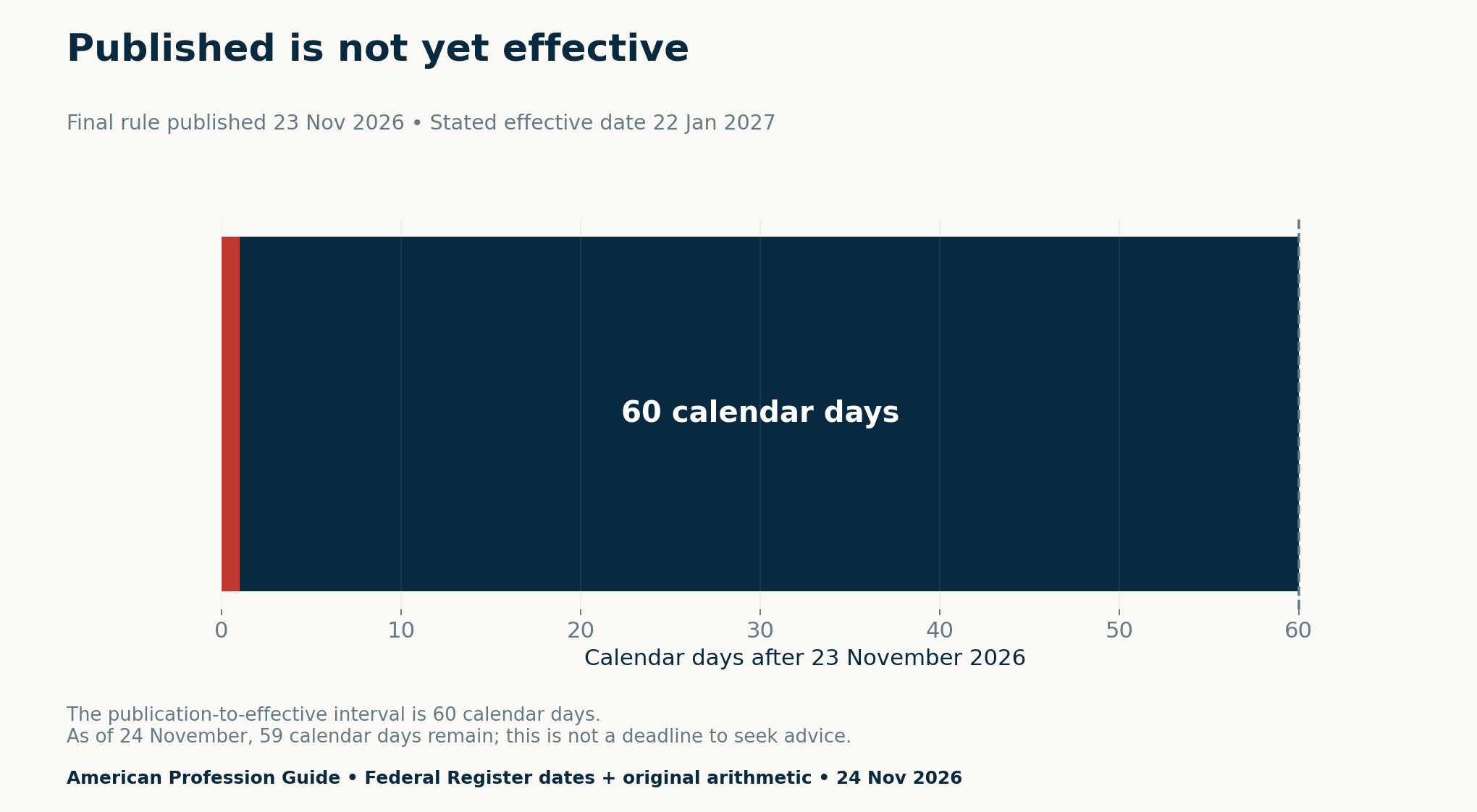
Keep the date of the work arrangement separate from the date of an article or notice. A qualified adviser may need the relevant period and jurisdiction before deciding which legal materials matter. Do not use this date chart to decide when a claim expires or whether a past arrangement was lawful.
Name the legal question before collecting answers
The rule addresses DOL’s employee-status analysis under the FLSA and applies that analysis under the FMLA and MSPA as specified. The DOL FAQ describes economic dependence as central, with control and opportunity for profit or loss as core considerations. Skill, permanence and integration into production also matter; this is not a numerical points test.
The three laws have their own coverage requirements. A federal status discussion does not automatically determine tax treatment, state-law status or eligibility for every benefit. Write the question at the top of your log: for example, which law, period and working relationship does the adviser need to assess? Leave the answer open until it is actually reviewed.
Keep terms, practices and evidence in different columns
Begin with the contract’s exact relevant term and its version or date. Then record an observed practice without turning it into a legal conclusion. “The client sent start-time instructions on three dated occasions” is a factual description. “This proves employee status” is a conclusion this worksheet is not designed to make.
A third column should identify the supporting record, such as a redacted schedule, change request or invoice reference. A fourth should state what remains unknown. Preserve contradictions instead of editing the observations to fit the agreement. Record lawful, relevant material without collecting other people’s sensitive information.
| Fact area | Neutral question to document |
|---|---|
| Control | Who directs schedules, assignments and how work is performed in practice? |
| Profit or loss | What actual initiative or investment choices can affect the result? |
| Skill | What skill does the work require, and what evidence shows it? |
| Permanence | What is the actual duration and continuity of the relationship? |
| Production integration | How does this work connect with the relevant production process? |
Compare two fictional arrangements without assigning status
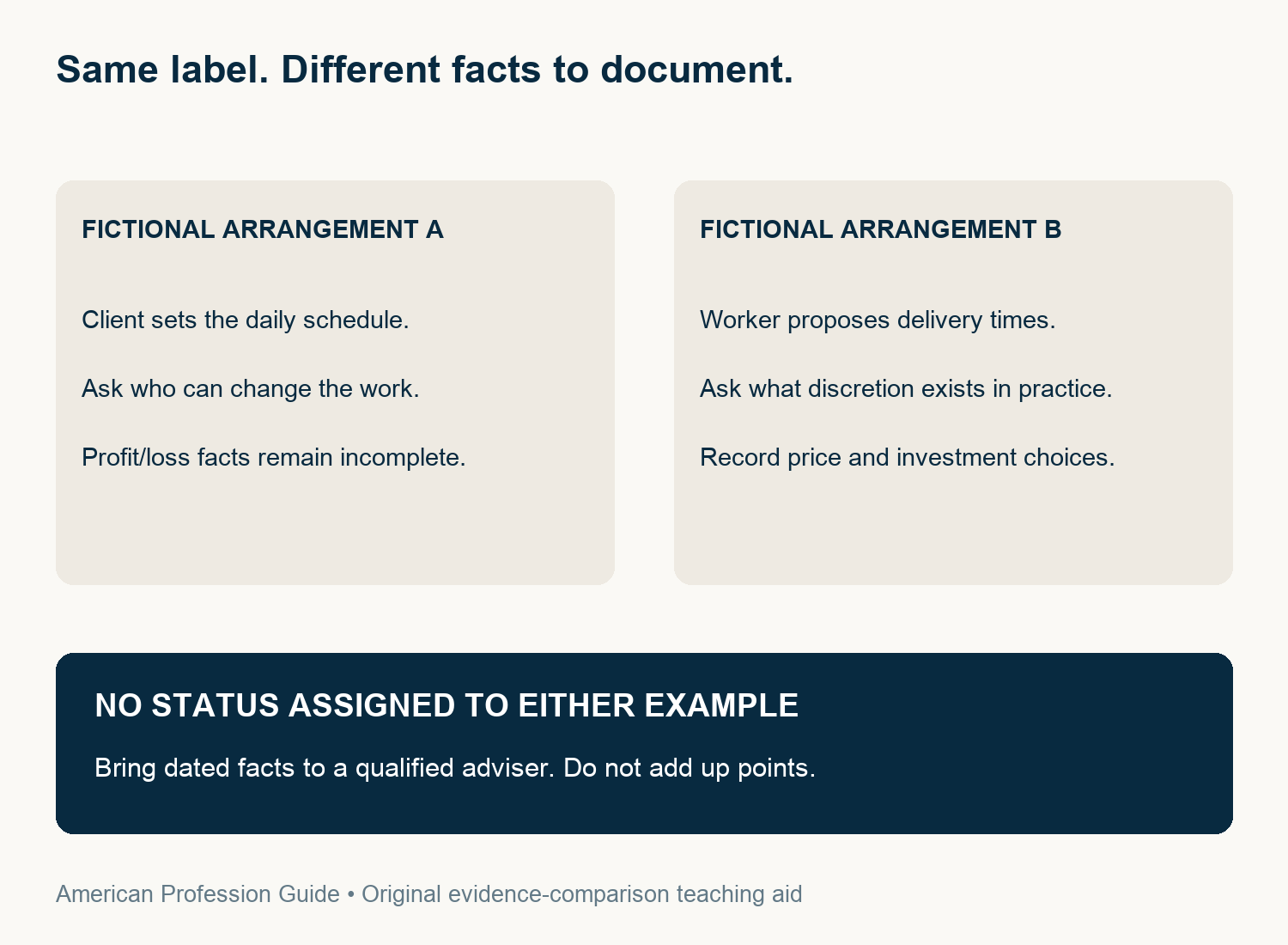
In fictional arrangement A, the client sets the daily start and finish schedule. The agreement uses an independent-contractor label. Record the schedule evidence and ask who can change assignments or methods. Its fixed project fee does not, by itself, establish the worker’s actual opportunity for profit or loss; costs and discretion still need documentation.
In fictional arrangement B, the worker proposes delivery times and negotiates prices and investment choices. Record what actually happens, including any practical restrictions or approvals. A clause allowing discretion is not the same as evidence that it can be exercised. Other relevant facts remain open in both examples.
We intentionally leave the classification column unresolved. Do not count rows pointing one way or assign a probability. Neither the chart nor the examples can settle a legal status from selected facts. Their purpose is to make the next conversation more specific and less dependent on labels.
Bring a useful evidence packet to the adviser
Choose a small, relevant set of dated records and keep originals securely. Use references or redacted copies in the working log. Separate a direct observation from an inference and from something another person reported. If accounts differ, record that disagreement and identify the source rather than deciding which account must be true.
Ask what additional evidence is needed and whether a separate tax, state-law or benefits question requires another specialist. Keep the reviewer’s answer and date beside the issue it addresses. An answer to one question should not silently fill every other status or coverage field.
The Wage and Hour Division’s local-office directory is an official route for questions within its remit. A suitably qualified employment-law adviser can assess the facts and applicable law. Do not publish private contracts, worker identities or accusations in a public comment or general online worksheet.
Recheck the legal position before relying on it
We checked the published final text and current indexed DOL material and ran a targeted change/litigation search on November 24. That is a dated research check, not a guarantee that no case, order or later amendment exists. Recheck current primary sources and obtain advice for the relevant state and period before acting.
The public worksheet collects no personal submissions. It offers no 1099 shortcut, tax strategy or method to avoid worker protections. Our separate team-trust guide discusses clearer workplace conversations; those management practices do not decide legal classification either.
Methods and four editable downloads
This is an evidence-preparation report built from dated primary sources and two invented arrangements. We verified the publication/effective interval independently and kept every example’s legal result unresolved. One date chart and one comparison infographic serve the question; invented employee-status statistics would not.
- Dated rule milestones and sources (CSV)
- Two fictional arrangements with unresolved status (CSV)
- Blank dated fact-versus-label log (CSV)
- Questions and evidence for qualified review (CSV)
Suggested citation: American Profession Guide, “Employee or Contractor? Document the Work, Not Just the Label,” November 24, 2026. Cite the official rule for legal provisions and this report for the original evidence-organizing tools.


