




For the NASA graduate research fellowship NSTGRO 2027, a prepared student response is not the same thing as a submitted institutional proposal. The mandatory preliminary deadline is December 9, 2026, at 6 p.m. Eastern / 3 p.m. Pacific. Identify the faculty adviser and authorized university submitter before treating your calendar as complete.
This report separates the two published stages from the internal deadline your school must confirm. Its downloadable calendar leaves that school deadline blank. The role card and fictional summary are planning aids, not NASA forms, eligibility decisions or promises of funding.
Read the NASA graduate research fellowship NSTGRO 2027 dates
The NSTGRO27 appendix, issued November 6, lists the December 9 preliminary deadline and March 18, 2027, at 6 p.m. Eastern / 3 p.m. Pacific as the full-proposal target. The Grants.gov notice confirms that preliminary proposals are mandatory and full proposals require an invitation. A later date on an opportunity listing does not remove the earlier gate.
We checked the live NSPIRES record and linked documents on November 24, 2026. The record includes the parent SpaceTech REDDI document amended November 23. Check that live document set again before acting; this article does not freeze its requirements or extend a deadline.
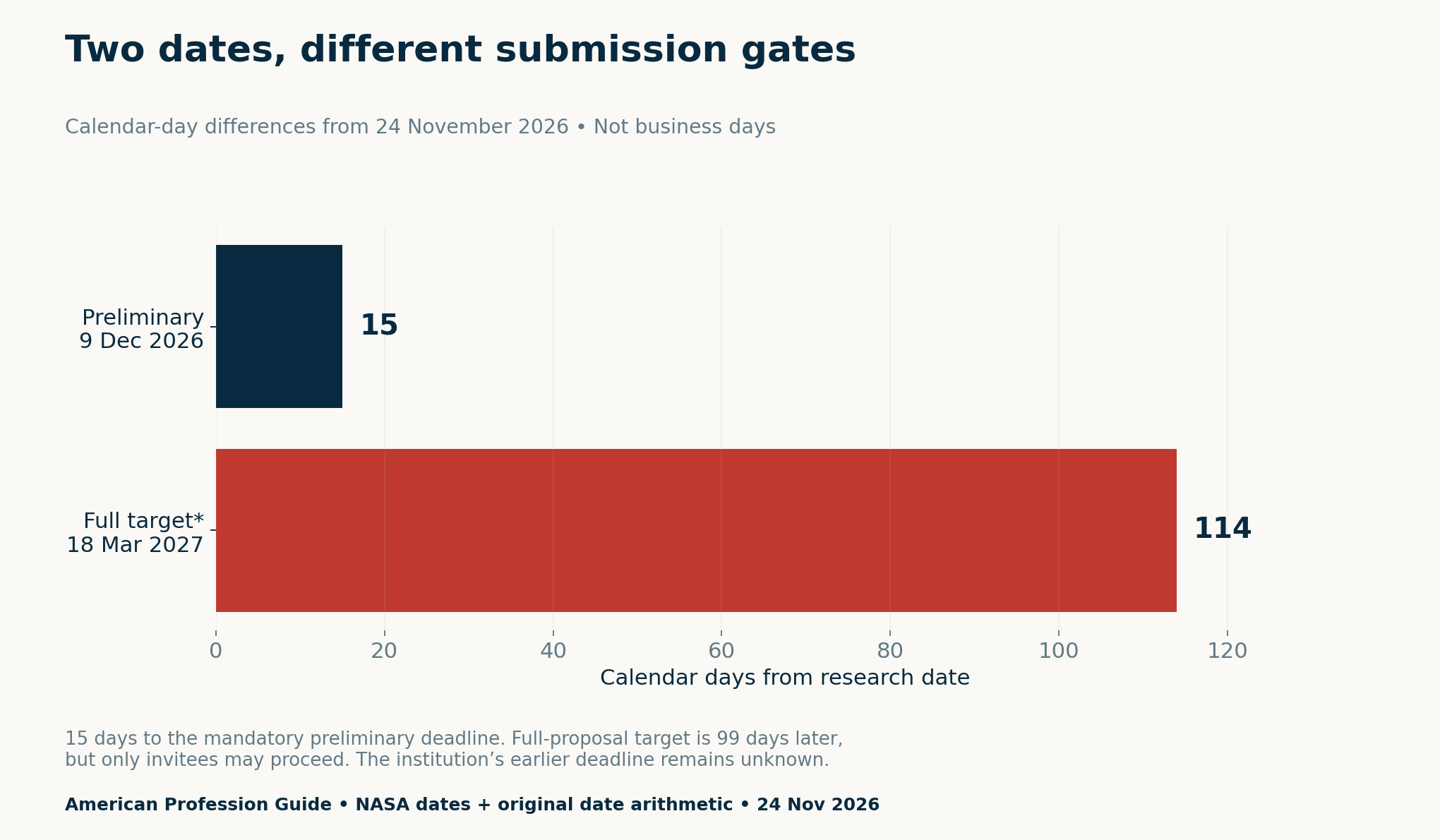
The date differences are useful for orientation, but they are not a recommended work schedule. The first interval is 15 calendar days from November 24 to December 9. The target full-proposal date is 99 days after the preliminary date, or 114 days from the research date. Neither interval accounts for local review, holidays or office availability.
Ask who owns the proposal in your institution
The official preliminary submission instructions distinguish preparation, release to the institution and final submission. The faculty adviser initiates the proposal; the student does not initiate it. The adviser releases it to the organization, after which the authorized organizational representative completes submission. A saved draft or release notice alone is not the final receipt.
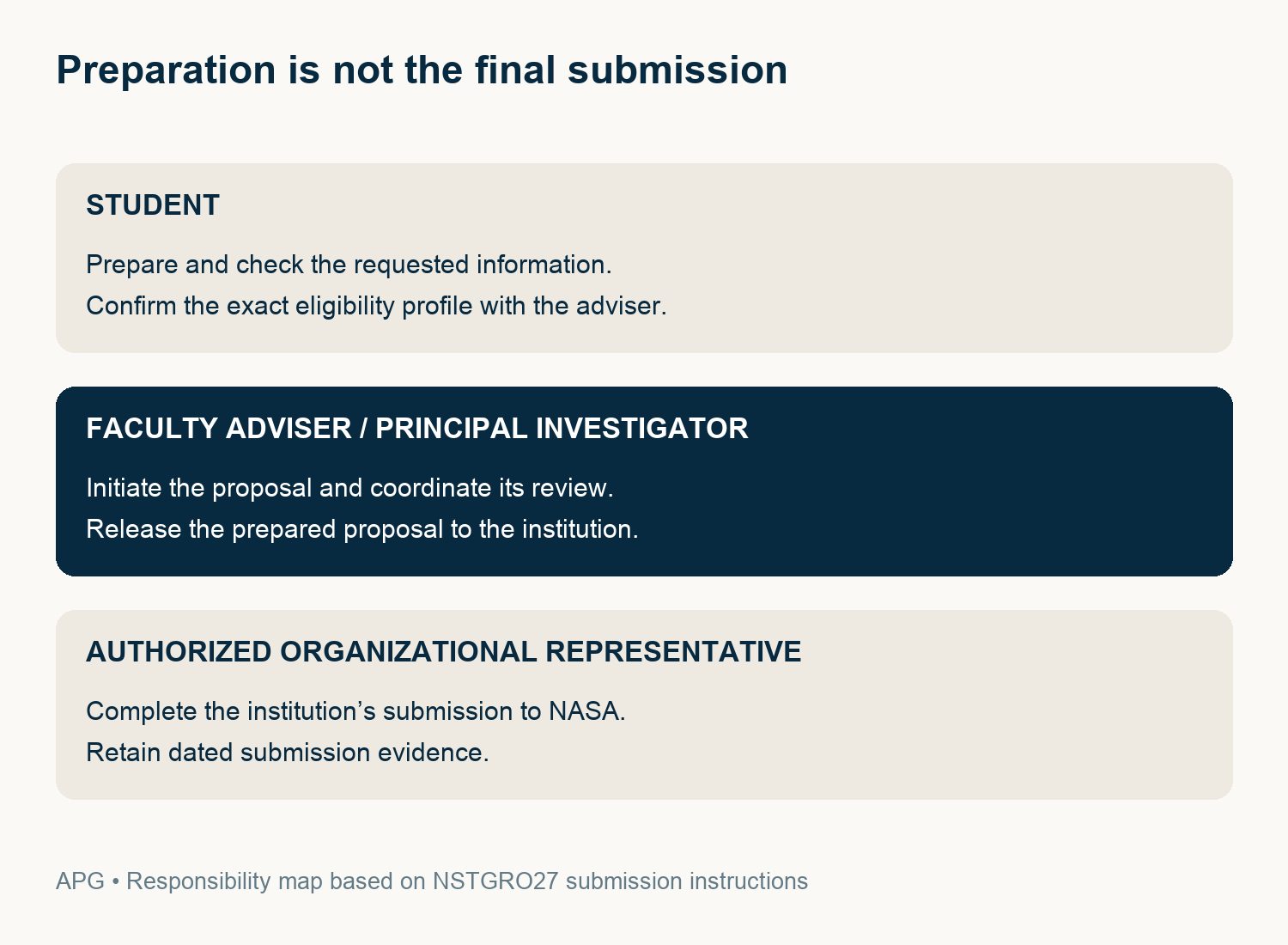
Start a short conversation with the research office and your adviser. Ask who will review the material, who can release it and who can submit it. Record role names or office references in your private planning copy. You do not need to publish personal contact details to keep a useful evidence trail.
For example, “my adviser reviewed the responses” answers a content-review question. It does not answer “has the institution submitted?” Keep those statuses separate. That distinction prevents a well-prepared draft from being mistaken for a completed external action.
Check the exact eligibility profile, not a headline
The appendix calls for U.S. citizen, national or permanent-resident status at submission, a bachelor’s degree before fall 2027, and full-time relevant graduate enrollment at the submitting U.S. institution by that term. Its Section B.1 and profile table add important conditions. Confirm your exact profile and the specified research area with the official documents and your adviser.
Do not turn a short eligibility summary into an automatic approval. A student can appear to fit a broad description while still needing a profile, support-history or enrollment check. In the blank calendar, record “unconfirmed” until the appropriate institutional source has resolved the question. Do not fill gaps with assumptions about another fellowship.
Back-plan from the school’s own deadline
The institution may need time before the external cutoff to review and route a proposal. Our worksheet deliberately leaves its internal deadline empty. Ask the office to supply the date, time, time zone and reviewer. Record when the answer was confirmed and what still needs to happen before release.
| Planning question | Evidence to record |
|---|---|
| Which internal deadline applies? | Date, time zone and research-office confirmation |
| Who reviews the preliminary responses? | Agreed reviewer and review status |
| Has the adviser released the proposal? | Dated release record |
| Has the authorized representative submitted? | Dated submission evidence from the system |
Work backward only after that internal date is known. Leave enough room for questions and corrections based on your institution’s actual arrangements. A worksheet cannot guarantee staff availability or solve a late submission. Avoid treating the external cutoff as the time to begin internal coordination.
Use a fictional summary to separate claims from evidence
The sample CSV contains one invented, non-sensitive sentence about checking repeatability in a classroom measurement. It leaves the claim, measure, feasibility and research-area confirmation columns blank for faculty discussion. It provides no technical design and is not represented as a compliant or competitive NASA proposal.
This blank structure has a practical purpose: a polished sentence should not silently become an accepted claim. Ask what would be measured, how the work could be assessed and what the adviser still needs to review. The exercise helps organize a discussion without copying a real student’s unpublished research.
Follow the official anonymity and formatting instructions for the actual preliminary submission. Keep our planning notes separate from the material entered into NSPIRES. Do not paste identifying worksheet information into a response that has different disclosure rules.
Confirm submission without assuming selection
Ask which dated record establishes final institutional submission, then keep it with the confirmed deadline and reviewed version. “Prepared,” “released,” “submitted” and “invited” are different states. Record the state supported by evidence; do not mark later stages complete because an earlier one went well.
Funding remains competitive and subject to appropriations. An invitation is not an award, and a fellowship proposal is not a NASA employment application. For broader career preparation, our space-science guide for new graduates covers a different question from this institutional submission route.
Methods and four planning downloads
Research date: November 24, 2026. We read the official opportunity record, appendix and submission instructions, then calculated simple calendar-day differences. We did not estimate selection probability, create an applicant ranking or assess a real student. One date chart and one responsibility infographic answer the reader question without adding repetitive graphs.
- Dated milestones and calendar-day calculations (CSV)
- Blank institutional back-planning calendar (CSV)
- Responsibility and evidence card (CSV)
- Fictional summary with blank faculty-review columns (CSV)
Suggested citation: American Profession Guide, “NASA Graduate Research Fellowship: Who Submits Each Step?”, November 24, 2026. Cite NASA for official requirements; the planning tools and date calculations are original editorial work.


