




The HIRE Vets award employers 2026 list is a useful starting point for a civilian job search. It is not a list of open jobs. Start with the recognized employer, then verify the employing entity, location, role and support offered by the team you would join.
Our analysis of the official 2026 download found 772 recipient records: 290 small, 383 medium and 99 large employers. Small and medium employers together account for 673 records, or 87.2%. That gives a practical reason to look beyond household-name companies, without assuming that every listed business is recruiting.
What the HIRE Vets award employers 2026 announcement says
The Department of Labor’s 13 November announcement reports 772 employers recognized after a 12 November ceremony. It also says the 2026 honorees hired more than 40,000 veterans over the previous two years. Those are different units: employers recognized and historical hires, respectively.
Neither figure tells you how many relevant vacancies exist today. Historical hiring can guide research, but it cannot establish a current opening or predict your chance of an offer. We therefore analyse the recipient list separately from the vacancy checks in our blank worksheet.
Look across employer sizes without turning size into a score
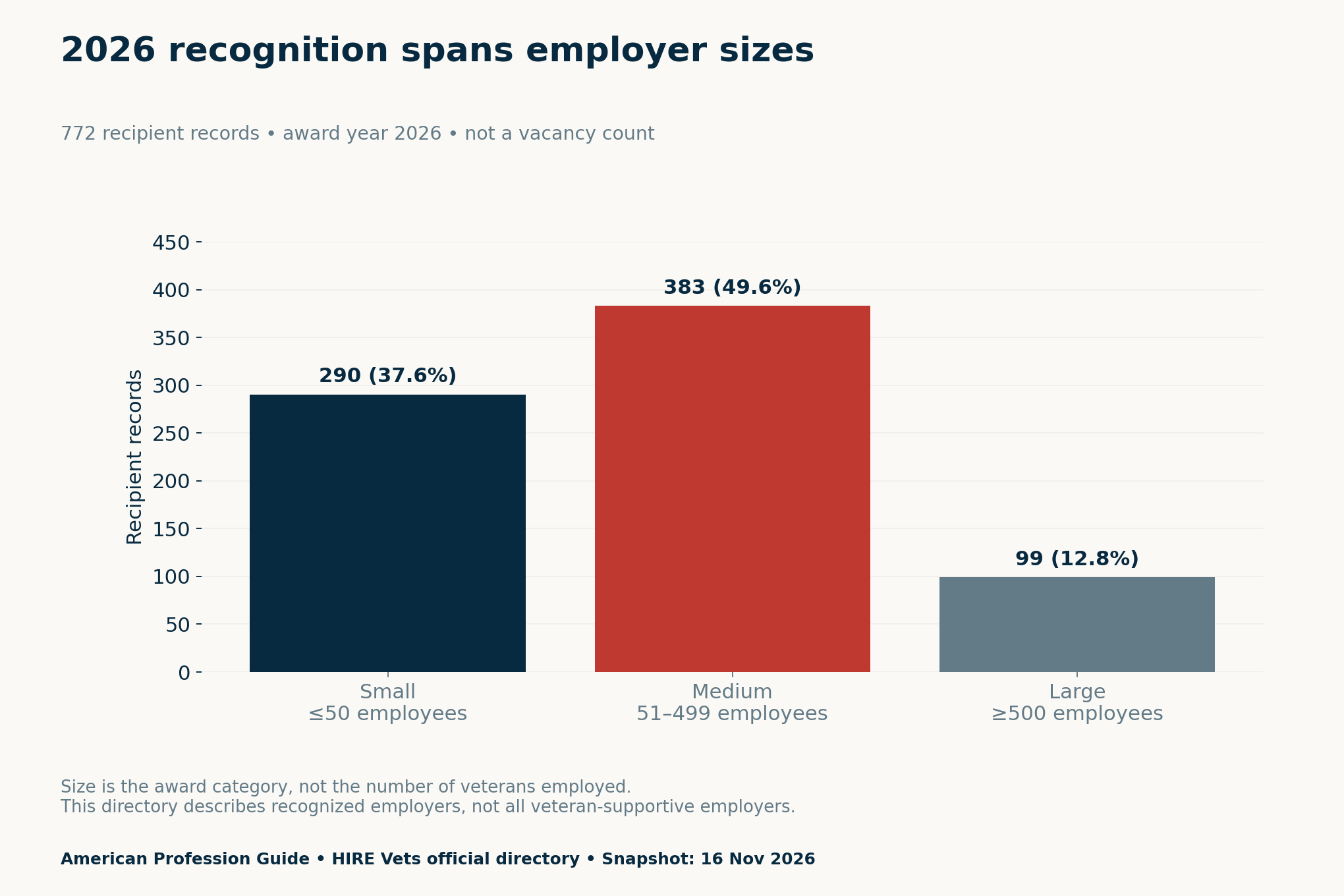
The official program FAQ defines small as 50 or fewer employees, medium as more than 50 and fewer than 500, and large as 500 or more. Gold and Platinum exist within each group. Criteria vary by group and level; some smaller employers can use alternative hiring or retention routes.
These definitions describe program categories. They do not count veteran employees or measure the resources of a particular department. For example, a small business may have a relevant technical role, while a large organization may have no suitable opening in your location. The directory alone cannot settle that comparison.
Read award level in context
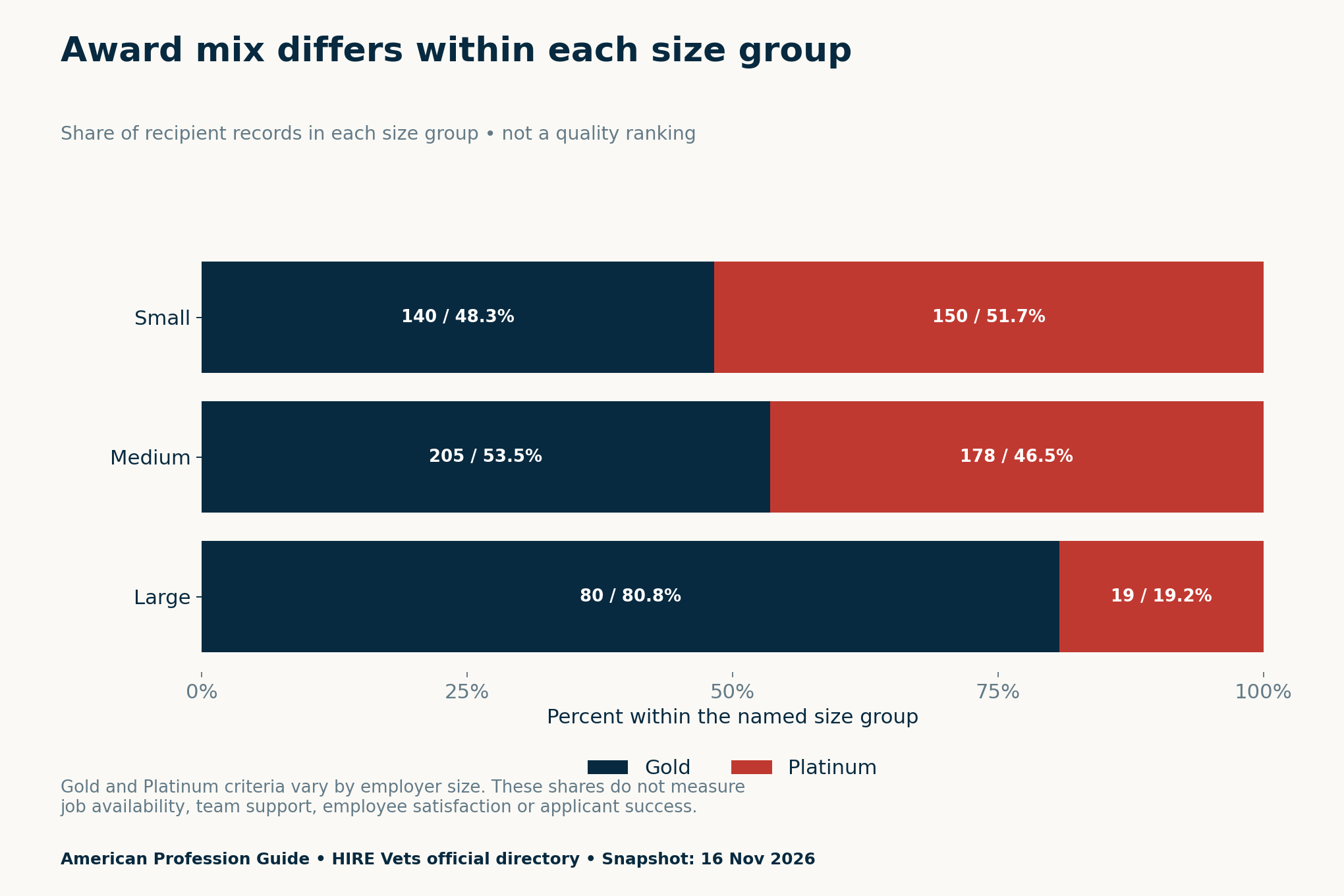
Across the whole download, 425 records are Gold and 347 are Platinum. However, a higher award level is not a personal job-fit rating. Our chart preserves both size and level so that the comparison does not silently treat unlike program categories as identical.
A company absent from this directory has not, on that basis alone, been shown to be unsupportive of veterans. Equally, recognition does not establish what a specific manager does. Ask concrete questions about onboarding, supervision and development rather than making either assumption.
Use the directory location as a lead, not a commute decision
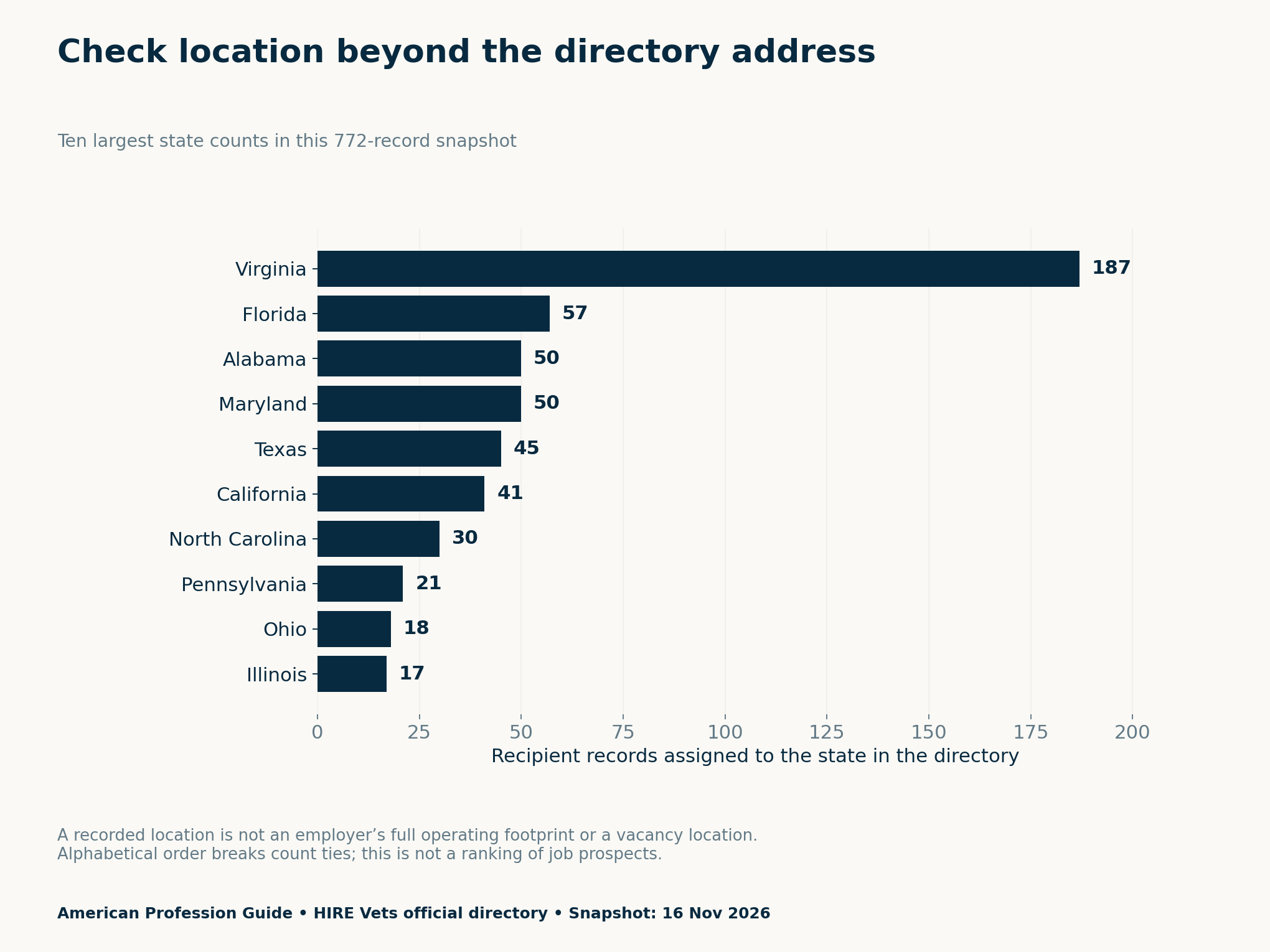
Virginia accounts for 187 records, or 24.2% of this snapshot. That concentration describes the directory’s recorded locations. It does not mean that 24.2% of available veteran jobs are in Virginia, or that an employer listed there recruits only there.
Check the work location on the actual advertisement. A headquarters address, customer site, branch office and remote-work arrangement can describe different places. Until the official advert answers the question, mark location as unknown rather than treating the directory address as a job location.
Build the HIRE Vets award employers 2026 shortlist in layers
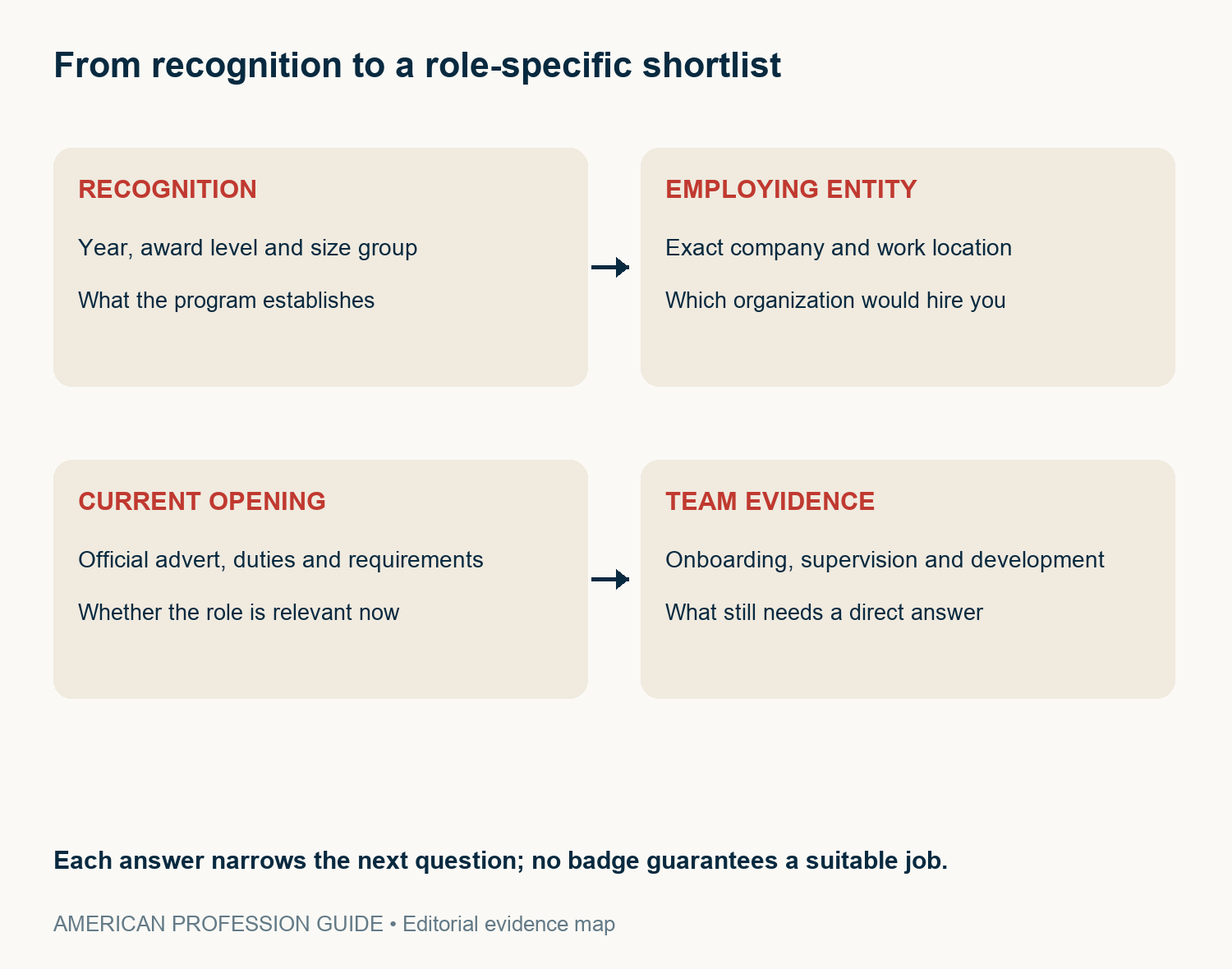
Use the official awardees table and keep the year filter at 2026 when reproducing this snapshot. Record the exact name, size group and award level. If an advert uses a trading name or a subsidiary, check how it relates to the recipient before carrying over the recognition.
Next, follow the employer’s official careers page and record a requisition identifier where available. Read duties and requirements, not only a job title. Save the date checked and any closing date stated. A cached search result or an expired advert should remain a lead to verify, rather than a current opportunity in your total.
Translate experience through tasks and evidence
Military and civilian titles do not always align. A useful comparison starts with the work: equipment maintained, schedules coordinated, records checked or teams supervised. Then identify the evidence you can appropriately describe, such as a qualification, a non-sensitive work example or a clear account of your responsibilities.
Consider a fictional applicant who coordinated equipment inspections. A civilian advert asking for maintenance records and fault tracking may warrant a closer reading. However, that overlap alone does not establish the required technical qualification, experience level or eligibility. The applicant still needs to check every stated requirement.
This method opens several possible occupational families without recommending a specific vacancy. Our older veterans-to-security guide discusses one route; this shortlist method is designed to work across sectors. Treat any older market figures in an adjacent guide as historical unless rechecked.
Ask the team questions the badge cannot answer
Ask who would supervise the role, how onboarding works and how prior experience is assessed. Also ask what development resources apply to this position and how a new employee obtains help. A general corporate statement is useful context, but a specific answer can reveal what still needs clarification.
Record an answer and its source, not just a yes-or-no impression. For instance, “manager described a named induction program on the interview date” is more informative than “veteran friendly.” Leave unresolved questions visible. Do not turn missing information into a negative score or publish an allegation about an employer.
Keep a current, private shortlist
The downloadable ledger separates award information from vacancy information and team evidence. You can add a new row for each relevant role, retaining the exact entity and requisition so repeated adverts do not inflate your count. Change a row’s status when the vacancy closes rather than silently deleting its history.
Use only the information needed for your own search. Do not place service records, health details, passwords or identity documents in a public spreadsheet. This article does not collect applicant files, contact employers or submit applications on a reader’s behalf.
Download the source snapshot and shortlist tools
- Official 2026 recipient snapshot, retained as downloaded (CSV)
- Reproducible size-by-award summary and denominators (CSV)
- Recorded state counts and location caveat (CSV)
- Blank role-specific employer shortlist (CSV)
For each candidate role, keep the award year, entity, official link, requirements, location and check date together. Return to the employer’s own listing before acting. Our Research & Reports collection provides further source-linked career analysis.
Methodology and limits
On 16 November 2026, we downloaded the official filtered award-recipient CSV with 2026 selected. It contains 772 rows, each with a 2026 award year and a distinct employer-name string. All rows were retained; no employer was excluded or merged. Grouping used the published size, award type and state fields. Counts across all three groupings reconcile to 772.
Percentages divide the relevant count by 772, except the award-mix chart, which uses each size group’s own total. We rounded displayed percentages to one decimal place. State counts are ordered by count, with alphabetical tie-breaking. The downloads preserve all recorded states, including those outside the chart’s ten displayed rows.
This is an analysis of program recipients, not a representative survey of U.S. employers. No live-vacancy sample, applicant-success study or assessment of team support was conducted. The worked applicant example and evidence map are editorial teaching tools. The DOL announcement was verified through indexed first-party text because direct fetching returned an access restriction; the directory CSV was downloaded through its normal public interface.


