






Reading travel nursing demand 2026 through a staffing company’s revenue requires care. A growing sales total can include several businesses, different assignment types and accounting adjustments. It does not directly measure the number of open assignments or a nurse’s pay.
AMN’s November 5 results offer a useful example. The company reported $717.3 million of third-quarter revenue, up 13% year over year. Yet its next-quarter Nurse and Allied Solutions outlook changes direction when labor disruption is excluded. This report explains the distinction with five charts, an evidence hierarchy and four free CSV tools.
Travel nursing demand 2026: separate revenue streams
AMN’s primary earnings release covers the quarter ended September 30. It reports labor-disruption revenue of $59 million, compared with $25 million in the preceding quarter and $12 million a year earlier. The release also describes reserve releases linked to earlier events.
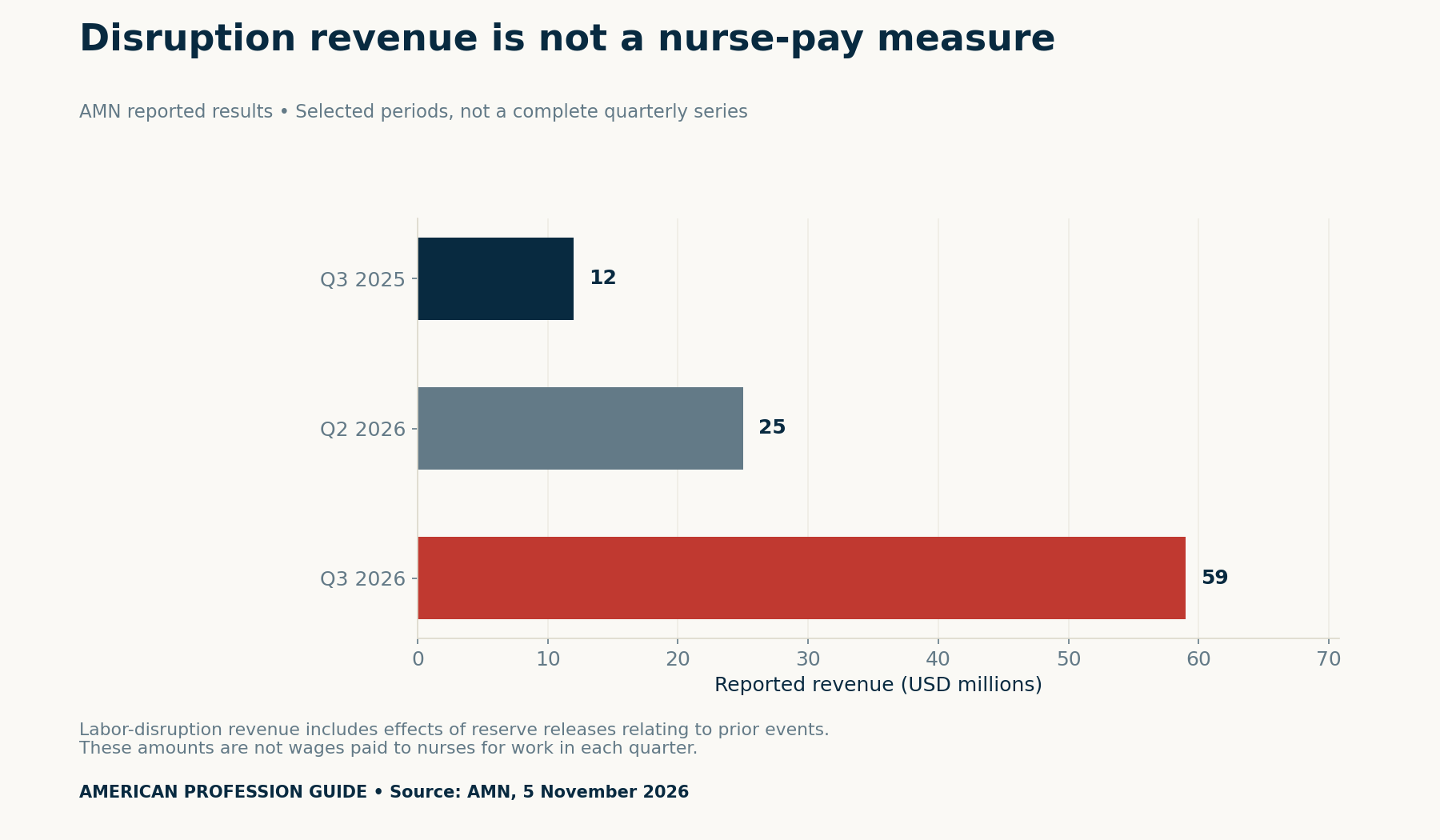
Those selected periods do not form a complete quarterly history. We keep the labels explicit and avoid a continuous trend line across the missing quarters. More importantly, recognized revenue is not the same as wages earned by nurses working during that quarter.
Accounting timing matters when an adjustment relates to an earlier event. A reader should not treat every recognized dollar as evidence of a new current assignment. Equally, the presence of an adjustment does not mean the entire business lacks regular staffing activity.
Why the Q4 outlook changes direction
For Q4, AMN expected Nurse and Allied Solutions revenue to fall 13–15% year over year including disruption, but rise 13–15% excluding it. Both ranges are guidance, not completed results. Their business coverage differs.
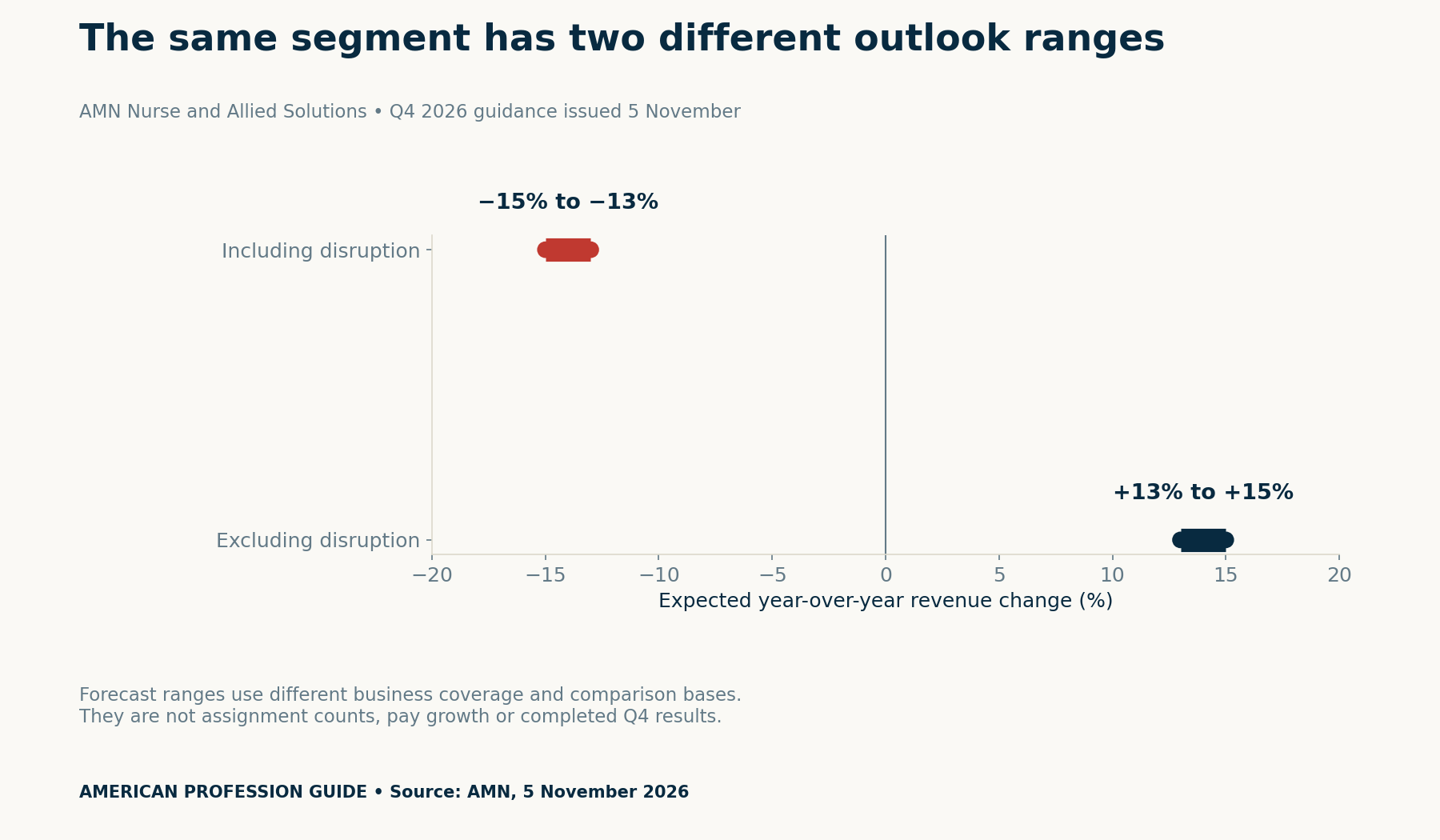
The editorial lesson is to ask what remains inside each comparison. A negative headline and a positive underlying comparison can describe the same segment under different coverage rules. Neither range alone establishes a national nursing boom or contraction.
Do not average the two ranges into a “true” forecast. Also, avoid describing their separation as a measured change in nurses’ opportunities. The chart preserves the two definitions rather than treating them as competing estimates of one identical quantity.
Company totals cover more than travel nurses
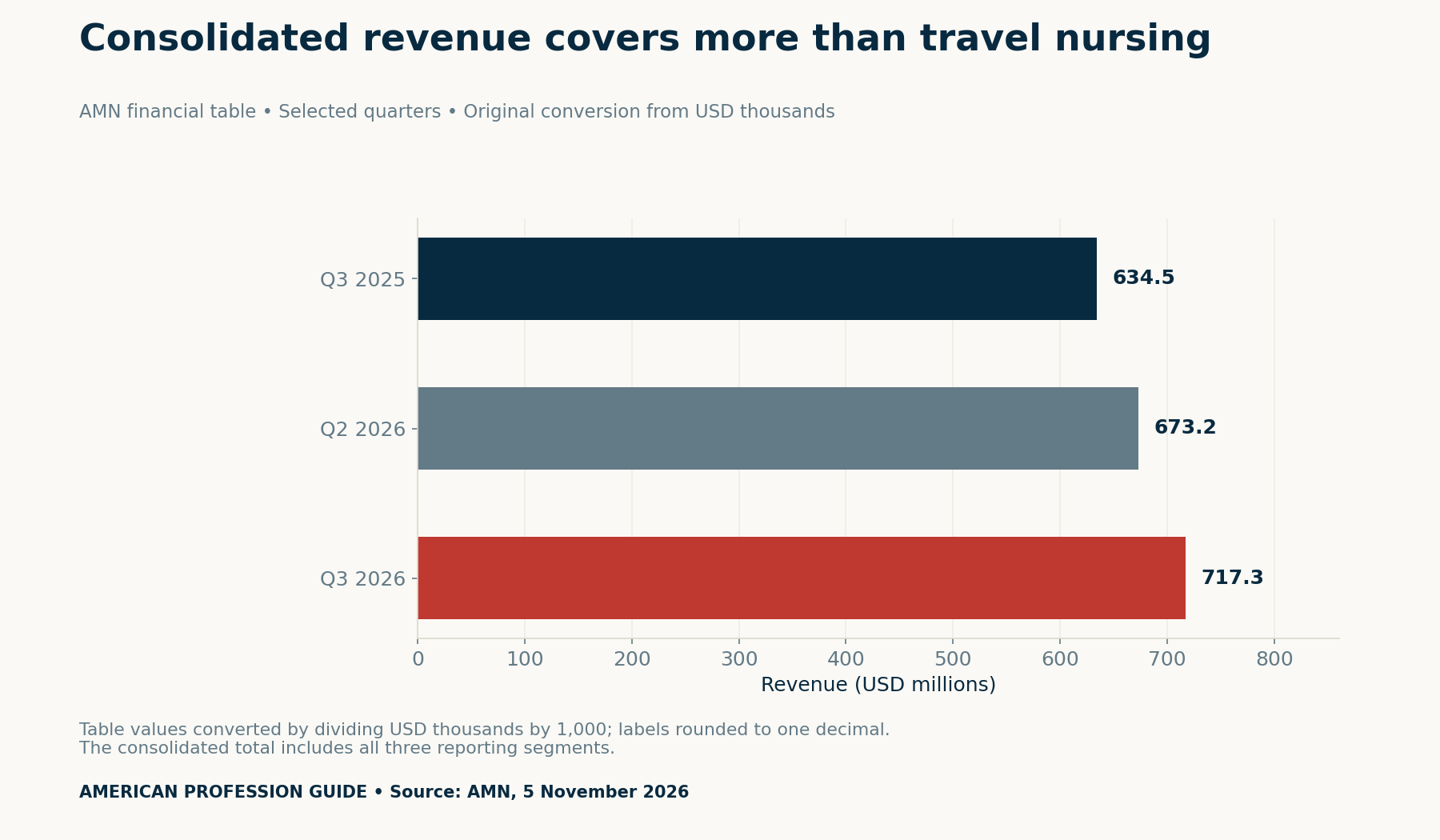
Our conversion of the financial table divides dollar amounts in thousands by 1,000 to express millions. We retain the source precision in the downloadable data and round chart labels afterward. Comparing matching quarters answers a different question from comparing consecutive quarters.
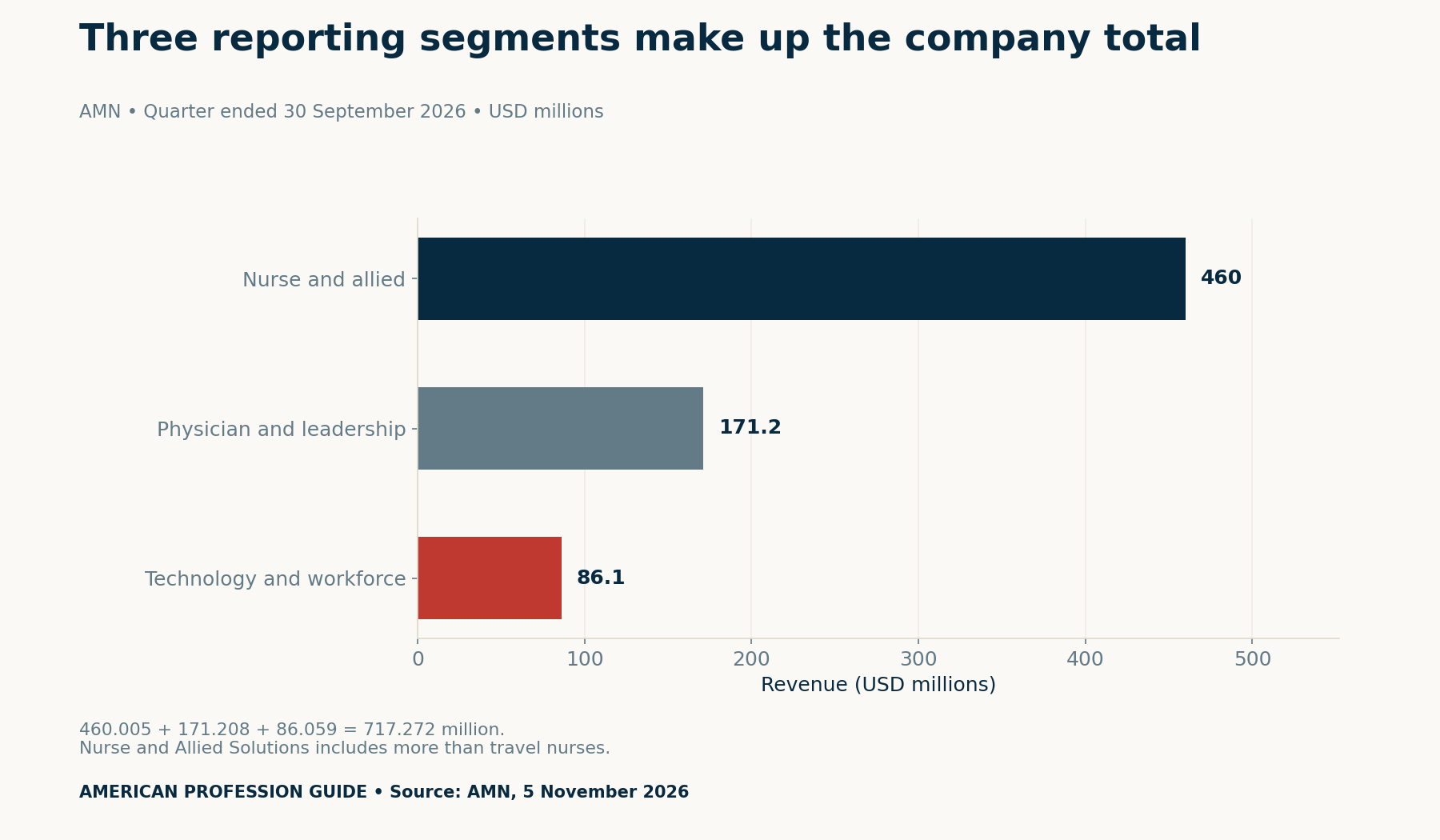
The three segment values reconcile to $717.272 million before display rounding. Nurse and Allied Solutions itself is broader than travel nurses. Readers therefore should not label consolidated or segment revenue as travel-nurse earnings.
This is an original reconciliation of the company’s published table, not independent verification of every underlying transaction. The company release is the primary source. A copy filed elsewhere would remain the same issuer’s statement rather than a second independent observation.
Keep year-over-year and sequential growth separate
The release reports travel-nurse staffing revenue growth of 19% year over year and 2% sequentially. Those percentages use different starting periods. They are revenue measures, not wage-growth or vacancy-growth rates.
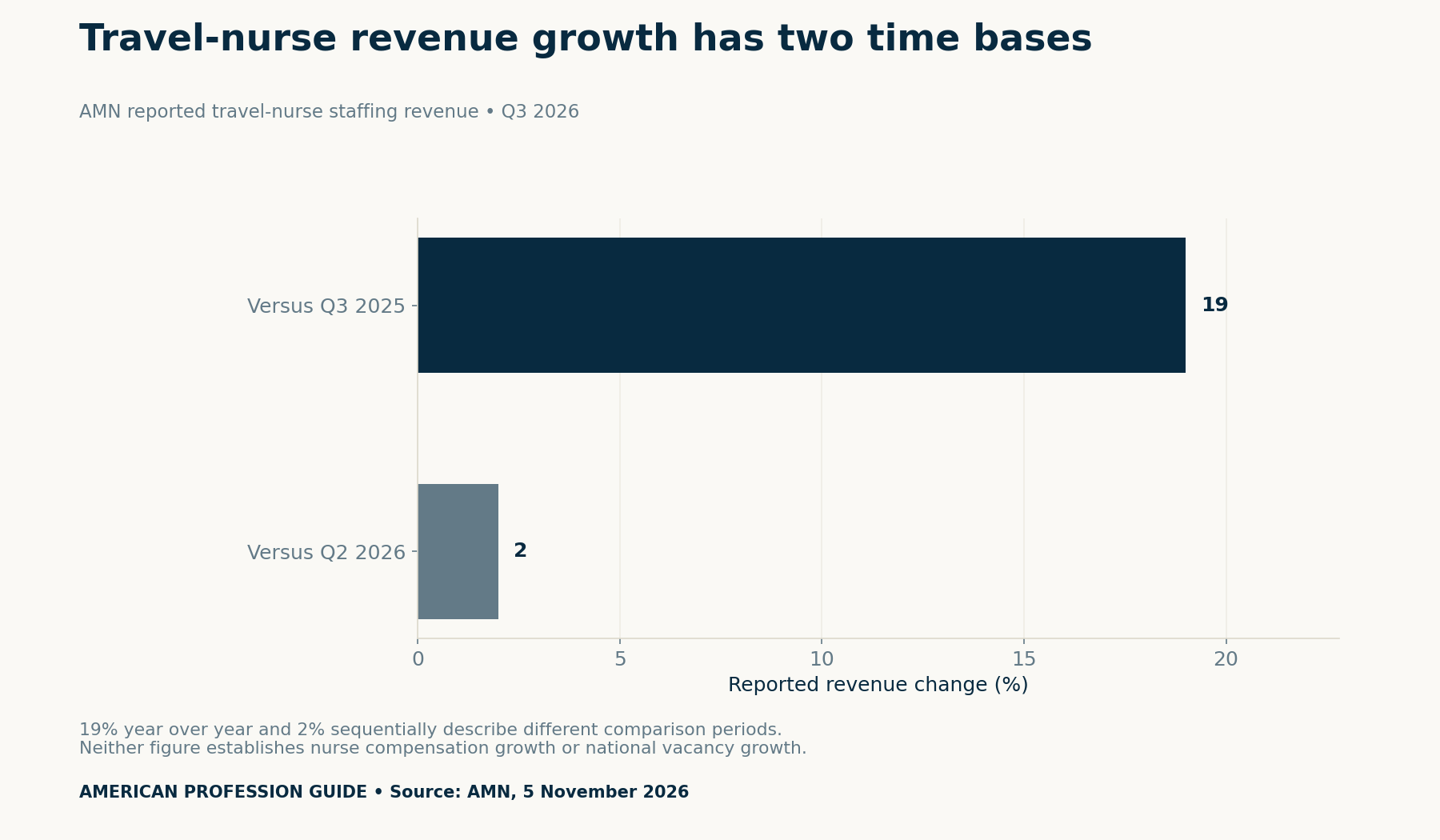
For a career decision, a revenue signal is a reason to investigate the relevant market. It is not enough to establish that a particular location needs your specialty, that you meet its requirements or that the quoted terms suit your circumstances.
Before making a commitment, move from the broad signal toward the evidence for the exact opportunity. Our temporary job-offer checklist can help structure questions about hours and terms. The seasonal hiring study also demonstrates why national announcements and live local requisitions belong in separate records.
Use an evidence hierarchy before choosing an assignment
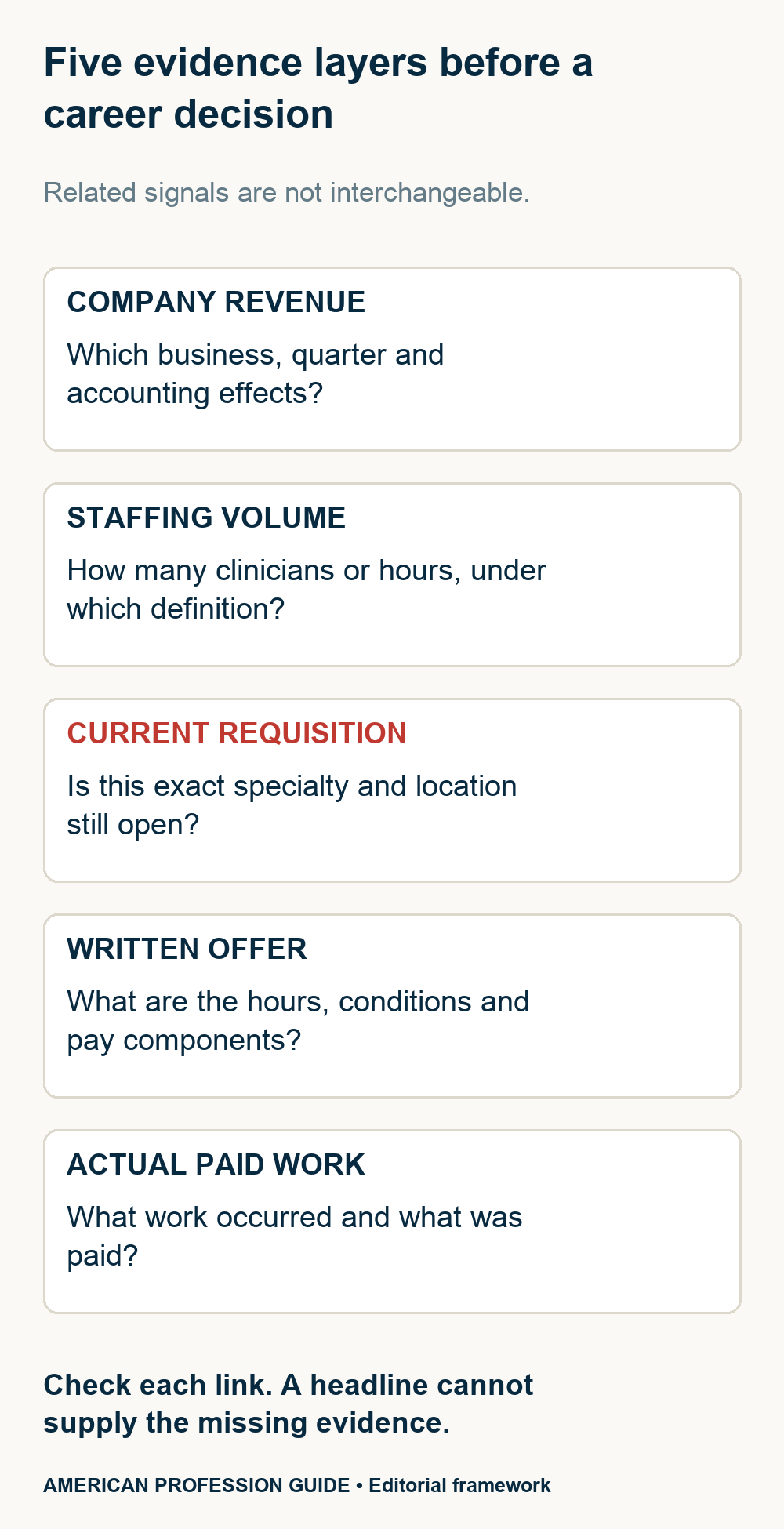
Begin by identifying the company, reporting period and business boundary. Next, look for a defined staffing-volume measure. Then verify a current requisition with a location, specialty, start date and source. These steps narrow the question without assuming that one number supplies every answer.
A written offer adds evidence about a specific arrangement. Keep its stated hours, compensation components and conditions together. Actual paid work is another layer again: a quote is not a payment record. The worksheet makes these distinctions explicit without estimating take-home pay.
Build a bounded posting observation
The blank register supports a prospective four-week observation. Choose a fixed specialty, location set and list of official agency or employer pages before collecting records. Check those same sources weekly, retaining retrieval dates and requisition identifiers.
Deduplicate by source and requisition ID. Record an assignment as regular or disruption-related only when its wording supports that classification; otherwise use unknown. Preserve a closed or expired status instead of counting the advert as currently available.
We have not collected that sample. The register contains blank rows, not observed vacancies. Even a completed convenience sample would describe its declared sources and window, rather than represent every U.S. agency or hospital.
Methods, limits and downloadable tools
We transcribed selected AMN reported figures and guidance from the November 5 release. Original calculations convert table units, reconcile segment totals and check growth from matching periods. Guidance remains clearly separate from results. No investment recommendation, compensation estimate or assignment guarantee follows from this analysis.
- AMN source figures with periods, units and reported-versus-guidance status (CSV).
- Unit conversions, segment reconciliation and growth calculations (CSV).
- Signal-to-evidence worksheet for staffing headlines (CSV).
- Blank weekly travel-nursing posting register (CSV).
One company cannot represent every specialty, agency or region. Revenue also cannot establish safe staffing, cancellation risk or personal eligibility. Use the travel nursing demand 2026 charts as a careful reading exercise, then seek the evidence needed for your own decision.
Suggested citation: American Profession Guide, “Travel Nursing Demand 2026: Read the Revenue Signals,” analysis dated November 12, 2026, using AMN’s November 5 Q3 results. When reusing a figure, keep its period, business coverage and forecast label attached.


