






Seasonal hiring 2026 looks stronger when measured against last year. However, the announced plans are concentrated in two employers. That matters when you turn a national headline into a local job search.
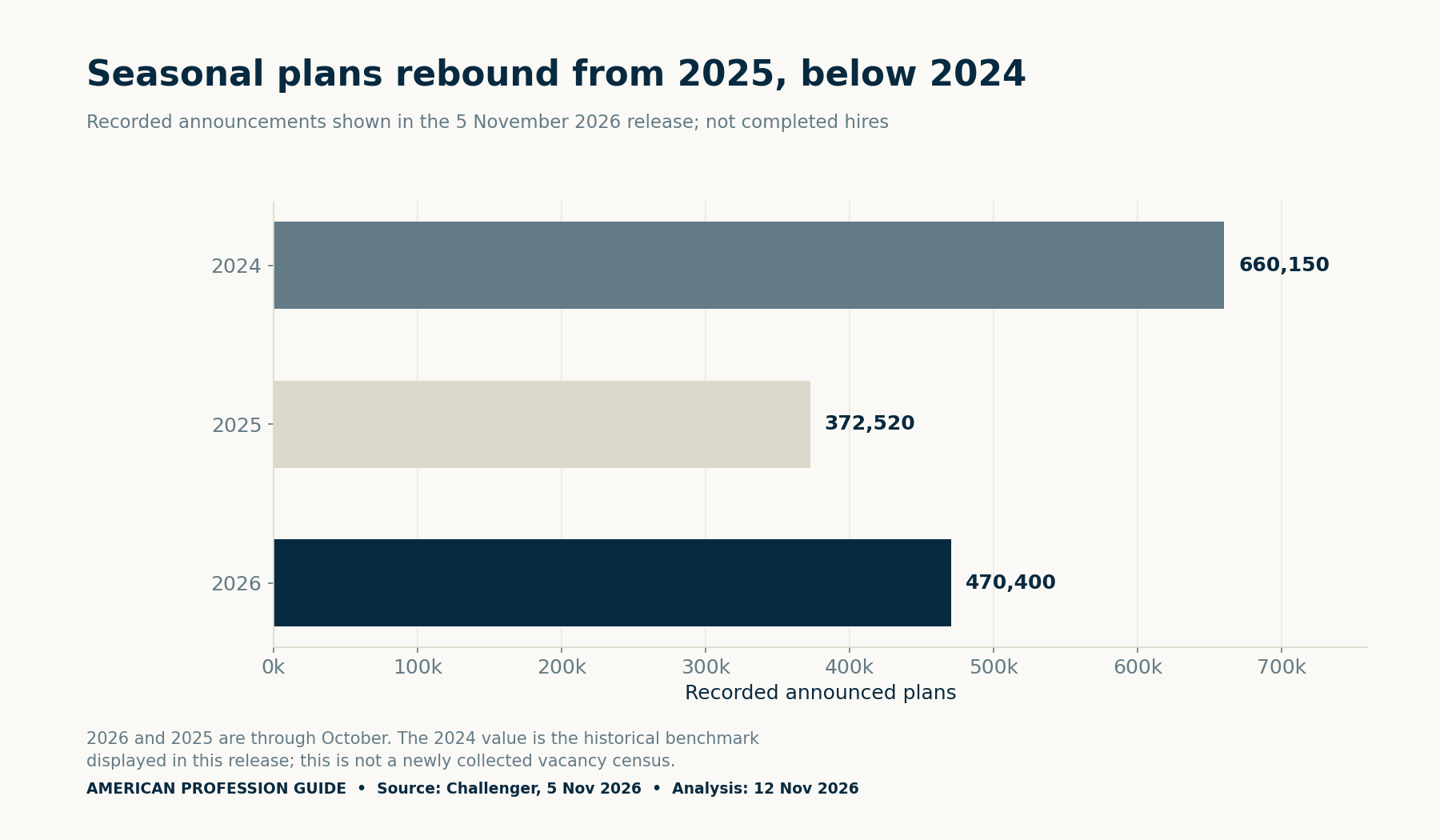
Challenger’s November 5 release records 470,400 seasonal plans through October. Our calculation puts Amazon and UPS at 85.0% of that total. These are company announcements, not completed hires, current vacancies or your probability of receiving an offer.
Evidence checked November 12, 2026. The figures below retain the source’s reporting scope. No local vacancy survey has been conducted for this article.
Seasonal hiring 2026: what the rebound measures
The Challenger release compares this year’s 470,400 plans with 372,520 through October 2025. It also displays a 2024 historical benchmark of 660,150. Thus, the latest total is 26.3% above the 2025 comparator and 28.7% below the displayed 2024 figure.
Those comparisons answer different questions. A positive change against one year does not establish a broad hiring boom. Also, our chart does not independently establish an identical reporting cutoff for the historical 2024 benchmark.
For a reader, the useful response is to investigate employers and locations. Avoid treating the national total as a list of positions still available today.
Two employers dominate the recorded plans
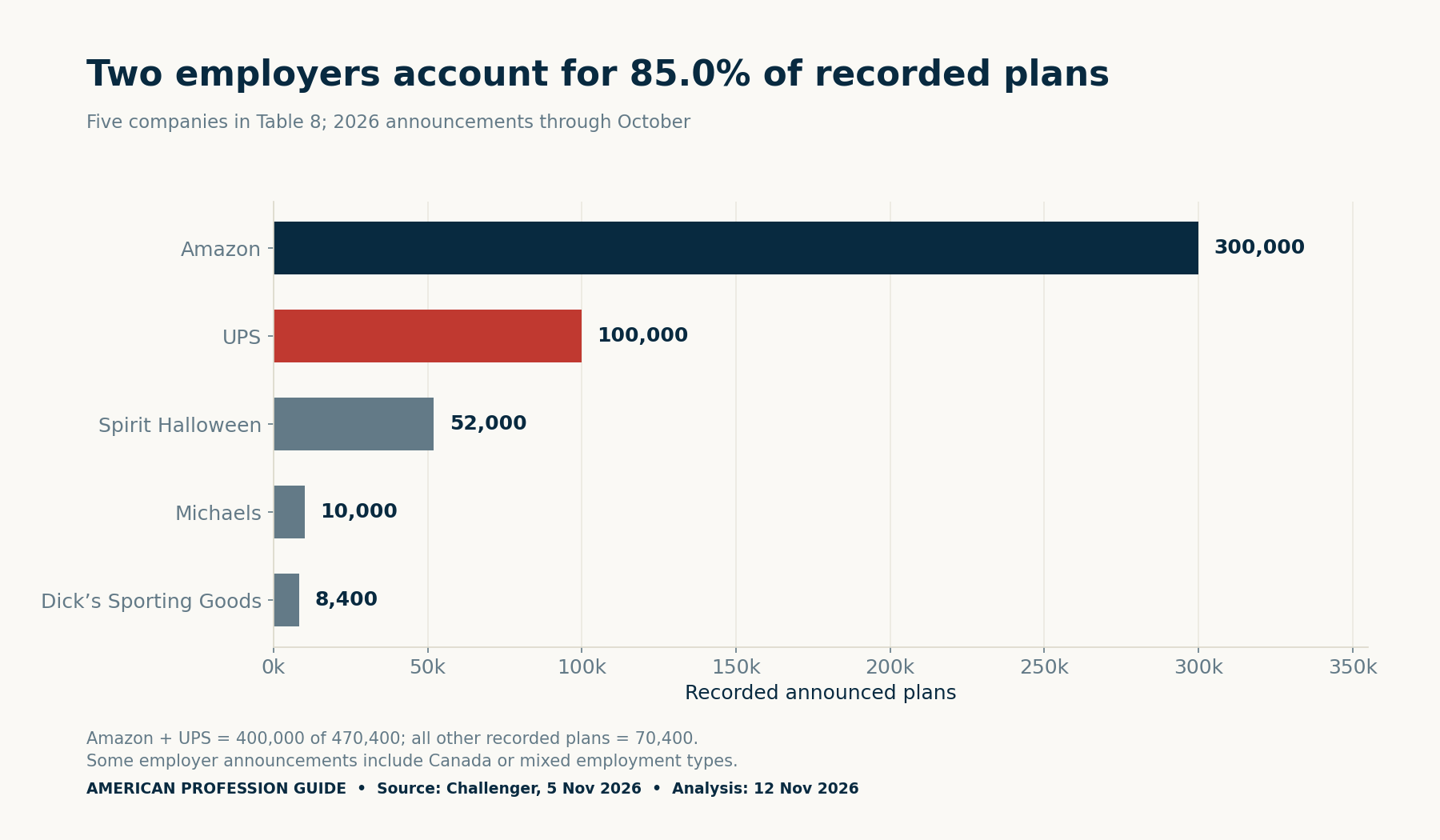
Table 8 of the primary report lists five companies. Amazon contributes 300,000 plans and UPS 100,000. Spirit Halloween, Michaels and Dick’s Sporting Goods account for the remaining 70,400.
The concentration calculation is transparent: (300,000 + 100,000) ÷ 470,400 × 100 = 85.0%, rounded to one decimal place. Its denominator is the source’s recorded plans. It is not all American seasonal employment.
| Employer | Plans recorded by Challenger | Important scope check |
|---|---|---|
| Amazon | 300,000 | Its announcement includes seasonal, part-time and full-time U.S. operations roles. |
| UPS | 100,000 | Check the current official advert for the location and role. |
| Spirit Halloween | 52,000 | U.S. and Canada; the Halloween season has passed. |
| Michaels | 10,000 | The employer release covers the U.S. and Canada. |
| Dick’s Sporting Goods | 8,400 | This is the source-table figure, not a combined group total. |
In particular, Amazon’s October announcement covers several employment types. Therefore, the recorded figure should not become a claim about 300,000 temporary-only jobs.
Likewise, the Spirit Halloween announcement and Michaels release include Canada. Keep that geography visible. Do not describe every recorded plan as a currently open U.S. vacancy.
More announced plans can coexist with fewer announcers
The report identifies five announcing companies, compared with eleven at the same point in 2025. This describes the breadth of recorded announcements. It does not count every business employing seasonal staff.
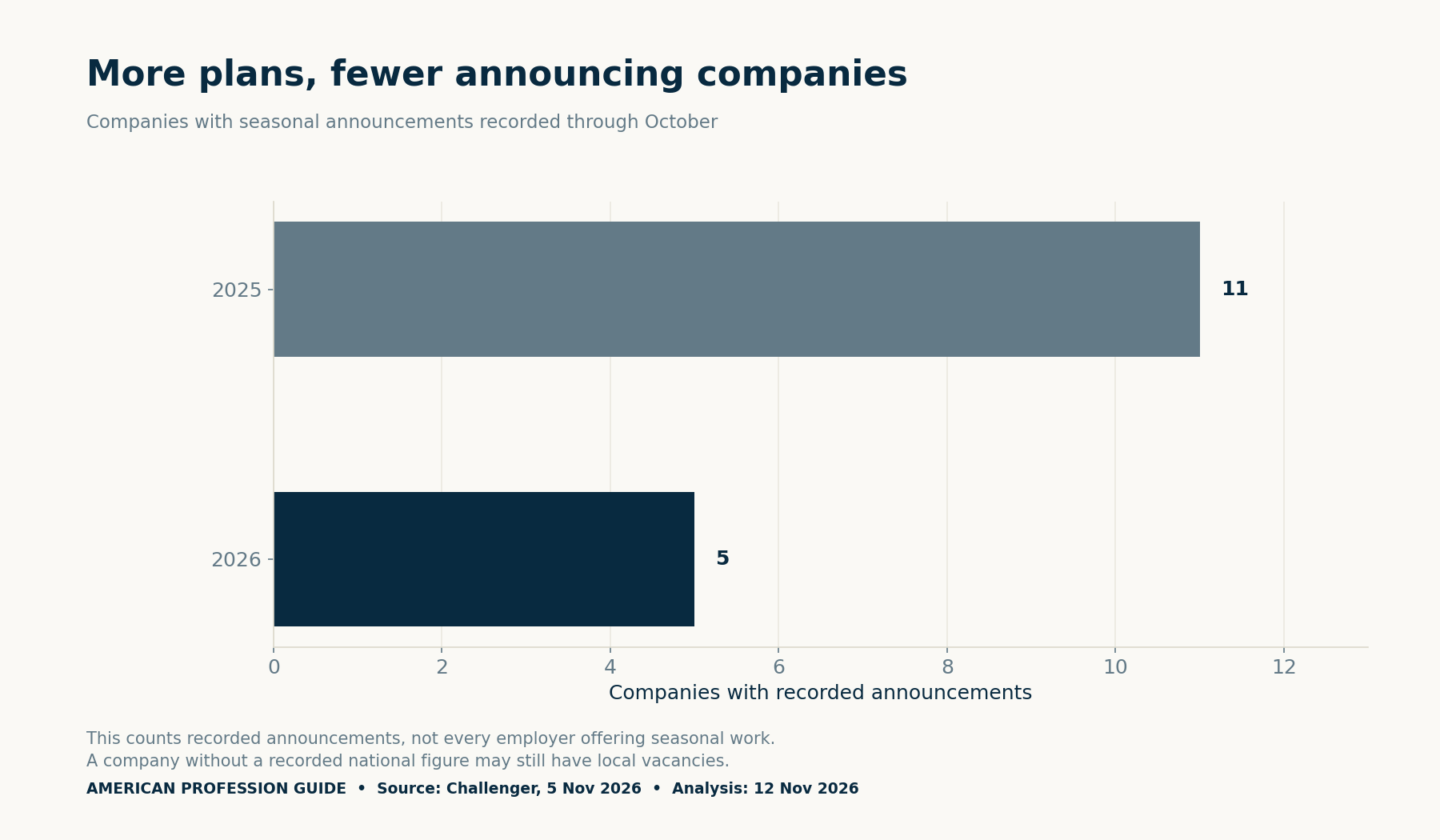
A company may advertise locally without publishing a national headcount target. Conversely, a large national announcement may cover locations you cannot reach. Therefore, search beyond the largest names while keeping each vacancy check specific.
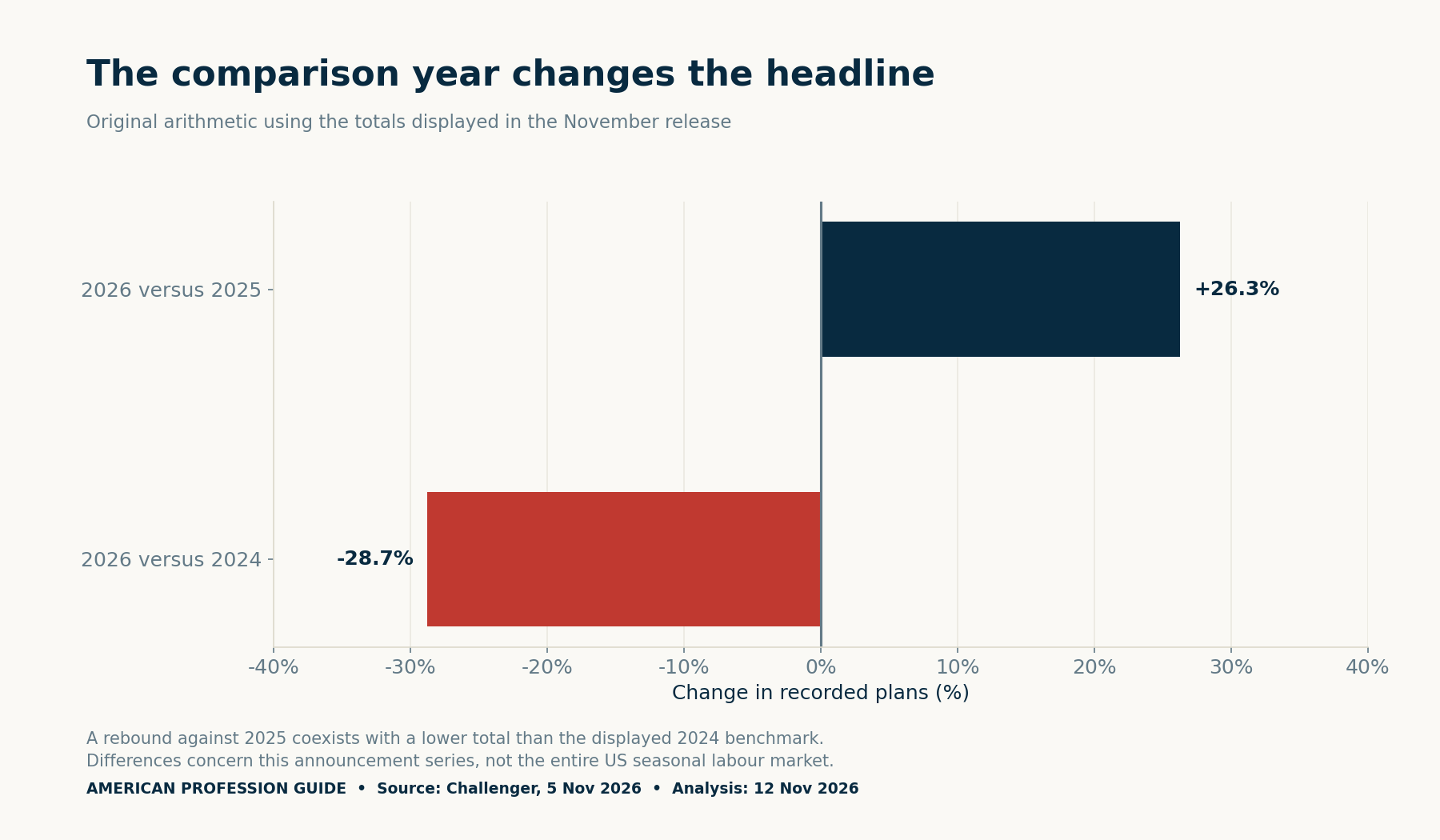
The comparison-year chart provides another safeguard. Describe the rebound and the lower historical benchmark together when reusing these findings. Neither comparison establishes the number of offers available in your metro area.
Read industry labels before choosing a career direction
Challenger places Amazon in its Technology industry category. Its October Technology hiring total includes 300,000 Amazon seasonal plans. Subtracting those plans from the category’s 300,252 leaves 252.
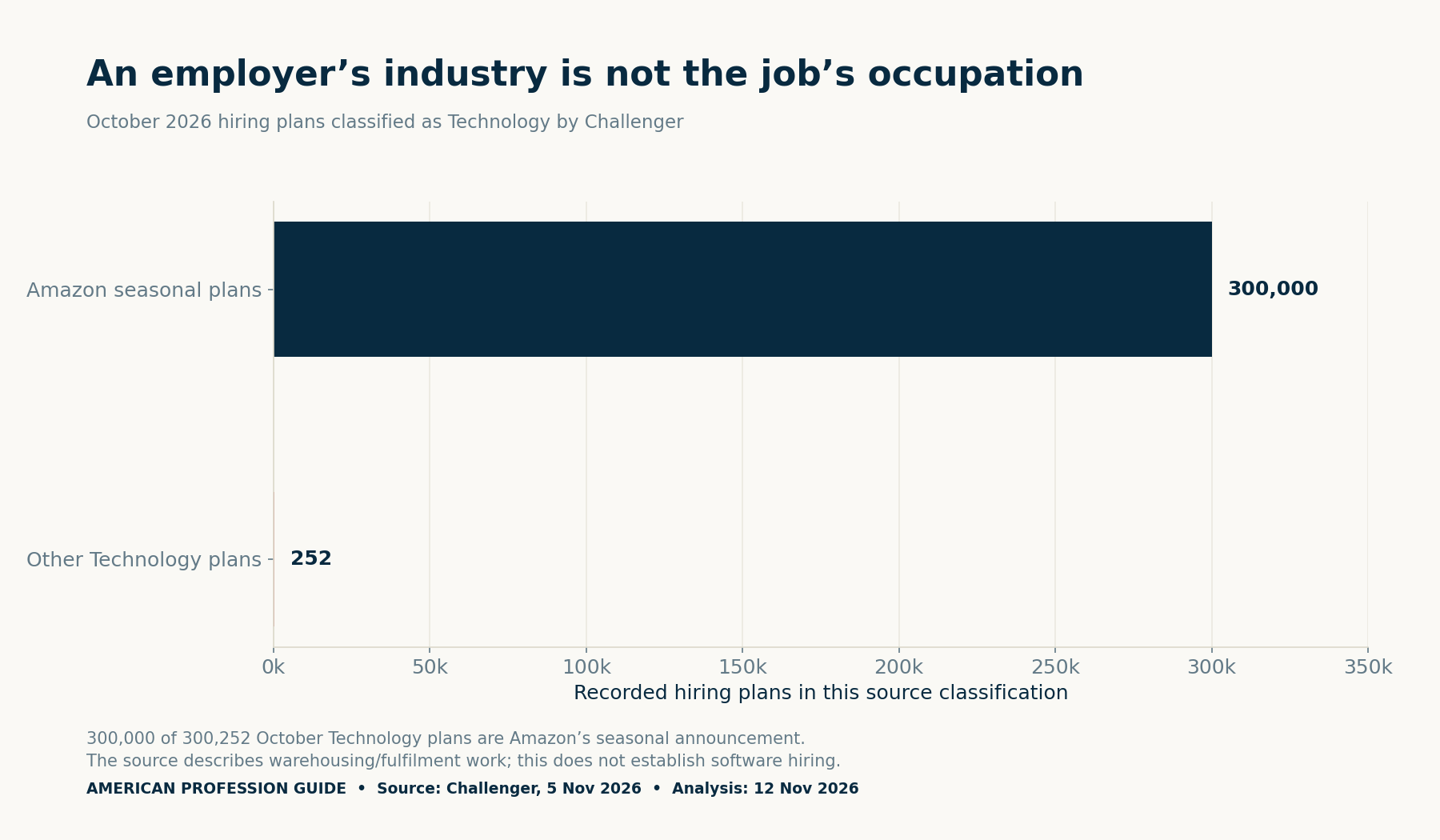
This is a classification lesson. A company’s industry is different from an employee’s occupation. The large seasonal component concerns fulfillment and warehousing, so this category total does not measure software vacancies.
Before changing your search or paying for training, read the actual duties and prerequisites. Our courier and warehouse comparison also explains why closely related employment headlines can measure different populations.
Turn seasonal hiring 2026 headlines into a local shortlist
Start with one metro area, a realistic travel radius and the shifts you can work. Then visit official employer career pages. For example, the UPS holiday hiring page is an employer source, but an individual advert still needs a fresh availability check.
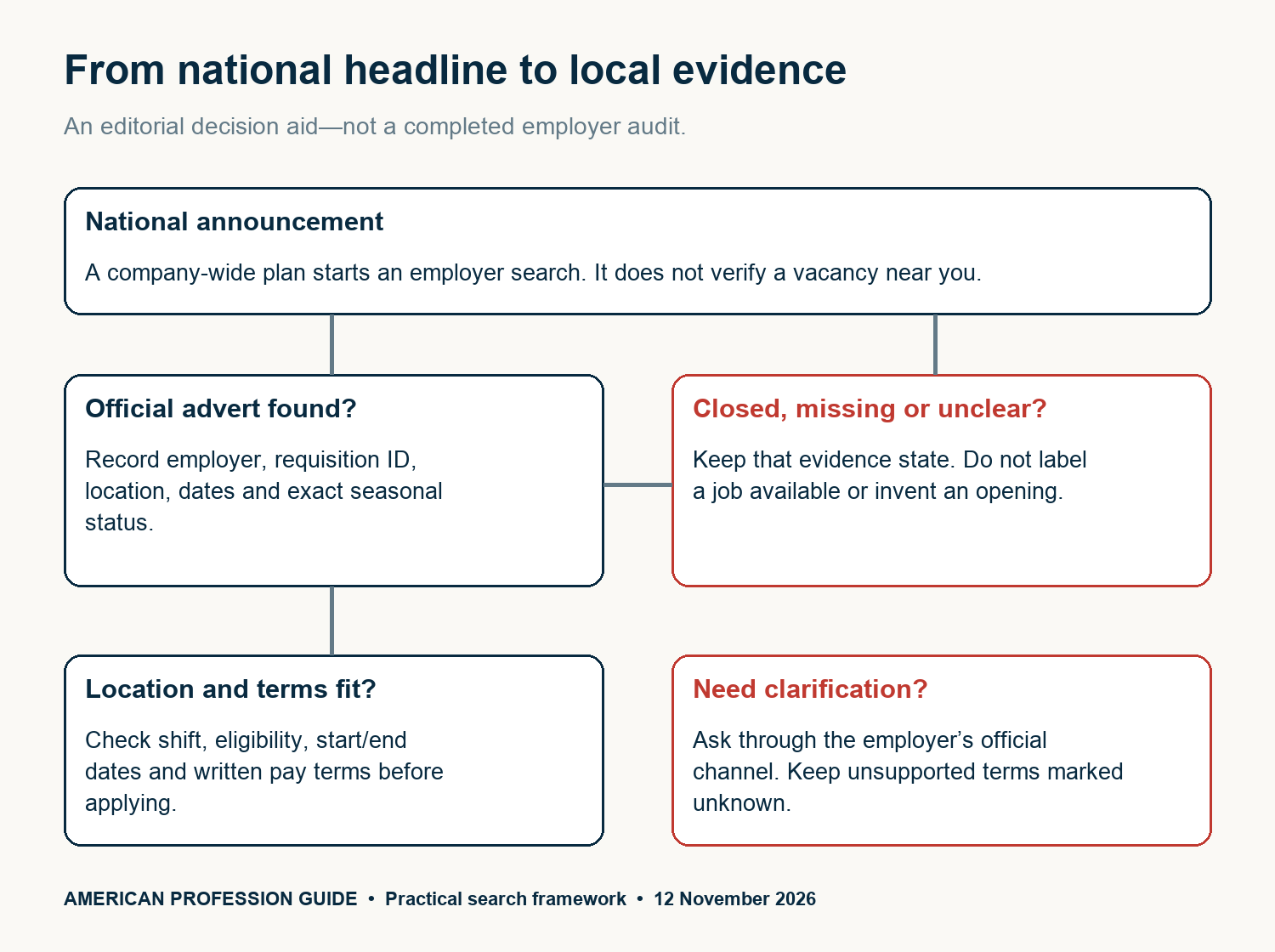
Use the following process for a fixed seven-day search period:
- Save the official advert URL and its retrieval date.
- Record the employer, requisition ID, location and role.
- Copy the stated seasonal status, posting date and closing date.
- Deduplicate using employer plus requisition ID.
- Keep closed, inaccessible and unclear records visible.
One requisition may cover several hires. As a result, a count of adverts is not a count of people hired. Do not add expired Halloween listings to a current-opportunities total. Also, do not infer pay, permanent conversion or acceptance rates from these national plans.
When an offer arrives, use our temporary job offer checklist to compare written hours and terms. A promising hiring headline cannot replace those details.
Seasonal hiring 2026 data and blank search tools
These four seasonal hiring 2026 CSV files separate source figures, arithmetic and future collection. The vacancy register is deliberately blank. It is a proposed tool, not evidence that we checked fifteen live jobs.
- Source ledger (CSV)
- Reproducible calculations (CSV)
- Blank local vacancy register (CSV)
- Field dictionary and collection rules (CSV)
Methods, limits and reuse
We transcribed the release and Table 8, reconciled the five employer values to 470,400, and recalculated the concentration and comparison-year changes. Percentages are rounded to one decimal place; the calculation file retains greater precision.
Announcements may be incomplete, revised or delayed. Blank company-year cells mean no recorded announcement, rather than zero actual hiring. Employer announcements also differ in geography and employment types. We preserve the source series instead of pretending these differences form a fully harmonized vacancy census.
No local posting sample, employer interview or hiring-outcome study was completed. The search framework is editorial guidance. Any future local study should publish its location, dates, inclusion rules and deduplication method before reporting results.
When citing this analysis, attribute American Profession Guide’s calculations and link to this article and the original Challenger report. Retain the date, denominator and plans-versus-vacancies distinction alongside any reused statistic.


