






Legal billing skills for junior lawyers include making work visible: a clear task record, accurate hours and early questions about scope. Alternative pricing can change a client’s charge while leaving the need to understand effort intact.
This report combines newly published firm survey findings with a fictional matter ledger. The example compares ordinary hourly arithmetic with an assumed fee cap. Four free CSV tools let you reproduce every amount and prepare questions for a supervisor.
What the November billing survey says
Best Law Firms’ 5 November 2026 analysis draws on nearly 5,800 U.S. firms in its 2026 research. It reports alternative-fee availability of 70%, compared with 72% in 2025. That is a decline of 2 percentage points, not a fall in fee revenue or matter volume.
The share reporting AI reduced hours on some tasks rose from 19% to 25%. The publisher also characterizes eight of nine popular alternative arrangements as retaining a strong hours-based component. These findings do not establish that AI caused a particular lawyer’s workload to change.
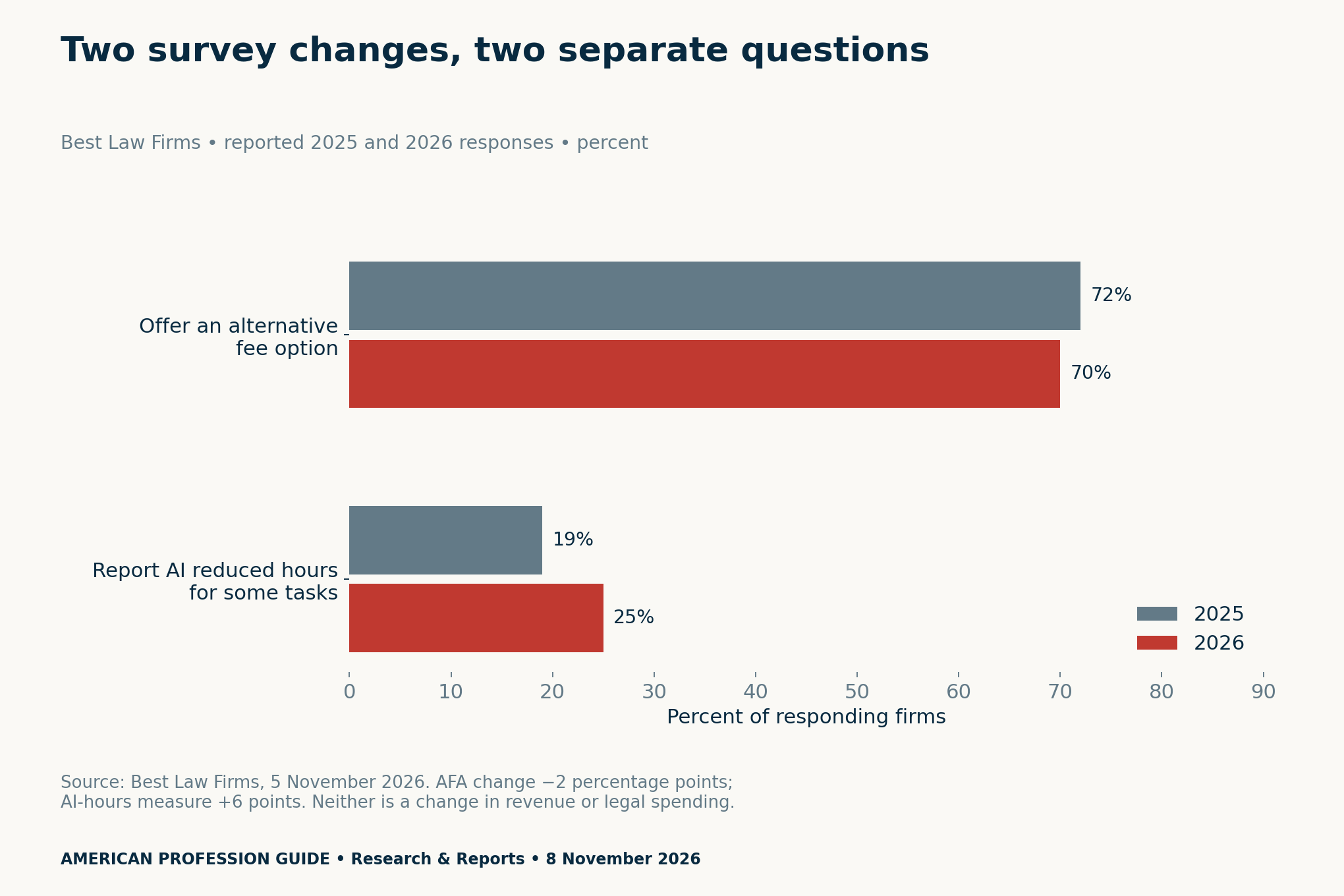
The public analysis does not supply fieldwork dates or show that the same firms answered in both years. Therefore, treat these as reported survey comparisons. The public summary also does not fully specify the AI question’s response base. Read each pair separately. These are not a matched longitudinal study, the share of client spending or the share of lawyers working under a cap.
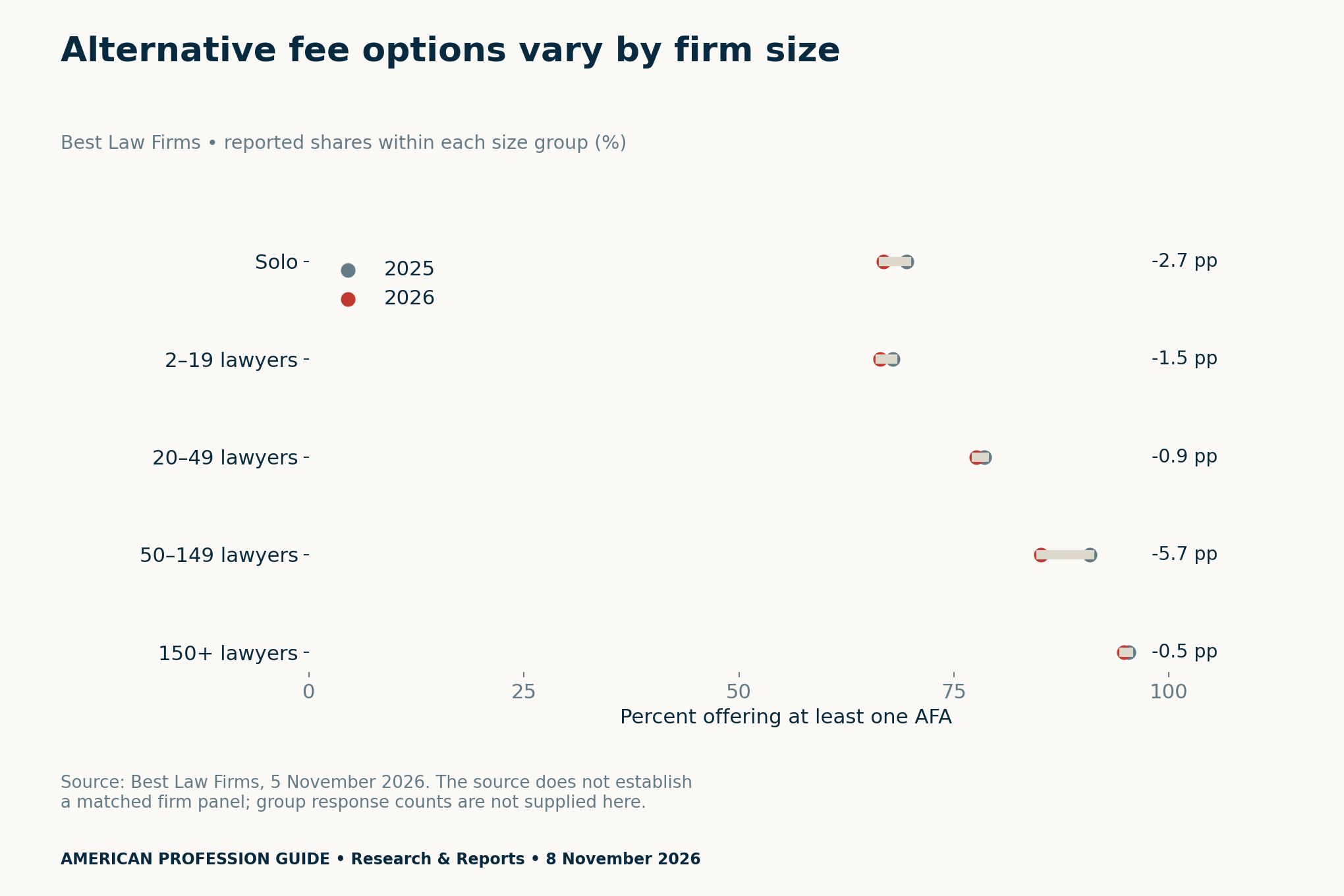
Legal billing skills for junior lawyers: two different records
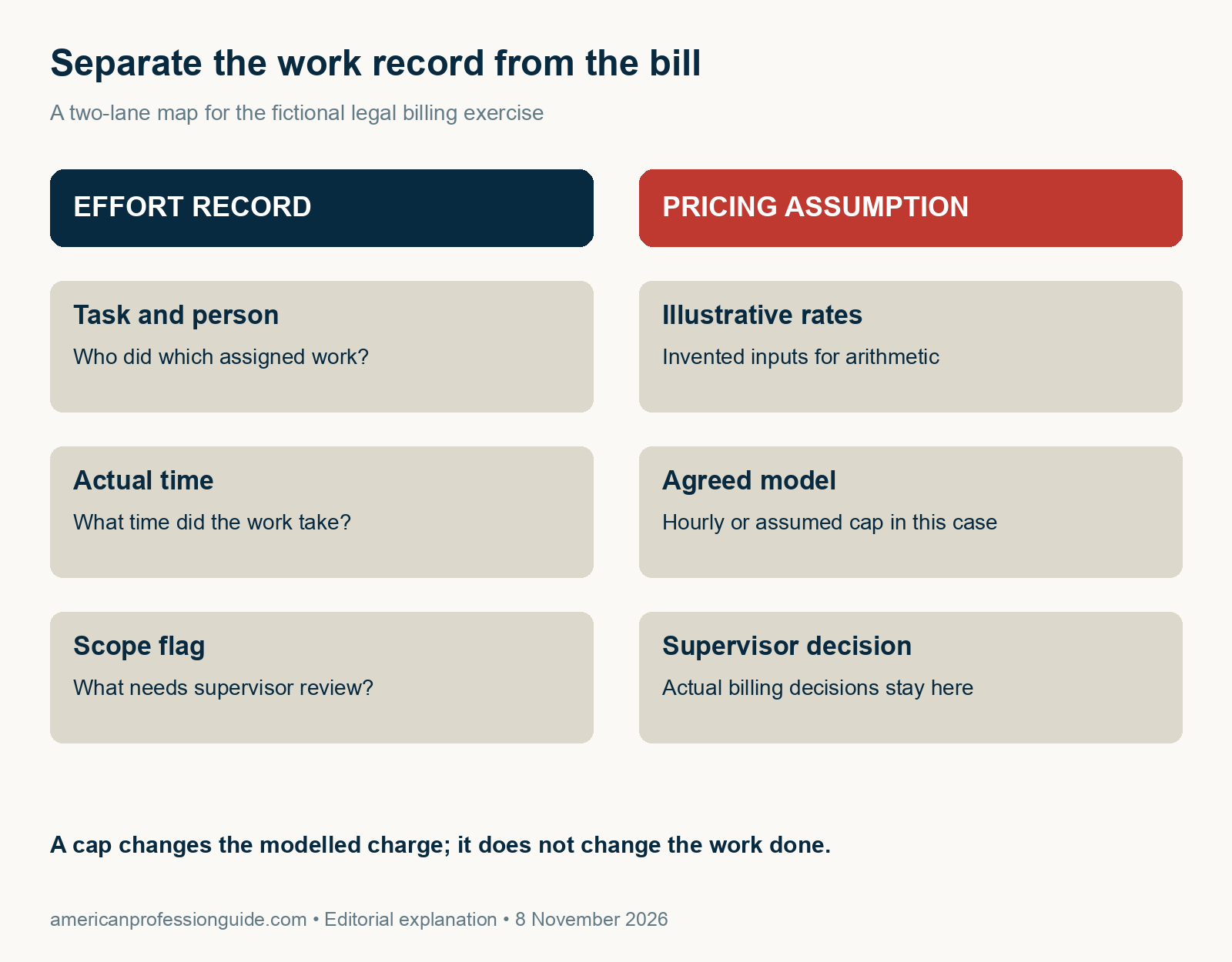
Separate three questions: what work happened, how the pricing model works and who has authority to approve the bill. Keeping those questions distinct helps a junior explain a budget issue without deciding the fee independently.
An effort ledger records the task, person, time and any scope concern. A pricing calculation applies an explicitly stated model to permitted inputs. An approval record captures the supervisor’s decisions. This article teaches that distinction through arithmetic; it does not establish billing or confidentiality rules for any jurisdiction.
For a public learning exercise, use invented people, tasks and matter identifiers. Do not paste client documents or case facts into a portfolio. If you want to use actual workplace material, first obtain the appropriate guidance and permission through the firm’s process.
Build an honest fictional task ledger
Fictional Matter A contains six tasks. The junior records nine hours, a supervisor records one and an assistant records one. Invented rates are $150, $300 and $90 per hour respectively. These values illustrate multiplication; they are not market-rate estimates or recommended fees.
| Invented task | Hours | Illustrative rate | Hours × rate |
|---|---|---|---|
| Junior: review pack | 3 | $150 | $450 |
| Junior: research | 2 | $150 | $300 |
| Junior: draft | 3 | $150 | $450 |
| Supervisor: review | 1 | $300 | $300 |
| Assistant: assemble | 1 | $90 | $90 |
| Junior: revise | 1 | $150 | $150 |
| Total | 11 | Not a blended-rate quote | $1,740 |
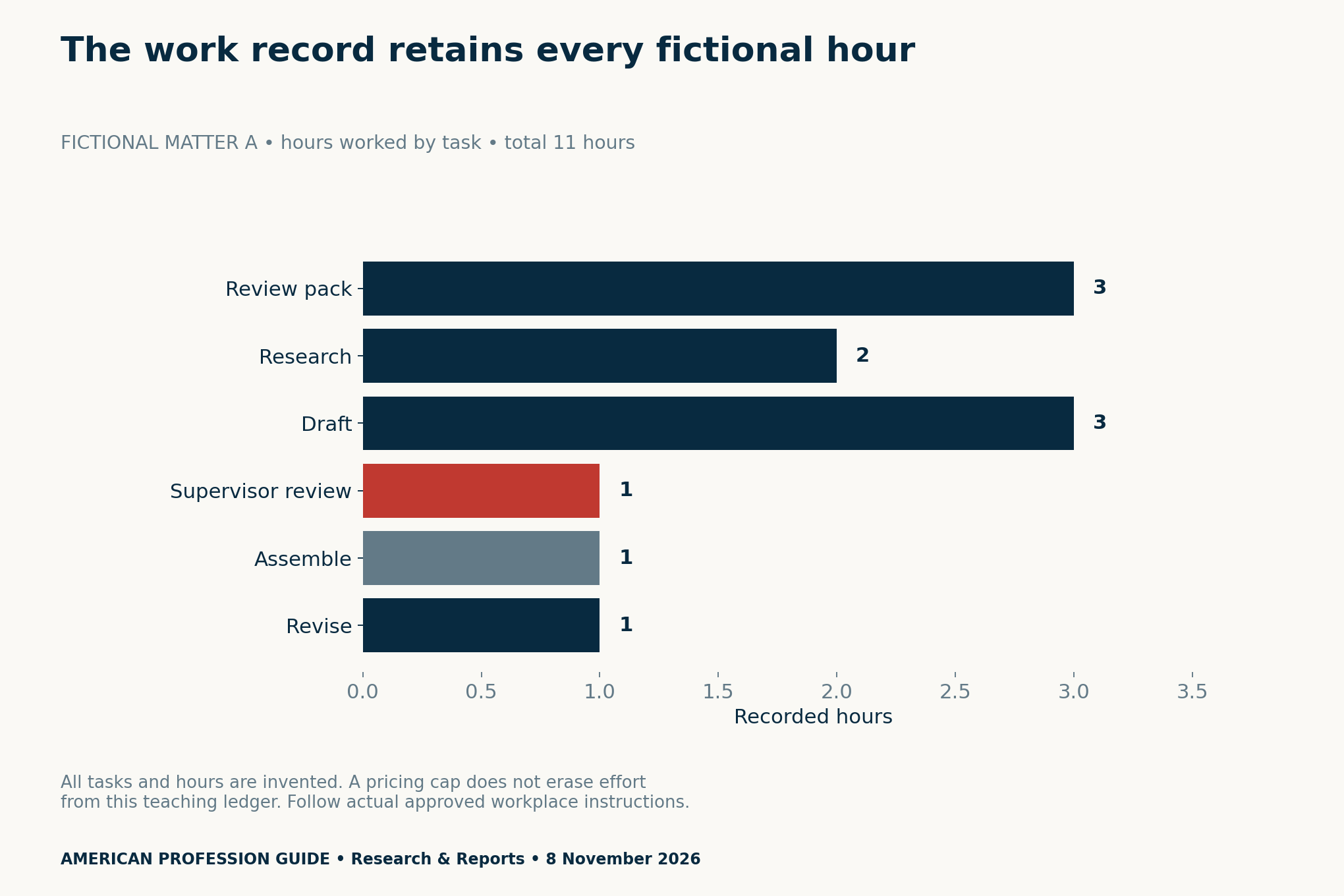
Reproduce the total by multiplying each task’s hours by its stated rate and adding the products. Keep the original task lines. If you discover a data-entry mistake, retain an explanation of the correction rather than silently changing the history of the example.
A useful task description identifies the assigned work without exposing information that should remain confidential. Ask your supervisor what level of detail, task codes and matter codes the firm permits. This worksheet cannot decide which description is appropriate for a real client.
Compare hourly arithmetic with an assumed cap
For teaching purposes, assume a $1,800 cap covers all the modelled fees. Exclude taxes, expenses, discounts and any different scope terms. Under this deliberately simple assumption, capped arithmetic is the smaller of the hourly total and $1,800.
At baseline, the hourly total is $1,740, so the capped result is also $1,740. Now add two fictional junior hours at $150 each. Recorded effort rises to 13 hours and hourly arithmetic to $2,040. The assumed cap produces $1,800, leaving $240 above the cap in the arithmetic.
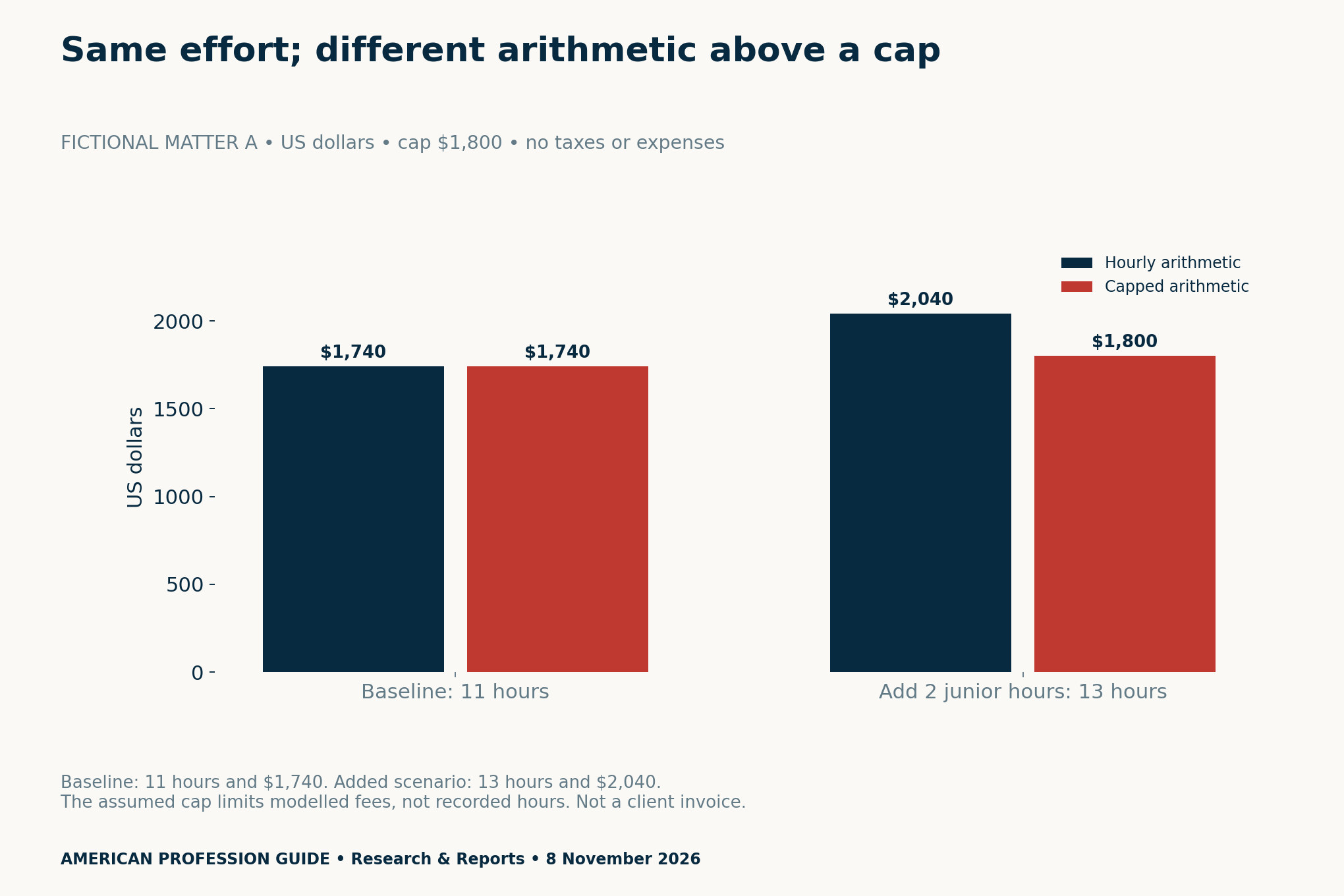
Do not relabel that $240 as the junior’s lost pay or the firm’s profit reduction. The exercise contains no compensation agreement, cost structure or collection data. Likewise, it does not show that the extra work was unnecessary. Those would be different questions requiring different evidence.
Make budget headroom a supervisor question
At baseline, signed headroom is $60: the $1,800 cap less $1,740 of hourly arithmetic. At the invented junior rate, 0.4 additional hours uses that headroom. After another full junior hour, the arithmetic is $90 above the cap.
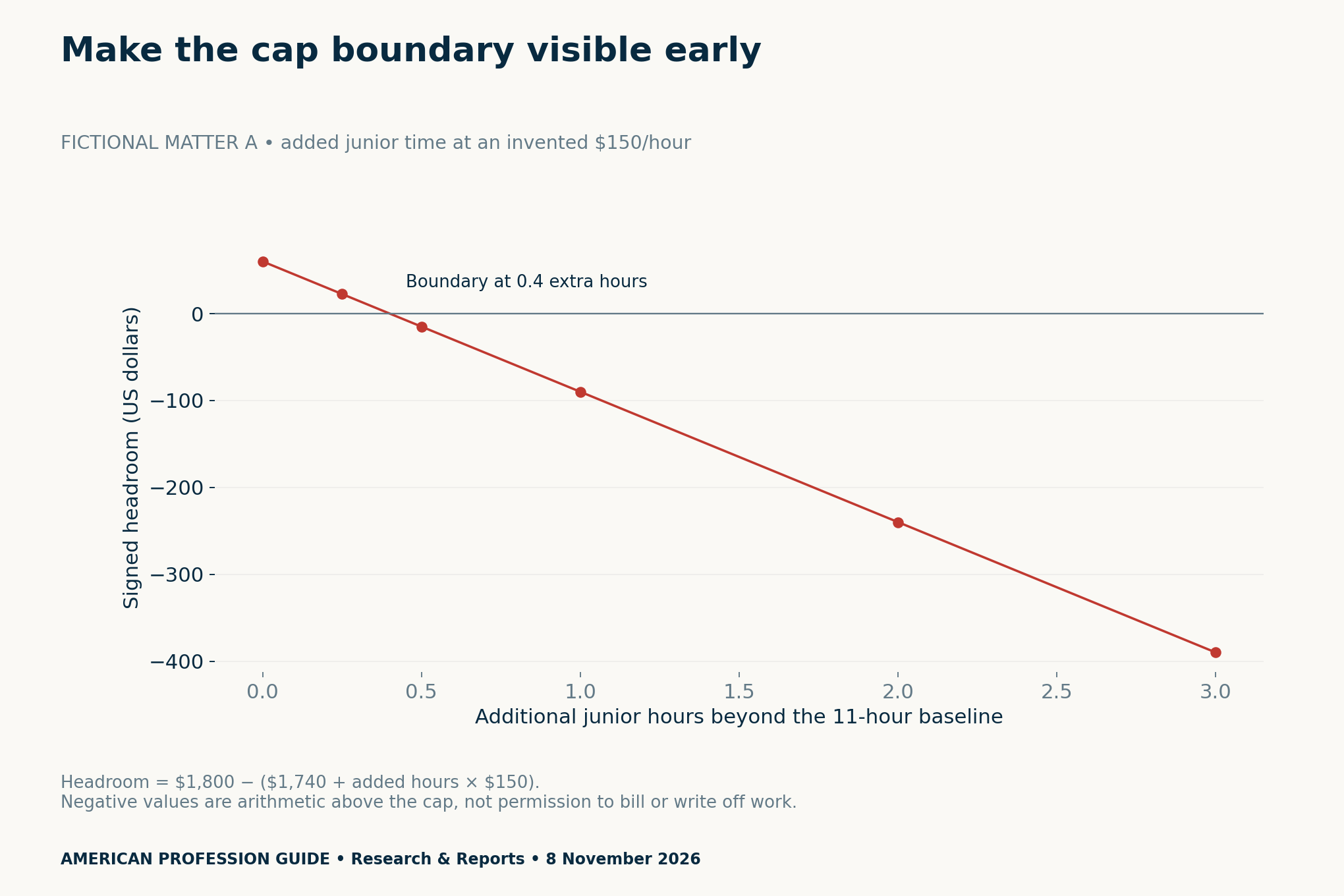
Use the register to surface a question early: “The current model has $60 of headroom. This new task may add time. Is it inside the scope, and who should review the budget?” A factual question is more useful than assuming the junior can revise the engagement terms.
Before adapting the worksheet, clarify which work and expenses the actual agreement includes, who approves rates and how scope changes are handled. Also ask when budget updates are expected. Seek jurisdiction-specific qualified advice for legal-ethics or billing-rule questions; this case provides none.
Download the billing-skills tools
- Dated firm-survey comparison table (CSV)
- Six-task fictional matter ledger (CSV)
- Fictional cap and headroom scenarios (CSV)
- Blank supervisor-instructions checklist (CSV)
The downloads contain plain data and no client details. They are free, with no login required. Enter your own spreadsheet formulas if you want a working model, preserve the assumptions and retain a separate copy of the original teaching case.
For a broader employer discussion, our questions about AI expectations at work can help you clarify the permitted tools and review arrangements. For evaluating a role, use our assignment and working-hours checklist alongside the actual offer.
Methodology and boundaries
We checked the publisher’s analysis and companion release on 8 November 2026, retaining their dated wording. Percentage-point changes use later share minus earlier share. Firm-size percentages preserve the published groups. We do not infer sample counts, weighting, exact respondent overlap or a cause for the change.
The ledger, cap and scenarios are original fictional arithmetic. Sum hours × rate for the hourly amount; apply the assumed cap; then calculate signed headroom as cap minus hourly amount. The case ignores expenses and taxes explicitly. No client transaction, fee recommendation, ethics assessment or workplace trial took place.
When revising an example, update the ledger, totals and charts together. Keep disagreement or missing instructions visible. Legal billing skills for junior lawyers are easier to demonstrate when another person can trace both the work record and the limits of the model.


