






A temporary job offer checklist should start with the assignment, not just the advertised hourly rate. Confirm who employs you, where you will work, which hours are scheduled and what remains conditional. Then compare the written terms. A national staffing headline cannot answer those questions for your particular placement.
This guide combines the latest verified American Staffing Association release with an original assignment worksheet and transparent gross-pay calculations. The national observations describe the staffing industry. Every hours-and-dollars scenario below is hypothetical. None promises a local vacancy, dependable hours or a permanent position.
What the October staffing release actually says
The ASA report published October 27, 2026 says staffing employment declined 0.8% in the week October 12–18 compared with the previous week. Its weekly index stood at a rounded 94. Meanwhile, employment over the four weeks ending October 18 was 4.2% higher than in the corresponding period a year earlier. The four-week index average was a rounded 95.
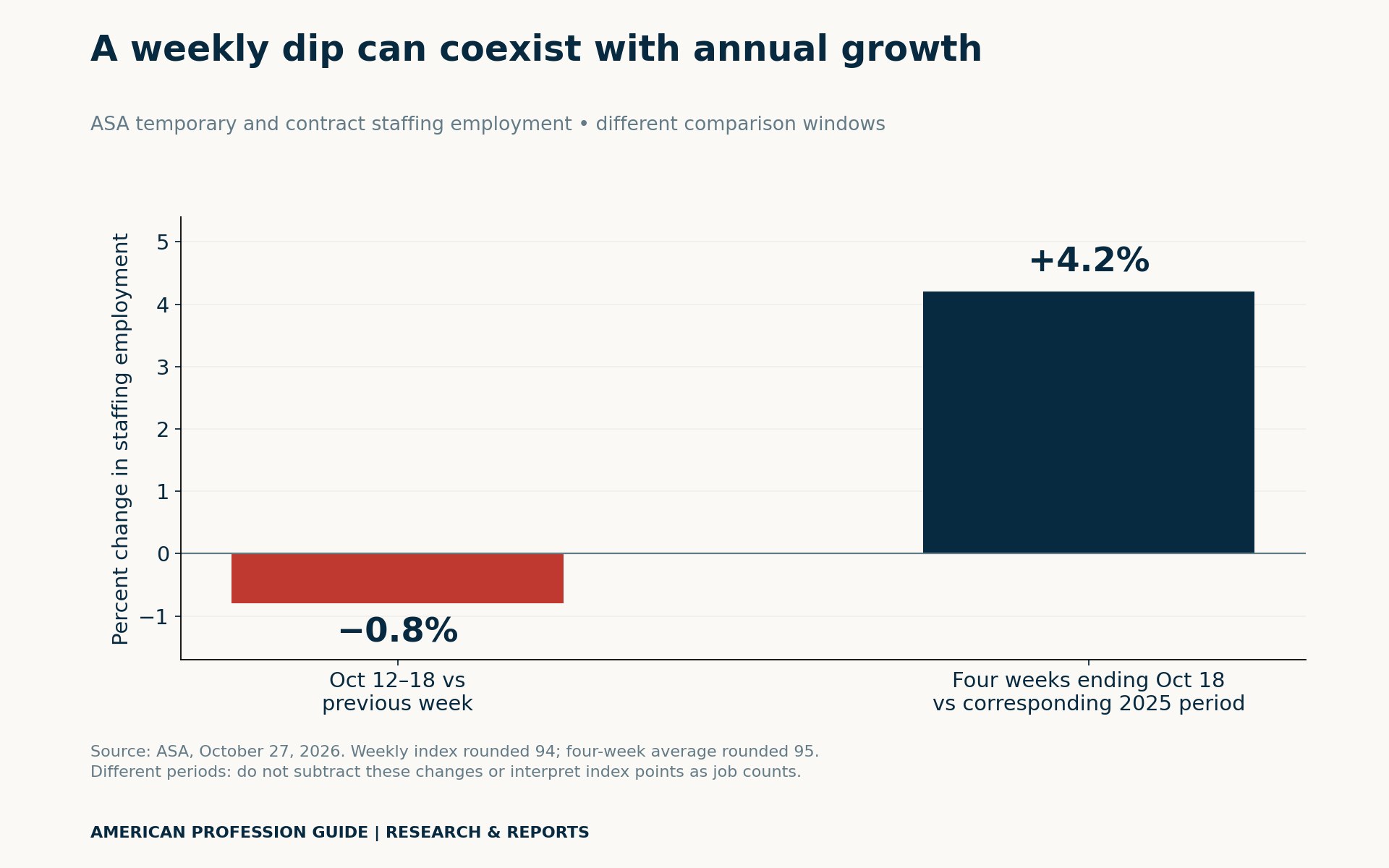
The weekly dip and annual increase can coexist. Do not subtract the two changes as if they used the same baseline. Likewise, index levels are not numbers of jobs. ASA’s Staffing Index information describes the series; its index reference is June 2006 = 100.
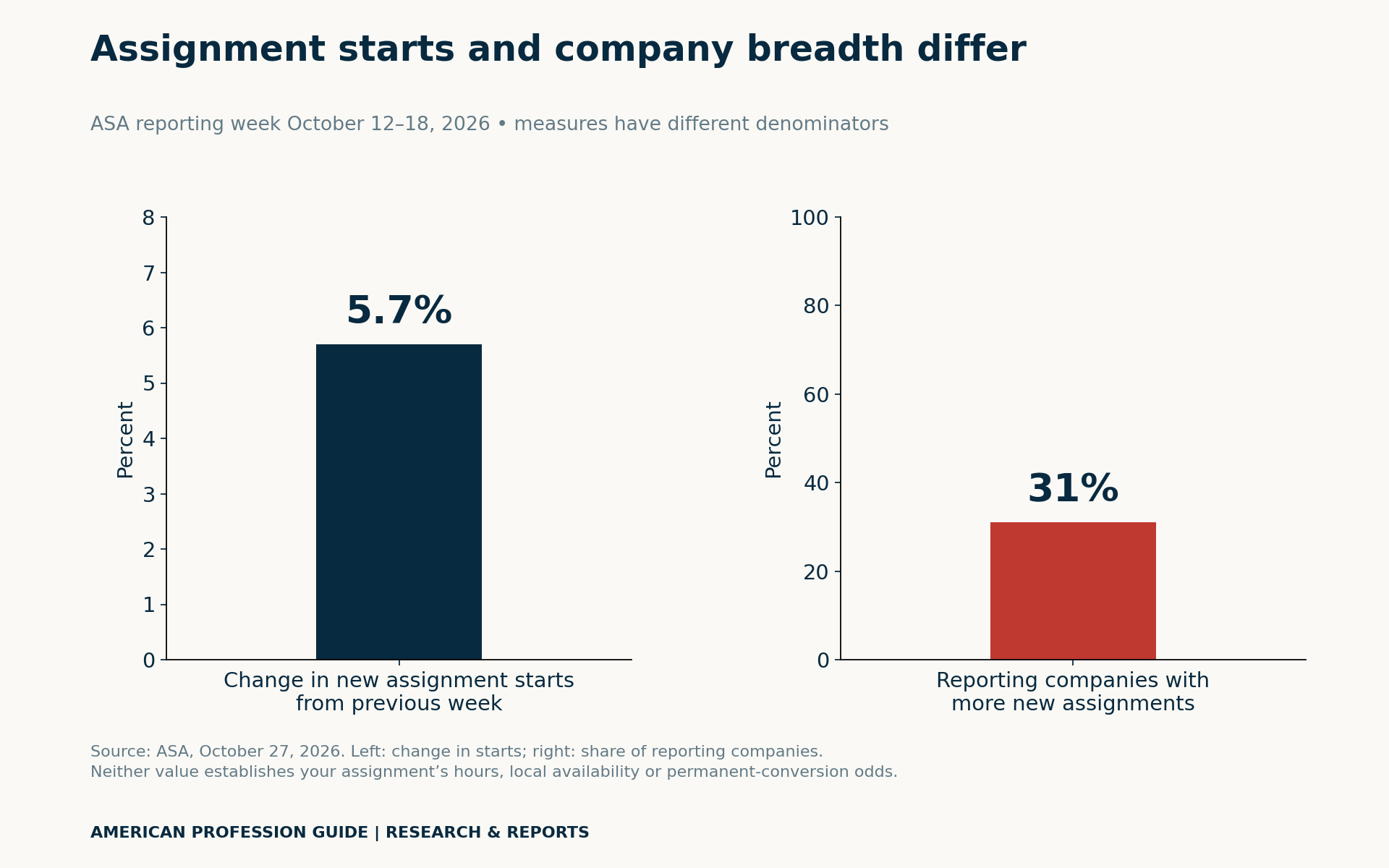
ASA also reported a 5.7% weekly increase in new assignment starts. Separately, 31% of reporting staffing companies saw an increase in new assignments. The first number concerns the change in starts; the second concerns the share of companies reporting an increase. Neither is the percentage of workers who found a permanent job.
Temporary job offer checklist: obtain these terms
Ask the agency contact to identify the legal employer and host worksite in writing. Record the supervisor and the person who answers pay or scheduling questions. If an answer comes only from a conversation, note the date and ask how you can confirm it. Leave an unresolved field blank rather than assuming the most favorable interpretation.
| Area | Information to obtain | Question to resolve |
|---|---|---|
| Employer and worksite | Legal employer, host location and named supervisor | Who can confirm the assignment and resolve a problem? |
| Rate and premiums | Base hourly rate and any shift-premium conditions | When does each quoted rate apply? |
| Hours and timing | Scheduled hours, start conditions and minimum hours if any | Are the stated hours expected, scheduled or expressly guaranteed? |
| Duration and cancellation | End date or review point and cancellation terms | What happens if the start is delayed or a shift is cancelled? |
| Training and supervision | Training schedule, pay terms and support contact | What must be completed before independent work begins? |
| Possible permanent role | Evaluation timing, decision maker and conversion conditions | What would need to happen before a separate permanent offer? |
Use the same fields for both offers. An agency may describe a typical schedule without guaranteeing it. That distinction belongs in your notes. Similarly, a proposed start date may depend on checks, client approval or training. Identify the actual conditions for this placement instead of importing assumptions from a previous assignment.

Compare hourly pay with hours worked
All dollar inputs here are invented. Assume a regular-time rate of $22 an hour. Forty hours produce $880 gross pay for one week. Twenty-four hours produce $528. The difference is $352, or 40% of the forty-hour amount. The rate is unchanged; the hours change.
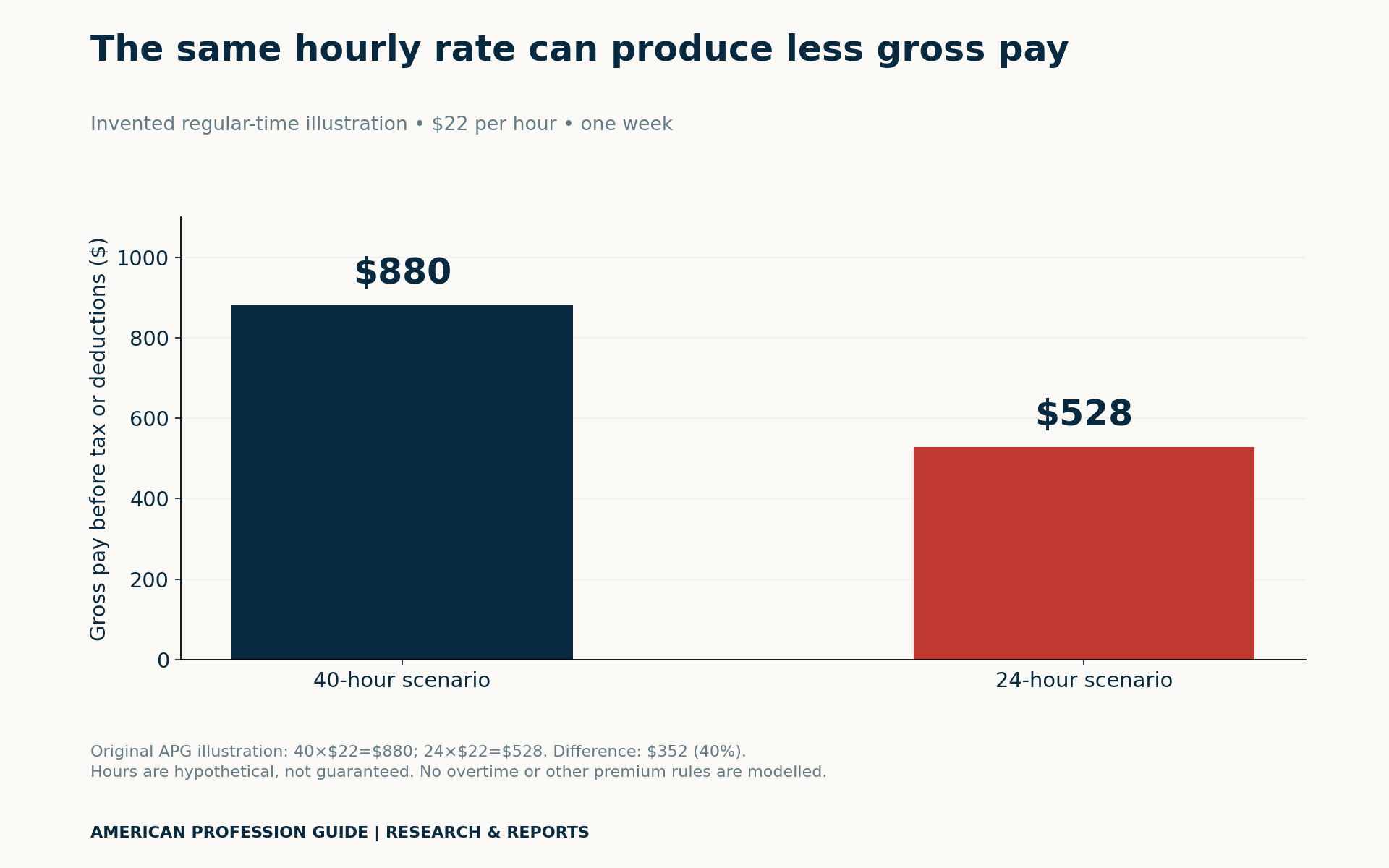
These figures do not establish take-home pay or your legal entitlement. No overtime, shift premium, benefit value or payroll deduction is modeled. Replace the invented inputs with comparable written terms when planning. If premium-pay rules are relevant, obtain an appropriate explanation before extending this simple calculation.
Test a reduced-hours scenario over four weeks
Now compare two fictional schedules at the same $22 rate. The first has forty hours in each of four weeks: 160 hours and $3,520 gross. In contrast, the second has forty, thirty-two, twenty-four and sixteen hours: 112 hours and $2,464 gross. As a result, the cumulative difference reaches $1,056.
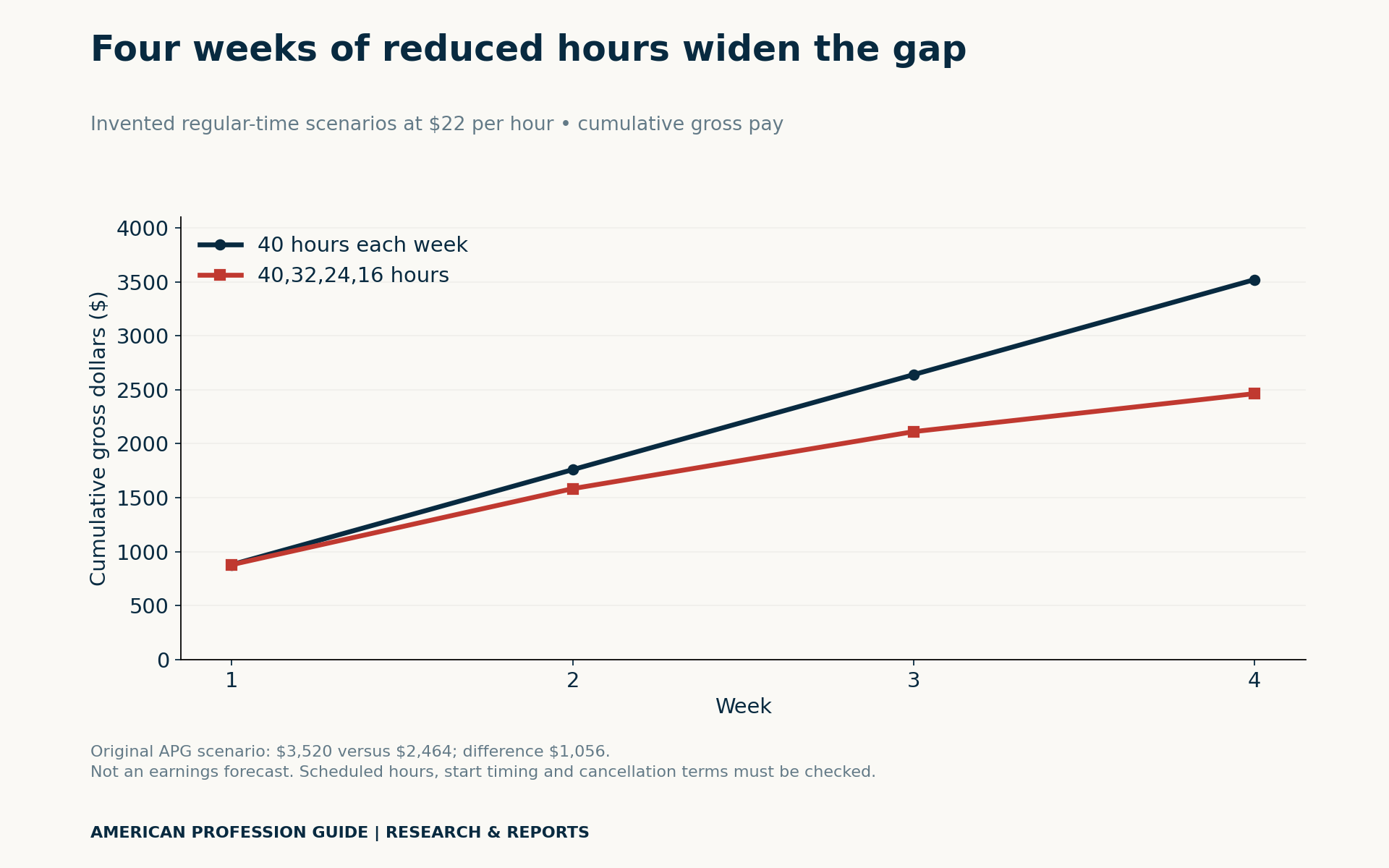
A scenario makes a dependency visible; it does not tell you how likely that dependency is. Ask what scheduling information is available, when the next schedule is confirmed and whom to contact about changes. Keep a delayed-start scenario separate from reduced weekly hours so you can see which assumption drives the result.
A higher rate may not offset fewer hours
To match the invented $880 weekly gross target, divide $880 by the hours worked. At forty hours, the required arithmetic rate is $22. With thirty-two hours, it is $27.50. For twenty-four hours, it is about $36.67; at sixteen hours, it is $55. These are equivalence calculations, not market wages or required pay rates.
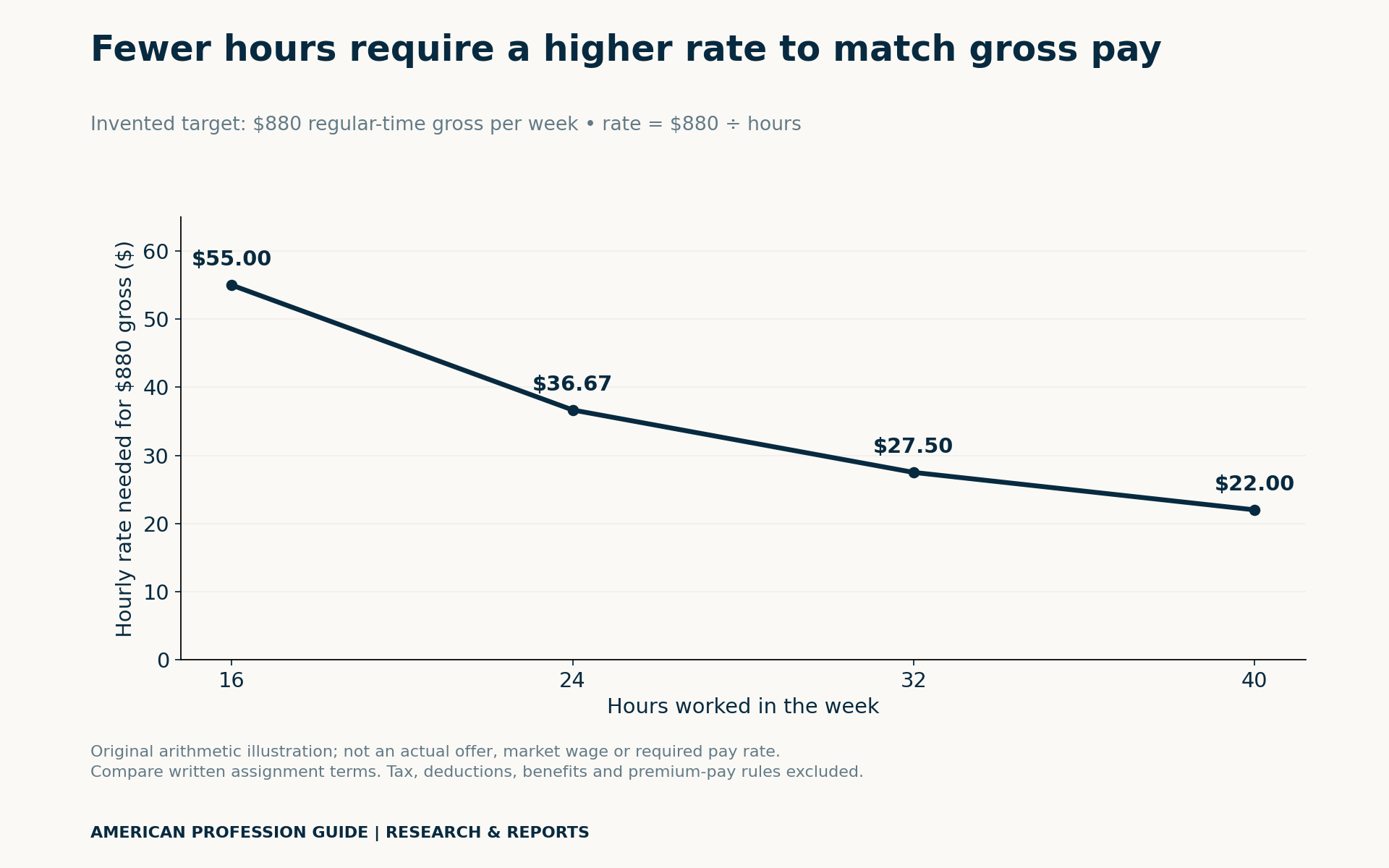
Compare the full assignment before calling a higher hourly figure the better offer. You may also have travel, equipment or timing considerations. Record your own inputs separately; this article has not measured those costs. Do not treat the worksheet as a recommendation to accept a placement or reject an agency.
Verify training, supervision and temp-to-hire conditions
Ask who provides initial instructions, how training time is scheduled and what the written pay terms say. Also, confirm the supervisor for each location or shift. Where the work involves equipment or unfamiliar procedures, obtain the relevant instructions and support contact before the task begins. This checklist is not a safety assessment or a statement of legal compliance.
A temp-to-hire description calls for further questions. Who makes the conversion decision? When is the evaluation expected? Which performance criteria, approvals and vacancies would matter? Until those conditions lead to an actual permanent offer, keep the possible future role separate from the temporary assignment you are comparing now.
For a broader employer conversation, our six-question company and role evidence register helps distinguish documented facts, company-reported answers and unknowns. Use the assignment checklist here for placement-specific terms. Neither tool predicts job security.
Download the temporary job offer checklist and calculations
Download the blank assignment comparison checklist (CSV), ASA observations and definitions (CSV), hypothetical hours and rate sensitivity (CSV), and four-week fictional schedules (CSV).
The blank sheet includes two offer rows. Fill in the documentary source and unresolved questions alongside the terms. Do not put confidential personal records into a public example. The downloadable scenarios contain invented values and formulas described above; they contain no actual worker or agency information.
Methodology, limitations and citation
Research checked November 3, 2026. We retained the ASA October 27 release and transcribed six clearly defined observations, preserving weekly and four-week periods. A separate 0.9% comparison has inconsistent baseline wording in the release and is excluded. Index levels remain rounded as reported. We do not infer exact index values from rounded levels.
ASA is an industry association. Its aggregate release cannot establish local availability, occupation-specific demand, assignment hours or permanent-conversion odds. The original calculations use simple regular-time arithmetic and pass reconciliation checks. They are planning illustrations, not measured earnings, an agency ranking or legal advice.
Suggested citation: American Profession Guide, “Temporary Job Offers: Check the Assignment, Not Just the Hourly Rate,” November 3, 2026. Attribute national staffing observations to ASA’s October 27 release and label the hours-and-pay scenarios as fictional APG calculations.


