




Bomb Squad Technician Responsibilities
Bomb squad technicians identify explosive devices.
They disarm explosive devices safely.
They also dispose of explosive devices responsibly.
Specialized Training Requirements
Aspiring technicians first complete law enforcement or military training.
This preparation typically covers explosive ordnance disposal and bomb detection.
It also addresses post-blast investigation techniques.
Additionally, specialized instruction covers robotics, hazardous materials, and chemical agents.
Hands-on internships and on-the-job training help technicians develop practical skills.
Furthermore, continuing education keeps technicians current with new techniques and technology.
Regular refresher courses reinforce essential knowledge and abilities.
Professional Qualifications and Personal Skills
Successful technicians demonstrate strong problem-solving skills.
They remain calm while managing pressure.
Careful attention to detail supports their work.
Moreover, excellent communication helps them coordinate effectively.
Teamwork also plays an important role in their responsibilities.
Physical fitness prepares technicians to work in hazardous environments.
Employers often require criminal background checks and security clearances.
Psychological evaluations may also support the selection process.
Career Preparation for Public Safety
The training path demands dedication and careful preparation.
It challenges individuals to develop technical knowledge and practical judgment.
Ultimately, qualified technicians can pursue fulfilling work that supports public safety.
Education Requirements
- High school diploma or equivalent
- Recommended coursework in physics, chemistry, mathematics, and electronics
Aspiring bomb squad technicians must meet specific educational requirements.
These requirements provide foundational knowledge for work in this specialized field.
They also prepare candidates for further education and technical training.
High School Diploma or Equivalent
A high school diploma or equivalent provides the basic educational foundation for aspiring bomb squad technicians.
It demonstrates that candidates completed a basic level of education.
It also shows readiness for more complex coursework and rigorous training.
Recommended Coursework
Aspiring technicians should consider coursework in physics, chemistry, mathematics, and electronics.
Physics introduces energy, motion, and force principles relevant to this field.
Chemistry explains how different substances behave and interact.
Mathematics strengthens problem-solving skills and supports data analysis related to bomb threats.
Electronics teaches concepts involving circuits, signaling, and communication systems.
Together, these subjects establish useful knowledge for working with bomb disposal equipment.
Technical Training for Explosives Disposal
Specialized programs prepare trainees for explosives handling and disposal.
First, trainees study the characteristics and behavior of different explosives.
They learn safe handling procedures, suitable storage methods, and emergency response protocols.
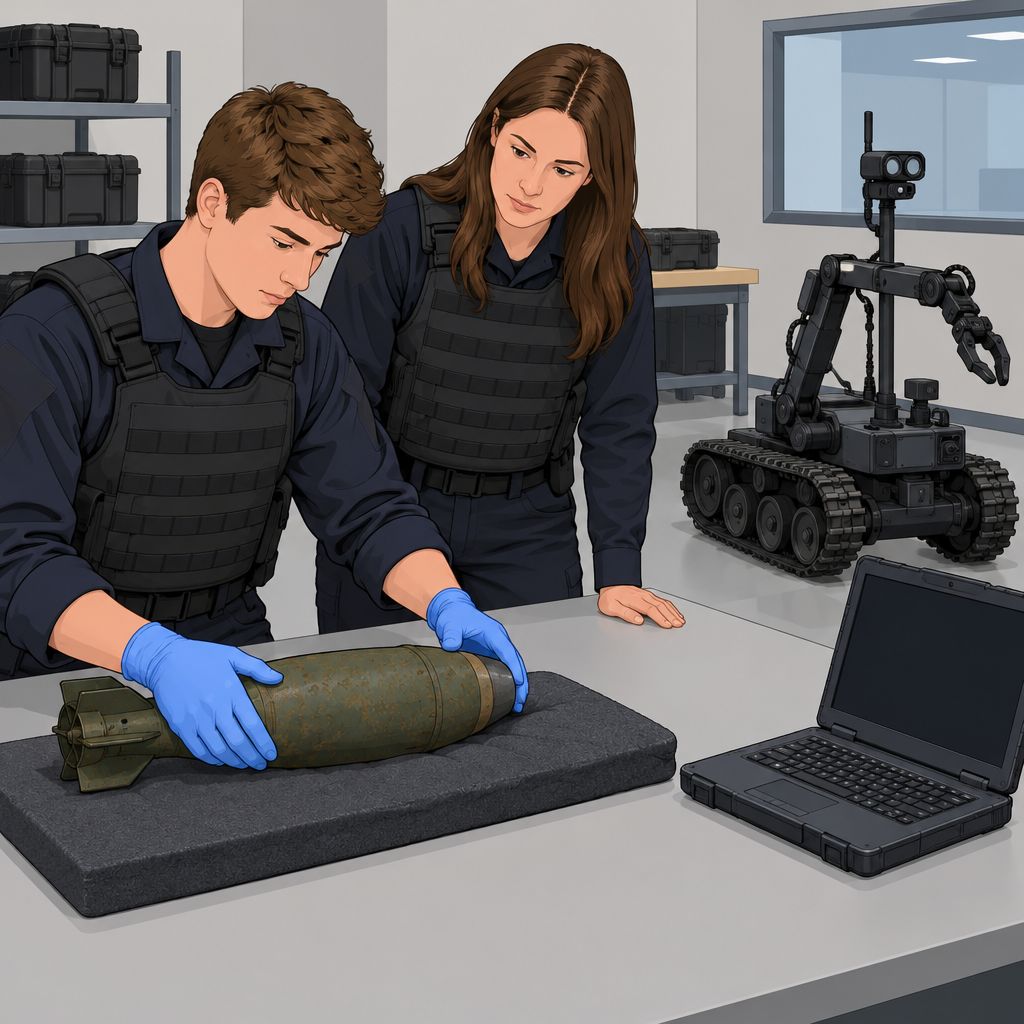
Additionally, trainees practice using bomb suits, robots, and detection devices.
They also learn to identify and classify explosive devices, including improvised explosive devices (IEDs).
Practical exercises provide hands-on experience with safe explosives disposal procedures.
These exercises include controlled detonations, bomb threat simulations, and realistic scenarios.
Transform Your Career Today
Unlock a personalized career strategy that drives real results. Get tailored advice and a roadmap designed just for you.
Start NowExperienced bomb squad technicians guide trainees throughout their practical instruction.
Furthermore, trainees study post-blast investigations to gather evidence and reconstruct explosion scenes.
Ongoing training and certification exams help technicians maintain current knowledge and skills.
Find Out More: Day in the Life of a Bomb Squad Technician
Certification
Certifications demonstrate a technician’s proficiency in handling explosive materials.
They also help confirm competency when technicians manage explosive devices safely and effectively.
Common credentials include Certified Explosive Specialist, or CES, and Hazardous Devices Technician, or HDT.
Certified Explosive Specialist Certification
CES candidates complete rigorous training before taking a series of examinations.
The certification evaluates knowledge and skills related to safe explosive-device handling.
Therefore, it supports professional readiness for bomb squad duties.
Hazardous Devices Technician Certification
HDT candidates complete specialized training programs for hazardous device response.
These programs cover bomb disposal techniques, explosive ordnance disposal procedures, and hazardous materials handling.
The credential supports personnel who respond to explosive threats as part of bomb squad work.
Certification Renewal
Technicians must renew CES or HDT certifications regularly.
They maintain their qualifications through continued education and recurring training.
Regular renewal keeps their knowledge current and their skills at the required level.
Continued Education and Training
Renewal programs strengthen technicians’ knowledge and skills for explosive-material handling.
Training may address advanced bomb disposal techniques.
It can also cover improvised explosive device recognition and CBRNE threats.
Specialized Training Courses
Technicians can also take specialized courses in explosive ordnance disposal.
These courses focus on specific areas of explosive ordnance disposal.
Hands-on practice helps technicians prepare for different explosive devices and field situations.
By maintaining their certifications, technicians demonstrate expertise in handling explosive materials safely and effectively.
These credentials also show that technicians remain prepared to respond to potential threats.
Uncover the Details: How Security Consultants Improve Business Safety
Internship Opportunities
Internships help aspiring bomb squad technicians develop practical experience in controlled professional settings.
These opportunities connect participants with experienced professionals from law enforcement agencies or military bomb squads.
Participants can observe real-life situations while learning appropriate safety practices and professional expectations.
- Seek internship programs with local law enforcement agencies or military bomb squads
- Gain practical experience under experienced bomb technicians’ supervision
Finding Suitable Internship Programs
Begin by researching internship programs offered by local law enforcement agencies or military bomb squads.
These organizations may provide structured placements alongside seasoned professionals in the field.
Compare available programs carefully to identify opportunities that match your career goals.
Preparing Strong Applications
Internship positions can attract many applicants, so submit your materials early.
Present polished application documents that communicate your qualifications clearly and professionally.
Prepare for background checks and interviews during the selection process.
Building Practical Experience
During an internship, participants gain practical experience with explosive devices and related equipment.
Experienced bomb technicians supervise activities and reinforce safe handling procedures.
This guidance helps interns understand professional responsibilities in realistic settings.
Developing Technical Skills
Internships help participants develop technical skills required for bomb disposal careers.
They learn to operate specialized equipment and analyze potential threats.
Additionally, interns practice applying established safety protocols during supervised activities.
Transform Your Career Today
Unlock a personalized career strategy that drives real results. Get tailored advice and a roadmap designed just for you.
Start NowBuilding Professional Relationships
Networking strengthens the value of an internship experience.
Interns should build respectful relationships with supervisors and colleagues.
These connections can provide career insights and potential future opportunities.
Experiencing Real-Life Situations
Bomb squad internships can expose participants to real-life situations.
Interns observe how professionals respond to emergencies and assess potential threats.
They also learn how experienced personnel make critical decisions under pressure.
Maintaining a Learning Mindset
Approach every assignment with curiosity and a willingness to learn.
Accept feedback and constructive criticism from experienced professionals.
Use that guidance to strengthen your skills and improve your professional performance.
Preparing for a Bomb Disposal Career
An internship can combine practical experience, technical development, and professional networking.
These experiences help aspiring bomb squad technicians understand expectations within the field.
With consistent preparation, interns can position themselves for future bomb disposal opportunities.
Explore Further: Navigating the TSA Officer Promotion Process
On-the-Job Training
- Learn practical skills, including bomb detection, disposal techniques, and incident response.
- Work closely with senior technicians to develop professional expertise.
On-the-job training helps aspiring bomb squad technicians apply theoretical knowledge during real-world scenarios.
This experience strengthens their skills in bomb detection, disposal techniques, and incident response.
Additionally, senior technicians provide mentorship and guidance throughout this practical learning process.
By observing experienced professionals, trainees learn established practices and understand the job’s complexities.
During training, participants practice responding to situations that simulate real emergencies.
They may identify suspicious packages or support controlled detonations under supervision.
These exercises test their skills and decision-making abilities.
Furthermore, trainees become familiar with equipment and tools used in bomb detection and disposal.
Hands-on practice helps them operate these tools safely and understand their importance.
Throughout training, supervisors evaluate each trainee’s proficiency and adaptability.
They provide feedback that helps trainees improve their performance.
Following established protocols remains essential during every assigned task.
However, trainees may also need to adapt when high-pressure situations create new challenges.
Practical experience builds the expertise and confidence required for this demanding profession.
See Related Content: Educational Background for Aspiring Secret Service Agents
Continuing Education
Aspiring bomb squad technicians must pursue lifelong learning to perform their duties effectively.
Continuing education helps these professionals remain aware of changing technology and techniques.
Additionally, ongoing learning strengthens their knowledge, skills, and professional readiness.
- Stay up-to-date on the latest technology and techniques in bomb disposal.
- Attend seminars, workshops, and conferences to expand knowledge and skills.
Staying Current With Technology
Bomb squad technicians must monitor advancements in tools, equipment, and disposal methods.
They can read industry publications and subscribe to relevant newsletters for updates.
Following leading field experts can also help technicians recognize emerging practices.
Attending Professional Events
Seminars, workshops, and conferences provide valuable opportunities for professional development.
These events allow technicians to learn from experts and exchange ideas with peers.
Furthermore, attendees can review emerging trends, best practices, and regulatory updates.
Participating in Specialized Courses
Specialized courses help technicians strengthen their knowledge and maintain professional competitiveness.
Course topics may include advanced disposal techniques, hazardous materials management, and incident response.
By pursuing additional instruction, technicians can expand their expertise and capabilities.
Transform Your Career Today
Unlock a personalized career strategy that drives real results. Get tailored advice and a roadmap designed just for you.
Start NowPracticing Through Practical Exercises
Practical exercises let technicians apply knowledge and skills in simulated real-world situations.
These activities help participants refine techniques and improve decisions under pressure.
Regular drills and simulations can prepare technicians for challenges encountered during field operations.
Building Long-Term Professional Readiness
Continuing education supports long-term growth for aspiring bomb squad technicians.
Technicians who pursue regular learning can broaden their skills and professional expertise.
As a result, they improve their ability to perform bomb disposal operations safely and effectively.
Physical Fitness Requirements
- Bomb squad technicians maintain physical fitness for optimal performance.
- Regular training improves endurance, strength, and hand-eye coordination.
- Physical fitness helps technicians manage stress and perform disposal tasks effectively.
- Agility enables quick responses during emergencies when every second matters.
- Endurance training prepares technicians for prolonged exertion in demanding environments.
- Strength training supports heavy equipment handling and other demanding tasks.
- Precise equipment handling requires strong hand-eye coordination.
- Regular fitness tests monitor progress and confirm required standards.
- Training programs combine cardiovascular exercises, strength training, and agility drills.
- Proper nutrition and hydration support training and sustain peak performance.
- Maintaining fitness helps technicians reduce injury risks during critical tasks.
- Outdoor sessions simulate real-world scenarios and build practical skills under pressure.
- Physical fitness requirements help technicians maintain operational readiness.
- Continuous practice preserves fitness levels and improves performance over time.
- Supervisors monitor physical abilities and provide training that addresses weaknesses.
- Fitness experts and instructors help create training plans for individual needs.
- Physical fitness remains fundamental to success in bomb squad work.
- The dynamic nature of bomb disposal work demands agility and fitness.
- Experienced technicians demonstrate the importance of maintaining physical fitness.
- Team-building exercises strengthen coordination and communication during high-pressure situations.
Building a Strong Career Foundation
A structured training path gives aspiring bomb squad technicians the skills and knowledge needed to handle dangerous situations effectively.
Therefore, interested individuals should prioritize education, certifications, and hands-on experience.
These steps can strengthen their abilities and support success in this challenging, rewarding field.
Additional Resources
Google search results for Training Path for Aspiring Bomb Squad Technicians Protective Services
Bing search results for Training Path for Aspiring Bomb Squad Technicians Protective Services


