




Bronx early childhood education apprenticeship searches now lead to a funded plan, not a confirmed open application. Bronx Community College expects to provide application information in spring 2027. Readers can prepare questions now, but should wait for the cohort’s own dated instructions before applying or changing work arrangements.
The useful distinction is between a program announcement and an individual offer. This report maps the expected sequence and provides four CSV tools for recording evidence. A planned place, a credential pathway and a wage agreement are different records. Keep each one visible in your decision.
Bronx early childhood education apprenticeship: what BCC announced
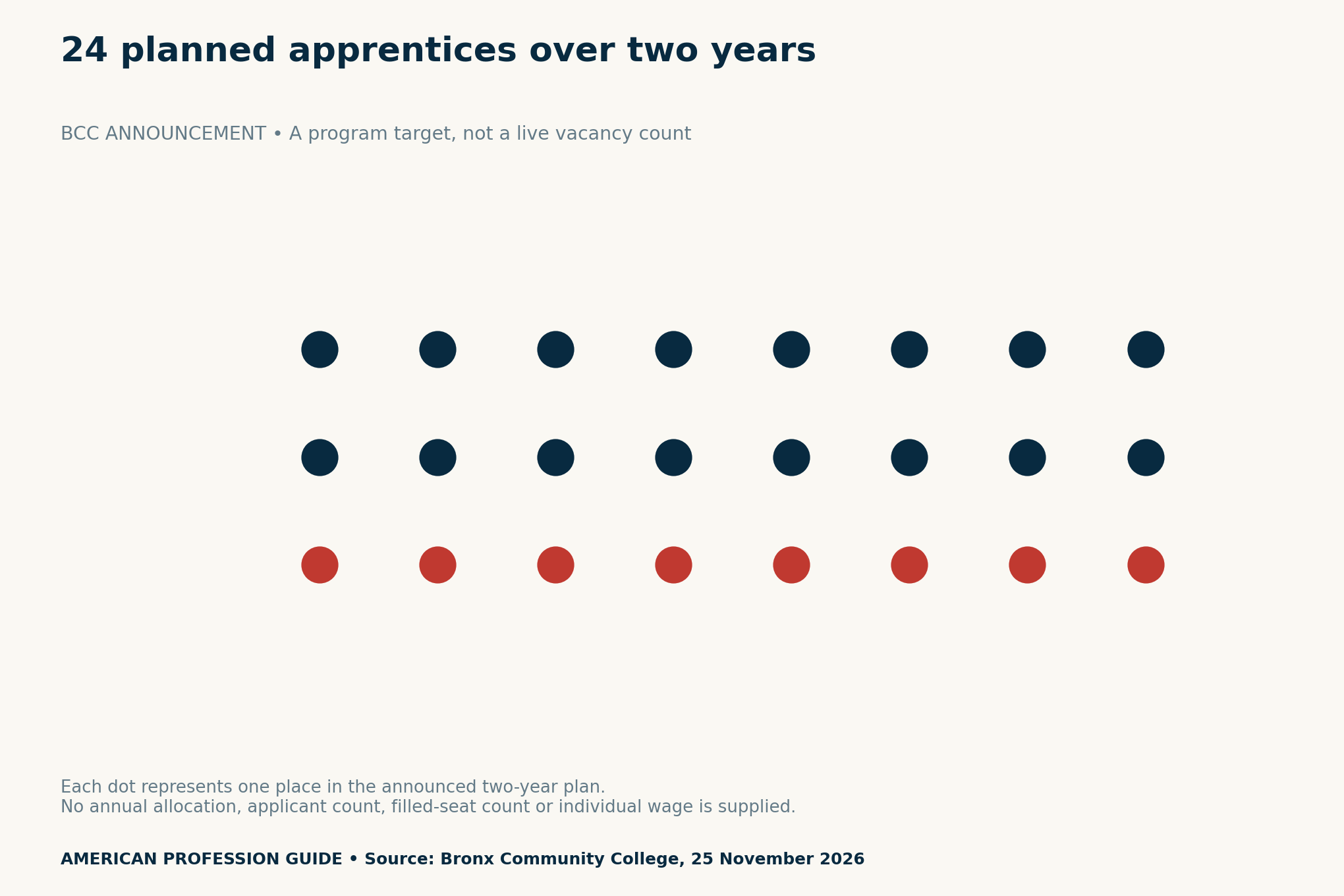
In its 25 November 2026 announcement, BCC reports a $713,225 CUNY Workforce Development Initiative award. The plan covers 24 apprentices over two years. Paid training combines classroom learning with work at BCC’s Early Childhood Center, the named employer and training site. The pathway includes a CDA credential and an opportunity to earn college credit.
Those facts describe the announced program. They do not give an individual a selected place, an hourly wage or a credit award. A useful adviser record therefore separates what BCC has stated from the terms a future participant must still obtain in writing.
Read the expected 2027 sequence carefully
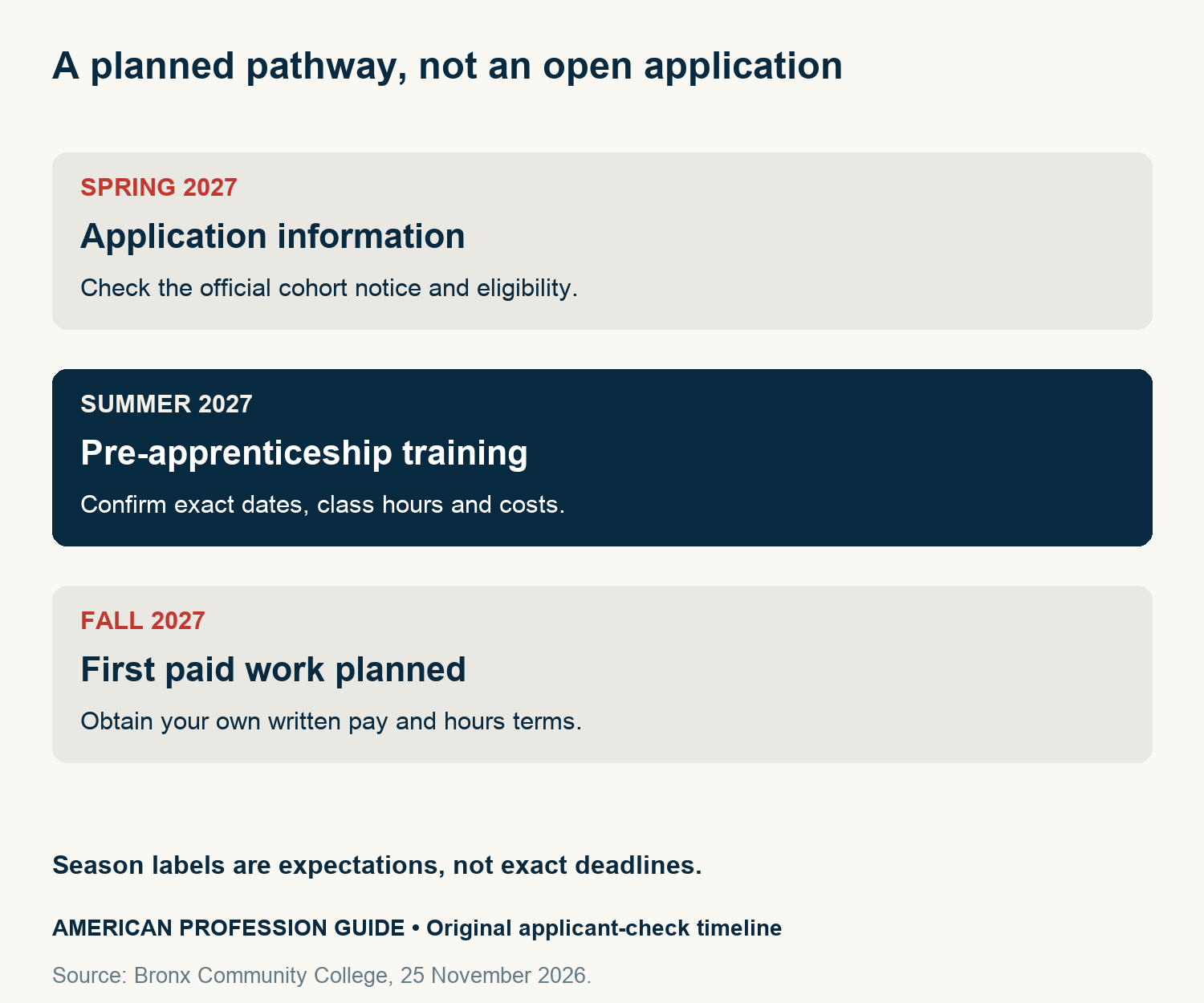
BCC expects application information in spring, pre-apprenticeship training in summer and the first work starts in fall 2027. These are seasonal planning statements. They do not supply exact dates, a closing time or your personal start date. Recheck the official notice when the next stage arrives.
Do not use a general college admission button as proof that this apprenticeship is accepting applications. First, find instructions that name the exact pathway and cohort. Then record the application owner, eligibility, required documents and deadline. Save the source date alongside those fields so an older instruction is easy to spot.
Ask for the wage and paid-hours terms
For paid work, ask the employer for the hourly rate, expected weekly hours, pay dates and any progression rules. Check whether classroom time and preparation time are paid, unpaid or treated differently. A statement that a pathway is paid does not answer every part of a household cash-flow question.
Also distinguish a regular schedule from a maximum or a minimum. Ask what happens during breaks, absences and changes to the training calendar. Keep the answer as a dated written term rather than turning a verbal expectation into a guaranteed monthly income. Until you have it, leave the amount blank.
Check college credit and credential costs separately
An opportunity to earn credit is not a stated credit count. Ask for the course codes, number of credits, assessment conditions and how the result appears on a transcript. If a later degree is your goal, seek a written explanation of which requirements those credits satisfy. Do not assume every activity transfers.
For the CDA pathway, ask who covers application, assessment, materials and any later renewal costs. Record any participant contribution and when it becomes due. A funded program can still have terms that matter to the learner. The announcement alone should not be used to label every possible expense as covered.
Why the award is not a personal training payment
Dividing the award by the planned apprentice count would create a program-level arithmetic average. It would not identify a wage, a grant paid to each learner or the cost of one credential. The numerator can cover different program activities, and the release does not allocate the total to individual compensation.
Therefore, this report does not publish that quotient as a benefit figure. Compare written personal terms instead: pay, paid hours, travel, care responsibilities and any remaining costs. The blank budget tool keeps confirmed amounts separate from estimates. It makes missing evidence visible without filling gaps with a misleading average.
| Evidence level | What to record | What it does not establish |
|---|---|---|
| Program announcement | Award, planned target, expected sequence | Your selection, wage or exact start |
| Cohort notice | Eligibility, application route, dated window | A personal offer |
| Individual terms | Your pay, hours, costs and conditions | A general guarantee for all applicants |
Use the applicant checklist before committing
Begin with the official BCC announcement and return to its current program instructions when available. For each question, record the written answer, date and responsible contact. Avoid sending sensitive identity documents through an unverified social account or a link that merely resembles a college application page.
For broader preparation, see our childcare education overview. Our funding-versus-enrollment guide explains a related distinction. Neither page replaces BCC’s future cohort rules or a written personal offer.
Download the evidence and planning tools
- Announced program facts (CSV)
- Expected seasonal timeline (CSV)
- Written-terms questions and answer tracker (CSV)
- Blank personal planning budget (CSV)
Method, limits and citation
Researched on 28 November 2026. American Profession Guide transcribed the named BCC release and built the place-count graphic, timeline and applicant worksheets. We use one count graphic because the source does not provide outcome or wage distributions. Extra statistical plots would imply evidence that is not published.
The seasonal statements remain expectations, and the 24-person figure remains a two-year plan. No live opening, wage, placement probability, credit total or fully funded personal budget is inferred. Targeted public-archive checks found related childcare coverage; they were not an exhaustive audit of every historical post.
Suggested citation: American Profession Guide, “Bronx Early Childhood Apprenticeship: What Opens in 2027?”, 28 November 2026. Credit Bronx Community College for the announcement and American Profession Guide for the original visual explanations and reusable worksheets.


