




Appalachian Virginia career training credentials deserve a closer look before you choose a course or placement. A program’s funding headline does not show what evidence you can take to a second employer. Start with the exact credential, issuer, assessment and record-release terms.
This report explains the announced Appalachian Advancement scope, then compares two fictional learning options. It offers four editable tools for checking the next step. Neither example represents an advertised course, available seat or promise of employment.
Appalachian Virginia career training credentials: read the scope
Virginia Works’ November 23, 2026 announcement describes a three-year, five-board partnership serving 33 ARC-designated Virginia jurisdictions. Its aim is education or training for 1,000 participants. The stated award is $7,994,951. These are program measures, not verified learner outcomes.
The consortium’s October 19 announcement describes the same initiative and gives a project period of October 1, 2026 through September 30, 2029. Therefore, the new state coverage should not be presented as a second award. The program period also differs from an individual course timetable.
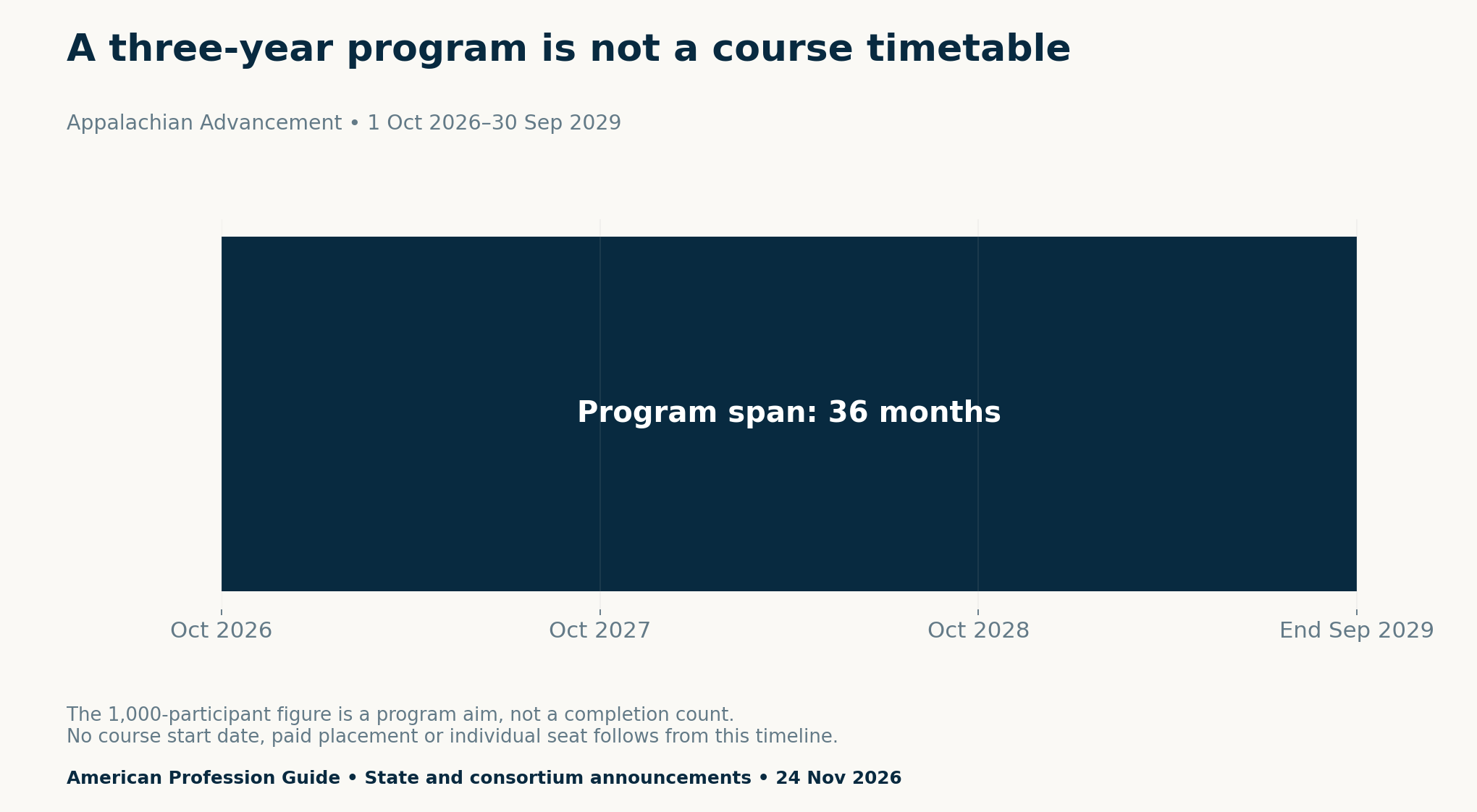
Do not divide the target by 33 jurisdictions to predict local seats. Nor should the award be divided by 1,000 and described as a learner’s grant. Geography, funding and an aggregate target cannot establish an individual’s eligibility, costs or likely result.
Find a contact route, then a real opportunity
Use the official Virginia workforce-center directory to identify a local contact. Ask whether a relevant participant opportunity has been announced and which organization owns it. Then request the current eligibility, dates and written terms for that specific opportunity.
The consortium’s procurement page concerns services from qualified offerors. Its proposal deadlines and addenda do not set a learner’s enrollment deadline. If you encounter that page while searching, keep it in a separate procurement column rather than treating it as a course application.
Separate a credential from a record of attendance
First, write the exact name of the credential or assessed skill. Next, identify the issuer and what must happen before completion. Is there an assessment, supervised practice or another requirement? Ask for the source document rather than relying on a broad phrase such as “industry recognized.”
Also ask what record you may retain and share after leaving the provider or employer. A completion card, assessment record and internal training entry can describe different things. Record the release process, any conditions and the contact who can verify authenticity. Do not imply that every option leads to a license.
Compare two fictional options without ranking them
| Fictional option | Record described | Still unverified |
|---|---|---|
| Healthcare course A | Releasable completion card | Assessment, pay, hours and another employer’s acceptance |
| Manufacturing placement B | Internal training record only | Release terms, pay, hours and another employer’s acceptance |
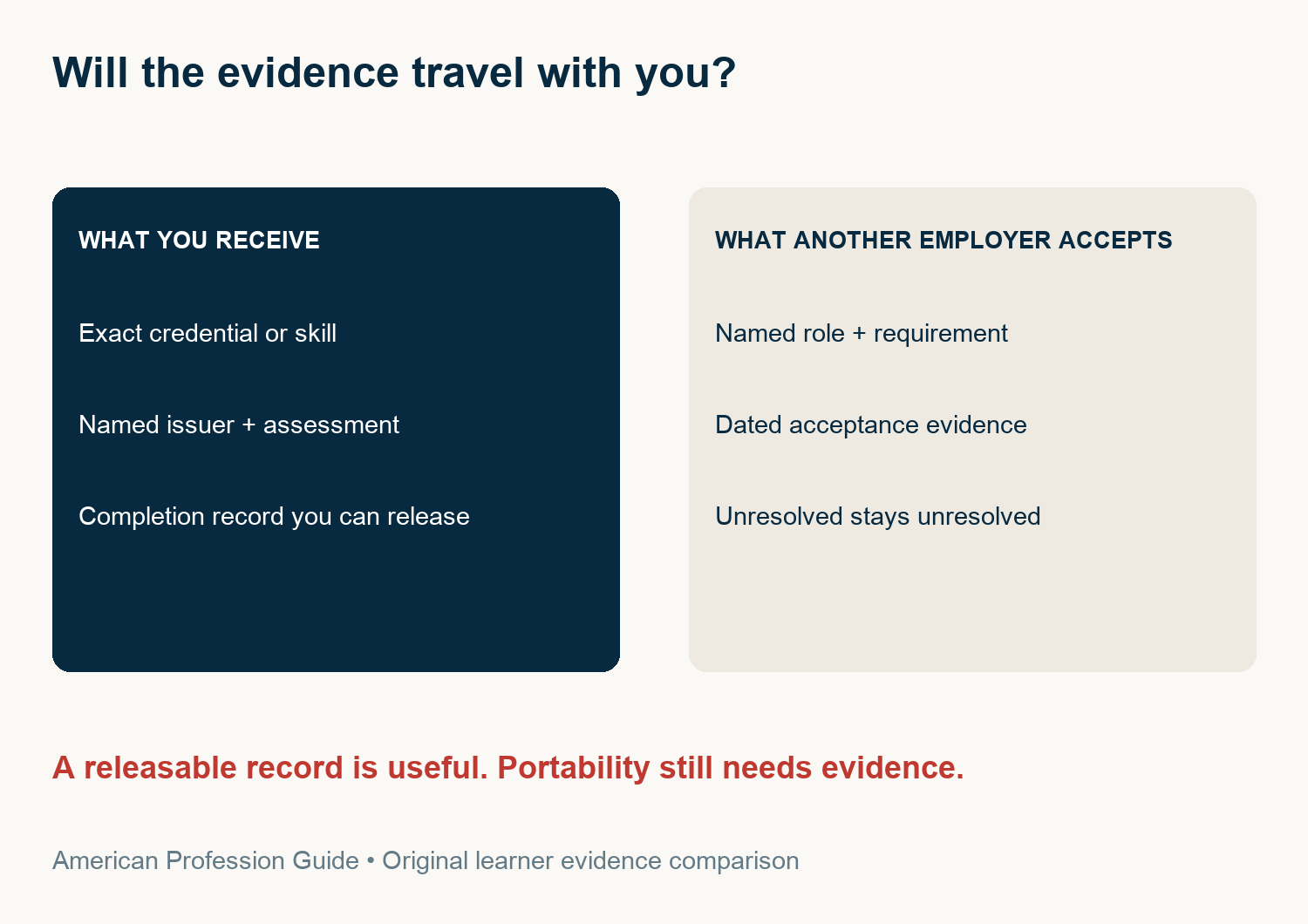
In option A, a provider describes a completion card that the learner can release. That makes the record easier to discuss, but it does not prove acceptance by another employer. Leave the acceptance field open until a dated source addresses the exact credential and role.
In option B, an employer records internal training. That record may describe useful experience, yet its release and meaning elsewhere remain unresolved. Ask what evidence a future employer could check. A fictional internal record should not be marked inferior or worthless without knowing the actual assessment and destination role.
Work-based learning does not settle pay or employment
For any real placement, request the work status, expected hours, pay terms and completion conditions in writing. Ask who provides supervision and which organization issues the record. A program announcement that mentions work-based learning does not supply those individual terms.
Before changing your work schedule, compare course hours, travel, remaining fees and any unpaid time using verified figures. Keep unknown values blank. If costs or pay have not been confirmed, a precise return-on-investment calculation would create confidence the evidence does not support.
Make an acceptance question specific enough to answer
A useful question names the issuer, exact credential, completion date and role requirement. For example: does this particular record satisfy the stated requirement for this advertised position? Save the dated response and its source. A general statement about valuing training should not fill a precise acceptance field.
Our construction multiskilling guide also separates learning from verified scope and assessment. Here the decision is different: what can you document after the training, and who else will accept that evidence?
Methods and editable evidence tools
We checked primary state, consortium and directory material on November 24, 2026. The timeline uses the published program dates. All course and placement details in the comparison are fictional; no live offer, seat, wage or employer acceptance has been established in those examples.
One timeline and one transfer-evidence infographic fit this question. We avoid invented completion rates and equal local allocations. Use the tools to collect dated answers, compare their limits and revisit unresolved fields before enrolling or paying.
- Program scope and source measures (CSV)
- Two fictional training-option records (CSV)
- Blank credential-transfer evidence card (CSV)
- Blank learner contact and confirmation log (CSV)
Suggested citation: American Profession Guide, “Appalachian Virginia Career Training: Will the Credential Travel?” November 24, 2026. Cite official sources for program scope and this report for the original comparison tools.


