




Battery safety recycling jobs require clear responsibility as well as suitable training. A new worker should know who receives an unresolved concern when a shift changes. Reporting an issue and confirming that an authorized person has closed it are different records.
This guide offers a neutral handoff worksheet for workers, supervisors and aspiring safety coordinators. It separates a current OSHA guidance highlight from historical EPA case counts. It does not tell readers how to handle a battery or respond to an incident.
Battery safety recycling jobs: what changed in the news?
OSHA’s November 23, 2026 QuickTakes highlights its lithium-ion battery safety resource in a discussion of recycling work. That is the dated news hook. It does not announce a new incident count or establish a new regulation in that paragraph.
The OSHA lithium-ion battery safety hub is an official reference for employers and workers. Use it alongside the facility’s approved procedures and authorized safety lead. A general article cannot decide which duties, training or reporting requirements apply at a particular workplace.
Read the historical numbers without creating a risk rate
The EPA’s July 2021 case analysis identified 245 fires at 64 waste facilities in 28 states during 2013–2020, caused or likely caused by lithium-ion or lithium-metal batteries. Its collection was neither complete nor random. Therefore, these are historical case counts, not a 2026 sector total.
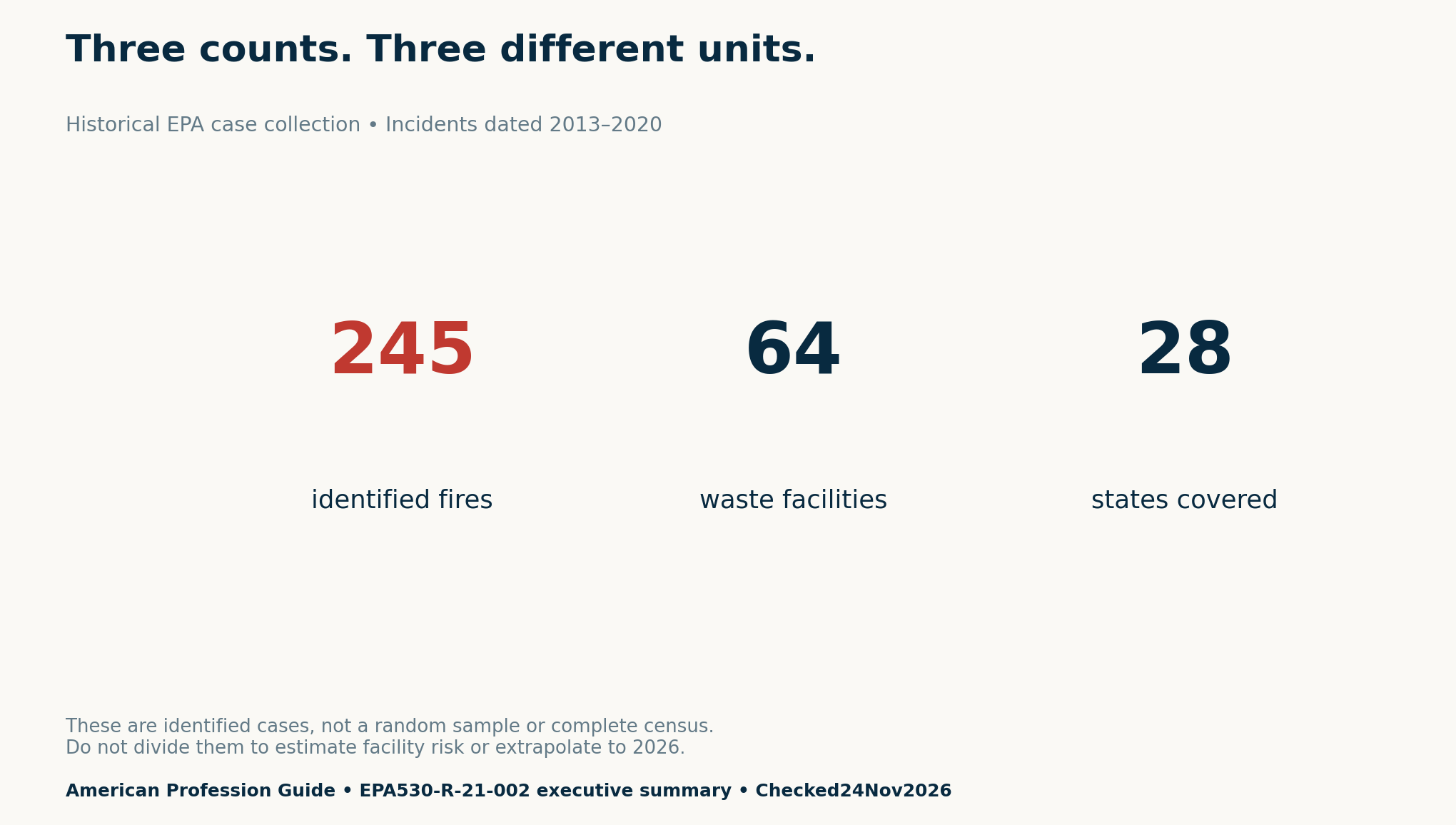
A numerator needs a suitable denominator before it becomes a rate. This collection does not provide a representative count of all exposed facilities or their operating time. Dividing fires by included facilities would not estimate a typical worker’s or facility’s risk. The different units should stay visible.
The useful career question is therefore about responsibility: can an employer explain its onboarding, approved escalation route and ownership of unresolved concerns? A historical count cannot answer those site-specific questions. Nor does a worksheet certify that a facility is safe.
Keep observation and inference separate
Write a time and a non-identifying location reference that the authorized team can interpret. Describe only what was directly observed. Put an explanation that has not been confirmed in a separate field. Do not convert an uncertain item description into a confirmed battery identification.
For example, “concern recorded; item identity unconfirmed” preserves uncertainty. A later reviewer can update the record with the source and time of any confirmed information. However, the original entry should remain understandable rather than silently changing into a different account.
A handoff needs an owner and an acknowledgement
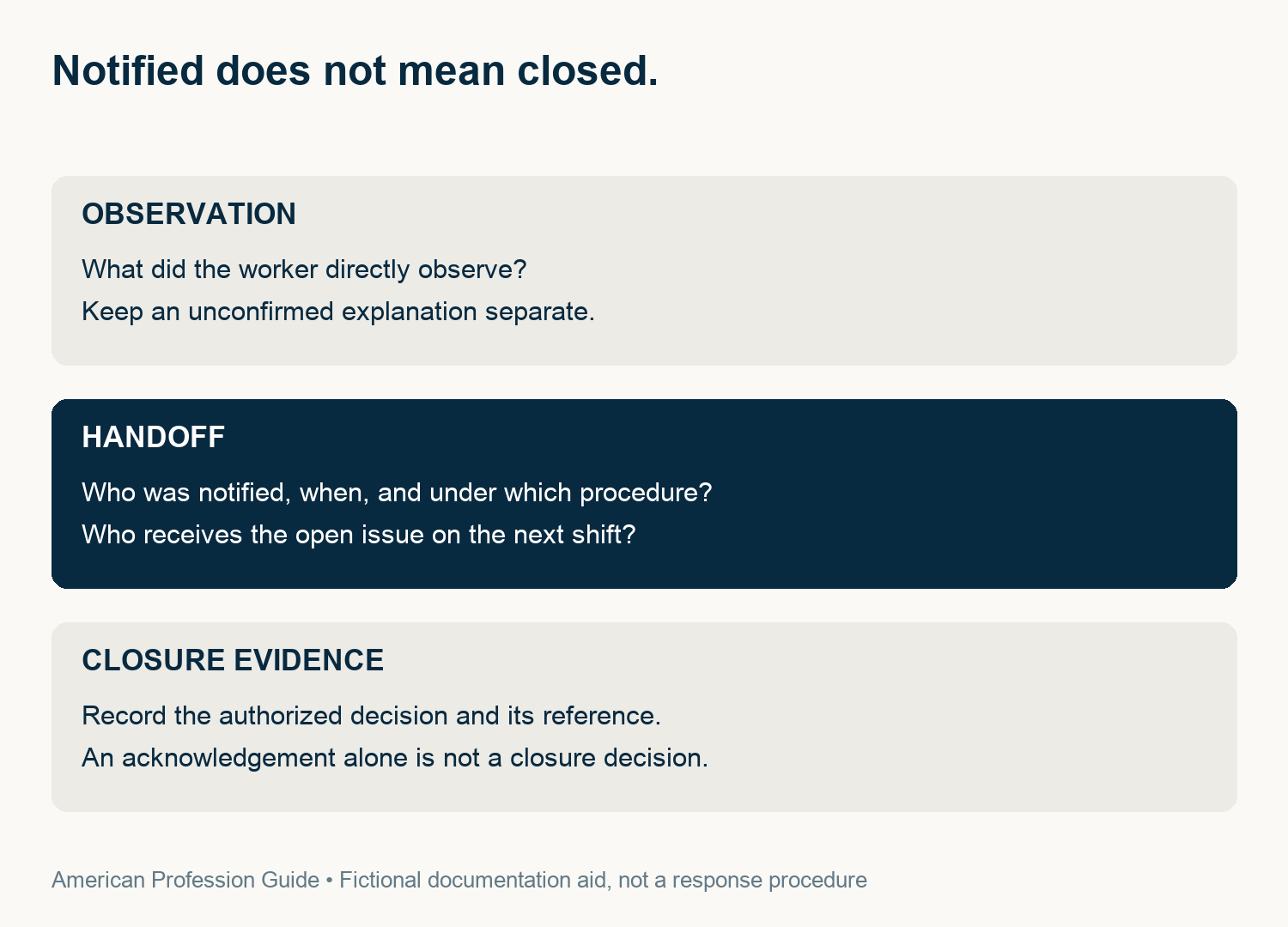
The blank log asks for the role notified, notification time and approved procedure reference. It also asks for the current status, next review owner and receiving acknowledgement. These are documentation prompts for discussion with the employer, not a replacement escalation procedure.
| Fictional entry | Recorded evidence | What remains open |
|---|---|---|
| A | Safety role notified at 14:10 | No closure evidence recorded |
| B | Notification acknowledged at 15:00 | Acknowledgement does not establish closure |
In case A, sending a notification records that a message was sent. However, the next shift still needs the authorized owner and current status. In case B, an acknowledgement records receipt, but it does not state that the concern has been assessed and closed. Both examples remain open in this teaching record.
Ask these questions during onboarding
Ask which role owns an unresolved concern and where to find the current approved procedure. Next, find out how a receiving shift acknowledges a handoff. Then ask who has authority to document closure and which record supports that decision. Keep the answer tied to a procedure version and date.
Also ask about the training required for the actual duties in your role. A job title alone does not establish competence or authorize an unfamiliar task. If a workplace concern arises, use the employer’s approved route and authorized safety personnel rather than experimenting from an online guide.
Our workplace handoff guide discusses making ownership clearer across teams. Its communication ideas do not replace hazard-specific procedures. For an interview or training portfolio, use fictional records and remove personal, employer-confidential or security-sensitive details.
Methods, limitations and reusable downloads
We checked the official OSHA newsletter and hub and EPA’s executive summary and methodology on November 24, 2026. The count display reproduces three differently scoped historical totals. Meanwhile, the handoff structure and both cases are original editorial teaching aids; they have not been tested as a safety intervention.
We deliberately omit response steps, battery manipulation, storage prescriptions and site photographs. This report makes no certification, compliance determination, current incident estimate or hiring forecast. Its narrow purpose is to help readers ask better questions about how unresolved information changes hands.
- Historical EPA count scope and source (CSV)
- Blank shift-handoff documentation log (CSV)
- Two fictional notified-versus-closed cases (CSV)
- Blank onboarding responsibility questions (CSV)
Suggested citation: American Profession Guide, “Recycling Safety Jobs: What a Battery Hazard Handoff Should Show,” November 24, 2026. Cite EPA for historical figures and this report for the original documentation tools.


