




Construction multiskilling career development starts with a specific second skill that you can verify and legitimately use. A request to “help with everything” is not a training plan. Ask which recurring task the employer needs, how readiness will be assessed and what limits apply before taking on broader work.
New research released on 12 November 2026 gives a reason to ask those questions. Simplar Foundation analysed labor records from 18 projects already using multiskilling. Its schedule results model a one-trade alternative; they do not promise an individual worker a pay rise, safer work or a universal productivity gain.
What the construction multiskilling research actually compares
The 12 November release introduces Report 3, Schedule Duration and Labor-Curve Outcomes. The records cover 11 contractors, nine states and Washington, D.C. The core crews included 183 workers and about 89,620 hours. Researchers deliberately sought multiskilled projects, so this is not a random national sample.
The report overview distinguishes keeping the crew and allowing more time from keeping the schedule and adding workers. Both alternatives restrict each worker to one trade. They are analytical comparisons with the recorded work, rather than observed before-and-after training outcomes.
Read the schedule assumptions before using the headline
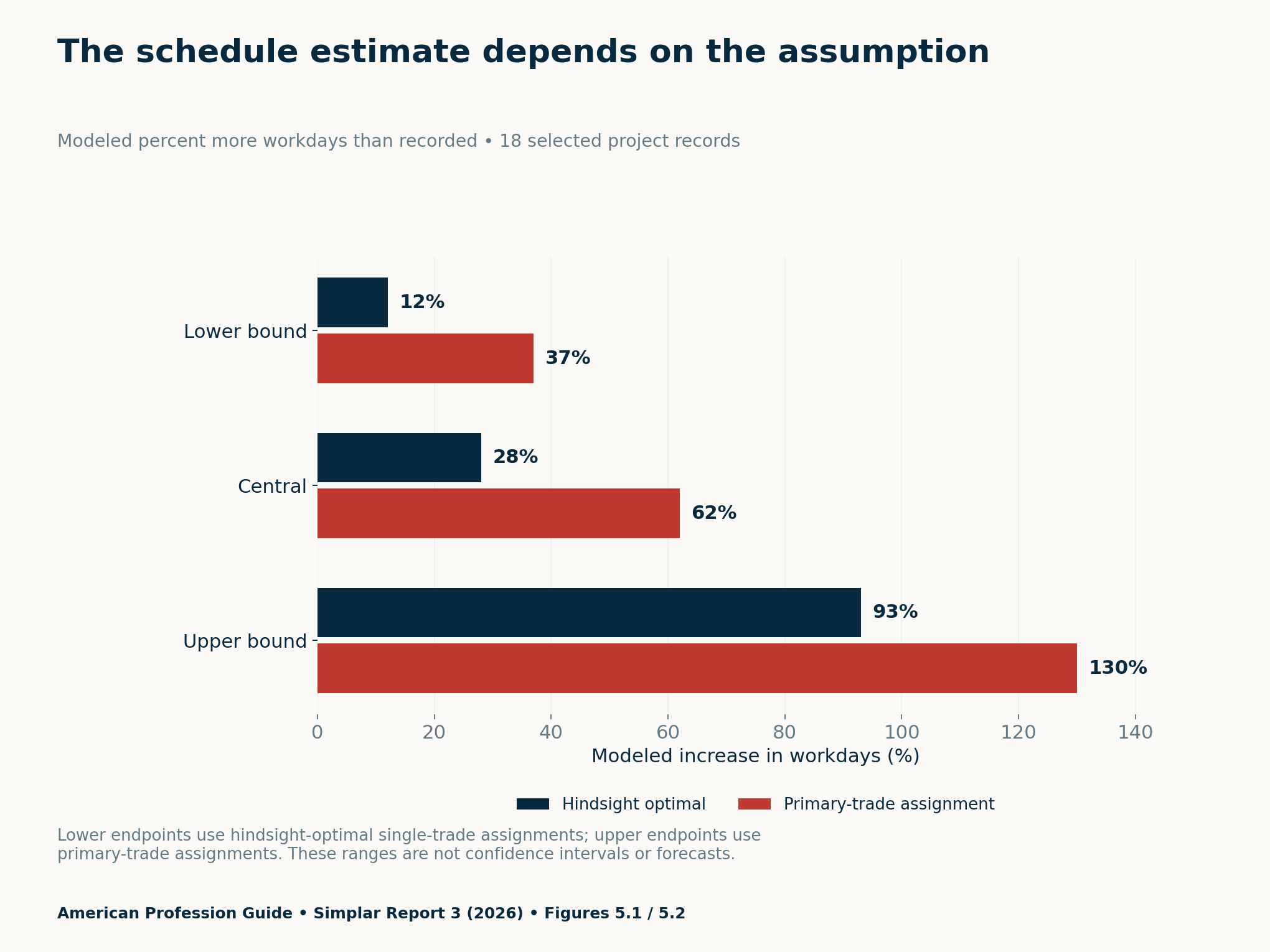
The central assumption supplies the headline 28%–62% increase in workdays under a one-trade restriction. The endpoints use different workforce assignments. The lower endpoint uses a theoretically optimal assignment chosen with hindsight; the upper keeps workers mainly in their primary trades. Neither is the result of randomly assigning workers to training.
The report lacked full project schedules and activity dependencies. Its lower, central and upper assumptions therefore describe alternative sequencing rules. A training proposal at your workplace needs its own task and competence evidence; selecting the most attractive percentage from this chart cannot establish what your employer will achieve.
Why 28% longer is about 22% shorter in reverse
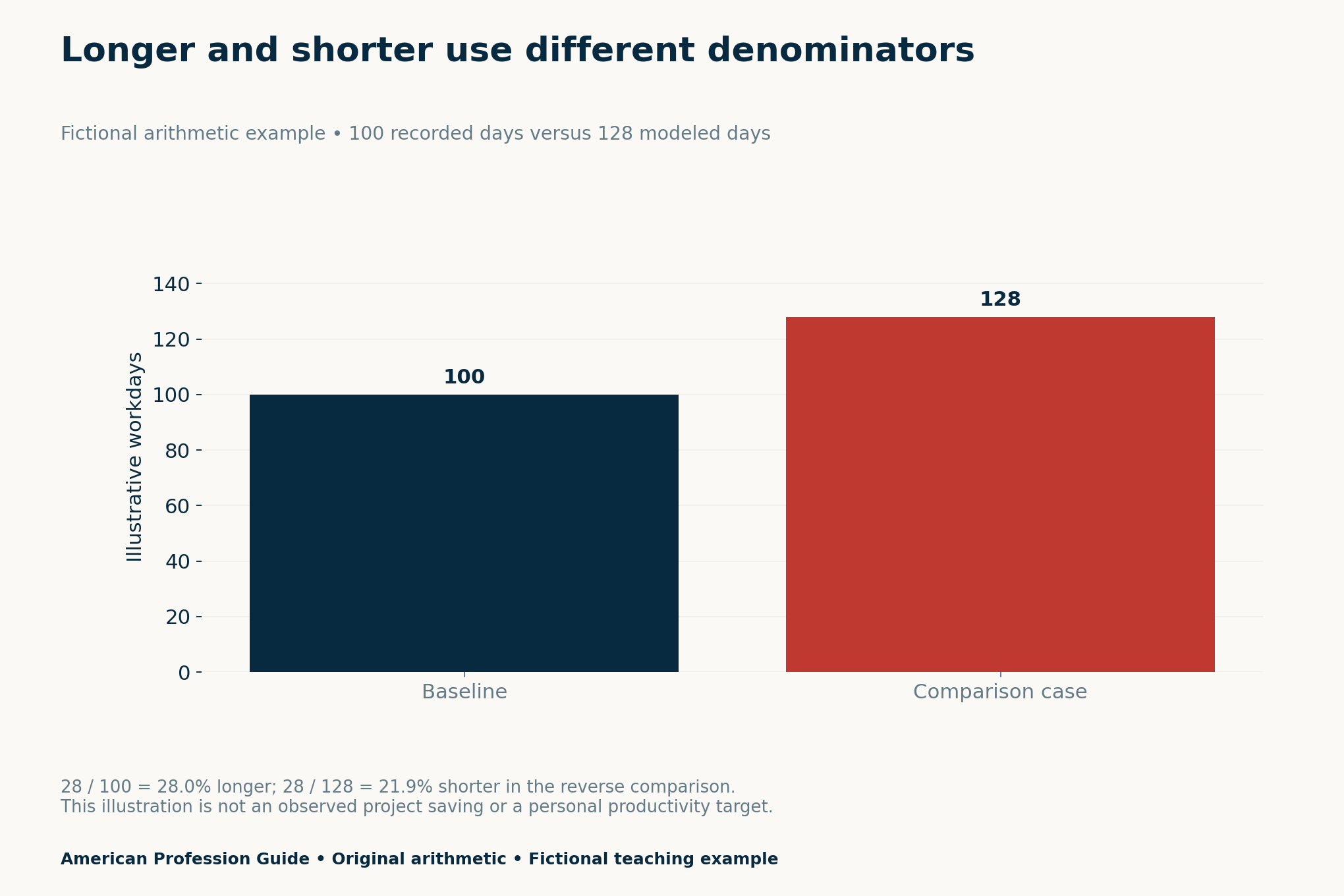
Suppose a fictional work package takes 100 days in one arrangement and 128 in another. The difference is 28 days in both directions. However, the percentage changes because the reference value changes. Keeping the denominator visible prevents a useful comparison from becoming an exaggerated claim.
For the same reason, a project-level estimate cannot become a personal performance target. A worker’s verified skill, supervision, work mix and available equipment are separate questions. The study does not establish that an individual should work a specified percentage faster or receive a corresponding wage increase.
Peak-day needs are different from average-day needs
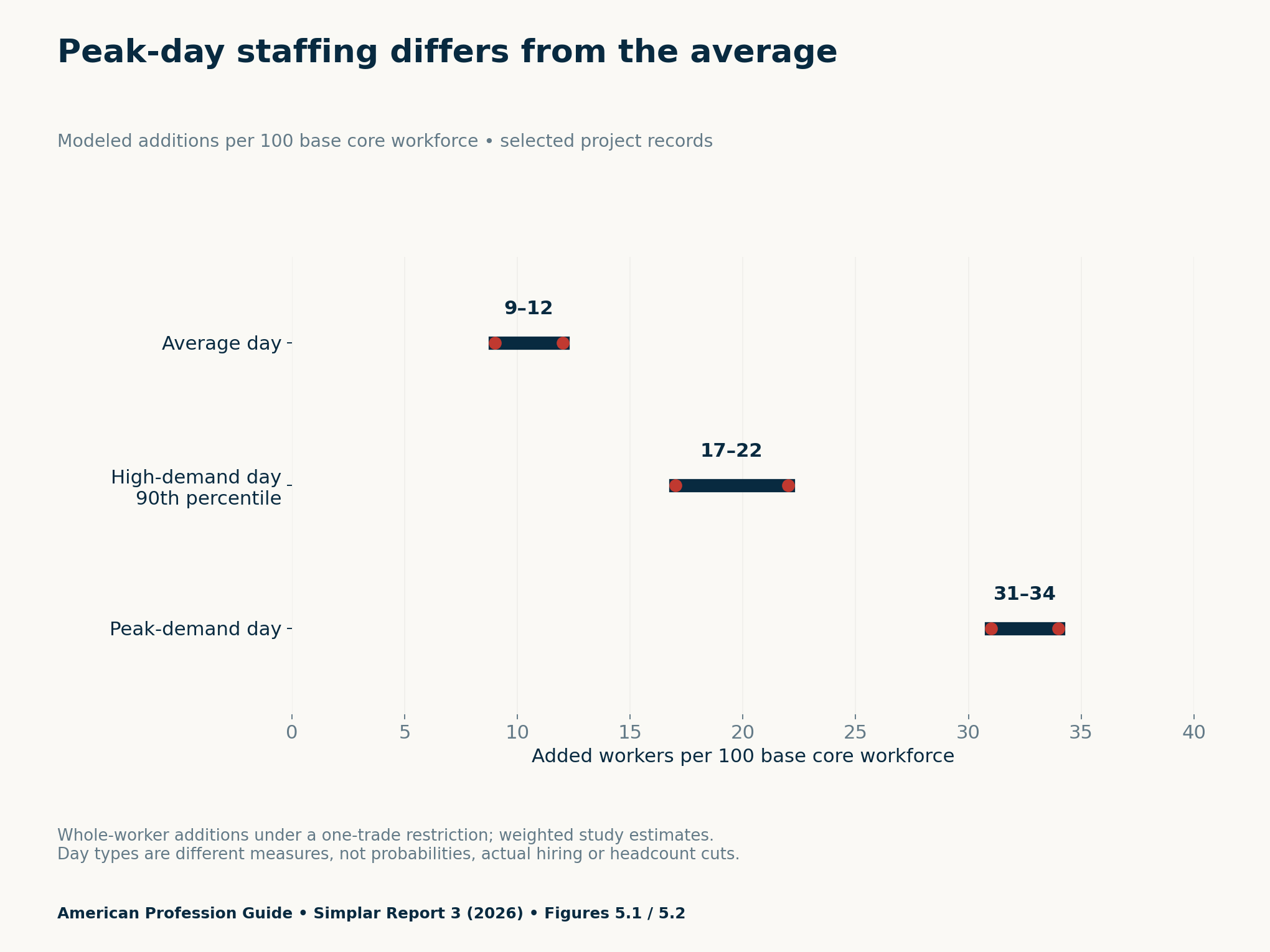
A recurring mismatch can matter even when total staffing looks adequate. The staffing model asks how many additional workers would cover the recorded work on the same days under a one-trade restriction. It does not document actual recruitment, layoffs or a budget saving.
Use that distinction to make a training conversation more precise. Ask when the adjacent task arises and who currently covers it. A second skill may be relevant to a recurring handoff even if it is used infrequently. Conversely, an impressive-sounding extra qualification may have little connection to the work you are likely to receive.
A fictional trade-demand example makes the mismatch visible
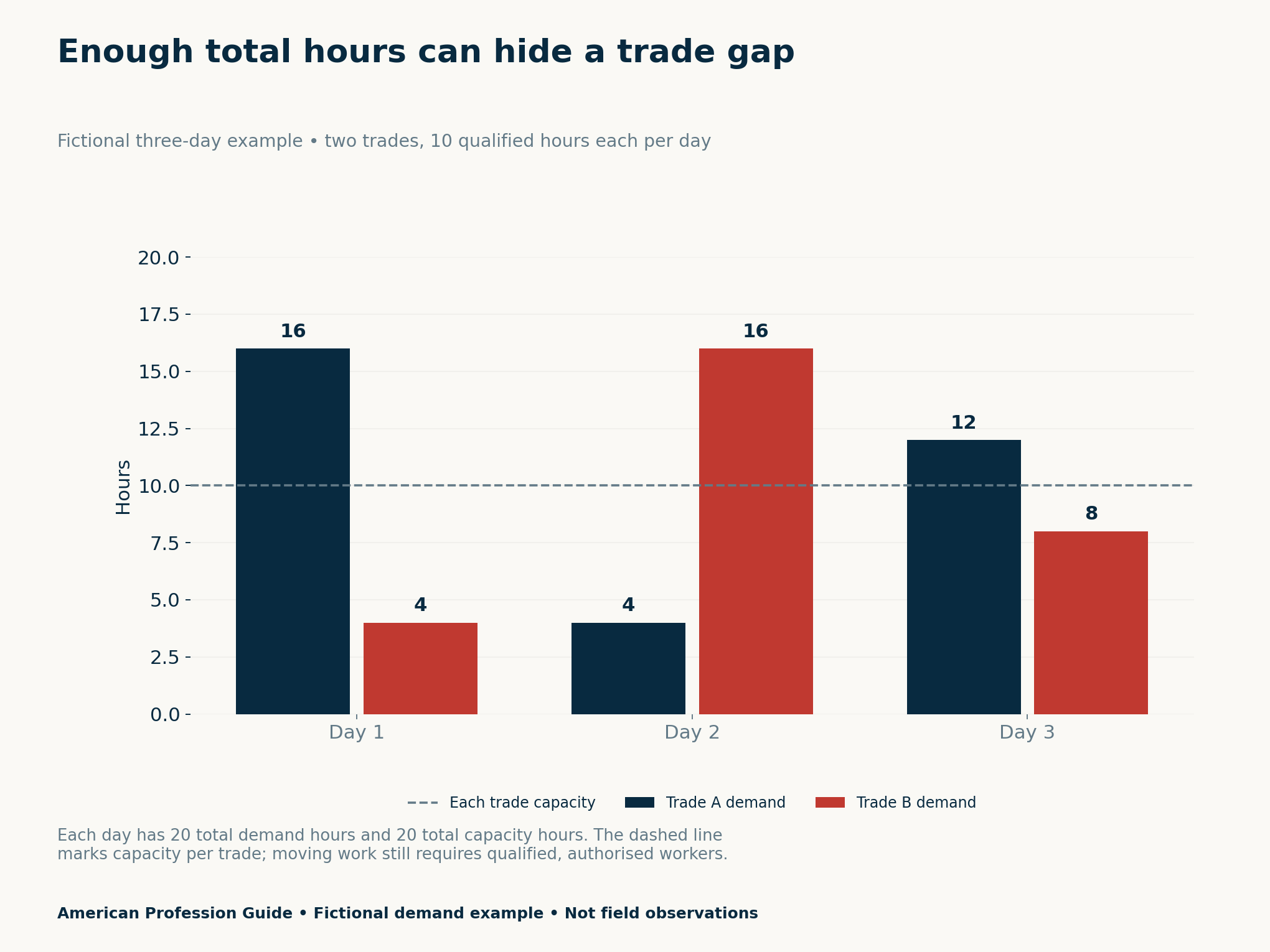
On the first fictional day, Trade A needs six hours beyond its assigned capacity while Trade B has six spare. The second day reverses the pattern. On the third, the mismatch is two hours. Total hours alone hide the problem, but arithmetic does not prove that the spare worker is qualified to perform the other task.
That is why a task description matters. Before discussing deployment, identify the competence evidence and required controls. This article does not provide technical instructions for unfamiliar construction work. Training, licensing, contracts, safety rules, quality checks and supervision still apply to the actual assignment.
Weighting changes the meaning of a summary
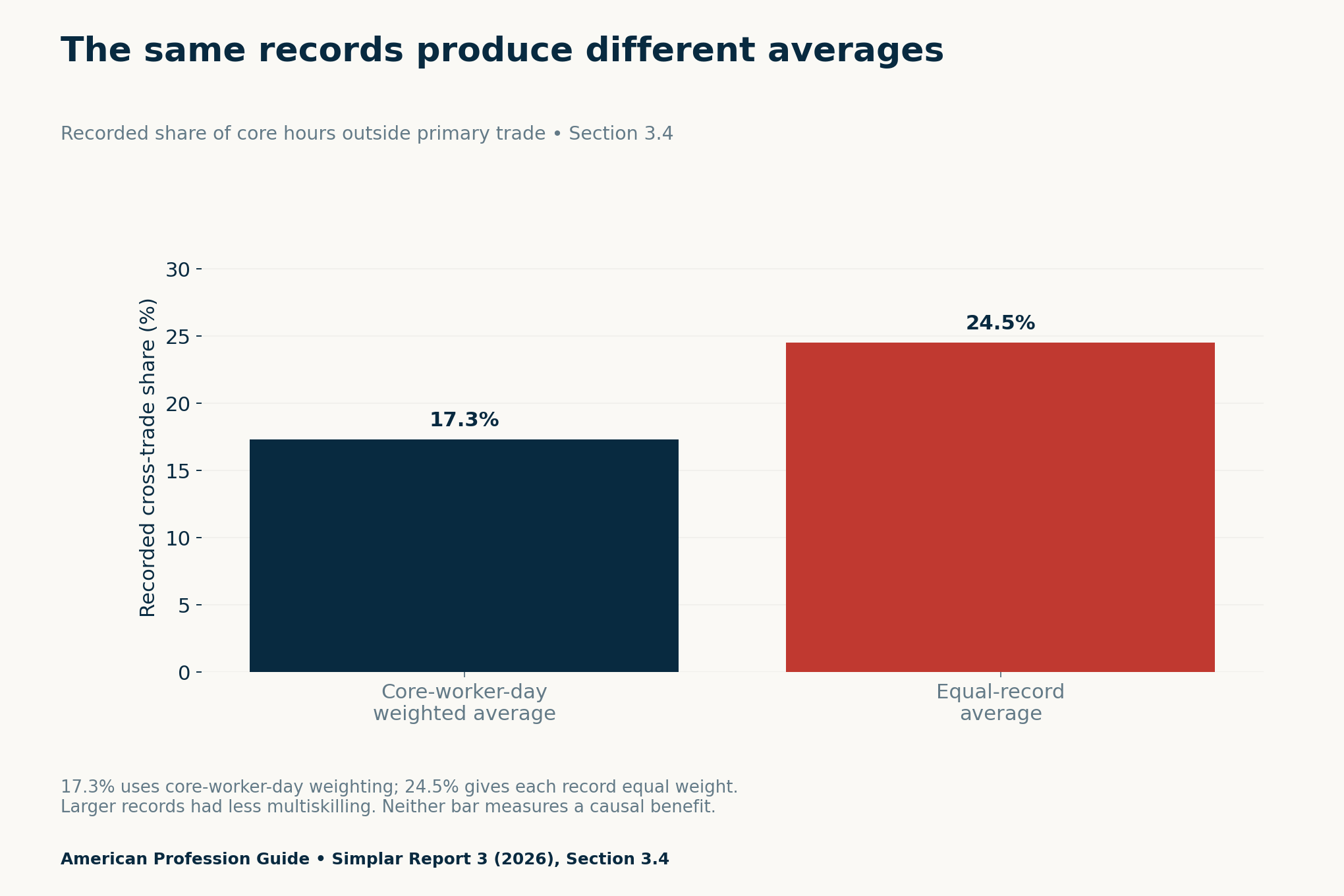
The two averages summarize the same set of records differently. One gives larger records more influence, while the other treats each record equally. Neither is a recommended proportion of your working week to spend outside your primary trade.
Avoid turning frequency into a skill score. A worker could use a carefully verified adjacent skill only when a specific handoff arises. Another may cross classifications more often because their work package differs. These records cannot rank their competence or establish a universal training requirement.
Choose a second skill through three evidence gates
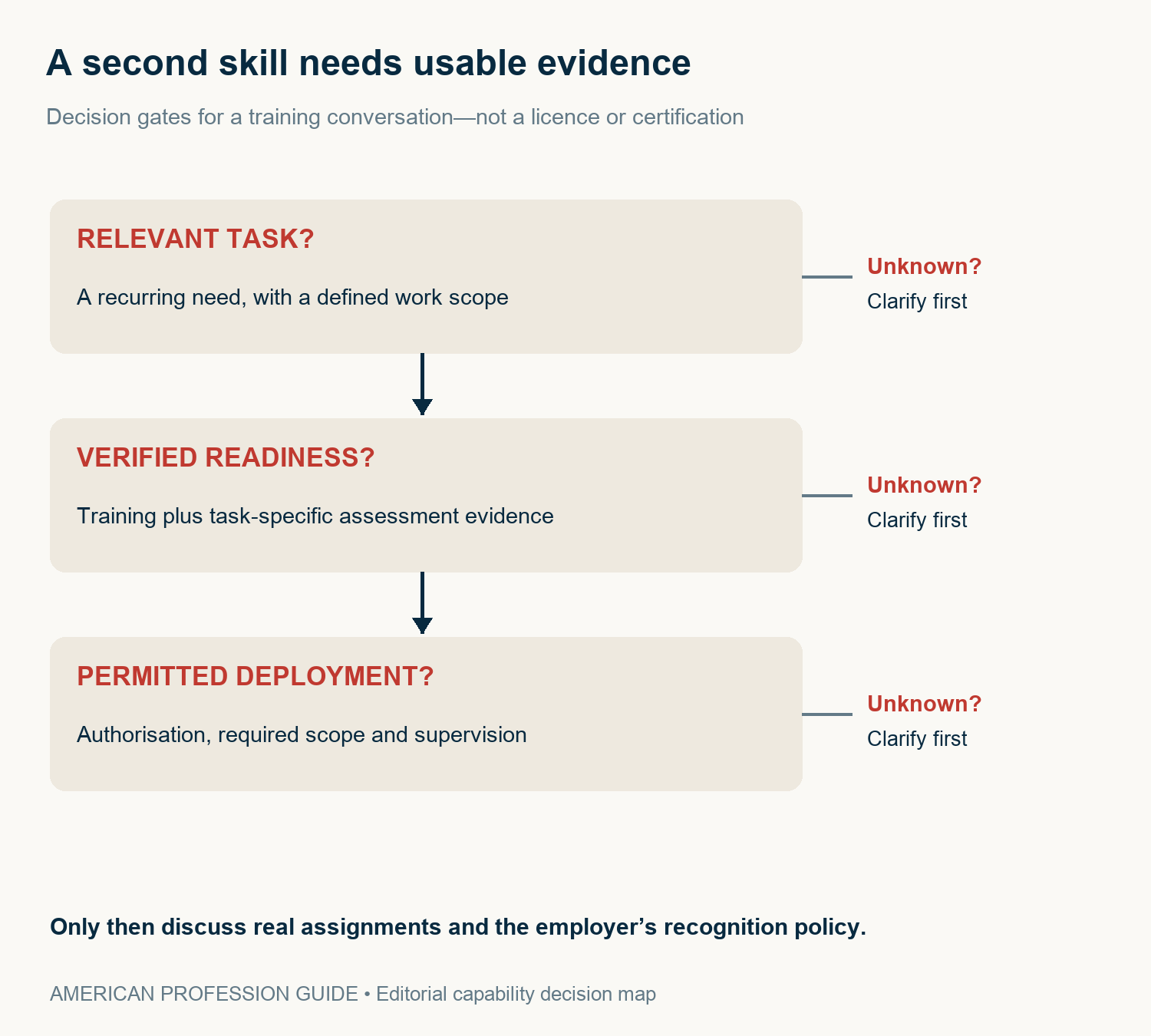
Start with a defined task. Ask for a recent non-sensitive example of the recurring need, rather than a broad instruction to cover another trade. Next, agree the training route and the assessment that will demonstrate readiness. Record who verifies the result and where that evidence will be kept.
Then clarify the permitted scope and supervision. A course attendance record is useful history, but it may not establish readiness for every task. If a requirement is unclear, retain it as an open question. Do not fill the gap by assuming that willingness, experience in a neighboring task or an informal request is sufficient.
Discuss recognition without assuming a pay premium
Ask how the employer uses and recognizes the additional capability. The answer might concern assignments, classifications, progression or a written pay policy. Record the actual policy and its date. This research does not establish a wage premium, guaranteed promotion or employment stability for any worker.
Also clarify who provides learning time, equipment, assessment and refresher training. A useful plan names responsibilities and a review point. If the employer cannot explain the link from training to permitted work, the next action is clarification rather than an open-ended commitment.
Download the data and training-conversation tools
- Reported figure values, units and report locations (CSV)
- Fictional demand and denominator calculations (CSV)
- Blank second-skill verification worksheet (CSV)
- Training, assessment and recognition conversation ledger (CSV)
The worksheets leave personal and employer-specific conclusions blank. Use them privately without confidential site or worker records. For another example of task-to-evidence matching, see our USDA Edinburg application analysis. More source-linked studies appear in Research & Reports.
Methodology, attribution and limits
We read Report 3’s dataset description, methods, results and limitations, including Sections 3 and 8. The selected values are transcribed from Figure 5.1, Figure 5.2 and Section 3.4. Nine records cover a subcontractor’s scope and nine cover an entire-project scope; either may cover less than a full project schedule. We did not access the underlying worker-level records or independently reproduce the original model.
The two fictional exercises are original teaching tools. Their data are not field observations and do not estimate an outcome for a reader. Associated Builders and Contractors funded the research; the report describes the research team’s control of methods and conclusions, with specified confidentiality and intellectual-property review rights for the funder.
Recommended source citation: Lines, B., Ogundare, I., Kassa, R., Smithwick, J., and Sullivan, K. (2026). Schedule Duration and Labor-Curve Outcomes, Report 3 of 6 in Volume 1. Simplar Foundation. DOI: 10.22361/vf3qybkgbd. The complete original report provides the definitions and assumptions; our charts identify the original figures and preserve their meaning.


